
Grid Congestion Management Software Market Report Scope and Overview:
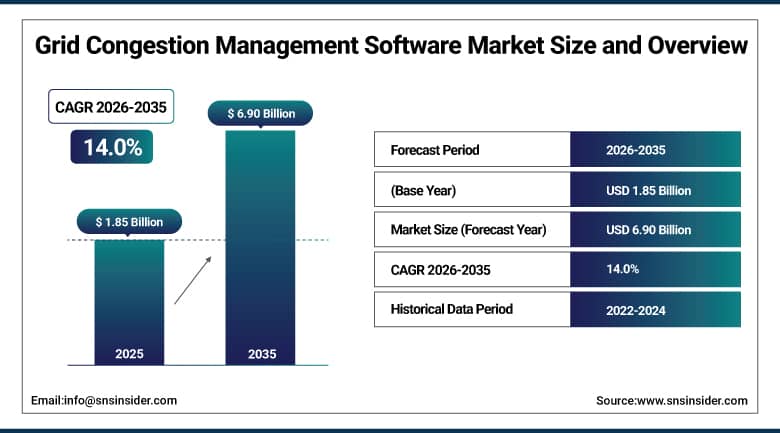
The Grid Congestion Management Software Market was valued at USD 1.85 Billion in 2025 and is projected to reach USD 6.90 Billion by 2035, registering a CAGR of 14.0% from 2026 to 2035.
The Grid Congestion Management Software has revolutionized the transmission and distribution system operations through real-time grid congestion management software applications that give grid managers a means of solving grid congestion challenges by providing an opportunity to relieve the congestion problems and make use of existing transmission capacity without constructing additional lines. This market is characterized by high spending by transmission system operators on software-based optimization applications, adoption of AI-based forecasting applications in corridors with a large number of renewables, regulations requiring grid reliability and avoidance of outages, and diverse uses in transmission grids, distribution grids, and cross-regional energy transactions.
In 2026, ABB further develops its digital grid management systems that allow utilities to control their network performance and increase the flexibility of electricity distribution with regard to rising renewables and electrification adding strain to the transmission process.
To Get More Information On Grid Congestion Management Software Market - Request Free Sample Report
Grid Congestion Management Software Market Trends
-
Expanding shift from static contingency planning toward AI-driven real-time congestion forecasting across transmission corridors.
-
Growing transmission system operator investment in remedial action optimization continues accelerating grid congestion software procurement.
-
Rising renewable energy interconnection demand continues expanding the addressable base for dynamic line rating and flexibility orchestration platforms.
-
Increasing integration of congestion management software with wholesale market bidding systems continues improving cross-regional energy trading efficiency.
-
Growing adoption of cloud-based deployment continues reducing implementation timelines for transmission and distribution system operators.
U.S. Grid Congestion Management Software Market Outlook
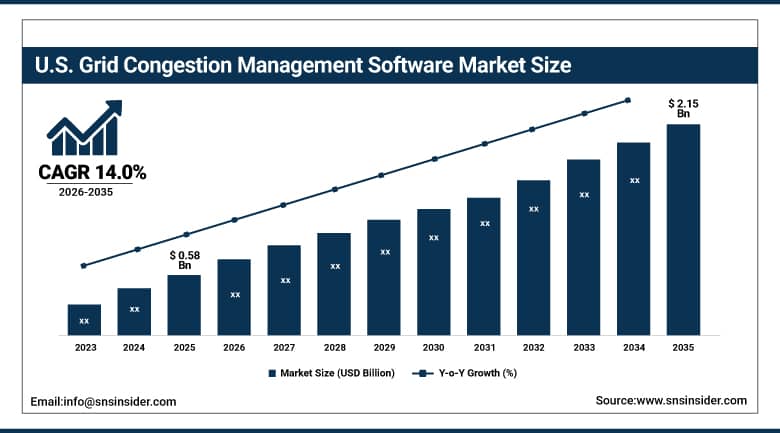
The U.S. Grid Congestion Management Software Market was valued at approximately USD 0.58 Billion in 2025 and is projected to reach approximately USD 2.15 Billion by 2035, registering a CAGR of approximately 14.0% from 2026 to 2035.
In the United States, the demand is driven by high investments made by transmission system operators in software solutions instead of building new transmission lines, regulatory push from FERC to speed up the process of processing interconnection queues, and high demand for technologies designed to relieve congestions on behalf of utilities receiving numerous interconnections of renewable energy resources and data centers. The use of AI-based software for predicting and optimizing congestion is important for consolidating the leadership of the U.S. grid congestion management software market. On top of that, the applications of dynamic line rating and flexibility orchestration solutions in interconnection queue management and cross-border trading drives the demand for the product in the domestic market.
In 2026, LineVision will assist in expanding the dynamic line rating system in the U.S., following the successful implementation of the same in utility companies such as Georgia Power, which will improve flexibility and capacity in the transmission lines.
Grid Congestion Management Software Market Segment Analysis
-
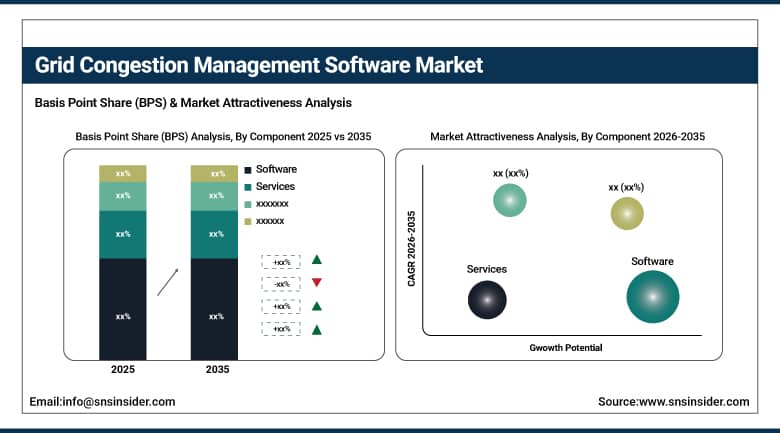
By Component, Software segment dominated the Grid Congestion Management Software Market in 2025 with 72% share; Services segment is the fastest growing segment, registering a CAGR of 11.4% from 2026 to 2035.
-
By Deployment Mode, Cloud-based segment dominated the market in 2025 with 61% share; Cloud-based segment is also the fastest growing segment, registering a CAGR of 10.8% from 2026 to 2035.
-
By Application, Congestion Forecasting segment dominated the market in 2025 with 34% share; Flexibility Orchestration segment is the fastest growing segment, registering a CAGR of 12.1% from 2026 to 2035.
-
By Grid Type, Transmission Grid segment dominated the market in 2025 with 64% share; Distribution Grid segment is the fastest growing segment, registering a CAGR of 11.7% from 2026 to 2035.
-
By End User, Utilities & TSOs segment dominated the market in 2025 with 58% share; Independent System Operators segment is the fastest growing segment, registering a CAGR of 11.9% from 2026 to 2035.
By Component, Software Leads, While Services Grow Fastest
Software held a prominent presence in the Grid Congestion Management Software Market during 2025 due to its essential nature in any application of congestion management systems and its proven eligibility through the procurement process carried out by transmission system operators across the globe. The entry of the Gridscale X Flexibility Manager module by Siemens AG, providing the facility of congestion prediction and optimized corrective actions, is an example where the software segment holds the major market share of revenue.
The services segment is projected to be growing at the fastest pace in the Grid Congestion Management Software Market due to the growing need for expert consultation and integration services from the operators of the transmission system, which help in developing a congestion forecast model that suits their network structure. The growing need for training and support services for the AI models is supporting the higher growth rate of the segment.
By Deployment Mode, Cloud-based Leads and Grows Fastest
The Cloud-based deployment segment held the highest market share in the Grid Congestion Management Software Market in 2025 because of the increasing preference of transmission operators for flexible and subscription-based software solutions that can be scaled up quickly with changing network topology and renewable connection points. The increasing trust of utilities in cloud security architecture that is compliant with NERC CIP standards further strengthens the choice of cloud deployment.
Cloud-based deployment is also projected to remain the fastest-growing deployment mode as transmission and distribution system operators increasingly favor faster implementation timelines and lower upfront infrastructure costs over on-premises alternatives. Vendors continue expanding interoperability with utility SCADA and energy management systems to reinforce this preference across both large and mid-sized grid operators.
By Application, Congestion Forecasting Dominates, Flexibility Orchestration Grows Fastest
In 2025, the Grid Congestion Management Software Market dominated by Congestion Forecasting as this application is the basic application that is deployed by the transmission operator prior to deploying any other advanced tool such as remedial action and flexibility orchestration. Accuracy of forecasting and utility’s experience in using load flow model have made this application the natural choice to use when deploying this kind of software.
The Flexibility Orchestration is the fastest growing application category in the Grid Congestion Management Software Market as there has been increasing efforts from transmission operators to integrate demand response, storage dispatch and curtailing distributed generation into one automated process to resolve congestion problems.
By Grid Type, Transmission Grid Dominates, Distribution Grid Grows Fastest
Transmission Grid emerged as the dominant segment in terms of market share for the Grid Congestion Management Software Market in 2025, owing to the economic impact of transmission congestion, which makes the use of congestion management software financially viable for operators dealing with such congestion. Transmission grid operators in North America, Europe, and Asia Pacific regions have made efforts to invest in software solutions that help in solving transmission congestion.
Distribution Grid is predicted to grow at the fastest pace as congestion is generated due to the rise in solar power rooftop installations, EVs charging, and distributed generation at the distribution grid level. Distribution grid operators who are piloting distribution congestion management software in densely populated urban environments and growing electrification are propelling the growth of this segment.
By End User, Utilities & TSOs Dominate, ISOs Gain Fastest Traction
Utilities & TSOs emerged as the key end-user segment in the Grid Congestion Management Software Market in 2025, given that grid operators and distributors have direct accountability in managing grid performance and interconnection queues. The widespread deployment of utilities' software solutions in North America, Europe, and Asia Pacific, related to renewables interconnection backlogs and infrastructural limitations, represents direct investments into congestion management as a component of grid modernization strategies.
ISOs are projected to grow at the fastest pace among all end-user segments due to the growing implementation of congestion management software by ISOs to facilitate energy trading and market clearing amid high renewables variability. Higher levels of investments into flexibility management platforms managed by ISOs reveal the increasing importance of congestion management software beyond utilities.
Regional Analysis:
|
Region |
Major Country |
Share within Region, 2025 (%) |
|---|---|---|
|
North America |
United States |
83.10% |
|
Europe |
Germany |
25.60% |
|
Asia Pacific |
China |
35.40% |
|
Middle East and Africa |
Saudi Arabia |
25.90% |
|
Latin America |
Brazil |
33.20% |
North America Grid Congestion Management Software Market Insights
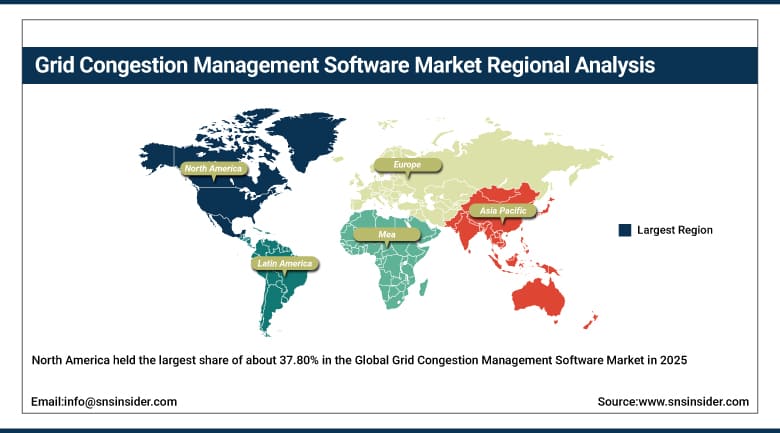
North America held the largest share of about 37.80% in the Global Grid Congestion Management Software Market in 2025, driven by the outdated condition of the transmission network infrastructure that needs relief from congestion without any new buildout expense, intense regulatory push from FERC to streamline the process of interconnection queue, and presence of prominent grid software players headquartered in the region. The collaboration between the transmission system operators and local software providers was yet another factor that made North America lead the market.
The U.S. was responsible for the majority of the overall revenue share of North America primarily because of the increasing use of AI-driven congestion forecast technology at the stage of PJM, MISO and CAISO planning, increase in federal investments for speeding up interconnections of renewables and data centers, and increasing requirement for remedial action optimization software from transmission system operators to resolve congestion in the interconnection queue.
Get Customized Report as Per Your Business Requirement - Enquiry Now
Europe Grid Congestion Management Software Market Insights
The Europe held the sustainable share of the world’s grid congestion management software market revenue owing to its stringent mandates on renewable integration, substantial investments on cross-border power trade infrastructure, and rise in usage of dynamic line rating software in Europe’s aging transmission network. Standardized grid planning models have motivated European transmission companies to invest in vendor neutral congestion management software systems.
Germany has been the leading country in the European grid congestion management software market in terms of revenue contribution due to deployment of large number of software projects associated with offshore wind interconnection expansion programs in Germany. UK has been an important contributor to the European grid congestion management software demand owing to its network reinforcement projects.
Asia Pacific Grid Congestion Management Software Market Insights
Asia Pacific region is forecast to be the fastest-growing region, growing at an approximate CAGR of 17.20% from 2026 to 2035. This was majorly fueled by massive investments worth several billions of dollars by China and India in their respective grid infrastructures, the need for expansion of congestion management capabilities because of urbanization and industrialization in both regions, as well as increased spending by governments in digitizing grids.
The majority of market share in Asia Pacific region belonging to China which is attributed to the constant investments made by State Grid Corporation on AI-based congestion forecasting, and the increase in the capability of domestic production of grid optimization software. Transmission line upgrades in India, regulated by the Central Electricity Authority reliability standards, were responsible for Asia Pacific's growth.
MEA and Latin America Grid Congestion Management Software Market Insights
The Middle East & Africa and Latin America witnessed consistent growth as a result of higher investments made in upgrading grid infrastructure, renewable energy diversification programs run by the government, and collaborations between local system operators and foreign congestion management software vendors. The capacity constrained transmission paths have emerged as important markets for congestion management software due to growing additions of renewables that are exceeding transmission capacity.
In ME&A, the biggest market has been Saudi Arabia due to investments made in upgrading the grid infrastructure as part of Saudi Arabia's solar and renewable diversification program. Besides this, projects being undertaken in grid modernization in the UAE have also helped ME&A gain more shares. In Latin America, Brazil was the biggest market due to the presence of large transmission grid and high congestion relief needs.
Market Dynamics:
Growth Drivers: Rising Interconnection Backlogs and Renewable Integration Pressure
The market moves forward due to the higher spending by the transmission system operators on software solutions in place of building new transmission lines, higher use of AI-based systems for congestion forecasting and optimization of actions, higher demand for interconnection of renewable energy sources, and higher variety of applications from relieving transmission bottlenecks to managing distribution congestion. Given the growing number of announcements made by transmission system operators on software-based congestion relief programs, and investments in the process made by governments and companies, the demand for software for congestion management will stay strong in the whole value chain during the forecast period.
Also, cooperation between software providers for the grid and the transmission companies, and financing of queue reforms initiatives by governments can be considered as additional evidence. Moreover, the constant focus on the global level on using untapped transmission capacity without lengthy permitting process is another factor that drives the demand and growth during the forecast period.
Restraints: Data Integration Complexity and Legacy System Interoperability Gaps
The relatively higher complexity of deploying the congestion management software in existing SCADA and energy management systems, in comparison with the ongoing process of manually planning contingency scenarios, is an actual problem that hinders faster market penetration, as transmission companies with limited IT budget find themselves unable to deploy such software fully. In consequence, the implementation of congestion management software has become phased and implemented in transmission companies that have enough funding and capacity.
Another problem hampering the deployment of the software is related to the problem of validating the predictive capabilities of the AI model on the basis of historical network performance. This process sometimes takes long and requires specific knowledge in data science, thus complicating the project beyond simple installation of software.
Opportunities: Cross-Regional Trading Integration and AI Model Advancement
The trend towards cross-regional energy trading presents an important opportunity for manufacturers that want to capitalize on their ability to provide congestion management tools that allow for coordination of flexibility between neighboring balancing authority areas. Platform offerings from vendors like Siemens AG and Smart Wires with automatic remediation action optimization along multi-operator corridors show the way manufacturers capitalize on this trend of broadened workflow.
Additionally, the growing interest of transmission operators in including the data from congestion management in the process of wholesale market bidding and interconnection queue handling creates the opportunity for vendors to show a measurable impact on curtailments and deferral of transmission investments. Manufacturers that can prove their value through providing data packages showing increased transmission capability and reduced interconnection timelines will secure their investment.
Recent Developments:
-
2025: Siemens AG introduced its Gridscale X Flexibility Manager module, adding real-time congestion forecasting and automated remedial action optimization for transmission system operators managing high renewable penetration corridors.
-
2026: Smart Wires expanded deployment of its SmartValve power-flow control platform across a major European transmission operator's network, targeting congestion relief on renewable-heavy corridors without new transmission line construction.
-
2026: Energy Management System from Hitachi Energy was featured and showcased as an advanced solution for energy management in the next generation to ensure coordination between transmission and distribution by utilizing real-time data.
Grid Congestion Management Software Market key players are:
-
Siemens AG
-
Hitachi Energy Ltd.
-
GE Vernova Inc.
-
Schneider Electric SE
-
ABB Ltd.
-
Oracle Corporation
-
IBM Corporation
-
SAP SE
-
Accenture plc
-
Capgemini SE
-
Aspen Technology, Inc.
-
Smart Wires, Inc.
-
LineVision, Inc.
-
PXiSE Energy Solutions, LLC
-
Opus One Solutions Energy Corporation
-
AutoGrid Systems, Inc.
-
Utilidata, Inc.
-
Gridspertise S.r.l.
-
Enverus, Inc.
-
Uplight, Inc.
Grid Congestion Management Software Market Report Scope:
| Report Attributes | Details |
|---|---|
| Market Size in 2025 | USD 1.85 Billion |
| Market Size by 2035 | USD 6.90 Billion |
| CAGR | 14.0% from 2026 to 2035 |
| Base Year | 2025 |
| Forecast Period | 2026-2035 |
| Historical Data | 2022-2024 |
| Report Scope & Coverage | Market Size, Segments Analysis, Competitive Landscape, Regional Analysis, DROC & SWOT Analysis, Forecast Outlook |
| Key Segments |
• By Component (Software, Services) • By Deployment Mode (Cloud-based, On-premises) • By Application (Congestion Forecasting, Flexibility Orchestration, Remedial Action Optimization, Dynamic Line Rating) • By Grid Type (Transmission Grid, Distribution Grid) • By End User (Utilities & TSOs, Independent System Operators, Industrial & Commercial)
|
| Regional Analysis/Coverage | North America (US, Canada), Europe (Germany, UK, France, Italy, Spain, Russia, Poland, Rest of Europe), Asia Pacific (China, India, Japan, South Korea, Australia, ASEAN Countries, Rest of Asia Pacific), Middle East & Africa (UAE, Saudi Arabia, Qatar, South Africa, Rest of Middle East & Africa), Latin America (Brazil, Argentina, Mexico, Colombia, Rest of Latin America). |
| Company Profiles | Siemens AG, Hitachi Energy Ltd., GE Vernova Inc., Schneider Electric SE, ABB Ltd., Oracle Corporation, IBM Corporation, SAP SE, Accenture plc, Capgemini SE, Aspen Technology, Inc., Smart Wires, Inc., LineVision, Inc., PXiSE Energy Solutions, LLC, Opus One Solutions Energy Corporation, AutoGrid Systems, Inc., Utilidata, Inc., Gridspertise S.r.l., Enverus, Inc., Uplight, Inc. |

Frequently Asked Questions
Key opportunities include rising renewable energy integration, increasing transmission congestion, grid modernization, real-time power flow optimization, and growing adoption of AI-enabled congestion management solutions.
The major growth factor is rising transmission system operator investment in software-driven alternatives to new transmission line construction, expanding deployment of AI-based congestion forecasting and remedial action optimization technologies, and growing renewable energy interconnection requirements worldwide.
The Software segment dominated the Grid Congestion Management Software Market by component, representing the largest share of revenue in 2025.
North America dominated the Grid Congestion Management Software Market in 2025, holding an estimated 37.80% share of total market revenue, while Asia Pacific is projected to be the fastest-growing region, registering a CAGR of approximately 17.20% from 2026 to 2035.
