
Grid Optimization Solution Market Report Scope and Overview:
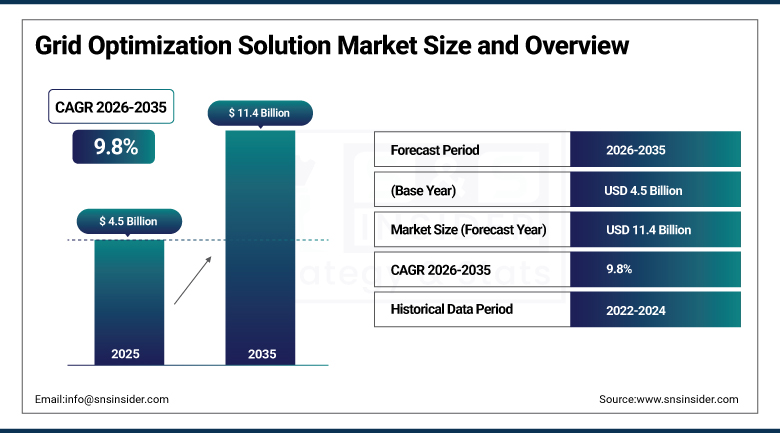
The Grid Optimization Solution Market was valued at USD 4.5 Billion in 2025 and is projected to reach USD 11.4 Billion by 2035, registering a CAGR of 9.8% from 2026 to 2035.
The Grid Optimization Solution Market is revolutionizing the utilities sector with the help of distribution management systems, distributed energy resource management systems, and grid analytics powered by AI that will enable utility companies to manage load balancing, renewable energy integration, and increase the efficiency of the transmission and distribution system. The key drivers of the market include increased spending by utilities on DERMS orchestration, increased implementation of cloud-native grid analytics solutions, increased pressure from regulations to comply with rules, such as FERC Order 2222 that require DERs participation, and the increased use of the solution in congestion management, demand response, and grid resiliency.
In 2026, Hitachi Energy announced its invention of AxoniQ – a novel grid system that involves using several terminals for transmission of electrical energy through the use of the latest technology of protection, control, and connection.
To Get more information On Grid Optimization Solution Market - Request Free Sample Report
Grid Optimization Solution Market Trends
-
Expanding deployment of DERMS orchestration platforms continues improving grid capacity for rooftop solar, EV charging, and battery storage integration.
-
Growing utility adoption of tightly integrated ADMS-DERMS architectures continues accelerating unified grid-edge orchestration at scale.
-
Rising virtual power plant program mandates continue expanding the addressable base for FERC Order 2222 compliant optimization platforms.
-
Increasing cloud-native deployment continues shortening utility implementation timelines from years to months for grid optimization software.
-
Growing adoption of AI-driven demand response stacking continues improving peak load reduction outcomes across utility service territories.
U.S. Grid Optimization Solution Market Outlook
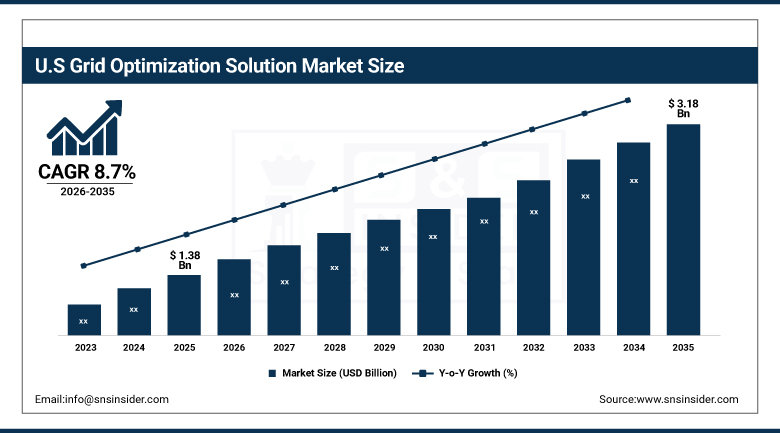
The U.S. Grid Optimization Solution Market was valued at approximately USD 1.38 Billion in 2025 and is projected to reach approximately USD 3.18 Billion by 2035, registering a CAGR of approximately 8.7% from 2026 to 2035.
In the U.S., the need for DERMS came about owing to the significant investment by utilities in terms of DERMS orchestration to handle the increasing installations of rooftop solar and electric vehicle chargers, increasing utility-scale renewable energy sources creating the necessity for sophisticated congestion management tools, and increasing demand for cloud native grid analytics software among distribution utilities seeking accelerated project time frames. The deployment of combined ADMS-DERMS solutions and AI-enabled demand response stacks within the territory served by some of the large investor-owned utilities contributed greatly towards the elevation of the position of the U.S. as the largest market for grid optimization technologies globally.
In June 2026, GridOS was further developed by GE Vernova to enhance its applications to U.S. utilities for near real-time grid monitoring, capacity management, managing congestion, and integration of renewable resources. The software is increasingly important because of the record demand for electricity in the United States fueled by AI data centers.
Grid Optimization Solution Market Segment Analysis
-
By Solution Type, Advanced Distribution Management Systems segment dominated the Grid Optimization Solution Market in 2025 with 31% share; Grid Analytics & AI Platforms segment is the fastest growing segment, registering a CAGR of 11.6% from 2026 to 2035.
-
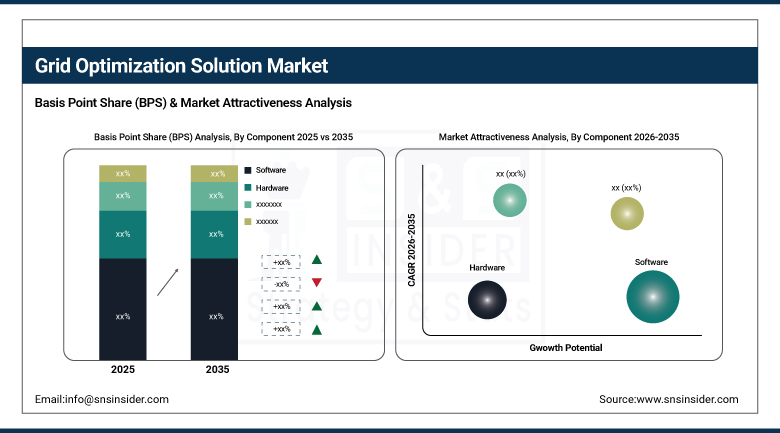
By Component, Software segment dominated the market in 2025 with 54% share; Services segment is the fastest growing segment, registering a CAGR of 11.2% from 2026 to 2035.
-
By Deployment, Cloud segment dominated the market in 2025 with 42.5% share; Hybrid segment is the fastest growing segment, registering a CAGR of 11.0% from 2026 to 2035.
-
By Application, Load Balancing & Congestion Management segment dominated the market in 2025 with 36% share; Renewable Integration segment is the fastest growing segment, registering a CAGR of 11.8% from 2026 to 2035.
-
By End User, Distribution System Operators segment dominated the market in 2025 with 47% share; Independent Power Producers segment is the fastest growing segment, registering a CAGR of 11.4% from 2026 to 2035.
By Solution Type, Advanced Distribution Management Systems Lead, Grid Analytics & AI Platforms Grow Fastest
Advanced Distribution Management Systems dominated the Grid Optimization Solution Market in 2025 due to their crucial role in the coordination of switching, voltage management, and outage management across utility distribution networks. Schneider Electric's ranking as one of the Guidehouse Insights leaders in ADMS solutions along with its highly integrated EcoStruxure DERMS platform illustrates how ADMS software has held the leading market position with respect to utility grid optimization expenditures as the level of control between field devices and operations decisions.
According to forecasts, Grid Analytics & AI Platforms will demonstrate the fastest rate of growth in the Grid Optimization Solution Market owing to the increasing implementation of predictive and AI-based forecasting to handle the complexity of renewable energy resources and distributed energy sources. The award of Schneider Electric as the Leader in the Verdantix Green Quadrant for DERMS solutions together with GE Vernova, AspenTech, and OATI demonstrates how stiff the competition is getting for AI-based forecasting, optimization, and control technologies.
By Component, Software Dominates, Services Post Fastest Growth
Software captured the largest component share of the Grid Optimization Solution Market in 2025 as utilities were showing a bias towards licensing ADMS, DERMS, and Analytics platforms rather than purchasing hardware. This was driven by the fact that software licensing offers recurring revenue streams and constant upgrades to align with the ever-changing FERC Order 2222, making it the dominant segment in utility grid optimization expenditure.
Services are expected to post the fastest growth rate over the forecast period due to the fact that utilities would need help in integrating, implementing and managing changes related to the software licensing process, to achieve grid optimization. Schneider Electric's deployment of DERMS solution with PG&E in seven months via agile implementation and cloud approach is evidence of the trend toward service-based implementation instead of traditional enterprise deployments.
By Deployment, Cloud Dominates, Hybrid Grows Fastest
The cloud segment dominated the Grid Optimization Solution Market in 2025 due to the preference of scalability and fast deployment over extended periods of time required for on-premise implementation by utilities. The launch of the cloud-based solution EcoStruxure DERMS offered by Schneider Electric to PG&E faster than conventional enterprise solutions proves that cloud-native architecture became the preferable one for obtaining immediate benefits from grid optimization software.
The hybris is the fastest growing type of deployment, due to the combination of cloud-based analytics and on-premise computing for performing functions related to control of the grid which should work without delays. The increasing number of grid-level and edge-level DERMS solutions offered by companies such as Schneider Electric and Uplight shows that hybrid deployment architecture can be optimized by combining cloud and edge computing technologies.
By Application, Load Balancing & Congestion Management Leads, Renewable Integration Grows Fastest
The Load Balancing & Congestion Management application accounted for the largest share of the Grid Optimization Solution Market in 2025 as utility companies sought to address the issue of increased demand for electricity and limited capacity due to old infrastructure without spending money on building new one. The application enjoys solid justification from the economic point of view since it promises to defer capital investments, thus becoming the most economically feasible optimization initiative in utility operations planning.
Renewable Integration is currently the fastest-growing application segment due to the rapid development of solar and wind power plants. As per the information provided by the U.S. Energy Information Administration, the production of utility-scale solar energy grew from about 163 billion kWh to above 238 billion kWh. It is reflected in the Grid to Prosumer strategy of Schneider Electric which combines grid optimization and flexibility services with prosumers' participation.
By End User, Distribution System Operators Dominate, Independent Power Producers Gain Fastest Traction
Distribution System Operators represented the dominant end-user segment of the Grid Optimization Solution Market in 2025 as DSOs carry primary responsibility for integrating rooftop solar, EV charging, and battery storage at the grid edge. Regulatory mandates positioning DSOs to procure optimization solutions for rising distributed energy resource penetration reflect how utilities are embedding grid optimization investment directly into long-term distribution planning strategies across service territories.
Independent Power Producers are expected to emerge as the fastest-growing end-user segment as renewable generation developers increasingly rely on grid optimization platforms to secure faster interconnection approval and participate in virtual power plant aggregation under FERC Order 2222. Growing adoption of AutoGrid's VPP platform for aggregating distributed resources into wholesale market bids illustrates how grid optimization is becoming a standard component of independent power producer market participation strategies.
Regional Analysis:
|
Region |
Major Country |
Share within Region, 2025 (%) |
|---|---|---|
|
North America |
United States |
83.00% |
|
Europe |
Germany |
22.60% |
|
Asia Pacific |
China |
35.20% |
|
Middle East and Africa |
Saudi Arabia |
27.90% |
|
Latin America |
Brazil |
31.80% |
North America Grid Optimization Solution Market Insights
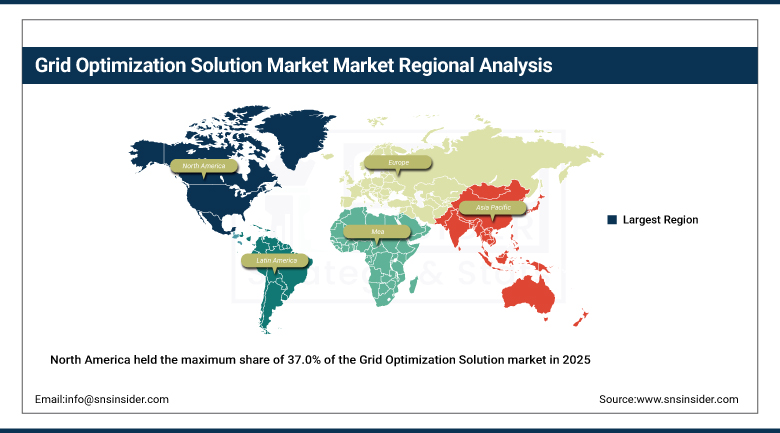
North America held the maximum share of 37.0% of the Grid Optimization Solution market in 2025. The rapid increase in the penetration of rooftop solar and EV charging along with robust regulatory environment via FERC Order 2222 for distributed resources participation in markets and the availability of DERMS and ADMS technology providers in North America boosted the adoption rate in North America. The coordination among the utilities and local grid analytics technology providers supported the leadership of North America in both distribution and transmission optimization.
The U.S. accounted for majority share of the total revenue in North America owing to high domestic adoption of EcoStruxure DERMS platform of Schneider Electric, utility installations of VPP aggregation technology by AutoGrid, and increase in the demand for AI-powered demand response stacking such as selection of Uplight and AutoGrid by Eversource in February 2025. Increase in investment in grid modernization projects in Canada led to further contribution from North America towards the dominance in the market.
Get Customized Report as per Your Business Requirement - Enquiry Now
Europe Grid Optimization Solution Market Insights
Sustainability was one of the key factors driving Europe's share of global Grid Optimization Solution income due to its stringent decarbonization targets, investments in digitalization of distribution system operators, and the increasing installation of DERMS in its networks which are getting electrified more rapidly than ever. Moreover, an increased adoption of standard frameworks for connecting grids to prosumers has driven utilities in Europe to implement vendor-independent solutions, allowing the region to maintain its leading position in regulation of DERs.
The country with the highest market demand in Europe was Germany, due to grid optimization investment of distribution system operators that followed the growth of renewable energy capacity of the country. The country of Estonia contributed to the regional demand through the implementation of DERMS by Schneider Electric together with Elektrilevi, while demand for grid optimization in Europe will keep growing due to decarbonization plans.
Asia Pacific Grid Optimization Solution Market Insights
The Asia Pacific region is witnessing the highest rate of growth among all regions covered in the market at a CAGR of 12.8%, driven grid modernization spending in China, the fast addition of renewable capacity in India, and increased efforts from governments to improve grid reliability in quickly electrifying nations. It is the combination of both these factors, along with increasing utility interest in artificial intelligence solutions, that has led the Asia-Pacific region to record the fastest growth of any market reported here.
The dominant country in the region was China, driven by its large investments in grid modernization as well as its growing capability to develop grid analytics software internally. Other important countries in this context are India, where distribution utilities are using DERMS solutions to cope with increasing solar capacity, and Japan, which continues to use optimization software to plan renewable integration.
MEA and Latin America Grid Optimization Solution Market Insights
The Middle East and Africa and Latin America both showed steady growth in the Grid Optimization Solution Market driven by the increased investments in grid modernization projects, diversification policies of renewable energy in the region, and increased cooperation between the region's utility companies and foreign grid technologies providers. The real-time load balancing and congestion management is becoming increasingly important for this region due to the fast development of renewable energy sources.
Within the ME&A region, the country with the biggest market share was Saudi Arabia, due to the huge investments in grid modernization projects associated with the country's programs of solar and renewable energy diversification. Within the LATAM region, the country with the highest revenue generation rate was Brazil, due to the vast transmission grid network and increased need for congestion management without additional infrastructural development.
Market Dynamics:
Growth Drivers: Rising DER Penetration and Expanding Regulatory Support for Grid Flexibility
The market is being driven by increased uptake of rooftop solar power, EV charging, and energy storage solutions causing stresses in distribution networks, wider adoption of AI-powered DERMS and ADMS platforms, increased regulatory push from FERC Order 2222 and similar international regulations on distributed resources participation in the market, and the increasing set of use cases, such as congestion management, demand response, and grid resiliency. The increasing number of utilities announcing their roadmaps for grid optimization linked to their DER integration schedules will keep the demand for scalable cloud-based optimization solutions high within the supply chain.
The increasing number of partnerships between providers of grid technologies and customer engagement solutions, along with increased commitment to the concept of unified grid-to-prosumer orchestration before the interconnection queues reforms, also serves as additional proof of the trend. The institutional validation of the leading vendors of DERMS through independent evaluations, such as Verdantix Green Quadrant is another contributor to increasing baseline confidence in deployment of the solution, and all of these aspects together drive the demand growth.
Restraints: Legacy System Integration Complexity and High Implementation Costs
The difficulty of integrating these systems into the existing SCADA, GIS and outage management systems is an actual limitation to accelerated growth in the market, as most utilities have an existing network infrastructure which was never designed with DERMS and AI-enabled analytics in mind.
This has led to the fact that the most advanced systems implementations were done mainly by large investor-owned utilities, which can afford it. The high cost of deployment remains a problem, as full-scale grid optimization requires significant investments in software and engineering. Solving this problem would require validated standard deployment practices, which is a long process involving many resources.
Opportunities: Virtual Power Plant Aggregation and Grid-to-Edge Platform Integration
The emergence of virtual power plant aggregation is an example of a key opportunity that has been presented by the trend of utilities and IPPs seeking to bid distributed resources into wholesale markets in light of FERC Order 2222. Vendors of validated, production-tested VPP offerings, such as AutoGrid within Uplight are well-poised to grab their fair share given the transition of utilities from demand response pilots to full-blown wholesale market participation.
A further key opportunity arises from the growing trend of grid-to-edge architecture offerings where the integration of grid-side DERMS and edge-level device orchestration can create more flexible value. Companies which have the ability to provide both grid- and edge-level DERMS offerings like Schneider Electric and Uplight's platform are projected to take a disproportionately high amount of deployment spending during the forecast period.
Recent Developments:
-
2026: Schneider Electric was named a Leader in the Verdantix Green Quadrant for Distributed Energy Resource Management Systems, recognized alongside GE Vernova, Emerson's AspenTech, and OATI for its EcoStruxure DERMS forecasting, optimization, and interoperability capabilities.
-
2026: Itron expanded its grid-edge intelligence portfolio, connecting smart meters, distributed energy resources, and utility software to improve visibility, demand management, and operational optimization across increasingly decentralized electricity networks.
-
2025: Eversource selected Uplight and AutoGrid's combined DERMS and demand-side flexibility platform, following a Brattle Group finding that integrated demand stacks deliver 60% more peak reduction than standalone programs.
Grid Optimization Solution Market key players are:
-
Siemens AG
-
Schneider Electric SE
-
GE Vernova Inc.
-
ABB Ltd
-
Honeywell International Inc.
-
Eaton Corporation plc
-
Oracle Corporation
-
IBM Corporation
-
Itron, Inc.
-
Hitachi Energy Ltd.
-
S&C Electric Company
-
Schweitzer Engineering Laboratories, Inc.
-
Doble Engineering Company
-
Aclara Technologies LLC
-
CGI Inc.
-
Landis+Gyr Group AG
-
Elisa Smart Grid Solutions
-
Huawei Technologies Co., Ltd.
-
AutoGrid Systems, Inc.
-
Uplight, Inc.
Grid Optimization Solution Market Report Scope:
| Report Attributes | Details |
|---|---|
| Market Size in 2025 | USD 4.5 Billion |
| Market Size by 2035 | USD 11.4 Billion |
| CAGR | 9.8% from 2026 to 2035 |
| Base Year | 2025 |
| Forecast Period | 2026-2035 |
| Historical Data | 2022-2024 |
| Report Scope & Coverage | Market Size, Segments Analysis, Competitive Landscape, Regional Analysis, DROC & SWOT Analysis, Forecast Outlook |
| Key Segments |
• By Solution Type (Advanced Distribution Management Systems, Grid Analytics & AI Platforms, Demand Response Management, Distributed Energy Resource Management Systems, Volt/VAR Optimization) • By Component (Software, Services, Hardware) • By Deployment (Cloud, Hybrid, On-Premise) • By Application (Load Balancing & Congestion Management, Renewable Integration, Demand Response, Grid Resiliency & Outage Management) • By End Use (Distribution System Operators, Independent Power Producers, Transmission System Operators, Industrial & Commercial)
|
| Regional Analysis/Coverage | North America (US, Canada), Europe (Germany, UK, France, Italy, Spain, Russia, Poland, Rest of Europe), Asia Pacific (China, India, Japan, South Korea, Australia, ASEAN Countries, Rest of Asia Pacific), Middle East & Africa (UAE, Saudi Arabia, Qatar, South Africa, Rest of Middle East & Africa), Latin America (Brazil, Argentina, Mexico, Colombia, Rest of Latin America). |
| Company Profiles | Siemens AG, Schneider Electric SE, GE Vernova Inc., ABB Ltd, Honeywell International Inc., Eaton Corporation plc, Oracle Corporation, IBM Corporation, Itron, Inc., Hitachi Energy Ltd., S&C Electric Company, Schweitzer Engineering Laboratories, Inc., Doble Engineering Company, Aclara Technologies LLC, CGI Inc., Landis+Gyr Group AG, Elisa Smart Grid Solutions, Huawei Technologies Co., Ltd., AutoGrid Systems, Inc., and Uplight, Inc. |

Frequently Asked Questions
Key players include Siemens AG, Schneider Electric SE, GE Vernova Inc., ABB Ltd, and Honeywell International Inc., among others.
Key opportunities include rising grid modernization, renewable energy integration, increasing electricity demand, AI-driven grid optimization, real-time monitoring, and growing deployment of advanced energy management solutions.
The major growth factor is rising rooftop solar, EV charging, and battery storage penetration straining distribution networks, expanding deployment of AI-driven DERMS and ADMS platforms, and growing regulatory support through FERC Order 2222 and comparable mandates for distributed resource market participation.
The Advanced Distribution Management Systems segment dominated the Grid Optimization Solution Market by solution type, representing the largest share of revenue in 2025.
