
Grid Digital Twin Market Report Scope and Overview:
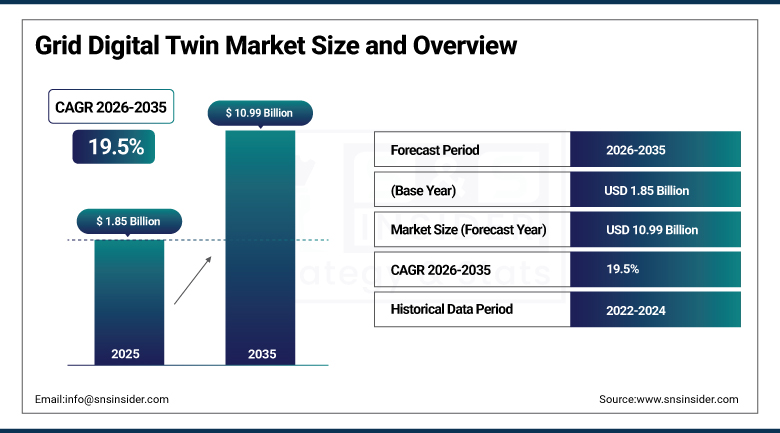
The Grid Digital Twin Market was valued at USD 1.85 Billion in 2025 and is projected to reach USD 10.99 Billion by 2035, registering a CAGR of 19.5% from 2026 to 2035.
The Grid Digital Twin Market is revolutionizing network planning for transmission and distribution through the use of virtual models of grids which integrate real-time sensors, AI simulations, and geographical information systems to simulate behavior of networks under different load and generation scenarios. The market consists of an increase in the level of utility spending on grid autonomy software, the increasing integration of digital twins in AI factory power planning, use of physics-based simulations in congestion planning, and usage in renewable interconnection, predictive maintenance, and gigawatts-level data center capacity planning.
In June 206, ABB expanded its collaboration with NVIDIA to support digital-twin modeling for AI data-center power systems, integrating ABB electrical equipment models into NVIDIA Omniverse for advanced simulation and optimization.
To Get more information On Grid Digital Twin Market - Request Free Sample Report
Grid Digital Twin Market Trends
-
Expanding integration of digital twin platforms with AI factory power planning continues accelerating grid-to-chip level capacity simulation.
-
Growing utility adoption of autonomous grid management software continues improving real-time congestion and outage forecasting accuracy.
-
Rising deployment of distribution network digital twins continues expanding the addressable base beyond transmission-class assets.
-
Increasing collaboration between grid technology vendors and cloud computing platforms continues strengthening demand for physics-based simulation tools.
-
Growing adoption of OpenUSD-based interoperable digital twin standards continues accelerating cross-vendor grid simulation compatibility.
U.S. Grid Digital Twin Market Outlook
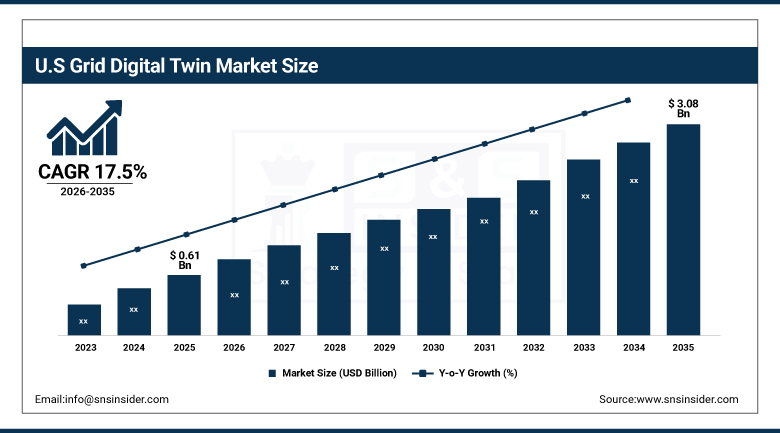
The U.S. Grid Digital Twin Market was valued at approximately USD 0.61 Billion in 2025 and is projected to reach approximately USD 3.08 Billion by 2035, registering a CAGR of approximately 17.5% from 2026 to 2035.
The growing need in the U.S. increased due to investments made by utilities into simulations of capacity on the grid to cope with requests related to interconnection of data centers, usage of digital twin solutions for integration of renewables and high demand for outage forecasting and predictive maintenance systems from operators of transmission and distribution networks with aging assets. Deployment of AI grid simulation platforms and digital twins at substation level in major investor-owned utility networks has been an important factor that helped maintain the leadership of the United States in the market.
In 2026, NVIDIA continued expanding its U.S. energy-infrastructure ecosystem around physically accurate digital twins, highlighting simulation of electrical-grid infrastructure to predict outages and optimize increasingly complex power networks. This is particularly relevant as U.S. electricity demand from AI data centers reaches record levels.
Grid Digital Twin Market Segment Analysis
-
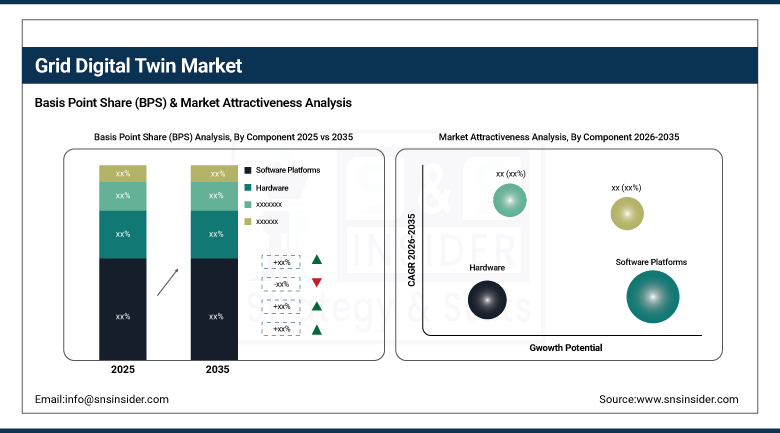
By Component, Software Platforms segment dominated the Grid Digital Twin Market in 2025 with 56% share; Services segment is the fastest growing segment, registering a CAGR of 21.8% from 2026 to 2035.
-
By Twin Type, Distribution Network Twins segment dominated the market in 2025 with 38% share; Substation Twins segment is the fastest growing segment, registering a CAGR of 22.1% from 2026 to 2035.
-
By Deployment, Cloud segment dominated the market in 2025 with 52% share; Hybrid segment is the fastest growing segment, registering a CAGR of 21.6% from 2026 to 2035.
-
By Application, Grid Planning & Capacity Simulation segment dominated the market in 2025 with 33% share; Renewable Integration & DER Management segment is the fastest growing segment, registering a CAGR of 22.4% from 2026 to 2035.
-
By End User, Utilities segment dominated the market in 2025 with 74% share; Independent System Operators segment is the fastest growing segment, registering a CAGR of 21.9% from 2026 to 2035.
By Component, Software Platforms Lead, While Services Grow Fastest
Software Platforms led the Grid Digital Twin Market in 2025 as software plays a pivotal role in turning the data collected through sensors and network into useful information for grid simulation and planning. The Siemens GridScale X platform, that offers an autonomous grid management solution and provides full situational awareness of the grid, is one of the many examples that show how software has turned into the key investment made by utilities in the process of deploying their digital twins.
The Services segment is forecasted to grow at the fastest pace within the Grid Digital Twin Market owing to the growing demand for external integration, calibration, and modeling from utilities for transforming the unprocessed sensor data into reliable digital twins. The formation of new partnerships between vendors, Alliance for OpenUSD initiative between Schneider Electric, ETAP, and AVEVA, shows how vital services have become for creating digital twins on multiple platforms.
By Twin Type, Distribution Network Twins Lead, Substation Twins Post Fastest Growth
The Distribution Network Twins accounted for the major share of the Grid Digital Twin Market in 2025 owing to the huge number of assets that need visibility as the DERs grow in numbers. The example of Gridscale X implementation by Siemens for Italian DSO AcegasApsAmga, which provides situational awareness about the medium- and low-voltage network of the Municipality of Trieste, indicates that the distribution network twins are now generating revenues at the highest level since they help manage growing DER integration.
The Substation Twins are expected to exhibit the highest CAGR during the forecast period because of the increasing adoption of digital twins of substations to enable prediction and identification of faults in substations. Pilot implementations of Microsoft Azure Digital Twins with electric utilities for monitoring substations and avoiding outages indicate that the substation twins have high growth potential because transformer and switchgear failure management is critical for utilities.
By Deployment, Cloud Dominates, Hybrid Deployment Grows Fastest
Cloud deployment dominated the Grid Digital Twin Market in 2025 owing to the preference of the utilities for scalable and centralized simulation platforms that can handle vast amounts of real-time sensor data. The release of Schneider Electric’s One Digital Grid Platform, which is based on cloud deployment, in late 2025 showcases that cloud-native deployment has become the preferred option for grid digital twin implementation at a utility scale.
The hybrid deployment category is expected to witness the fastest growth rate due to the need to balance cloud analytics and on-premise processing in order to perform latencysensitive safety critical applications in the grid. GE Vernova’s implementation of digital twins across the entire power-to-compute stack in sync with the NVIDIA Vera Rubin DSX AI Factory reference architecture is an example of such hybrid architectures.
By Application, Grid Planning & Capacity Simulation Leads, Renewable Integration & DER Management Grows Fastest
The Grid Planning & Capacity Simulation Application Segment held the largest market share in the Grid Digital Twin Market in 2025, supported by the efforts of utility companies to model their capacity in anticipation of data center and electrification-induced demand growth. This application is helped by a well-documented business case that involves avoiding an overbuild of infrastructures, thus being the best-funded digital twin project in utility companies' planning departments.
Renewable Integration & DER Management is the most rapidly growing application segment, due to increasing use of digital twins for modeling the effect of increasing penetration of renewable energy sources and distributed energy storage systems on the performance of grids. An example of this is the collaboration between ETAP and Schneider Electric to simulate power requirements of an AI factory from the grid to the chip level using NVIDIA Omniverse platform.
By End User, Utilities Dominate, Independent System Operators Gain Fastest Traction
Utilities were the leading end user group in the Grid Digital Twin market in 2025 since they play an important role in making decisions about network planning, reliability and capacity expansion. Mass adoption of digital twins, especially those implemented by utilities such as Southern Company and Duke Energy based on Grid Edge and GE Vernova solutions, demonstrates the role of utilities in incorporating investment in digital twins into grid modernization plans.
Independent System Operators are expected to be the fastest-growing end-user group since grid operators become more active in implementing digital twin platforms for capacity planning across several utility territories owing to high interconnection queues. Collaboration of ISOs and grid technology providers in regional simulation projects shows that digital twin technology has already become an integral part of interregional grid cooperation and grows faster than traditional single-utility implementation.
Regional Analysis:
|
Region |
Major Country |
Share within Region, 2025 (%) |
|---|---|---|
|
North America |
United States |
84.00% |
|
Europe |
Germany |
23.20% |
|
Asia Pacific |
China |
36.00% |
|
Middle East and Africa |
UAE |
29.80% |
|
Latin America |
Brazil |
32.60% |
North America Grid Digital Twin Market Insights
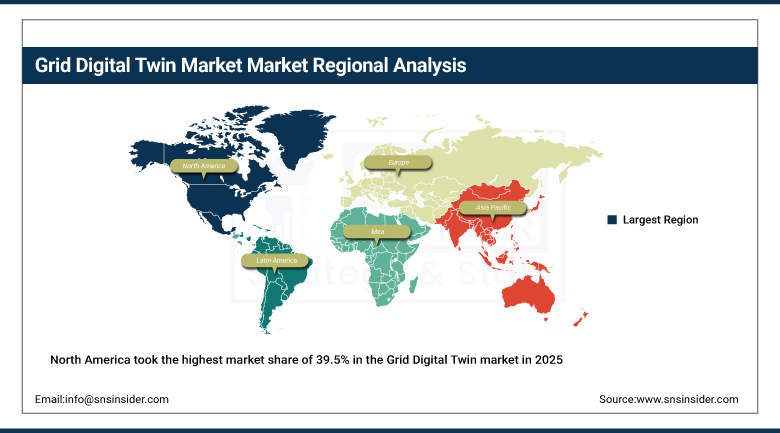
North America took the highest market share of 39.5% in the Grid Digital Twin market in 2025 owing to unprecedented demand for grid capacity planning through data center and AI infrastructure, investments from utility companies into autonomous grid management platforms, and presence of major digital twin and grid software providers located in North America. Tight cooperation between utility companies and simulation platform providers based in North America helped strengthen its position as the top region both in terms of digital twin for transmission grids and digital twin for distribution grids.
The U.S. comprised majority of the entire revenue share due to high adoption of digital twin technologies by utility companies such as Siemens' Grid Edge and GE Vernova's digital twin technologies, along with the increasing demand from hyperscalers in connection with grid-to-chip power simulation through the NVIDIA Omniverse partnership of Schneider Electric and ETAP. The growth of grid modernization spending in Canada helped the region make its own contribution to the dominance of North America in the market.
Get Customized Report as per Your Business Requirement - Enquiry Now
Europe Grid Digital Twin Market Insights
Europe maintained a sustainable share of worldwide Grid Digital Twin revenue was attributed to the region's aggressive decarbonization goals, considerable investments into digitalization of distribution system operators, and increasing implementation of situational awareness solutions on transmission and distribution systems in Europe. The use of open interoperability standards compatible with OpenUSD has become another reason for utility companies to invest in vendor-neutral digital twin solutions.
Germany became the biggest demander of the Grid Digital Twins in Europe due to the significant investment into grid digitalization done by TSOs in the context of growing renewable integration in the country as well as Siemens' platform development in Germany. Siemens' Gridscale X solution implementation by DSO AcegasApsAmga in Trieste in Italy became one of the important factors influencing regional demand, and Europe's future demand for grid digital twins will not be declining in connection with decarbonization projects.
Asia Pacific Grid Digital Twin Market Insights
The Asia Pacific region shows the fastest growth in this market at a CAGR of 23.8%, owing to investments made by China in the modernization of the grid infrastructure, India's growing implementation of smart meters and grid digitization initiatives, and increased government-led efforts to enable grid capacity planning in electrifying economies. The combination of rapid capacity growth from renewables and increased appetite for AI-based simulations has guaranteed that the fastest-growing grid digital twin market is in this region.
China was the leading country in the region due to the substantial investments in grid modernization and increased capacity to develop digital twins within the country. Other important countries in the region include India, where large scale deployment of smart meters provides a solid foundation for using grid digital twins, and Japan, where utilities are continuing to develop digital twin platforms to plan renewable integration.
MEA and Latin America Grid Digital Twin Market Insights
The Middle East & Africa (ME&A) and Latin America (LATAM) regions were seen to exhibit consistent growth in the Grid Digital Twin Market due to an increase in investments towards grid infrastructure modernization, initiatives taken by governments to create digital economies through diversification, and increased collaborations between local utilities and grid technology suppliers across the world. Increasing visibility of grid capacities is becoming a priority in these regions since data center and renewable power capacities are being added rapidly.
In ME&A, the UAE was the largest country market due to its standing as the leading regional data center/grid modernization hub with huge investments made in AI-based grid power planning infrastructure. ME&A also witnessed grid digitalization initiatives being rolled out in Saudi Arabia. Brazil was the largest revenue generator in LATAM owing to its extensive transmission grid network.
Market Dynamics:
Growth Drivers: Rising Grid Capacity Planning Demand and Expanding AI Infrastructure Integration
The market is driven by the rising requirement for real-time visibility of the grid in the context of the unprecedented demand for capacity from the data center industry and electrification coupled with the increased deployment of digital twins integrated with artificial intelligence-based factory power planning, the pressure on regulators to speed up the process of capacity evaluation in the grid, and an expanded use case base, including renewable energy integration, predictive maintenance, and outages forecasting.
The increase in the number of partnerships between grid technology providers and cloud computing platforms, along with the utilities' interest in adopting AI-enabled unified grid simulation before the implementation of the interconnection queue reform, can be regarded as yet another piece of evidence supporting the identified trend. The increasing use of interoperable simulation standards, such as Alliance for OpenUSD, is contributing to the rise in the capability to deploy the technology, which translates into higher demand in the forecast period.
Restraints: Legacy Data Integration Complexity and High Implementation Costs
The difficulty of implementing digital twins into existing systems such as SCADA, GIS, and asset management software is still an actual challenge for market growth since many utilities rely on a system not built with digital twins in mind. This is the reason why most advanced applications of digital twins have been made mainly by large transmission and distribution utilities.
High implementation remains the problem, since deploying the digital twin across the entire grid entails considerable initial costs related to sensors, software licensing, and integration expertise. The solution to this problem would be the development of deployment approaches that could be validated and standardized, which is still a costly process.
Opportunities: AI Factory Power Planning and Cross-Vendor Interoperability Standards
The advent of AI factory power planning is a promising opportunity amid rising demands for digital twin simulation from grid-to-chip level to enable gigawatt-scale AI infrastructure planning in the era of hyperscalers. Vendors who manage to forge anchor deals, like the partnership of GE Vernova and NVIDIA on the expansion of digital twin capabilities from grid to compute through the entire stack, will have an opportunity to win a considerable share amid the shift from the former grid-only planning to comprehensive power-to-compute simulation.
One more opportunity is associated with the growing need for interoperability standards amid the increasing use of OpenUSD and Omniverse compatible solutions for enabling interoperability of competing digital twins. Vendors who offer standards compliant and interoperable simulation solutions will see a high probability of capturing a large share of deployment expenditure amid the period under review, like Schneider Electric, ETAP, and AVEVA do with their cooperation within the Alliance for OpenUSD.
Recent Developments:
-
2026: GE Vernova and NVIDIA jointly announced the extension of digital twin capabilities across the full power-to-compute stack, aligning grid infrastructure modeling with the NVIDIA Vera Rubin DSX AI Factory reference architecture to unlock capacity for gigawatt-scale AI factories.
-
2025: Schneider Electric and ETAP unveiled a digital twin using NVIDIA Omniverse to simulate AI factory power requirements from grid to chip level, integrating ETAP's Electrical Digital Twin technology with Omniverse Cloud APIs.
-
2026: Hitachi Energy developed digital grid solutions involving network modeling, monitoring, and analysis, which would allow utilities to simulate the grid's performance and improve its operation.
Grid Digital Twin Market key players are:
-
Siemens AG
-
Schneider Electric SE
-
GE Vernova Inc.
-
Hitachi Energy Ltd.
-
ABB Ltd
-
Mitsubishi Electric Power Products, Inc.
-
Honeywell International Inc.
-
AVEVA Group plc
-
ETAP (a Schneider Electric Company)
-
Microsoft Corporation
-
IBM Corporation
-
PTC Inc.
-
Bentley Systems, Incorporated
-
Cognite AS
-
Itron, Inc.
-
Landis+Gyr Group AG
-
NVIDIA Corporation
-
Emerson Electric Co.
-
Camus Energy, Inc.
-
Willow Technology Corporation
Grid Digital Twin Market Report Scope:
| Report Attributes | Details |
|---|---|
| Market Size in 2025 | USD 1.85 Billion |
| Market Size by 2035 | USD 10.99 Billion |
| CAGR | 19.5% from 2026 to 2035 |
| Base Year | 2025 |
| Forecast Period | 2026-2035 |
| Historical Data | 2022-2024 |
| Report Scope & Coverage | Market Size, Segments Analysis, Competitive Landscape, Regional Analysis, DROC & SWOT Analysis, Forecast Outlook |
| Key Segments |
• By Component (Software Platforms, Services, Hardware) • By Twin Type (Distribution Network Twins, Substation Twins, Transmission Network Twins, DER & Microgrid Twins) • By Deployment (Cloud, Hybrid, On-Premise) • By Application (Grid Planning & Capacity Simulation, Renewable Integration & DER Management, Predictive Maintenance & Asset Management, Outage Management & Restoration) • By End User (Utilities, Independent System Operators, Government & Regulatory Bodies)
|
| Regional Analysis/Coverage | North America (US, Canada), Europe (Germany, UK, France, Italy, Spain, Russia, Poland, Rest of Europe), Asia Pacific (China, India, Japan, South Korea, Australia, ASEAN Countries, Rest of Asia Pacific), Middle East & Africa (UAE, Saudi Arabia, Qatar, South Africa, Rest of Middle East & Africa), Latin America (Brazil, Argentina, Mexico, Colombia, Rest of Latin America). |
| Company Profiles | Siemens AG, Schneider Electric SE, GE Vernova Inc., Hitachi Energy Ltd., ABB Ltd, Mitsubishi Electric, Power Products, Inc., Honeywell International Inc., AVEVA Group plc, ETAP (a Schneider Electric Company), Microsoft Corporation, IBM Corporation, PTC Inc., Bentley Systems, Incorporated, Cognite AS, Itron, Inc., Landis+Gyr Group AG, NVIDIA Corporation, Emerson Electric Co., Camus Energy, Inc., and Willow Technology Corporation. |

Frequently Asked Questions
Key players include Siemens AG, Schneider Electric SE, GE Vernova Inc., Hitachi Energy Ltd., and ABB Ltd, among others.
Key opportunities include accelerating grid modernization, increasing renewable energy integration, predictive asset management, real-time grid optimization, and growing adoption of digital twins for resilient power infrastructure.
The major growth factor is rising utility demand for real-time grid visibility amid unprecedented data center and electrification-driven capacity requests, expanding integration of digital twin platforms with AI factory power planning, and growing adoption of autonomous grid management software.
The Software Platforms segment dominated the Grid Digital Twin Market by component, representing the largest share of revenue in 2025.
