
Grid-Enhancing Technologies Market Report Scope and Overview:
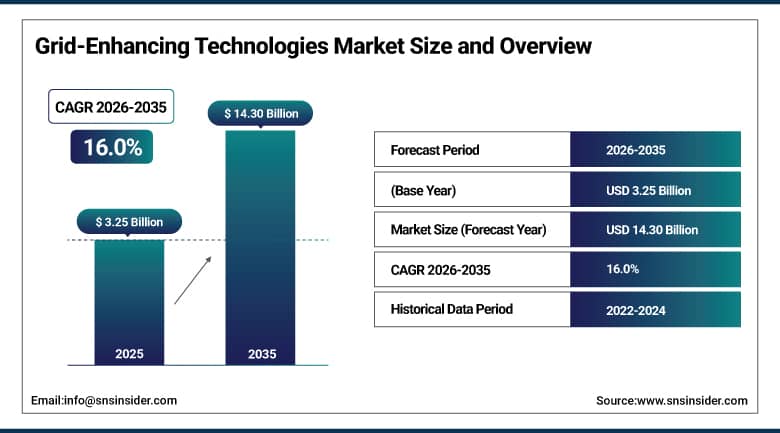
The Grid-Enhancing Technologies Market size was worth USD 3.25 Billion in 2025 and is projected to reach USD 14.30 Billion by 2035, registering a 16.0% CAGR during 2026-2035.
The Grid-Enhancing Technologies Market is reshaping how transmission system operators and utilities extract additional capacity from existing electrical grid assets without resorting to costly new line construction. The market can be described in terms of accelerating deployment of dynamic line rating and advanced power flow control hardware on congested corridors, growing adoption of topology optimization and grid analytics software layered onto legacy SCADA systems, rising utility mandates to relieve renewable interconnection bottlenecks, and expanding recognition among regulators that near-term congestion relief is achievable in months rather than the multi-year timelines associated with greenfield transmission build-out.
In 2026, Smart Wires Inc. confirmed that its SmartValve power-flow control platform had been deployed across additional Midcontinent ISO transmission corridors, following earlier installations that regulators credited with materially reducing renewable curtailment and congestion-related wholesale price spikes in the region.
To Get More Information On Grid-Enhancing Technologies Market - Request Free Sample Report
Grid-Enhancing Technologies Market Trends
-
Utilities are increasingly pairing dynamic line rating sensors with power-flow control devices on the same congested corridors.
-
Growing regulatory recognition of grid-enhancing technologies is shortening approval timelines for congestion-relief projects.
-
Rising adoption of topology optimization software is helping operators reroute power flow without new hardware investment.
-
Expanding renewable interconnection backlogs continue pushing transmission owners toward faster, lower-cost capacity solutions.
-
Increasing vendor consolidation is bundling hardware, software, and advisory services into single grid-enhancing technology packages.
U.S. Grid-Enhancing Technologies Market Outlook
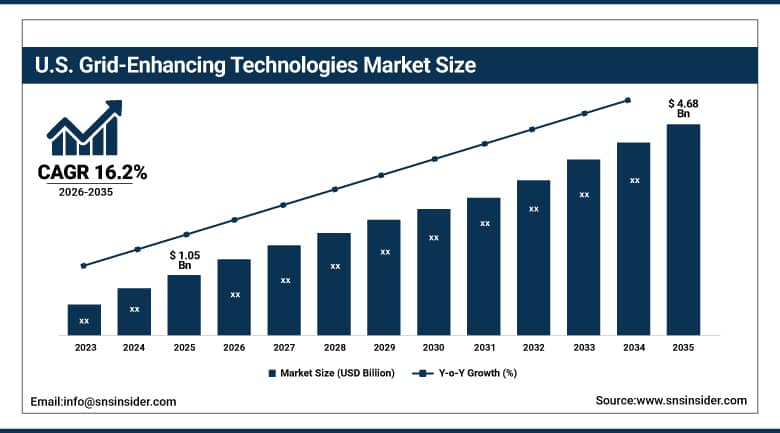
The U.S. Grid-Enhancing Technologies Market was valued at approximately USD 1.05 Billion in 2025 and is projected to reach approximately USD 4.68 Billion by 2035, registering a 16.2% CAGR from 2026 to 2035.
Growth across the country continues to be shaped by FERC Order 1920 and Order 881, which jointly encourage transmission planners to evaluate grid-enhancing technologies before committing to new line construction, alongside aggressive interconnection queue backlogs across ISO-New England, MISO, and ERCOT. Rising utility familiarity with dynamic line rating and power-flow control pilots, combined with growing Department of Energy grant support for grid modernization, has reinforced the country's position as the largest addressable market for grid-enhancing hardware, software, and services in North America.
In 2026, GE Vernova confirmed that its Grid Software Solutions division had expanded topology optimization deployments across multiple U.S. transmission operators, with early adopters reporting measurable reductions in renewable curtailment during peak wind and solar generation hours.
Grid-Enhancing Technologies Market Segment Analysis
-
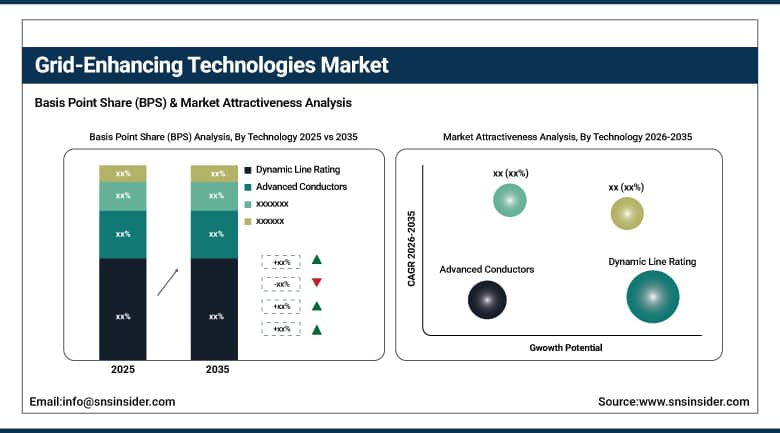
By Technology, Dynamic Line Rating segment dominated the Grid-Enhancing Technologies Market in 2025 with 41% share; Advanced Power Flow Control segment is the fastest growing segment, registering a CAGR of 18.2% from 2026 to 2035.
-
By Component, Hardware segment dominated the market in 2025 with 48% share; Software segment is the fastest growing segment, registering a CAGR of 18.0% from 2026 to 2035.
-
By Application, Congestion Management segment dominated the market in 2025 with 44% share; Renewable Energy Integration segment is the fastest growing segment, registering a CAGR of 18.5% from 2026 to 2035.
-
By Deployment Model, Standalone Deployment segment dominated the market in 2025 with 66% share; Hybrid Deployment segment is the fastest growing segment, registering a CAGR of 17.8% from 2026 to 2035.
-
By End User, Utilities segment dominated the market in 2025 with 59% share; Renewable Energy Developers segment is the fastest growing segment, registering a CAGR of 18.3% from 2026 to 2035.
By Technology, Dynamic Line Rating Leads, While Advanced Power Flow Control Grows Fastest
Dynamic Line Rating accounted for the highest market share of Grid-Enhancing Technologies in 2025. DLR continues to be one of the best operational technologies for utilities that seek to maximize capacity of their existing transmission lines. This technology enables operators to take advantage of existing thermal capacity of the transmission line, without building new facilities. LineVision and Heimdall Power have created reference projects in collaboration with utility companies to help increase confidence in using this technology. Advanced Dynamic Line Rating allows utilities to manage congestion and integrate renewable energy into the grid without requiring extensive expansion of the grid.
Power Flow Control is the technology that experiences the fastest growth within the market. As utilities continue to shift from being reactive to proactive by taking measures, such as Power Flow Control that redirects power flow around congested transmission lines. Power Flow Control gives operators an ability to manage power flows through the network more efficiently. Several companies, such as Smart Wires and Hitachi Energy have expanded their power flow control services as grid congestion becomes more common issue for the utilities. Power Flow Control can also work in combination with Dynamic Line Rating to increase efficiency of the existing grid.
By Component, Hardware Dominates, While Software Emerges Fastest
Hardware was the biggest segment component in 2025, which reflects the dependence of utilities on sensors, monitoring systems, power flow control devices, conductors, and other grid components necessary for the deployment of innovations. Hardware is the foundation of data collection and transmission system physical improvement and is vital for the modernization efforts. Established equipment of reputable suppliers is especially important for transmission operators who need to ensure minimum risks in deploying new technologies on live grids. Deployments of hardware can provide capacity gains without the need for immediate start of time-consuming processes related to conventional transmission construction.
Software is the fastest growing segment because of the transition of utilities from the pilots of single technologies to the development of an integrated platform that can process real-time information about grid operations and support automated decision-making. Modern software can use information provided by the sensors, weather forecast, topology of the network, power flows, and other information and analytics tools to assist the operators to determine the transmission capacity and improve its efficiency. GE Vernova and Siemens Energy have expanded their portfolio of digital grid software products that can be integrated into current energy management systems and help utilities improve visibility without full-scale replacement of existing systems.
By Application, Congestion Management Leads, While Renewable Energy Integration Grows Fastest
Congestion Management was the largest application segment in 2025 of the applications due to the need for operators to implement measures that will help relieve the bottlenecks on congested transmission routes and facilitate the movement of electricity. Grid enhancing technologies offer relatively quick capacity enhancement options compared to traditional transmission expansion due to the fact that the latter involves long procedures of planning, permitting, and construction among others. Technologies such as dynamic line rating, power flow control, and topology optimization help the operators make maximum use of the existing assets and minimize the impact of transmission congestion. The fast and efficient nature of grid enhancing technologies makes congestion management the most applicable technology for immediate improvement in the grid efficiency and reliability.
Renewable Energy Integration is the fastest growing segment since the addition of wind and solar energy generation is increasing the pressures on the transmission networks. Grid enhancing technologies will help transmission operators to cope with the pressure from increasing capacity requirements for renewable interconnection by maximizing the usage of the existing assets. According to CTC Global and Southwire, opportunities are growing in relation to the implementation of advanced conductors and renewable energy integration projects in order to avoid network expansion. This technology will help the renewable projects get connected faster while also promoting the objective of grid decarbonization.
By Deployment Model, Standalone Deployment Dominates, While Hybrid Deployment Grows Fastest
Standalone Deployment was the leading one in 2025 since utilities tend to test individual technologies before going for multi-technology grid modernization initiatives. Dynamic line rating was widely used among the pilot projects since it was an opportunity to increase the transmission capacity without making major changes to the existing grid infrastructure. Moreover, such approach enables utilities to test technology, estimate its requirements for operation, educate employees and make them feel comfortable in using it. Such approach is especially necessary for transmission companies since technologies should work successfully in complex network and any change in the network might have severe consequences.
The Hybrid Deployment is expected to grow at the highest rate since utilities realize that combination of several technologies may provide more value than individual technologies separately. The dynamic line rating gives an opportunity to see how much transmission capacity is available, power flow control and topology optimization allow to reroute electricity and use the network more efficiently. Therefore, those utilities that have successfully tested individual technologies in their pilot projects started looking for multi-technology solutions for high-value transmission corridors. Such vendors as ABB and Schneider Electric position their products accordingly.
By End User, Utilities Dominate, While Renewable Energy Developers Grow Fastest
Utilities were the largest end-user category in 2025, due to direct ownership/operation of the majority of major transmission infrastructure and their regulatory obligation to ensure consistent electricity delivery. Investor-owned, publicly-owned, and vertically integrated utilities are one of the primary users of grid enhancement technology as there is ever-growing pressure on these companies to upgrade transmission capacity, resolve congestion issues, incorporate renewable generation sources, and ensure grid reliability. There have been numerous instances of utilities in the U.S., UK, and China actively deploying technologies in corridor pilot programs prior to implementing successful technologies throughout other parts of the network. Their large infrastructure base and long-term needs when it comes to grid planning create a large addressable market for hardware, software, and grid enhancement technology.
Renewable energy developers are currently the fastest-growing end-user category as wind and solar projects increasingly seek alternative solutions to deal with the transmission problem and speed up the interconnection process. Renewable energy developers who are waiting for years to be inter-connected with the grid can take advantage of supporting/co-funding grid enhancement technology deployment which will allow increasing available capacity of transmission corridors. Dynamic line rating, advanced conductors, and power flow control are some examples of how capacity can be unlocked in a timely fashion without having to wait for new transmission lines to be built. That way, there is increased incentive for renewable energy developers to collaborate with utilities and transmission operators in order to deploy such technology.
Regional Analysis:
|
Region |
Major Country |
Share within Region, 2025 (%) |
|---|---|---|
|
North America |
United States |
84.10% |
|
Europe |
Germany |
23.70% |
|
Asia Pacific |
China |
40.20% |
|
Middle East and Africa |
Saudi Arabia |
28.60% |
|
Latin America |
Brazil |
32.40% |
North America Grid-Enhancing Technologies Market Insights
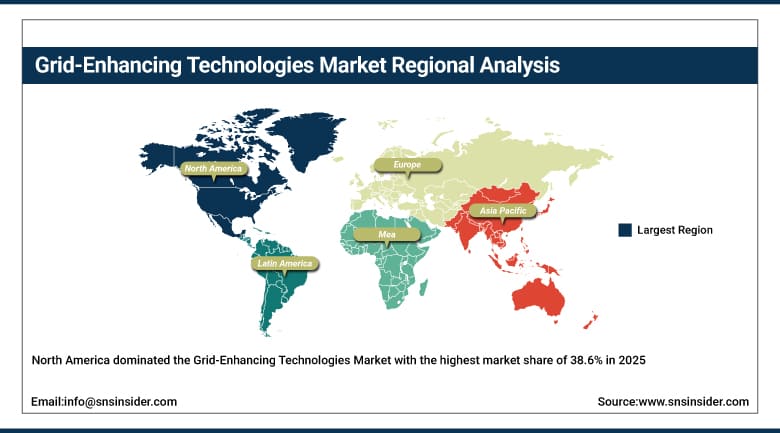
North America dominated the Grid-Enhancing Technologies Market with the highest market share of 38.6% in 2025 because of early regulatory acceptance under FERC Order 1920 and Order 881, a long list of pipeline projects for wind and solar farms that await interconnection permission, and consistent grants by the Department of Energy for grid modernization trials. Utility projects that started on congested lines have since spread to be multi-technology, network-wide systems, thereby solidifying North America's leadership as the largest market addressable worldwide for hardware, software, and consulting services.
The U.S. is the largest country in the region owing to its large aging transmission network, backlog of interconnections, and active participation from vendors, such as Smart Wires and LineVision. Canada provided a relatively small yet growing share of the market owing to its provinces deploying Grid-Enhancing Technologies to facilitate renewable energy trading with the northeastern states of the U.S.
Get Customized Report as Per Your Business Requirement - Enquiry Now
Europe Grid-Enhancing Technologies Market Insights
Europe represented a significant share of the Grid-Enhancing Technologies Market due to the region's ambitious renewable energy targets as part of the EU Green Deal and REPowerEU initiatives, and regulatory push from transmission systems operators in each country towards postponing investment in expensive line construction. The increase in capacity for offshore wind in the North Sea region, coupled with interconnector congestion, has only made utilities more inclined to adopt grid enhancement technologies in Europe's aging high-voltage grid network.
Germany was the leading country within Europe in terms of revenue, aided by the northern wind corridors of Germany and the ongoing efforts of the government to expand grid capacity in the absence of overhead line permitting issues. Other countries that significantly participated included the UK and the Nordic nations, where National Grid ESO and various Nordic transmission operators had grid enhancing technology initiatives.
Asia Pacific Grid-Enhancing Technologies Market Insights
The Asia-Pacific region is forecasted to be the fastest growing regional segment in the Grid-Enhancing Technologies Market, registering a CAGR of approximately 18.6% due to rapid investments in grid upgrades, substantial capacity addition from both wind and solar energy plants, and smart grid initiatives in China, Japan, and South Korea. Increased demand for power transmission and renewable energy targets set by government authorities ensured that this region outpaced all others in terms of growth.
China is the largest country in the region, owing to its high investments in grid technology and capacity addition from wind and solar resources. NARI Technology is providing grid monitoring and optimizing systems for State Grid Corporation's projects in China. Japan and South Korea have made substantial contributions, with Toshiba Corporation helping in deploying grid monitoring systems for utility companies and Korean transmission system operators experimenting with grid-enhancing technologies.
MEA and Latin America Grid-Enhancing Technologies Market Insights
The Middle East & Africa and Latin America both witnessed constant growth in the Grid-Enhancing Technologies market due to an increase in the number of renewable energy projects, investments in the development of grids and cooperation between local utilities and foreign suppliers of grid-enhancing technologies. The need for verification of real-time capacity became a realistic one for utilities in these regions, where conservative static approach to the grid development has been traditionally used.
Saudi Arabia is the largest market among MEA countries due to the large-scale development of renewable energy projects within Vision 2030 project as well as continuous development of transmission grids of Saudi Electricity Company. Brazil is the largest revenue market in Latin America, which is facilitated by developed transmission system of hydroelectric power plants and increasing capacity of wind farms in northeastern regions.
Market Dynamics:
Growth Drivers: Rising Transmission Congestion and Regulatory Recognition of Faster Capacity Relief
The market is being driven by increasing transmission congestion in aged grid corridors, interconnection queues lasting multiple years in length for wind and solar installations, and increased regulatory acknowledgement under FERC Order 1920 and similar frameworks to mandate that transmission planners analyze grid enhancing technologies prior to making new line investments. For utilities experiencing increasing electrification demand from data centers, electric vehicles, and industrial reshoring, grid enhancing technologies provide an approach that is materially quicker and cheaper than new line investments.
Collaboration between transmission companies and grid enhancing technology suppliers adds to the trend, as utilities are increasingly deploying multiple grid enhancing technologies on a network basis following successful corridor-based pilots. Increasing venture and corporate investments into sensors, power flow control hardware, and grid analysis software solutions are also contributing to expanding vendor capabilities, driving continued demand expansion through the forecast period.
Restraints: Integration Complexity and Utility Risk-Aversion to Active Grid Control
The challenge of integrating with existing legacy SCADA and EMS systems is an actual limitation on the rate of market expansion, as most utility providers have decades old control room infrastructures that were not built with the ability to handle constant flow of sensor telemetry data, or the inclusion of real-time control devices. This has contributed to the prolongation of timelines from pilot stage to the roll out phase, as the integration between IT and OT can often be more expensive than the hardware itself.
Utility hesitation in controlling their transmission assets with active devices poses another barrier, as utility providers need to be certain about the reliability and security of the devices before they allow the flow of power in these areas. Overcoming this challenge will require continuous investments in terms of validation and cybersecurity, and the necessary training for the operators.
Opportunities: AI-Driven Grid Optimization and Expanding Data Center Interconnection Demand
The increasing investment in software solutions that use AI to optimize the grid holds real potential, since the providers are moving beyond mere monitoring to using machine learning models based on sensor data, weather forecasts, and topological information to determine how best to route electrical flows in almost real time. The winners in terms of model accuracy will disproportionately benefit from their success as the market evolves past just selling sensors.
Another major opportunity centers around the rise in power needs of data centers as hyperscale companies and grid-interfaced industrial customers look for direct visibility into capacity and fast interconnects along the corridors feeding into their installations. Technology providers capable of offering quick-deployed, interconnect-ready grid enhancement packages suited to large load customers can capitalize on these sources of income outside of traditional utility transmission agreements.
Recent Developments:
-
2026: Dynamic Line Rating has been adopted by Vattenfall R&D and Heimdall Power to enhance the real-time monitoring of transmission lines and the use of the available grid capacity.
-
2026: Nexans announced a groundbreaking CORECHECK solution for validating 380 kV grids for the first time in the world, contributing to advancements in real-time monitoring and diagnosis of high voltage transmission systems.
-
2026: LineVision, Inc. launched its LV-Series sensor platform with integrated AI-based ampacity forecasting, giving utilities combined real-time and day-ahead capacity visibility from a single deployed device.
Grid-Enhancing Technologies Market key players are:
-
Smart Wires Inc.
-
LineVision, Inc.
-
Ampacimon SA
-
GE Vernova
-
Siemens Energy AG
-
Hitachi Energy Ltd
-
ABB Ltd
-
Schneider Electric SE
-
Heimdall Power AS
-
Nexans S.A.
-
Prysmian Group
-
CTC Global Corporation
-
Southwire Company, LLC
-
Emerson Electric Co.
-
Landis+Gyr Group AG
-
NARI Technology Co., Ltd.
-
Toshiba Corporation
-
Valmont Industries, Inc.
-
Lindsey Manufacturing Company
-
Sentient Energy, Inc.
Grid-Enhancing Technologies Market Report Scope:
| Report Attributes | Details |
|---|---|
| Market Size in 2025 | USD 3.25 Billion |
| Market Size by 2035 | USD 14.30 Billion |
| CAGR | 16.0% from 2026 to 2035 |
| Base Year | 2025 |
| Forecast Period | 2026-2035 |
| Historical Data | 2022-2024 |
| Report Scope & Coverage | Market Size, Segments Analysis, Competitive Landscape, Regional Analysis, DROC & SWOT Analysis, Forecast Outlook |
| Key Segments |
|
| Regional Analysis/Coverage | North America (US, Canada), Europe (Germany, UK, France, Italy, Spain, Russia, Poland, Rest of Europe), Asia Pacific (China, India, Japan, South Korea, Australia, ASEAN Countries, Rest of Asia Pacific), Middle East & Africa (UAE, Saudi Arabia, Qatar, South Africa, Rest of Middle East & Africa), Latin America (Brazil, Argentina, Mexico, Colombia, Rest of Latin America). |
| Company Profiles | Smart Wires Inc., LineVision, Inc., Ampacimon SA, GE Vernova, Siemens Energy AG, Hitachi Energy Ltd, ABB Ltd, Schneider Electric SE, Heimdall Power AS, Nexans S.A., Prysmian Group, CTC Global Corporation, Southwire Company, LLC, Emerson Electric Co., Landis+Gyr Group AG, NARI Technology Co., Ltd., Toshiba Corporation, Valmont Industries, Inc., Lindsey Manufacturing Company, and Sentient Energy, Inc. |

Frequently Asked Questions
Key players include Smart Wires Inc., LineVision, Inc., Ampacimon SA, GE Vernova, and Siemens Energy AG, among others.
Key opportunities include accelerating grid modernization, rising renewable energy integration, transmission congestion management, increasing electricity demand, and deployment of advanced technologies to maximize existing grid capacity.
The major growth factor is rising transmission congestion, expanding renewable interconnection backlogs, and growing regulatory recognition under frameworks such as FERC Order 1920 that push utilities to evaluate grid-enhancing technologies before new line construction.
The Dynamic Line Rating segment dominated the Grid-Enhancing Technologies Market by technology, representing the largest share of revenue in 2025.
North America dominated the Grid-Enhancing Technologies Market in 2025, holding an estimated 38.6% share of total global market revenue.
