
Grid Forming Inverter Market Report Scope and Overview:
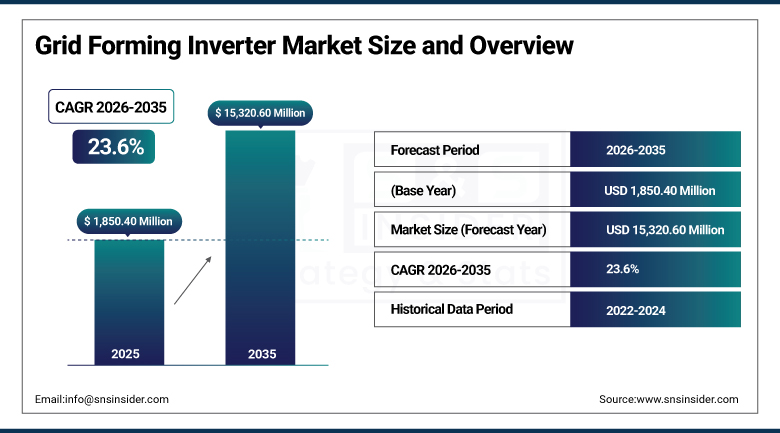
The Grid Forming Inverter Market size was valued at USD 1,850.40 Million in 2025 and is projected to reach USD 15,320.60 Million by 2035, registering a CAGR of 23.6% from 2026 to 2035.
The Grid Forming Inverter Market is transforming the way power systems achieve stability in the face of high penetration of renewable energy sources and phase out of traditional synchronous generation. The market growth is driven by increased utility demands for synthetic inertia and black start capabilities, increased usage of grid forming conversion systems in utility battery energy storage facilities, integration of grid forming control technologies in solar PV and offshore wind farms, and increasing requirements from national grid codes on inverter-based resources to mimic synchronous generators. Indeed, there has been a noticeable increase in technology partnership deals, production investments and grid services contracts since the utilities and independent power producers together with inverter makers have invested in the installation of grid forming hardware.
In 2026, SMA Solar Technology launched its Stability Enhanced DC Coupled Hybrid Solution, integrating the grid-forming Sunny Central Storage UP-S battery inverter, at Intersolar Europe 2026, reinforcing accelerating commercial momentum behind grid-forming battery storage deployment.
To Get more information On Grid Forming Inverter Market - Request Free Sample Report
Grid Forming Inverter Market Trends
-
Expanding utility mandates for synthetic inertia and black-start capability continue accelerating grid-forming inverter deployment across renewable-heavy grids.
-
Growing integration of grid-forming controls into utility-scale battery energy storage systems continues strengthening grid-service revenue opportunities.
-
Rising strategic technology partnerships between inverter manufacturers and utility-scale developers continue expanding global grid-forming product portfolios.
-
Increasing national grid code reforms in the UK, Australia, and the U.S. continue accelerating formal grid-forming interconnection requirements.
-
Growing deployment of grid-forming power conversion systems in offshore wind and solar PV projects continues broadening addressable applications.
U.S. Grid Forming Inverter Market Size Outlook
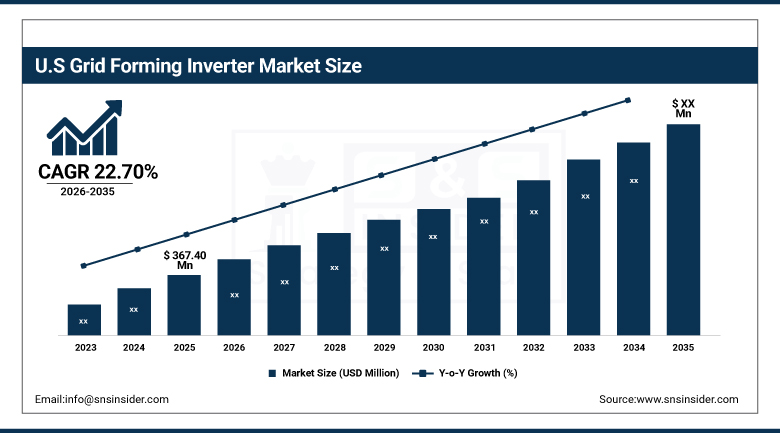
The U.S. Grid Forming Inverter Market was valued at approximately USD 367.40 Million in 2025 and is projected to grow at a CAGR of approximately 22.70% from 2026 to 2035.
The growth in the U.S. market is driven by rising interconnection of renewables and changing standards in grid reliability. The demand in America was largely impacted by the rise in utility-scale energy storage systems installations, declining system inertia due to the closure of coal and gas plants, and the emergence of grid-forming interconnection framework for the United States. The rising number of pilot and commercial scale grid-forming energy storage systems projects in the ERCOT, CAISO, and other regions has enabled the U.S. to maintain its importance as a major center for the deployment of grid-forming inverters.
In 2026, GE Vernova and Siemens Energy both expanded investment in inverter-based resource technologies to help U.S. transmission operators integrate rising shares of wind and solar generation while preserving grid stability
Grid Forming Inverter Market Segment Analysis
-
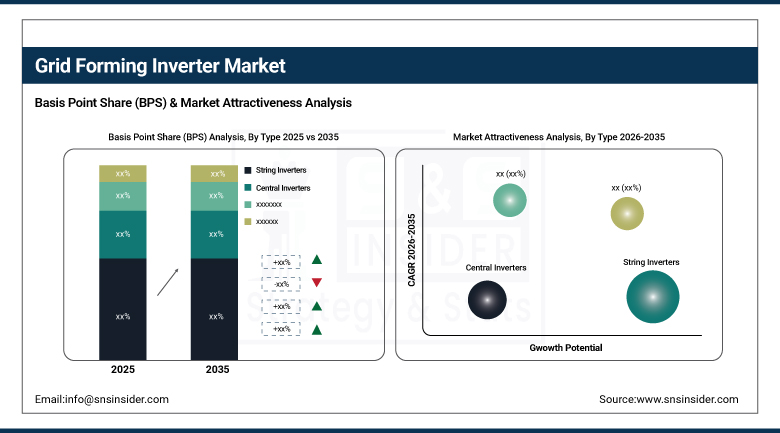
By Type, String Inverters segment dominated the Grid Forming Inverter Market in 2025 with 46.1% share; Central Inverters segment is the fastest growing segment, registering a CAGR of 25.1% from 2026 to 2035.
-
By Power Rating, Above 100 kW segment dominated the market in 2025 with 52% share; Below 50 kW segment is the fastest growing segment, registering a CAGR of 24.8% from 2026 to 2035.
-
By Application, Utility-Scale Renewable Integration segment dominated the market in 2025 with 58% share; Microgrids & Distributed Energy Systems segment is the fastest growing segment, registering a CAGR of 25.4% from 2026 to 2035.
-
By End User, Utilities segment dominated the market in 2025 with 61% share; Commercial & Industrial segment is the fastest growing segment, registering a CAGR of 24.9% from 2026 to 2035.
By Type, String Inverters Lead While Central Inverters Grows Fastest
String Inverters accounted for the leading share of the Grid Forming Inverter Market in String Inverters constituted the largest market share of the Grid Forming Inverter Market in 2025, owing to their modularity, reduced unit cost, and successful experience in distributed solar PV systems and small to mid-sized battery storage systems. The incremental deployment of these inverters across several strings has allowed developers to scale up their grid-forming capabilities without investing in large central hardware units. Reliable supply chains, extensive availability of string inverters from major manufacturers such as Sungrow, Huawei, and SolarEdge, and the increasing development of grid-forming capabilities at the firmware level on these string inverters have helped solidify their leadership in the commercial space.
Central Inverters are expected to be the fastest-growing type segment of the Grid Forming Inverter Market, owing to the suitability of these inverters for gigawatt-scale utility storage systems and renewable integration systems. The major developers in this space include GE Vernova, Siemens Energy, and Hitachi Energy, which are developing centralized power conversion systems with grid-forming capability to provide synthetic inertia and black-start services at large interconnection points. The increasing preference among utilities for centralized solutions due to easy grid code compliance testing and fewer certified units per project has aided growth.
By Power Rating, Above 100 kW Dominates as Below 50 kW Grows Fastest
Above 100 kW power rating was the leading segment in the Grid Forming Inverter market in 2025 due to the predominance of grid forming needs in utility scale solar, wind, and battery storage where large capacity power conversion systems are needed to provide valuable contributions to grid services. The investment in the large scale of gigawatts worth of renewables by utilities and IPPs favors the use of high-capacity grid forming inverter to meet the requirements of upcoming interconnection standards while at the same time delivering maximum synthetic inertia and reactive power support per installed megawatt.
Below 50 kW power rating segment is forecasted to experience the highest growth rate in the Grid Forming Inverter Market due to the incorporation of grid forming ability in microgrid, commercial roof top solar, and residential battery storage. Following the increase in behind the meter energy resilience need after severe weather conditions, along with the incentives given to microgrids and community microgrids, the small capacity grid forming inverters are seeing an increase in adoption rate. Companies like Enphase Energy and SolarEdge are adding grid forming capabilities in their small capacity product line.
By Application: Utility-Scale Renewable Integration Leads, Microgrids Grows Fastest
The Utility-Scale Renewable Integration was the largest contributor in terms of application shares to the Grid Forming Inverter Market in 2025, supported by rapidly increasing solar PV and wind power installations that require grid forming functionality to ensure stability as conventional synchronous power generation fades. Grid formers are increasingly becoming mandatory to ensure the stability of grid systems due to the retirement of synchronous generation, prompting the grid operators in Australia, the UK, and several states of the U.S. to come up with formal technical requirements for synthetic inertia and voltage regulation in any new utility scale renewable interconnections.
Microgrids and distributed energy systems are the fastest-growing applications in the Grid Forming Inverter Market, spurred by increased spending on community resilience projects, campus and industry microgrids, as well as remote/isolated grid electrification schemes which rely on grid forming inverters to create a stable reference frequency and voltage in the absence of connection to the primary transmission grid. The increasing number of outages triggered by severe weather conditions coupled with the reduced cost of battery storage systems has been boosting the adoption rate of microgrids in developing as well as developed economies.
By End User: Utilities Dominate, Commercial & Industrial Grows Fastest
Utilities held the majority market share of the Grid Forming Inverter Market in 2025, considering their critical importance in acquiring and maintaining the large renewable and battery storage infrastructure necessary to maintain grid stability amid a shrinking supply of traditional energy production. Utilities bear direct responsibility for meeting any new grid code regulations and increasingly require the ability to perform grid forming functions as a component of new interconnection contracts and storage procurement processes, further cementing the importance of this end user segment in leading market growth in both mature and emerging power markets.
The Commercial & Industrial end user segment is anticipated to experience the highest growth rate in the Grid Forming Inverter Market based on the increasing installation of battery storage and microgrids by businesses in order to control costs and provide continuous power during times of electricity price volatility. Large data centers, manufacturing plants, and industrial commercial campuses have adopted the use of grid forming inverters as part of a strategy to operate in an islanded mode during grid disturbances.
Regional Analysis:
|
Region |
Major Country |
Share within Region, 2025 (%) |
|---|---|---|
|
North America |
United States |
82.40% |
|
Europe |
Germany |
23.80% |
|
Asia Pacific |
China |
41.30% |
|
Middle East and Africa |
Saudi Arabia |
29.40% |
|
Latin America |
Brazil |
34.70% |
North America Grid Forming Inverter Market Insights
North America occupied a considerable market share in the Global Grid Forming Inverter Market in 2025, driven by increasing instances of interconnection activities of renewable energy, increased demand for battery storage, and growing focus of grid operators in regulating performance of inverter-based resources.
The U.S. occupied the highest market share of revenue in North America owing to increasing investments in battery storage projects by utilities along with grid forming interconnection standards being developed by regional grid operators.
Get Customized Report as per Your Business Requirement - Enquiry Now
Europe Grid Forming Inverter Market Insights
Europe Grid Forming Inverters Market is expected to experience the fastest growth rate (CAGR) of 26.80% among all regions in Europe from 2026 to 2035 due to the high renewable energy targets, quick decommissioning of synchronous coal and gas plants, and grid-forming interconnection mandates set by transmission companies in order to compensate for loss of inertia. The increase in the number of projects for offshore wind farms and battery storage installations in Europe has made it the fastest growing region in the grid forming inverter market.
The leading market was Germany with SMA Solar Technology as the major developer of grid forming products due to ambitious capacity targets. The United Kingdom contributed greatly to the regional growth due to the Stability Pathfinder agreements signed by National Grid that reward provision of the grid-forming service. Other countries in Western Europe developed their offshore wind and battery storage projects with grid-forming interconnection needs.
Asia Pacific Grid Forming Inverter Market Insights
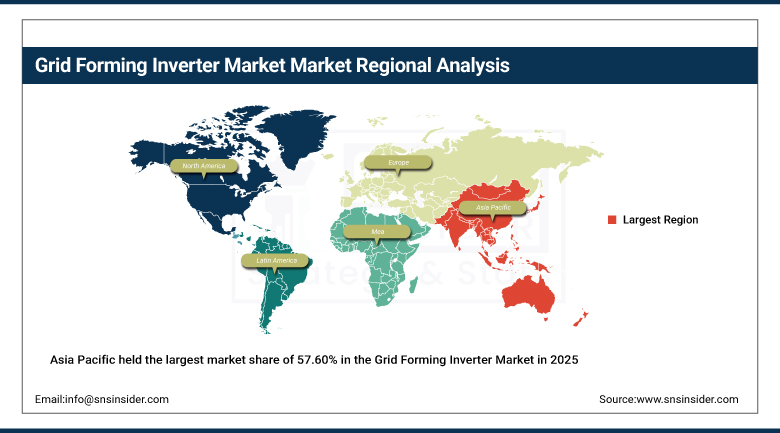
Asia Pacific held the largest market share of 57.60% in the Grid Forming Inverter Market in 2025, fueled by the significant additions in solar and wind energy capacity at utility scale in the region, the setting of ambitious renewable energy goals, and the presence of top players in the form of Sungrow, Huawei, and NingBo Deye Inverter Technology. The large-scale grid upgrading projects carried out in China and India along with the growing focus of national policies on grid stability amid phasing out of coal-fired electricity generation by renewable energy sources have further enhanced Asia Pacific's dominance in manufacturing and deployment of grid forming inverters.
China had a highest revenue share in Asia Pacific owing to massive construction of renewable energy and battery energy storage capacity at utility scale along with production capability of grid forming inverters. India, Japan, and South Korea have contributed more to the region's demand via growth in solar park construction, offshore wind energy investments, and grid forming interconnectivity frameworks.
MEA and Latin America Grid Forming Inverter Market Insights
The Middle East & Africa and Latin America exhibited strong growth rates driven by massive investment in renewables projects, modernization of grids, and increasing collaboration between utilities and inverter makers in regional grid stability projects.
Saudi Arabia emerged as the dominant country in the Middle East & Africa region, driven by large scale renewable energy megaproject investments, whereas Brazil led Latin America with highest market share.
Market Dynamics:
Growth Drivers: Accelerating Renewable Penetration and Formal Grid-Forming Interconnection Mandates
The market is being driven by a rapid penetration of renewable energy which is displacing traditional sources of synchronous generation and natural inertia in grids, growing recognition of the importance of grid-forming inverters as essential infrastructure as opposed to an add-on feature, and increased need for devices that provide synthetic inertia, black-start ability and voltage support amid grid disturbances. With more and more transmission providers developing standards for grid-forming inverters, project developers within solar, wind and battery storage space specify grid-forming solutions as a basic requirement for utility-scale projects.
Grid-services based revenue opportunities, such as Stability Pathfinder deals in the UK and system integrity protection mechanisms in Australia lend even more strength to this trend and offer additional financial motivation for grid-forming inverters beyond pure energy production. Increased government spending on grid modernization and emerging cooperation between utilities and inverter companies is also fueling commercial deployment of grid-forming inverters, thus all these trends altogether continue to strengthen investors' and utilities' interest in the Grid Forming Inverter Market.
Restraints: High Equipment Costs and Fragmented Regional Grid Code Standards
The grid-forming inverters are more expensive than their grid-following counterparts, by an average of 10% to 25% more upfront costs, is one major restraint on the growth of this market segment, especially smaller-scale projects operating with limited capital budgets. This price premium, which would take time before becoming standard for markets that don't require grid-forming capability from interconnection standards, is likely to slow down the market adoption of these technologies until markets have policy mandates or clear incentives for providing grid services are available.
Another factor to consider is the fragmented grid code standards in different regions, which increases the time to market because the products need to be engineered and certified according to these standards, which vary by country and even among different transmission operators. International harmonization of grid-forming performance standards is yet to be achieved.
Opportunities: Offshore Wind Integration and Emerging Grid-Service Revenue Markets
The expansion of grid-forming inverter use into offshore wind energy installations provides a great opportunity, considering that the lengthy sub-sea cabling and weak grid environment around far-off interconnection points make offshore wind plants more dependent on grid-forming ability for reliable operations. Manufacturers that are able to showcase their grid-forming capabilities in the difficult offshore setting can gain an important first-mover advantage as the offshore wind capacity around the world continues to grow in Europe and the Asia Pacific regions.
Development of grid-service revenue markets, inspired by the Stability Pathfinder project of the UK, presents another opportunity in the area, since utilities and IPPs that are quick to adopt grid-forming technologies will have an edge when it comes to securing premium revenues as other grid operators follow the same path. Companies that are quick to ramp up production and regional certification of the grid-forming equipment will be well-placed to gain significant market share once the grid-forming technology shifts from emerging to standard grid-interconnect requirements.
Recent Developments:
-
2026: Hitachi Energy continued advancing grid-forming technologies and inverter-based solutions designed to provide grid stability services as renewable penetration increases.
-
2026: Sungrow Power Supply demonstrated black-start capable grid-forming power conversion systems across gigawatt-scale utility battery storage deployments.
-
2026: Wartsila integrated grid-forming inverter capability into its GridSolv Quantum energy storage platform for utility-scale deployment.
Grid Forming Inverter Companies are:
-
Siemens Energy AG
-
Schneider Electric SE
-
Mitsubishi Electric Corporation
-
ABB Ltd
-
Sungrow Power Supply Co., Ltd.
-
Ingeteam S.A.
-
Fronius International GmbH
-
SMA Solar Technology AG
-
Hitachi Energy Ltd
-
Toshiba Corporation
-
TMEIC Corporation
-
Enphase Energy, Inc.
-
NingBo Deye Inverter Technology Co., Ltd.
-
SolarEdge Technologies, Inc.
-
Huawei Technologies Co., Ltd.
-
Delta Electronics, Inc.
-
Eaton Corporation plc
-
Emerson Electric Co.
Grid Forming Inverter Market Report Scope:
| Report Attributes | Details |
|---|---|
| Market Size in 2025 | USD 1,850.40 Million |
| Market Size by 2035 | USD 15,320.60 Million |
| CAGR | CAGR of 23.6% from 2026 to 2035 |
| Base Year | 2025 |
| Forecast Period | 2026-2035 |
| Historical Data | 2022-2024 |
| Report Scope & Coverage | Market Size, Segments Analysis, Competitive Landscape, Regional Analysis, DROC & SWOT Analysis, Forecast Outlook |
| Key Segments | • By Type (String Inverters, Central Inverters, Micro Inverters) • By Power Rating (Above 100 kW, Below 50 kW, 50-100 kW) • By Application (Utility-Scale Renewable Integration, Microgrids & Distributed Energy Systems, Battery Energy Storage Systems) • By End User (Utilities, Commercial & Industrial, Residential) |
| Regional Analysis/Coverage | North America (US, Canada), Europe (Germany, UK, France, Italy, Spain, Russia, Poland, Rest of Europe), Asia Pacific (China, India, Japan, South Korea, Australia, ASEAN Countries, Rest of Asia Pacific), Middle East & Africa (UAE, Saudi Arabia, Qatar, South Africa, Rest of Middle East & Africa), Latin America (Brazil, Argentina, Mexico, Colombia, Rest of Latin America). |
| Company Profiles | Siemens Energy AG, GE Vernova, Schneider Electric SE, Mitsubishi Electric Corporation, ABB Ltd, Sungrow Power, Supply Co., Ltd., Power Electronics S.L., Ingeteam S.A., Fronius International GmbH, SMA Solar Technology AG, Hitachi Energy Ltd, Toshiba Corporation, TMEIC Corporation, Enphase Energy, Inc., NingBo Deye Inverter Technology Co., Ltd., SolarEdge Technologies, Inc., Huawei Technologies Co., Ltd., Delta Electronics, Inc., Eaton Corporation plc, Emerson Electric Co. |

Frequently Asked Questions
Key palyers include Siemens Energy AG, GE Vernova, Schneider Electric SE, Mitsubishi Electric Corporation, and ABB Ltd, among others.
Key opportunities include increasing renewable energy integration, rising grid modernization investments, growing battery storage deployment, and expanding demand for resilient and stable power systems.
The major growth factor is accelerating renewable energy penetration displacing conventional synchronous generation, combined with rising utility mandates for synthetic inertia and black-start capability from new interconnections.
The String Inverters segment dominated the Grid Forming Inverter Market by type, representing the largest share of revenue in 2025.
Asia Pacific dominated the Grid Forming Inverter Market in 2025, holding an estimated 57.60% share of total global market revenue.
