
Smart Grid Sensors Market Report Scope and Overview:
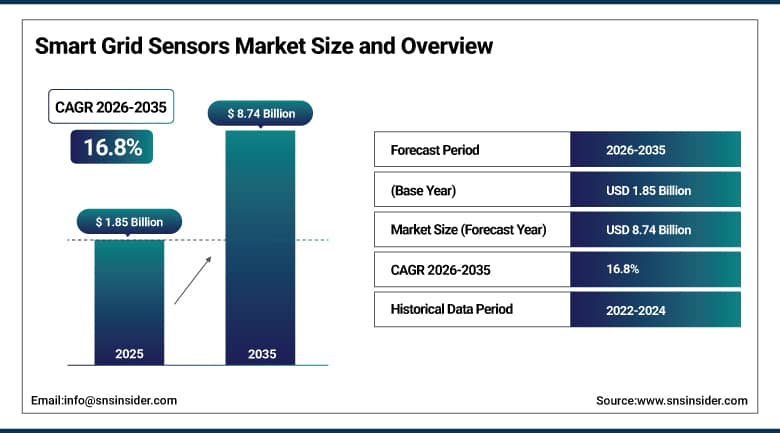
The Smart Grid Sensors Market size was valued at USD 1.85 Billion in 2025 and is projected to reach USD 8.74 Billion by 2035, registering a CAGR of 16.8% from 2026 to 2035.
The Smart Grid Sensors Market is revolutionizing the future of grid monitoring through the incorporation of voltage, current, temperature, and vibration sensors to detect any grid malfunctions. The market is characterized by the increase in the need for predictive maintenance analytics among utilities, the rise in the installation of wireless and IoT-based sensors, increase in pole-mounted structural monitoring capabilities, and its application in outage detection, renewable energy integration, and smart metering applications.
In August 2026, Hitachi Energy added more products to its EconiQ SF₆-free high voltage family with 245 kV and 420 kV circuit breaker innovations. The product upgrades facilitate grid infrastructure that is digitalized and resilient as well as complementing the condition monitoring technology.
To Get More Information On Smart Grid Sensors Market - Request Free Sample Report
Smart Grid Sensors Market Trends
-
Expanding pole-mounted vibration and structural monitoring deployment continues improving wildfire and storm-related fault detection.
-
Growing integration of AI-based distribution management platforms continues accelerating real-time sensor data utilization.
-
Rising utility investment in advanced metering infrastructure continues expanding the addressable base for grid-edge sensing devices.
-
Increasing rooftop solar and distributed generation penetration continues strengthening demand for bi-directional flow monitoring sensors.
-
Growing adoption of 5G and edge analytics continues reducing latency and bandwidth costs for wireless grid sensor networks.
U.S. Smart Grid Sensors Market Size Outlook
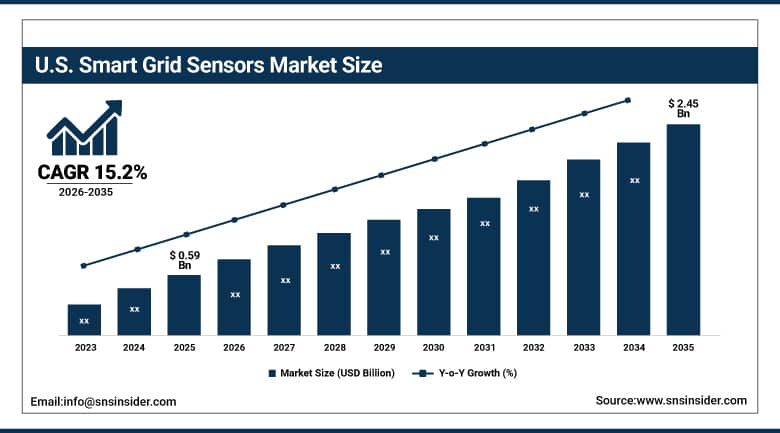
The U.S. Smart Grid Sensors Market was valued at approximately USD 0.59 Billion in 2025 and is projected to reach approximately USD 2.45 Billion by 2035, registering a CAGR of approximately 15.2% from 2026 to 2035.
The demand in the U.S. was also driven due to huge investment made in utility grid modernization, extensive development in sensor networks that provide resilience against wild fires and storms and high demand for predictive fault detection in aging distribution grids from utility companies. Deployment of pole-based sensor networks and adoption of distribution management platforms using AI across major utilities played an important role in enhancing the status of the U.S. as the largest market for smart grid sensors worldwide. In addition to this, applications of grid sensors in outage prevention, renewable energy management, and advanced metering infrastructure were supporting the high domestic demand for this monitoring technology.
In April 2026, Landis+Gyr after the divestment of its EMEA business, Landis+Gyr has shifted its strategic attention to the Americas region, especially software, services, and grid edge intelligence offerings. This makes it a strong player in the U.S. smart metering and grid sensing ecosystem.
Smart Grid Sensors Market Segment Analysis
-
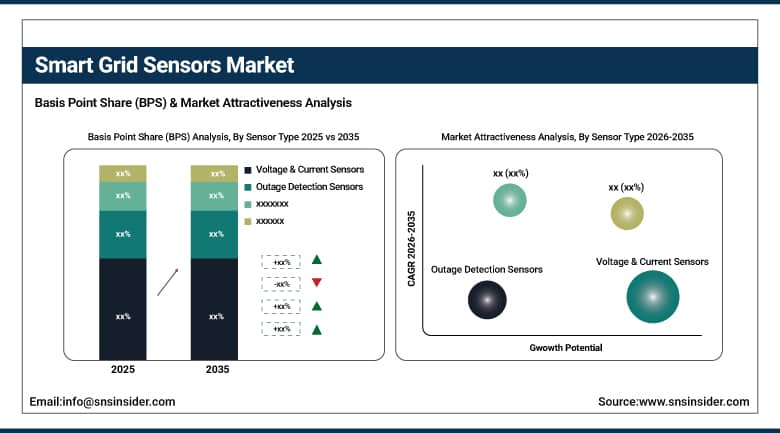
By Sensor Type, Voltage & Current Sensors segment dominated the Smart Grid Sensors Market in 2025 with 39% share; Outage Detection Sensors segment is the fastest growing segment, registering a CAGR of 18.9% from 2026 to 2035.
-
By Component, Sensors segment dominated the market in 2025 with 56% share; Software & Analytics segment is the fastest growing segment, registering a CAGR of 19.2% from 2026 to 2035.
-
By Application, Advanced Metering Infrastructure segment dominated the market in 2025 with 33% share; Distribution Automation segment is the fastest growing segment, registering a CAGR of 19.5% from 2026 to 2035.
-
By Connectivity, Wireless segment dominated the market in 2025 with 57% share; Wireless segment is also the fastest growing segment, registering a CAGR of 18.3% from 2026 to 2035.
-
By End User, Utilities segment dominated the market in 2025 with 61% share; Industrial segment is the fastest growing segment, registering a CAGR of 18.7% from 2026 to 2035.
By Sensor Type, Voltage & Current Sensors Lead, While Outage Detection Sensors Grow Fastest
Voltage & Current Sensors dominated the Smart Grid Sensors Market in 2025 due to their foundational role in the continuous monitoring of grid health, including at substations, transformers, and transmission lines. Voltage and current sensors have been used for many years by utilities to monitor for voltage variations and abnormal current readings that point to problems developing in the grid, making this sensor category one of the most firmly established within grid infrastructures currently in place. Continuous advancements from manufacturers, such as ABB and Siemens in terms of accuracy, miniaturization, and wireless capabilities in voltage and current sensors have further cemented this sensor category's primacy among all other types of sensors in grid modernization efforts.
Outage Detection Sensors are projected to experience the highest growth rate of all sensors within the Smart Grid Sensors Market as utilities begin to focus more and more on preventing failures rather than responding to outages. The pole-mounted grid surveillance sensors from Gridware which detect abnormal vibration and movement in order to deliver a notification in a few minutes after detecting a problem point to the continued growth of this sensor category in an area beyond electricity. Risk of wildfires and extreme weather conditions in North America is spurring the adoption of outage detection sensors by utilities.
By Component, Sensors Dominate, Software & Analytics Post Fastest Growth
Sensors have contributed the maximum share in terms of component in the Smart Grid Sensors Market in 2025 since the physical sensors constitute the core component that any grid monitoring project needs to start with before adding communications and analytics capability to it. The focus of utilities on the procurement of sensors in their modernization projects is the key reason behind the dominance of sensors in terms of revenues earned by the component across the value chain despite advancements in the software technology segment.
The Software & Analytics component of the Smart Grid Sensors Market is expected to record the highest growth rate over the forecast period as utilities are moving from basic data gathering to smart and predictive analytics that can trigger the response automatically without any human intervention. The GridOS for Distribution offering of GE Vernova is one such example where the combination of AI and advanced distribution management system capability helps utilities in managing grids as a single entity.
By Application, Advanced Metering Infrastructure Leads, Distribution Automation Grows Fastest
Advanced Metering Infrastructure was the biggest application segment in the Smart Grid Sensors Market in 2025, due to the extensive roll-out of smart meters that have sensing technology embedded within them at the point of consumption. This application segment is able to leverage already mature business models, regulation, and utility revenue models and is therefore the best funded application segment in terms of funding from grid modernization initiatives, making it the biggest money spinner among all sensors manufacturers in the world.
The Distribution Automation application segment is the fastest-growing application segment of the Smart Grid Sensors Market. It is experiencing increasing levels of complexity from distributed generation, two-way flow of electricity, and rooftop solar that the conventional distribution network is not equipped to deal with. The GridOS for Distribution initiative by GE Vernova for Alabama Power company, which relies on sensing technology to enhance reliability and reduce power outages, shows just how essential the concept of distribution automation has become.
By Connectivity, Wireless Sensors Dominate and Post the Fastest Growth
Wireless connectivity had a dominant market share in the Smart Grid Sensors Market in 2025 owing to its ability to significantly reduce installation cost and complexity compared to wired counterparts. The cost reduction in IoT hardware, improvements in battery efficiency, and convergence around standards, such as IEEE C37.118 and IEC 61850 have enabled wireless connectivity to become the preferred form of connectivity for utilities upgrading their existing grid network infrastructure by installing sensors without trenching and rewiring.
Wireless connectivity is also anticipated to become the fastest-growing segment within the Smart Grid Sensors Market. With more utility companies adopting 5G networks and edge computing analytics, the latency and bandwidth costs will continue to decrease while making the real-time transmission of sensor data much more efficient and viable. In North America, companies that will deploy tens of thousands of new sensors in the upcoming years will prefer a wireless architecture for scalability and reduced cost of ownership.
By End User, Utilities Dominate, Industrial Users Gain Fastest Traction
The utility segment dominated the share of the end-users of the Smart Grid Sensors Market in 2025 owing to the fact that grid operators have major concerns with regard to reliability and are also under the maximum regulatory pressure to upgrade the existing old infrastructure. The large-scale deployment of utility installations in North America and Europe signifies that the grid operators are integrating sensor technologies into their long-term planning in order to increase the reliability and resiliency and thus act as the key drivers in terms of the adoption of the smart grid sensors.
The Industrial Users are likely to emerge as the fastest-growing end-users of the Smart Grid Sensors Market owing to the fact that the manufacturers who use huge amounts of energy are now using grid sensing to manage their electrical loads and also for the avoidance of any unplanned downtimes due to the poor power quality. The growing trend of electrifying the processes and using on-site renewable energy sources is the reason why this end-user segment is growing faster than others.
Regional Analysis:
|
Region |
Major Country |
Share within Region, 2025 (%) |
|---|---|---|
|
North America |
United States |
83.60% |
|
Europe |
Germany |
25.40% |
|
Asia Pacific |
China |
39.80% |
|
Middle East and Africa |
Saudi Arabia |
27.10% |
|
Latin America |
Brazil |
30.90% |
North America Smart Grid Sensors Market Insights
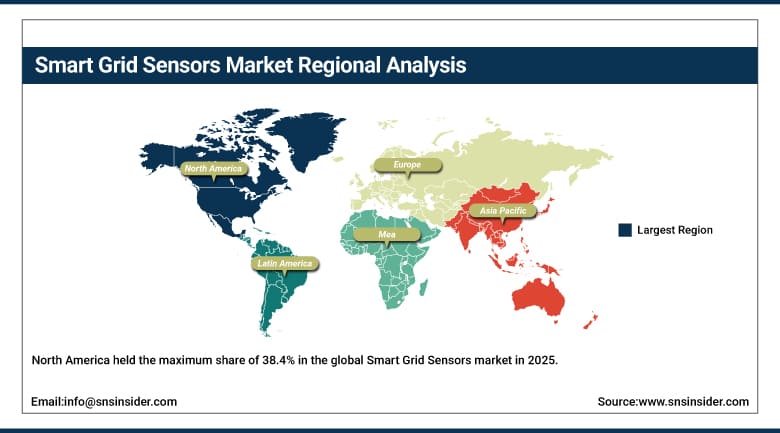
North America held the maximum share of 38.4% in the global Smart Grid Sensors market in 2025. The growth was driven by robust utility grid modernization spend, high spending on making grids resilient to both wildfire and storm events, along with the presence of several utilities investing in pole mounted and substation sensors in the region. The close collaboration between sensor manufacturing companies operating in the domestic environment and reliability plans of the utilities also helped the region maintain its dominance in the market.
The U.S. held largest share of the total revenue share of North America largely on account of strong presence and adoption of GE Vernova and Itron's domestic platforms along with Gridware's fast growing pole mounted sensor network in utilities exposed to storms. Expansion in grid modernization funding in Canada helped the region make substantial contributions towards the dominance of North America in the market.
Get Customized Report as Per Your Business Requirement - Enquiry Now
Europe Smart Grid Sensors Market Insights
Europe maintained a sustainable market share in the worldwide revenue of Smart Grid Sensors due to green deal ambitions, and significant investments made in continental interconnectors and increasing installations of intelligent monitoring sensors throughout both distribution and transmission grids. Increased adoption of interoperable protocols has also motivated utilities in Europe to invest in scalable vendor neutral sensing solutions, helping them secure their role as a regulatory leader for grid digitalization.
Germany had the largest market demand among European countries due to considerable investments in grid modernizations related to the country's Energiewende and presence of Siemens' manufacturing facilities for grid sensors within its boundaries. UK was another important country making a significant contribution to regional market demand through implementation of Siemens Smart Infrastructure's SICAM Enhanced Grid Sensor, which aims to increase visibility in distribution networks. Europe's increasing demand for smart grid sensors is expected to continue due to renewable energy integration efforts in the region.
Asia Pacific Smart Grid Sensors Market Insights
The Asia Pacific region is witnessing the highest rate of growth among all other regions covered in the market, registering a CAGR of approximately 18.9% from 2026 to 2035, due to the major investments in grid modernization projects in China and India, growing requirements of governments to incorporate renewable energy into the grids, and urbanization trends requiring high-precision load monitoring systems. The combined effects of the development of manufacturing capabilities for sensors and the rise in the demand for digitalization of the utility scale grid guaranteed the fact that this region saw the highest rate of growth in comparison to all other regions featured in this report.
The leading position belonged to China due to major investments in grid modernization and developing capacities of domestic manufacturers of sensors. Other key countries contributing to this outcome in this report include Japan due to grid sensor developments of Mitsubishi Electric and Toshiba and South Korea due to smart grid deployments.
MEA and Latin America Smart Grid Sensors Market Insights
The Middle East and Africa and Latin America both showed steady growth in the Smart Grid Sensors Market driven by increasing investment in grid infrastructure, government investment in electrification and modernization initiatives, and collaborations among local utility companies and international sensor manufacturers. It was becoming a necessity for the infrastructure initiatives being carried out in these regions to have real-time visibility of their grid networks since it was entirely dependent on manual inspections before.
In ME&A, Saudi Arabia was the largest country market for the market since it has an increasing grid infrastructure investment plan, along with an increasing focus on smart cities and renewable integration initiatives. Moreover, the ME&A region saw contributions from grid modernization projects being implemented in UAE. In LATAM, the largest revenue generating country was Brazil due to its large transmission grid network and demand for outage detection capacity.
Market Dynamics:
Growth Drivers: Rising Demand for Predictive Maintenance and Expanding Wireless Sensor Deployment
The market is propelling due to the growing utility demand for real-time grid visibility, greater deployment capabilities for wireless and IoT-connected sensors, greater investment in building resilience against wildfires and storms, and a growing range of use cases including outage prevention, renewable energy integration, and advanced metering infrastructure. With an increasing number of utilities announcing their plans for grid modernization and reliability improvement, the demand for accurate and low-latency sensor data will ensure that the capacity for deployments remains high across the supply chain.
The growing number of integrations between sensor suppliers and analytics vendors, together with growing commitment from utilities to gain unified AI-powered distribution management solutions ahead of future regulation regarding grid resilience reporting, provides further evidence in favor of this trend. Venture and utility capital injections to support the development of sensor networks are also contributing to the increase in baseline deployment capabilities, and all those factors combine into constantly increasing demand throughout the forecast period.
Restraints: Legacy Infrastructure Incompatibility and Cybersecurity Concerns
Incompatibility of legacy infrastructure continues to be an actual constraint for the faster development of the market because small utility companies have old control systems that were never meant to function alongside new technologies, including wireless sensor networks and analytics software. Such a situation has resulted in the most advanced implementation of the technology being carried out only by large and well-financed utility companies.
Security concerns continue to pose a problem as the use of the sensors in grid infrastructure increases the risk of an attack from a malicious actor trying to affect the delivery of power. The issue needs to be addressed through developing encrypted communication channels and anomaly detection, and it is an evolving process that requires substantial resources from both the utilities and the sensor manufacturing companies.
Opportunities: AI-Driven Distribution Automation and Wildfire Resilience Investment
The rise in investments into distribution automation with the help of AI becomes an important opportunity since utilities start committing to multiyear platform contracts where the whole system, consisting of sensor data, analytics, and automated actions, is created. Those manufacturers who can get early anchor customers for their products, such as GE Vernova with its partnership with Alabama Power through GridOS, will be able to occupy a significant market share when moving from individual sensor projects to full-fledged intelligent orchestration platforms.
Another major opportunity lies in the rise of the investment in wildfire and severe weather resilience since many utilities operating in areas that are prone to wildfires and severe weather invest in structural pole-mounted monitoring network systems that are aimed at detecting any faults before they cause fires and long-lasting power outages. The manufacturers who are capable of showing fast and effective fault detection will be able to obtain a significant market share.
Recent Developments:
-
2026: GE Vernova launched its GridOS for Distribution platform, unifying AI analytics and advanced distribution management system capabilities to help utilities orchestrate the distribution grid as one intelligent system, with early adopter Alabama Power using sensor data to improve reliability and reduce outages.
-
2026: Gridware raised USD 55 Million in Series B funding to expand its national pole-mounted sensor platform, which tracks structural vibrations and movement to detect grid faults and send alerts within minutes.
-
2026: New Energy Technologies from Schneider Electric Launched over 30 at Innovation Summit India 2026 The expansion in technology portfolio highlights the rising trend of incorporation of sensing, automation, analytics and digital technology into smart grid infrastructure.
Smart Grid Sensors Companies are:
-
ABB Ltd
-
Schneider Electric SE
-
GE Vernova Inc.
-
Honeywell International Inc.
-
Itron, Inc.
-
Landis+Gyr Group AG
-
Eaton Corporation plc
-
Mitsubishi Electric Corporation
-
Toshiba Corporation
-
Hitachi Energy Ltd.
-
Gridware, Inc.
-
GridSense Pty Ltd.
-
Emerson Electric Co.
-
Sensus (a Xylem brand)
-
S&C Electric Company
-
Trilliant Networks, Inc.
-
Awesense Wireless Inc.
-
Lindsey Manufacturing Company
Smart Grid Sensors Market Report Scope:
| Report Attributes | Details |
|---|---|
| Market Size in 2025 | USD 1.85 Billion |
| Market Size by 2035 | USD 8.74 Billion |
| CAGR | 16.8% from 2026 to 2035 |
| Base Year | 2025 |
| Forecast Period | 2026-2035 |
| Historical Data | 2022-2024 |
| Report Scope & Coverage | Market Size, Segments Analysis, Competitive Landscape, Regional Analysis, DROC & SWOT Analysis, Forecast Outlook |
| Key Segments |
|
| Regional Analysis/Coverage | North America (US, Canada), Europe (Germany, UK, France, Italy, Spain, Russia, Poland, Rest of Europe), Asia Pacific (China, India, Japan, South Korea, Australia, ASEAN Countries, Rest of Asia Pacific), Middle East & Africa (UAE, Saudi Arabia, Qatar, South Africa, Rest of Middle East & Africa), Latin America (Brazil, Argentina, Mexico, Colombia, Rest of Latin America). |
| Company Profiles | ABB Ltd, Siemens AG, Schneider Electric SE, GE Vernova Inc., Honeywell International Inc., Cisco Systems, Inc., Itron, Inc., Landis+Gyr Group AG, Eaton Corporation plc, Mitsubishi Electric Corporation, Toshiba Corporation, Hitachi Energy Ltd., Gridware, Inc., GridSense Pty Ltd., Emerson Electric Co., Sensus (a Xylem brand), S&C, Electric Company, Trilliant Networks, Inc., Awesense Wireless Inc., and Lindsey Manufacturing Company. |

Frequently Asked Questions
Key players include ABB Ltd, Siemens AG, Schneider Electric SE, GE Vernova Inc., and Honeywell International Inc., among others.
Key opportunities include accelerating grid modernization, increasing renewable energy integration, rising demand for real-time monitoring, predictive maintenance, and growing adoption of AI-enabled smart grid sensor technologies.
The major growth factor is rising demand for real-time grid visibility and predictive maintenance, expanding wireless and IoT-enabled sensor deployment, and growing wildfire and storm resilience investment by utilities.
The Voltage & Current Sensors segment dominated the Smart Grid Sensors Market by sensor type, representing the largest share of revenue in 2025.
