
Grignard Reagents Market Report Scope & Overview:
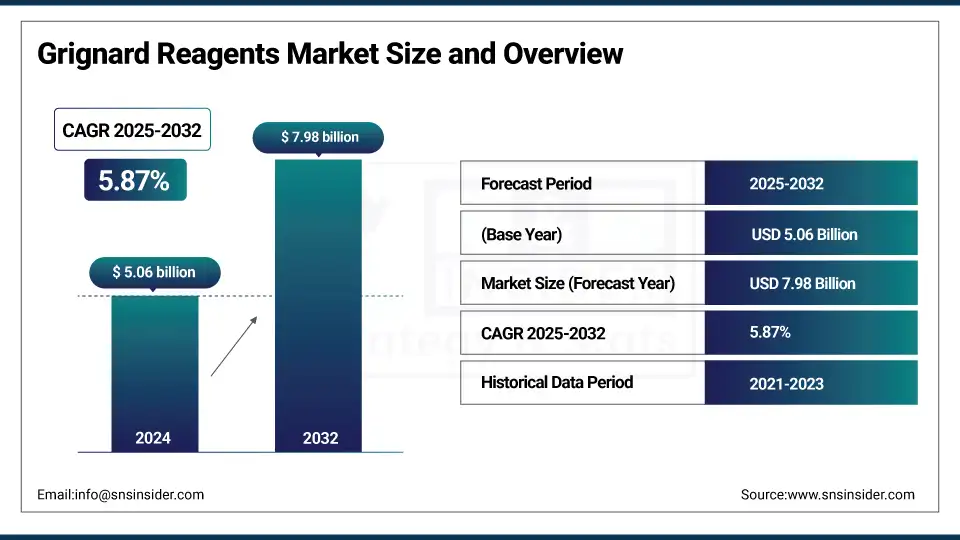
The Grignard Reagents market size was valued at USD 5.06 billion in 2024 and is expected to reach USD 7.98 billion by 2032, growing at a CAGR of 5.87% over the forecast period of 2025-2032.
The Grignard reagents market is witnessing strong momentum due to rising demand for complex molecule synthesis in pharmaceuticals and the agrochemicals market. Alkyl Grignard reagents are widely used in API manufacturing, while aryl Grignard reagents are gaining traction in fine chemical processes. Grignard reagents companies like Albemarle have introduced advanced “turbo grignard” formulations that enhance reaction efficiency. Grignard reagents market trends are shifting toward greener solvents like 2-methyltetrahydrofuran.
To Get more information On Grignard Reagents Market - Request Free Sample Report
The Grignard reagents industry is gaining strong momentum on account of increasing demand for complex molecule synthesis in the pharmaceuticals and agrochemical industries. Alkyl Grignard reagents are common in the preparation of APIs, and aryl Grignard reagents are becoming increasingly popular in fine chemicals synthesis. Firms such as Albemarle’s Grignard reagents business have also developed sophisticated “turbo grignard” reagents to improve the efficiency of ECRs. Current trends in Grignard Reagents Markets are changing their preference towards greener solvents, such as 2-methyltetrahydrofuran.
According to the U.S. Patent and Trademark Office, 120 patents related to Grignard breakthroughs were submitted, as reported by the U.S. Patent and Trademark Office. ECHA phenylmagnesium chloride registrations of more than 10t/y under REACH 2022. The Grignard reagents market growth is being driven by continuous-flow technologies, according to findings in ACS journals. These are the trends governing the Grignard reagents industry share in pharmaceuticals, research, and flavors & fragrances industries. These are key in the current Grignard reagents market trends and represent a dynamic and innovation-led Grignard reagents market size growth.
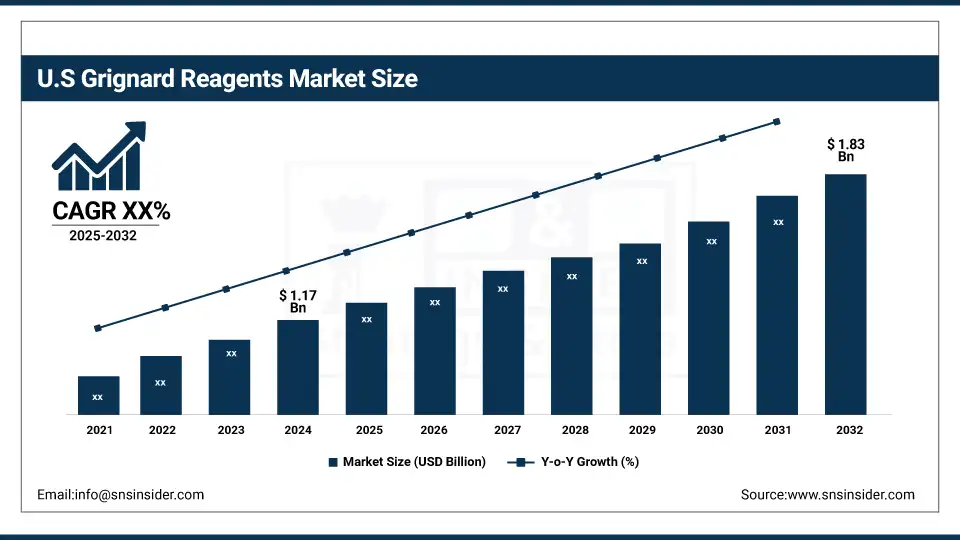
The U.S. dominates the North American Grignard reagents market with a market size of USD 1.17 billion and is projected to reach a value of USD 1.83 billion by 2032 with a market share of around 74%. The dominance is due to a robust pharmaceutical ecosystem, advanced production technologies, and consistent R&D funding. According to the National Institutes of Health (NIH), over $40 billion in biomedical research was funded in 2023, supporting strong academic–industry collaboration. Additionally, the U.S. FDA’s streamlined drug approval pathways increase demand for high-purity Grignard reagents in small-molecule synthesis. Companies like Millipore Sigma (Merck’s U.S. subsidiary) provide a range of customized Grignard reagents for research and large-scale manufacturing.
Market Dynamics:
Drivers:
-
Rising adoption of continuous-flow technology enhances the Grignard reagents market growth
The Grignard reagents industry is progressing with the incorporation of continuous-flow technology, enabling safer, scalable, and more efficient production. This is playing to sustainability and regulatory compliance and driving productivity in pharma and agrochem. The American Chemical Society (ACS) claims that Grignard synthesis in continuous flow is more selective and less wasteful. With the investment of the Grignard reagents companies in this innovation, such R&D effort significantly fortifies the Grignard reagents market size and share, primarily for alkyl Grignard reagents in advanced molecule development.
-
Innovations in the flavors & fragrances sector accelerate Grignard reagents market demand
Increasing research and development activities in the flavors & fragrances industry contribute toward the growth of the Grignard reagents market, and more specifically, towards that of aryl Grignard reagents. These are the agents to create the aromatic compounds responsible for smell and taste. According to the International Fragrance Association (IFRA), there is a hike in the demand for new molecules, which is augmenting the growth of the market for Grignard reagents. Organizations aim for high-purity formulations for safety and performance, which in turn enhances the Grignard reagents market potential through consumer-driven end uses.
Restraints:
-
Availability of safer alternatives restricts the Grignard reagents market growth in some applications
The increased significance of sustainable and much safer synthetic alternatives retards the market growth of Grignard reagents, in some of the applications. Cross-couplings such as Suzuki and Negishi provide similar advantages with better safety and scalability. The National Institute of Standards and Technology (NIST), these options are being used more often in pharmaceutical synthesis. This is leading to a reduced use of alkyl and aryl Grignard reagents and has implications for the application of Grignard reagents market for markets that prefer solutions must are environmentally friendly.
Segmentation Analysis:
By Product Type
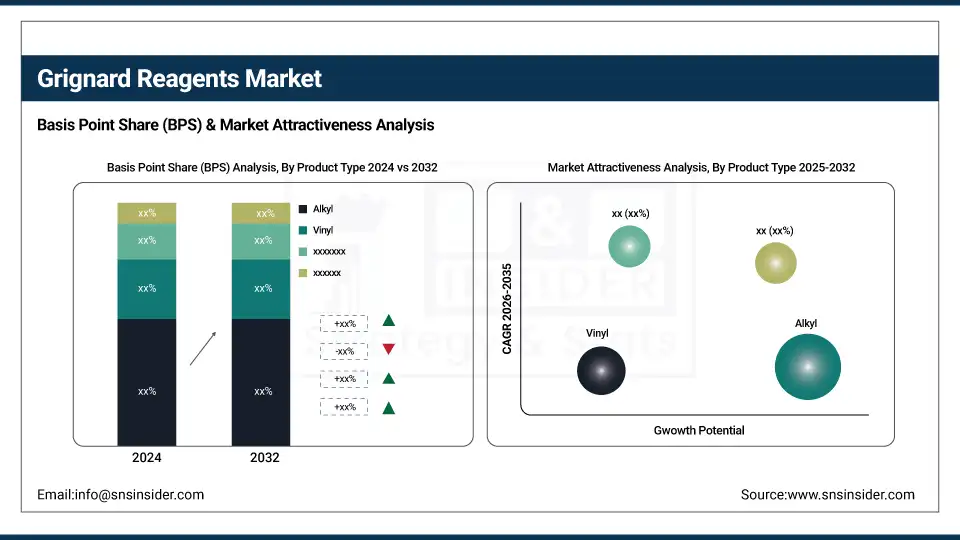
Alkyl grignard reagents dominated the grignard reagents market in 2024 with a 50.6% share, as it is widely used in pharmaceutical and fine chemicals synthesis. The nucleophilicity of these reagents is relatively strong for carbon–carbon bond formation. The US Environmental Protection Agency has encouraged programs to promote safer, more scalable chemical making, consistent with the greater use of alkyl grignards. Key Grignard reagents market players have adopted improved packaging to improve stability, which is expected to increase demand, thereby driving the Grignard reagents market size and overall market analysis.
Vinyl Grignard reagents are projected to be the fastest-growing segment from 2025 to 2032, with a CAGR of 6.4%. Their growing use in polymerization and functionalization, especially in specialty chemicals, is pushing the sector. Vinyl Grignard Compounds for Next Generation Materials Research. The American Chemical Society has reported on the employment of vinyl Grignard compounds. In addition to this, the insistence on the use of sustainable materials and performance coatings supports wider uptake. Such trends are influenced by the growing Grignard reagents market dynamics and are further supported by driving the sector towards sustained Grignard reagents market growth.
By Application
The active pharmaceutical ingredients and drugs emerged as the dominant application segment in the Grignard reagents market with a 53.2% market share in 2024. Alkyl and aryl reagents are key in the formation of drug intermediates in areas such as oncology and cardiovascular care. The US Food and Drug Administration has expedited the approval of small-molecule drugs developed through Grignard chemistry. Global pharmaceutical R&D activities are still increasing, which increases the demand. These factors develop the size of the Grignard reagents industry and its dominance in market research.
Polymer synthesis and functionalization is the fastest-growing application segment, with a CAGR of 6.45% during 2025–2032. Grignard reagents are commonly used for modifying polymers to enhance resistance, conductivity, or adhesion. Funding by the National Institutes of Health for drug delivery polymers made by Grignard-based chemistry has propelled demand. R&D spending by electronics, coatings, and bioplastics giants is also favoring the growth of the Grignard reagents market share. These factors contribute to high growth opportunities in polymer functionalization in the current Grignard reagents market scenario.
By End-Use Industry
In 2024, the pharmaceutical and biotechnology segment held a dominant 56.1% share of the Grignard reagents market. Grignard reagents have been widely used for drug discovery owing to the high requirement for API synthesis and biopharmaceutical intermediates. This dominance is reinforced by the continued funding of initiatives in organic synthesis technologies by the National Institutes of Health. Furthermore, Grignard reagents manufacturers are expanding manufacturing capabilities to cater to increasing pharmaceutical requirements. Such trends provide a positive outlook for the Grignard reagents market analysis in life sciences applications.
Agriculture is the fastest-growing end-use industry segment, with a CAGR of 6.54% from 2025 to 2032. The Grignard reagents are applied in the preparation of super-agrochemical intermediates that improve crop resilience and yield. The United States Department of Agriculture has also been encouraging sustainable farming and eco-friendly alternatives for bees. Rising R&D for bio-based crop protection solutions is playing a major role in the growth of the Grignard reagents market. These trends emphasize agriculture’s growing role in the Grignard reagents market trends and overall share growth.
-
Flavors & Fragrances Industry Contribution to Grignard Reagents Demand
|
Contribution Aspect |
Details |
|---|---|
|
Aromatic compound synthesis |
Aryl Grignard reagents are essential for producing complex aromatic intermediates used in high-value fragrance and flavor molecules. |
|
Novel molecule development |
Ongoing R&D in consumer-driven scent and taste profiles drives demand for custom Grignard reagents, enhancing product portfolios. |
|
High-purity requirements |
Regulatory bodies (e.g., U.S. FDA) require extremely pure reagents for flavor applications, bolstering demand for specialized Grignard reagent formulations. |
|
Sustainability trends |
Shift toward greener solvent use (e.g., 2-methyltetrahydrofuran) in fragrances aligns with eco-friendly manufacturing practices, promoting Grignard Reagents Market growth. |
Regional Analysis:
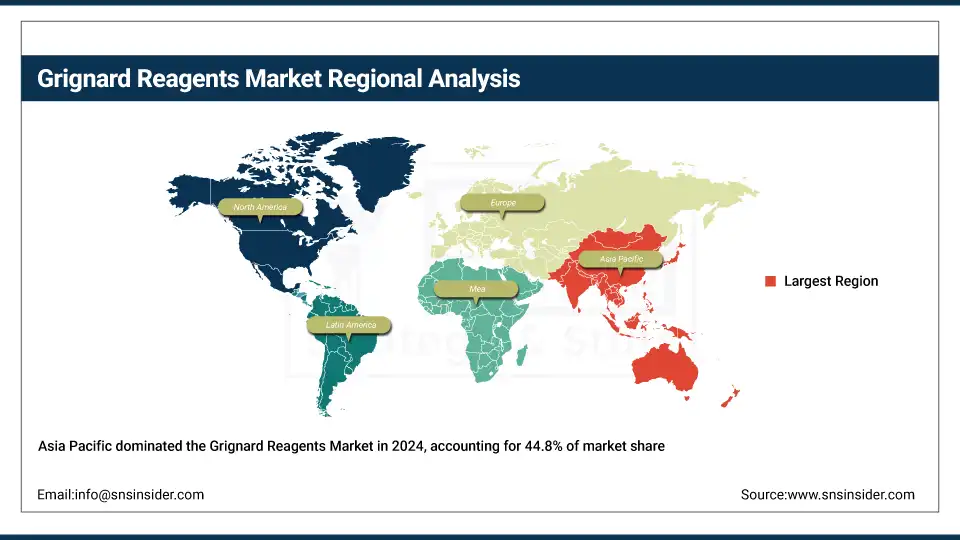
Asia Pacific accounted for the largest Grignard reagents market share of 44.8% in 2024 and is the fastest-growing region, with a projected CAGR of 6.1% during the forecast period. This growth is driven by strong manufacturing infrastructure, government-backed chemical production initiatives, and low operational costs. Increasing applications of alkyl Grignard reagents in polymer synthesis, agrochemicals, and flavors & fragrances further support demand. China dominates the region, supported by MIIT’s innovation subsidies. According to CCIN, China saw a 15% rise in chemical R&D investment in 2023, reinforcing its leadership in the Grignard reagents market.
Get Customized Report as per Your Business Requirement - Enquiry Now
North America is the second-dominant region in the Grignard reagents market, accounting for 31.2% in 2024. The market is driven by a well-established pharmaceutical industry and a surge in fine chemical R&D. Increased emphasis on sustainable chemistry by the U.S. Environmental Protection Agency has pushed demand for alkyl Grignard reagents in scalable, low-emission synthesis. Key Grignard reagents companies such as Thermo Fisher Scientific and Albemarle are driving innovation, improving reagent purity and packaging for enhanced safety, stability, and efficiency in production across pharmaceutical and agrochemical industries.
Europe holds the third-largest Grignard reagents market share at 13.4% in 2024, driven by strong chemical manufacturing and sustainability regulations. The European Chemicals Agency promotes environmentally responsible synthesis, with REACH-compliant facilities supporting production. Growing demand for alkyl and aryl Grignard reagents in fine chemicals and flavors & fragrances strengthens the market. Germany leads Europe’s market, where companies like BASF and Merck expand their Grignard product lines for pharmaceuticals and agrochemicals. The Federal Ministry of Education and Research invested over €20 billion in 2023, boosting synthetic chemistry advancements and market growth.
Key Players:
The major Grignard reagents market competitors include Merck KGaA / Sigma-Aldrich, Albemarle Corporation, WeylChem International GmbH, HOKKO Chemical Industry Co., Ltd., CHEMIUM srl, FAR Chemical, PMC Group, Inc., Boulder Scientific Company, Neogen Chemicals Ltd., and Tokyo Chemical Industry (TCI).
Recent Developments:
-
In January 2025, WeylChem International GmbH inaugurated a dedicated organometallic synthesis facility in Frankfurt, equipped for large-scale alkyl and aryl Grignard reagent production.
-
In November 2024, HOKKO Chemical Industry announced a collaboration with the University of Tokyo to develop continuous-flow Grignard processes, targeting safer, scalable synthesis under inert conditions.
| Report Attributes | Details |
|---|---|
| Market Size in 2024 | USD 5.06 billion |
| Market Size by 2032 | USD 7.98 billion |
| CAGR | CAGR of 5.87% From 2025 to 2032 |
| Base Year | 2024 |
| Forecast Period | 2025-2032 |
| Historical Data | 2021-2023 |
| Report Scope & Coverage | Market Size, Segments Analysis, Competitive Landscape, Regional Analysis, DROC & SWOT Analysis, Forecast Outlook |
| Key Segments | •By Product Type (Alkyl, Vinyl, Aryl, and Others) •By Application (Active Pharmaceutical Ingredients (Apis) & Drugs, Agrochemicals, Polymer Synthesis & Functionalization, and Others) •By End-Use Industry (Pharmaceutical & Biotechnology, Agriculture, Chemical, Flavors & Fragrances, Research, and Others) |
| Regional Analysis/Coverage | North America (US, Canada, Mexico), Europe (Germany, France, UK, Italy, Spain, Poland, Turkey, Rest of Europe), Asia Pacific (China, India, Japan, South Korea, Singapore, Australia, Rest of Asia Pacific), Middle East & Africa (UAE, Saudi Arabia, Qatar, South Africa, Rest of Middle East & Africa), Latin America (Brazil, Argentina, Rest of Latin America) |
| Company Profiles | Merck KGaA / Sigma-Aldrich, Albemarle Corporation, WeylChem International GmbH, HOKKO Chemical Industry Co., Ltd., CHEMIUM srl, FAR Chemical, PMC Group, Inc., Boulder Scientific Company, Neogen Chemicals Ltd., and Tokyo Chemical Industry (TCI) |
Frequently Asked Questions
R&D is crucial, with over 120 Grignard-related patents filed in 2023 and $40B NIH funding supporting innovation.
Key players include Hexcel, Toray, Owens Corning, SGL Carbon, Solvay, Gurit, and Teijin Composite Materials.
Alkyl Grignard reagents enable scalable pharmaceutical synthesis and benefit from regulatory support for safer chemical processes.
Alkyl Grignard Reagents dominate the market with a 50.6% share in 2024 due to high API demand.
The Grignard Reagents Market size was valued at USD 5.06 billion in 2024.
