
Hair Color Market Report Scope & Overview:
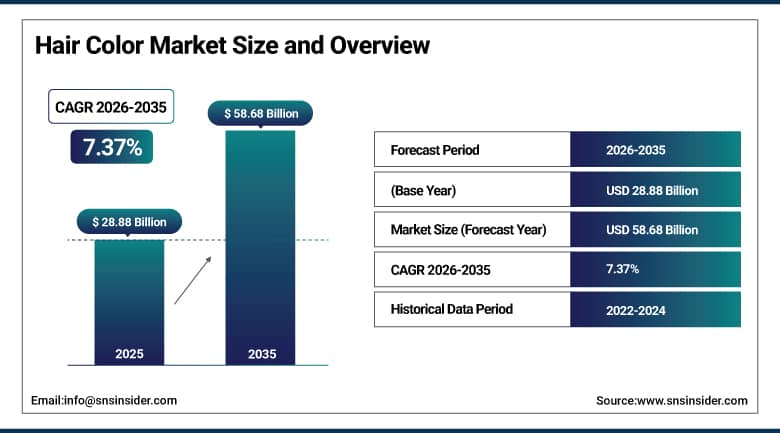
The Hair Color Market was valued at USD 28.88 billion in 2025 and is expected to reach USD 58.68 billion by 2035, growing at a CAGR of 7.37% from 2026–2035.
The hair color market is witnessing significant growth in the global market due to rising fashion consciousness and changing lifestyle preferences. Increasing aging population and growing demand for grey coverage solutions are driving strong market expansion across multiple regions. Rising adoption of at-home coloring products and salon-based services is significantly supporting market demand. Growing preference for organic and ammonia-free formulations is further strengthening product innovation. Rapid urbanization and increasing disposable income are boosting consumption of premium hair color products worldwide.
The global hair color market is expanding steadily, supported by rising demand for premium beauty products, at-home coloring solutions, and aging population trends. According to L’Oréal’s 2025 financial results, the company achieved $44.05 billion in, with haircare and hair color among the fastest-growing beauty categories globally.
To Get More Information On Hair Color Market - Request Free Sample Report
Hair Color Market Trends:
-
Rising demand for ammonia-free hair color formulations drives 28% increase in clean-label cosmetic product launches globally in 2025.
-
Digital try-on technologies and AR-based personalization tools boost consumer conversion rates by nearly 35% across online retail channels.
-
Growing regulatory restrictions on PPD and chemical dyes across Europe reduce formulation approvals by 22% since 2024 tightening compliance.
-
Surging preference for vegan hair color products drives plant-based ingredient adoption increasing 40% in premium salon applications during 2025.
-
At-home hair coloring kits witness 30% volume growth due to rising DIY grooming and post-pandemic convenience-oriented consumer behavior shift.
-
Investments exceeding USD 1.2 billion in sustainable pigment R&D accelerate biodegradable dye innovations and reduce water usage by 18%.
U.S. Hair Color Market Size Outlook:
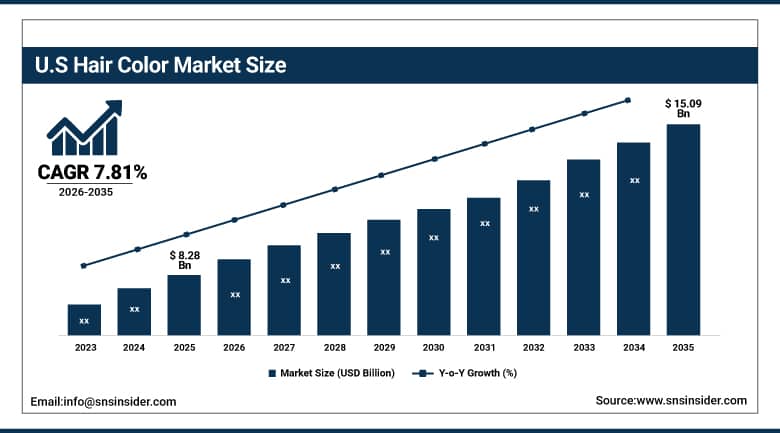
The U.S. Hair Color Market was valued at USD 8.28 billion in 2025 and is expected to reach around USD 15.09 billion by 2035, growing at a CAGR of 7.81% from 2026–2035.
The U.S. hair color market is witnessing steady growth because of high consumer spending and strong salon industry presence. Hair coloring usage in grey coverage, fashion styling, and premium salon services has been responsible for consistent market expansion. Increasing demand for organic formulations and at-home coloring kits has led to an increase in product adoption across urban consumers.
According to the U.S. Food and Drugs Administration (FDA), hair dyes are one of the cosmetics that are highly regulated due to their safety and ingredients which need to be made transparent in order to protect consumers. In the United States, the use of hair colors is prompted by increasing fashion trends, the need for coverage by an aging population, and the increasing use of hair coloring at home.
Hair Color Market Segment Analysis:
-
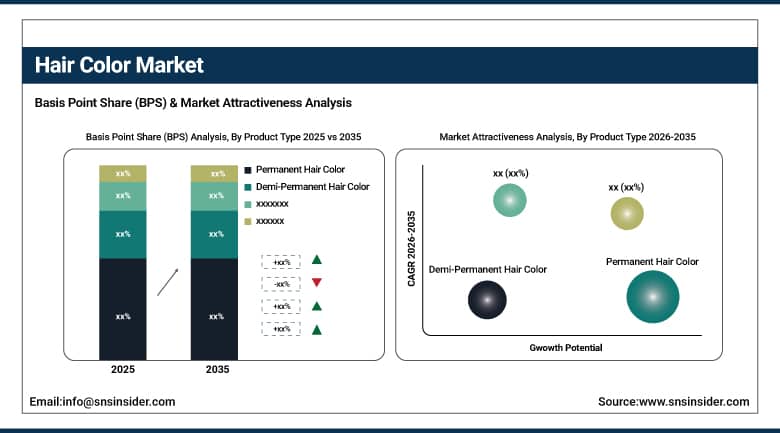
By Product Type, permanent hair color dominated the hair color market with 42.80% share in 2025; while demi-permanent hair color is the fastest growing segment with CAGR of 9.82% during 2026 to 2035.
-
By Formulation, chemical-based hair color dominated the hair color market with 78.60% share in 2025; while organic hair color is the fastest growing segment with CAGR of 11.43% during 2026 to 2035.
-
By End User, females dominated the hair color market with 67.40% share in 2025; while males are the fastest growing segment with CAGR of 10.35% during 2026 to 2035.
By Product Type, permanent hair color dominated the hair color market, while demi-permanent hair color is the fastest growing segment.
Permanent Hair Color segment held the dominated revenue share in the hair color market during 2025. The segment is led by high demand for long-lasting grey hair coverage and excellent retention of color. It enjoys high acceptance among older individuals and working professionals. High availability in both salon and retail channels further contributes to its popularity. Cost-effectiveness and easy availability also enable frequent use of the product.
The Demi-Permanent Hair Color segment is projected to witness the fastest growth at a CAGR throughout the review period due to the increasing preference of customers towards hair colors that do not harm their hair and can be changed according to their wish. This is because customers are opting for hair colors that cause less harm to them and give them freedom to try without going under any obligation of permanence.
By Formulation, chemical-based hair color dominated the hair color market, while organic hair color is the fastest growing segment.
Chemical-Based Hair Color segment had the dominated revenue share in 2025 owing to high product effectiveness, longevity, and better coverage of grey hairs in different hair textures. The high availability of the products and growing trust among consumers with respect to its effectiveness are fueling their use. Also, affordability when compared to the premium options adds to its dominance in the global Hair Color Market.
Organic Hair Color segment, it is likely to register the fastest growth during the forecast period, from 2026 to 2035, on account of increasing health concerns of consumers regarding hair coloring. Preference for organic and non-ammonia hair coloring products by consumers and growing demand for sustainable beauty products are boosting their adoption. Innovation in clean labeling and cosmetics is driving its growth.
By End User, females dominated the hair color market, while males are the fastest growing segment.
Females Segments dominate the hair color market with dominated revenue contribution in 2025. The reason for high domination is attributed to greater usage of hair coloring for beauty purposes, covering greys, and fashion reasons. High preference for salon treatments along with quality home hair colorings further strengthens the usage. Innovative nature of hair colors along with wide shade options is making the users purchase again and again. The growing level of awareness related to personal beauty along with the influence of social media is expected to further boost adoption.
Males Segments hold the fastest CAGR from 2026 to 2035. Factors responsible for rapid growth include the increasing levels of personal grooming and growing acceptance for hair coloring. The demand for greys' coverage and beard coloring is contributing positively towards adoption. Influence of professional looks along with that of social media is further making the product more popular. The increasing presence of gender-specific products along with high disposable income is propelling the growth.
Regional Analysis:
|
Region |
Major Country |
Share within Region, 2025(%) |
|---|---|---|
|
North America |
United States |
82.40% |
|
Europe |
Germany |
24.50% |
|
Asia Pacific |
China |
38.00% |
|
Middle East & Africa |
UAE |
14.50% |
|
Latin America |
Brazil |
44.00% |
North America Hair Color Market Insights.
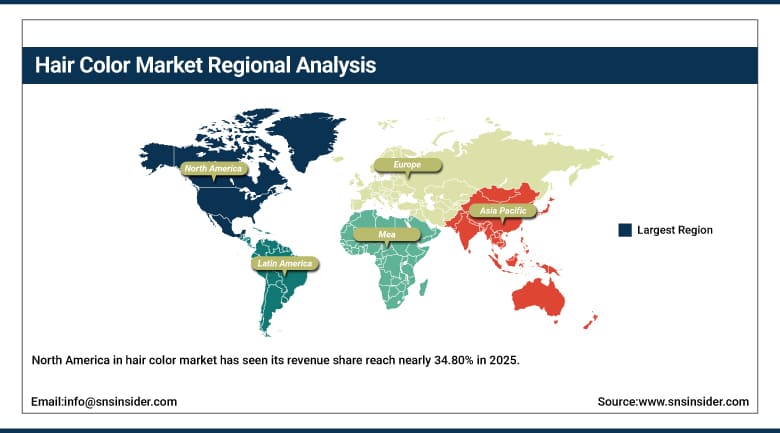
North America in hair color market has seen its revenue share reach nearly 34.80% in 2025 due to strong salon culture and high consumer spending power. The region benefits from advanced retail distribution networks, premium product availability, and widespread adoption of at-home coloring kits. Increasing demand for grey coverage and fashion-based coloring trends is driving steady growth across the United States and Canada. Expanding organic product adoption and sustainability trends are further supporting market expansion.
Based on the recent trends, it can be deduced that the North America hair color market is one of the most important segments within the cosmetics industry, due to the high demand for personal grooming and the need to hide gray hairs. Based on government data from the U.S., hair care represents 22% of total cosmetics expenditure. It is forecasted that the North America hair color market will reach a valuation of USD 12.09 billion by 2028, up from a valuation of USD 7.01 billion in 2021, with a CAGR of 6.50%.
Get Customized Report as Per Your Business Requirement - Enquiry Now
Europe Hair Color Market Insights.
Europe hair color market leaves a significant impression during the year 2025 due to strong trends in the fashion industry and use of high-end beauty products. Countries such as Germany, France, UK, and Italy have emerged as major contributors in the region's demand. High emphasis on hair appearance, greys coverage, and salon treatment is helping in sustaining the growth of the market.
According to the European Commission, hair dyes have a market penetration rate of more than 60% among women and 5–10% among men in Europe. Moreover, official EU statistics show that hair care products constitute an essential component of the €104 billion cosmetics industry in 2024.
Asia Pacific Hair Color Market Insights.
Asia Pacific is well positioned for growth in the hair color market in 2025 with a CAGR of around 9.29% because of rapid urbanization and rising beauty consciousness. China, India, Japan, and Southeast Asian countries are key contributors. Rising disposable income, increasing youth population, and growing salon penetration are boosting adoption. Expanding e-commerce beauty sales and increasing demand for fashion-based hair coloring are further strengthening market development across the region.
The recent trend analysis suggests that there is substantial growth being experienced in the Asia Pacific hair color market owing to increased consumer awareness about personal grooming coupled with increased urbanization, backed up by official industry data. The government-backed statistics of the cosmetics industry such as those released by the DPIIT of India and NBS cosmetics category data of China suggest that there is an increase in the demand for personal grooming products.
Middle East & Africa and Latin America Hair Color Market Insights.
The Middle East & Africa region along with Latin America is expected to have steady growth in the hair color market in 2025 due to increasing urbanization and rising beauty awareness. The UAE, Saudi Arabia, South Africa, Brazil, and Mexico are emerging contributors. Growth in salon services, increasing youth population, and expanding retail availability are supporting gradual expansion of hair coloring products across these developing economies.
The latest trends have shown that the hair coloring industry in the Middle East region is worth almost $320 million due to increased awareness about grooming practices, youth population, and saloons in the UAE and Saudi Arabia. The beauty industry in Latin America is growing fast thanks to countries like Brazil and Mexico, where it is forecasted that the cosmetics industry will be worth close to $99.5 billion by 2029.
Market Dynamics:
Growth Drivers: Rising fashion consciousness and increasing preference for aesthetic hair transformation across global consumer segments
Growing awareness about fashion trends and changing aesthetic perceptions are major factors contributing towards acceptance of hair color products around the world. The users are employing hair coloring in order to exhibit their personalities and enhance their appearances in line with season-specific fashion trends. Media effects along with changing styles among celebrities are playing an important role in increasing their market acceptance and purchases. Increasing presence of salons and availability of professional quality products is another factor contributing towards the growth of this category.
Increased awareness of fashion and the aesthetic makeover process have played an instrumental role in meeting the rising demand for hair color; 67% of millennials and Gen Z users view hair coloring as a form of self-expression, with about 45% choosing bright hair colors that keep pace with the latest trends. Furthermore, almost 60% of individuals base their choice of hair colors on social media trends in the realm of beauty and hair. Vogue Business highlights some of the latest trends in the beauty industry for 2026, including bright and expressive hair.
Restraints: Increasing concerns regarding chemical side effects and scalp sensitivity limiting frequent usage of hair color products
The growing realization of the risks of adverse side effects of hair coloring chemicals is creating a roadblock in terms of expanding their market share. People have become more aware of the possibility of irritation, allergies, and other damage to their hair caused by these products. There is also growing difficulty complying with regulations pertaining to the usage of such chemicals. In some places, the lack of trust in artificial products makes people use alternative expensive options.
Opportunities: Rising male grooming trends and expansion of at-home hair coloring solutions driving untapped market growth potential
As awareness regarding male grooming increases, there arise new channels for the growth of hair coloring products. Hair coloring amongst men has become common as it helps cover up graying hair and enhance their looks. There is also a rising trend towards using home kits for coloring hair, and with technological developments that make hair coloring easier to do, it has created immense scope for market expansion globally.
Government-sponsored NSSO-related grooming expenditure statistics indicate increased personal care per capita expenditures, while industry-sponsored corporate statistics indicate that the hair color market of India attained a value of USD 156.6 million in 2025, registering a compound annual growth rate of 6.3%, due to increasing usage among males and increasing trend towards at-home solutions. According to Mintel, more than 40% of adults use at-home hair coloring solutions.
Recent Developments:
-
2026: L'Oréal S.A. expanded AI-driven hair color recommendation tools and strengthened sustainable dye formulations across professional and consumer product portfolios globally.
-
2026: Hoyu Co., Ltd. introduced enhanced salon-grade hair coloring systems in Japan, emphasizing long-lasting color retention and reduced chemical formulation intensity.
-
2025: Coty Inc. expanded professional hair color offerings under Wella and Clairol brands, focusing on digital-first consumer engagement and salon partnerships.
-
2024: Davines Group S.p.A. advanced sustainability-driven professional hair color initiatives, increasing use of renewable energy in production and eco-certified formulations globally.
Hair Color Market Key Players are:
-
L'Oréal S.A.
-
Henkel AG & Co. KGaA
-
Wella Company
-
Coty Inc.
-
Kao Corporation
-
Shiseido Company, Limited
-
Revlon, Inc.
-
Godrej Consumer Products Limited
-
Hoyu Co., Ltd.
-
Combe Incorporated
-
Davines Group S.p.A.
-
Keune Haircosmetics
-
Natura &Co
-
Unilever PLC
-
Estée Lauder Companies Inc.
-
Oriflame Holding AG
-
Laboratorios Phergal S.A.
-
Alfaparf Milano S.p.A.
-
Eugene Perma Professionnel
-
Lakmé Cosmetics
Hair Color Market Report Scope:
| Report Attributes | Details |
|---|---|
| Market Size in 2025 | USD 28.88 Billion |
| Market Size by 2035 | USD 58.68 Billion |
| CAGR | CAGR of 7.37% From 2026 to 2035 |
| Base Year | 2025 |
| Forecast Period | 2026-2035 |
| Historical Data | 2022-2024 |
| Report Scope & Coverage | Market Size, Segments Analysis, Competitive Landscape, Regional Analysis, DROC & SWOT Analysis, Forecast Outlook |
| Key Segments | • By Product Type (Permanent Hair Color, Demi-Permanent Hair Color, Semi-Permanent Hair Color, Temporary Hair Color, Root Touch-Up, Others) • By Formulation (Chemical-Based Hair Color, Organic Hair Color, Others) • By End User (Females, Males, Unisex) |
| Regional Analysis/Coverage | North America (US, Canada), Europe (Germany, UK, France, Italy, Spain, Russia, Poland, Rest of Europe), Asia Pacific (China, India, Japan, South Korea, Australia, ASEAN Countries, Rest of Asia Pacific), Middle East & Africa (UAE, Saudi Arabia, Qatar, South Africa, Rest of Middle East & Africa), Latin America (Brazil, Argentina, Mexico, Colombia, Rest of Latin America). |
| Company Profiles | L'Oréal S.A., Henkel AG & Co. KGaA, Wella Company, Coty Inc., Kao Corporation, Shiseido Company, Limited, Revlon, Inc., Godrej Consumer Products Limited, Hoyu Co., Ltd., Combe Incorporated, Davines Group S.p.A., Keune Haircosmetics, Natura &Co, Unilever PLC, Estée Lauder Companies Inc., Oriflame Holding AG, Laboratorios Phergal S.A., Alfaparf Milano S.p.A., Eugene Perma Professionnel, Lakmé Cosmetics |
Frequently Asked Questions
The hair color market is expected to grow at a CAGR of 7.37% from 2026 to 2035.
The hair color market was valued at USD 28.88 billion in 2025.
Rising fashion consciousness, aging population, and increasing demand for grey coverage and at-home coloring solutions are driving market growth globally.
Permanent Hair Color led the hair color market in 2025 due to strong demand for long-lasting grey coverage, high salon usage, and wide product availability across retail channels.
North America led the hair color market in 2025 due to strong salon culture, high consumer spending power, and widespread adoption of premium and at-home hair coloring products.
