
Treadmill Market Report Scope & Overview:
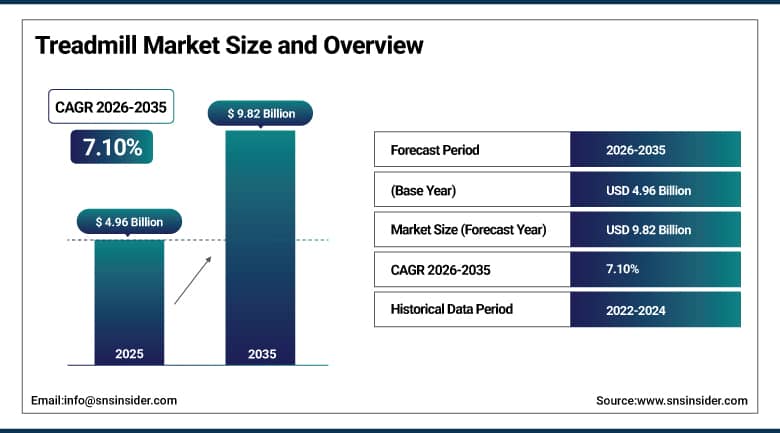
The Treadmill Market was valued at USD 4.96 Billion in 2025 and is projected to reach USD 9.82 Billion by 2035, expanding at a CAGR of 7.10% during the forecast period from 2026 to 2035.
The market is driven by growing health consciousness, increasing number of people doing workouts at their homes, and increasing spending on commercial fitness equipment all around the world. Consumers are increasingly buying features like touchscreen technology, AI-enabled workout suggestions, heart rate sensors, virtual coaches and cloud compatibility in their advanced treadmills. Rising obesity levels, preventive health care programmers and growing disposable income levels are motivating people to exercise regularly at homes and commercial fitness centers. Manufacturers of fitness equipment are also introducing more energy-efficient motor technologies and foldable compact designs to cater to the changing needs of consumers in the fitness market.
Johnson Health Tech started selling the AI-enabled connected treadmills in 2026 that give personal workout advice and advanced fitness tracking via cloud. In 2025, Technogym launched advanced interactive fitness training system and premium treadmills.
To Get More Information On Treadmill Market - Request Free Sample Report
Market Trends:
-
Growing adoption of connected fitness equipment driven by rising demand for personalized home workout experiences.
-
Increasing investments in digital fitness ecosystems creating opportunities for AI-enabled treadmill innovations.
-
Rising health awareness and preventive wellness initiatives accelerating residential and commercial treadmill demand.
-
Expanding corporate wellness and rehabilitation programs supporting wider deployment of advanced treadmill systems.
-
Growing demand for compact, energy-efficient smart treadmills encouraging continuous product innovation and premium equipment upgrades.
U.S. Treadmill Market Outlook:
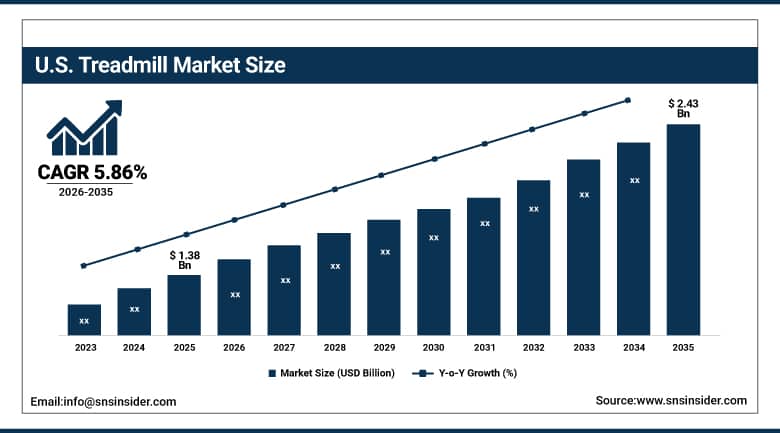
The U.S. Treadmill Market was valued at approximately USD 1.38 Billion in 2025 and is expected to reach approximately USD 2.43 Billion by 2035, growing at a CAGR of approximately 5.86% from 2026 to 2035.
The market share of North America is the highest because of higher awareness of the consumers regarding health, higher expenditure of consumers on fitness equipment, availability of numerous commercial gyms, health clubs, rehabilitation centers, and fitness equipment in their homes. The introduction of intelligent fitness equipment, subscription-based fitness training, and well-being technology has resulted in high demand for the treadmills. Higher investment in the prevention of health care programs, wellness programs of corporates, and high-quality home gyms has resulted in high sales of intelligent treadmills with artificial intelligence (AI) coaches and fitness analysis.
Peloton introduced updated treadmill software with personalized workout using artificial intelligence (AI) and advanced fitness analytics for its customers in 2026. Life Fitness launched new commercial treadmills having efficient motors and shock absorption feature in 2025.
Treadmill Market Segment Analysis:
-
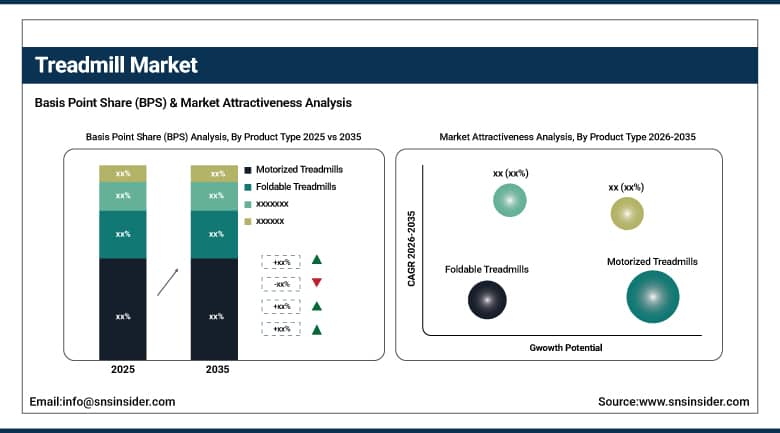
By Product Type, Motorized Treadmills dominated the treadmill market with 52.80% share in 2025, while Foldable Treadmills are the fastest-growing product segment from 2026 to 2035.
-
By End User, Residential Users dominated the treadmill market with 47.30% share in 2025, while Hospitals & Rehabilitation Centers are the fastest-growing end-user segment from 2026 to 2035.
-
By Distribution Channel, Offline Retail Stores dominated the treadmill market with 61.20% share in 2025, while Online Platforms are the fastest-growing distribution channel from 2026 to 2035.
-
By Application, Home Fitness dominated the treadmill market with 49.60% share in 2025, while Medical Rehabilitation is the fastest-growing application segment from 2026 to 2035.
By Product Type, Motorized Treadmills dominate, Foldable Treadmills grow fastest
Motorized Treadmills dominated the treadmill market with a revenue share of over 52.80% in 2025. The market leadership was backed up by the broad application of these in residential homes, fitness clubs, hotels and rehabilitation centers. Consumer preference continues to be driven by features such as adjustable speed, automatic incline, built-in workout programmers, touchscreen displays and smart connectivity. Increasing investments for a connected fitness ecosystem and growing demand for premium home exercise equipment in developed and emerging markets further strengthen the adoption of motorized treadmills.
Foldable treadmills are expected to experience the fastest CAGR during the forecast period due to increasing urbanization, limited residential space, and growing adoption of home fitness. Consumers today want compact fitness equipment that doesn’t sacrifice performance, but that also stores away easily. Manufacturers are continuing to introduce lightweight, foldable models with AI-enabled coaching, cloud connectivity, quieter motors and increased durability and they are proving to be extremely attractive to apartment dwellers, first-time buyers and digitally connected fitness enthusiasts.
By End User, Residential Users dominate, Hospitals & Rehabilitation Centers grow fastest
Residential segment dominated the treadmill market by accounting for the largest revenue share of the total revenue, which is 47.30%. Consumers bought treadmills for everyday exercise due to rising health awareness, increasing home workout adoption and greater investment in personal wellness. Smart fitness technologies, subscription-based workout platforms, and virtual coaching features further boosted demand for residential equipment. Rising disposable incomes and the convenience of exercising at home continue to support strong market growth across household consumers globally.
Hospitals and rehabilitation centers are expected to experience the fastest CAGR owing to growing demand for physical therapy, cardiac rehabilitation, orthopedic recovery, and neurological treatment programmers. Medical providers continue to invest in treadmills that are medically designed and have patient monitoring systems, speed controls that can be adjusted, body-weight support and the ability to analyses gait. Global healthcare facilities are seeing increased adoption driven by growing elderly populations, expanding rehabilitation infrastructure, and increasing chronic disease management programmers.
By Distribution Channel, Offline Retail Stores dominate, Online Platforms grow fastest
Offline retail stores dominated the treadmill market by, accounting for approximately 61.20% of the total revenue. Consumers still preferred to buy equipment from brick-and-mortar stores where they could assess the quality of equipment, get expert advice, compare different models and get installation and after-sales service. Specialty fitness stores and branded showrooms are among the most important sales channels for premium residential and commercial treadmills, especially for customers seeking personalized purchase assistance when making a high-value investment.
Online platforms are expected to witness the fastest CAGR during the forecast period as digital commerce is booming across the globe. Manufacturers are boosting direct-to-consumer sales with virtual product demonstrations, financing, doorstep delivery and installation, and online customer service. Growing consumer confidence in e-commerce, wider product availability, competitive pricing and easy buying experiences continue to drive online treadmill sales for residential and commercial buyers.
By Application, Home Fitness dominates, Medical Rehabilitation grows fastest
Home fitness dominated and held a share of around 49.60% of the market revenue in the treadmill market in 2025. The increase in treadmill ownership is being driven by consumer interest in preventive healthcare, flexible workout schedules and convenient home exercise. Home demand for professional-quality fitness experiences continues to drive the market. Smart connected treadmills offer interactive training, AI-powered fitness coaching, real-time tracking of performance and personalized workout recommendations.
The medical rehabilitation segment is expected to grow with the fastest CAGR owing to the increasing demand for therapeutic exercise devices in hospitals, rehabilitation centers and physiotherapy clinics. Health care providers use advanced treadmills for gait training, neurological rehabilitation, orthopedic recovery and cardiovascular therapy, and therefore need to understand clearly the important features of these products. Increasing investments in rehabilitation infrastructure, increasing elderly populations and rising incidence of mobility related disorders continue to support the long-term demand for medical rehabilitation treadmills worldwide.
Regional Analysis:
|
Region |
Major Country |
Share within Region, 2025 (%) |
|---|---|---|
|
North America |
United States |
83.52% |
|
Europe |
Germany |
26.80% |
|
Asia Pacific |
China |
38.60% |
|
Middle East |
Saudi Arabia |
31.20% |
|
Latin America |
Brazil |
46.40% |
North America Treadmill Market Insights
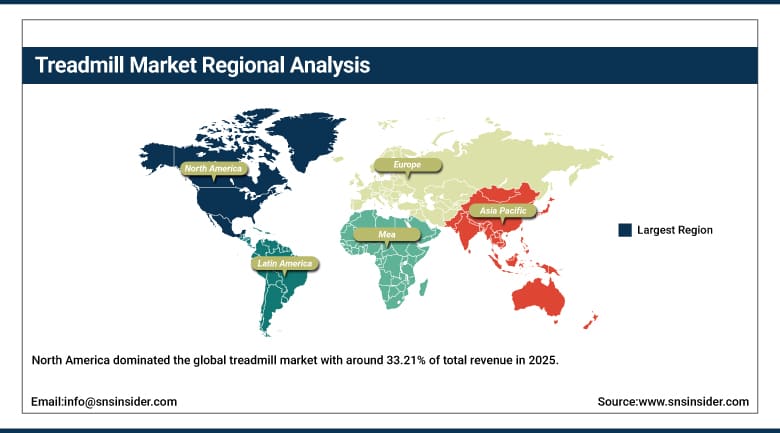
North America dominated the global treadmill market with around 33.21% of total revenue in 2025. The region is characterized by high consumer expenditure on fitness equipment, the proliferation of connected fitness solutions for the home, and an extensive network of commercial gyms, health clubs, hotels, and rehabilitation facilities. Enhanced awareness of preventive healthcare, increasing obesity management initiatives and rising investments in premium fitness technologies continue to support strong demand for advanced treadmills in residential and commercial environments.
Across the region, manufacturers are investing in AI-enabled treadmills, interactive workout platforms, cloud-connected fitness ecosystems, and subscription-based digital training services to improve user engagement and retention. Increasing replacement of ageing commercial fitness equipment, expanding corporate wellness programmers and increasing rehabilitation applications are generating additional demand for technologically advanced treadmill systems. Continuous product innovation and increasing adoption of personalized fitness solutions are expected to sustain the market leadership of North America throughout the forecast period.
Get Customized Report as Per Your Business Requirement - Enquiry Now
Europe Treadmill Market Insights
Europe is a substantial market due to increasing health consciousness, the expansion of commercial fitness infrastructure, and rising participation in recreational fitness activities. With the increased awareness of fitness throughout the region, consumers are buying more premium home exercise equipment. Commercial fitness operators, hotels, rehabilitation centers and wellness facilities are also updating their equipment portfolios to meet changing consumer expectations for connected and digitally enabled fitness experiences.
Manufacturers are still rolling out energy-efficient treadmills that come with smart connectivity, interactive training programmers, touchscreen displays and performance monitoring technologies. Growing investments in preventive health, expansion of boutique fitness studios and wider adoption of virtual fitness platforms continue to support the demand for equipment. The increased adoption of personalized training solutions and ongoing modernization of commercial fitness centers are anticipated to support stable market growth across Europe in the coming years.
Asia Pacific Treadmill Market Insights
Asia Pacific is expected to grow at the fastest CAGR during the forecast period. Rapid urbanization, increasing disposable income, growing middle class populations and increasing awareness of preventive healthcare are driving tremendous demand for residential and commercial fitness equipment. The consumers in the region are embracing healthier lifestyles and regular exercise and this is in turn driving significant investment in fitness centers, smart home gyms and digital wellness ecosystems.
Manufacturers are growing regional manufacturing capacity and debuting affordable smart treadmills with AI coaching, cloud connectivity, interactive workouts and mobile app integration. Market growth is driven by rising gym memberships, rising online fitness subscriptions, rising e-commerce penetration and continued investment in digital fitness technologies. The Asia Pacific is expected to be the fastest growing regional market over the forecast period due to rising demand in China, India, Japan, South Korea and South-east Asia.
Middle East & Africa & Latin America Treadmill Market Insights
The joint revenue share of the treadmill market of the Middle East and Latin America in 2025 was estimated to be about 6.60%. Growth in awareness regarding health, increasing number of fitness clubs, increase in recreational workouts, and investment in wellness infrastructure are contributing factors that are fueling the growth of the market. With the increased development of commercial gyms and premium health clubs, the demand for home fitness equipment is increasing in regions such as Brazil, Mexico, Saudi Arabia, and UAE.
There is an intensification of the distribution networks of the region along with the expansion of online sales platforms and competitive pricing of smart treadmills. Brazil has been the largest market in Latin America because of the increasing consumer expenditure on fitness products whereas Saudi Arabia has become the fastest-growing market in the Middle East due to the growth in wellness and commercial fitness investments.
Market Dynamics:
Growth Driver: Rising Health Awareness and Home Fitness Adoption
The demand for treadmills is increasing substantially across the globe owing to the increasing consumer awareness about preventive healthcare, obesity management and active lifestyles. Market growth is supported by increasing participation in home workout and investment in residential exercise equipment is growing and expansion of fitness memberships. Consumers are increasingly choosing treadmills with advanced technology, offering personalized workouts, real-time performance tracking, and connected fitness experiences, which enhance exercise convenience and long-term engagement.
Manufacturers continue to roll out AI-powered coaching, interactive displays, cloud-connected fitness platforms and virtual training programmers to enhance user experience and differentiate products. The demand for equipment is also being driven by increasing corporate wellness initiatives, the growth of commercial fitness facilities, and higher rehabilitation applications. The treadmill market is projected to witness sustained long-term growth driven by continuous innovation in smart fitness technologies and increasing consumer preference for integrated digital wellness ecosystems.
Restraint: High Equipment Costs and Maintenance Requirements
High cost of purchase along with high expenses associated with maintenance are still the two main factors that hinder widespread use of treadmills, especially in low-price sensitive consumer groups and emerging economies. State-of-the-art treadmills, equipped with high-tech digital elements, strong engines and sophisticated health facilities entail considerable expenditure on their part. Expenses related to servicing, replacing the moving parts, software upgrading and repairs make the overall cost of ownership even higher.
Besides, there is competitive threat coming from less expensive workout equipment and outdoor physical activity that entails minor expenses. The lack of space in apartments in big cities and the issue of longevity of machines are other factors that affect the consumers’ decision-making process. Thus, many people tend to prolong the period between replacements or prefer cheaper solutions.
Opportunity: Expansion of Connected Fitness and Smart Digital Platforms
The explosive growth of connected fitness devices presents a multitude of opportunities for treadmill brands around the world. The total user experience is being changed by the incorporation of artificial intelligence, cloud computing, wearable synchronization, virtual coaching and individual fitness analysis. “Consumers are increasingly interested in immersive workout products that will provide them with a personalized programmed, health monitoring and the link to the whole digital ecosystem.
Brands develop the subscription model of fitness services, interactive training solutions and mobile applications to increase consumer interaction and revenue. The growing popularity of the hybrid fitness approach of home training with virtual coaching and the rise of digital ecosystems and smart home devices keep providing new opportunities for treadmill manufacturers to upscale.
Recent Developments:
-
January 2026: Johnson Health Tech expanded its premium treadmill portfolio by introducing AI-powered training capabilities, enhanced cloud connectivity, and upgraded interactive workout experiences across its Matrix and Horizon treadmill product lines.
-
September 2025: iFIT Inc. upgraded its connected fitness ecosystem with personalized coaching algorithms, expanded wearable integration, and advanced workout analytics across NordicTrack and ProForm treadmill platforms.
-
June 2025: Technogym introduced next-generation connected treadmills featuring AI-assisted workout recommendations, expanded digital wellness services, and improved performance monitoring capabilities for commercial fitness facilities.
-
March 2025: Life Fitness enhanced its commercial treadmill portfolio with advanced cloud-based equipment management, real-time performance tracking, and predictive maintenance capabilities for gyms and institutional fitness centers.
Key Players:
-
Johnson Health Tech
-
Technogym S.p.A.
-
iFIT Inc.
-
Life Fitness
-
TRUE Fitness
-
Precor Incorporated
-
Dyaco International
-
Nautilus Inc.
-
Shuhua Sports Co., Ltd.
-
Impulse Health Tech Co., Ltd.
-
BH Fitness
-
SportsArt Fitness
-
Core Health & Fitness
-
Torque Fitness
-
BodyCraft
-
Landice Inc.
-
Spirit Fitness
-
Sole Fitness
-
Horizon Fitness
-
Matrix Fitness
Treadmill Market Report Scope:
| Report Attributes | Details |
|---|---|
| Market Size in 2025 | USD 4.96 Billion |
| Market Size by 2035 | USD 9.82 Billion |
| CAGR | CAGR of 7.10% from 2026 to 2035 |
| Base Year | 2025 |
| Forecast Period | 2026-2035 |
| Historical Data | 2022-2024 |
| Report Scope & Coverage | Market Size, Segments Analysis, Competitive Landscape, Regional Analysis, DROC & SWOT Analysis, Forecast Outlook |
| Key Segments | • By Product Type (Motorized Treadmills, Manual Treadmills, Foldable Treadmills, Commercial Treadmills) • By End User (Residential Users, Health Clubs & Gyms, Hotels & Hospitality, Hospitals & Rehabilitation Centers) • By Distribution Channel (Offline Retail Stores, Specialty Fitness Stores, Online Platforms) • By Application (Home Fitness, Commercial Fitness Centers, Medical Rehabilitation, Corporate Wellness) |
| Regional Analysis/Coverage | North America (US, Canada, Mexico), Europe (Eastern Europe [Poland, Romania, Hungary, Turkey, Rest of Eastern Europe] Western Europe] Germany, France, UK, Italy, Spain, Netherlands, Switzerland, Austria, Rest of Western Europe]), Asia Pacific (China, India, Japan, South Korea, Vietnam, Singapore, Australia, Rest of Asia Pacific), Middle East & Africa (Middle East [UAE, Egypt, Saudi Arabia, Qatar, Rest of Middle East], Africa [Nigeria, South Africa, Rest of Africa], Latin America (Brazil, Argentina, Colombia, Rest of Latin America) |
| Company Profiles | Johnson Health Tech, Technogym S.p.A., iFIT Inc., Life Fitness, TRUE Fitness, Precor Incorporated, Dyaco International, Nautilus Inc., Shuhua Sports Co., Ltd., Impulse Health Tech Co., Ltd., BH Fitness, SportsArt Fitness, Core Health & Fitness, Torque Fitness, BodyCraft, Landice Inc., Spirit Fitness, Sole Fitness, Horizon Fitness, Matrix Fitness |

Frequently Asked Questions
Motorized Treadmills dominated the market in 2025 due to their widespread adoption across residential users, gyms, hotels, and rehabilitation centers.
The Treadmill Market is expected to grow at a CAGR of 7.10% during the forecast period.
The Treadmill Market was valued at approximately USD 4.96 Billion in 2025.
Increasing health awareness, rising adoption of home fitness equipment, and growing investments in connected fitness technologies are major factors driving market growth globally.
North America dominated the Treadmill Market in 2025 due to high consumer spending on fitness equipment, strong adoption of connected fitness solutions, and a well-established commercial fitness infrastructure.
