
Travel Tourism Market Report Scope & Overview:
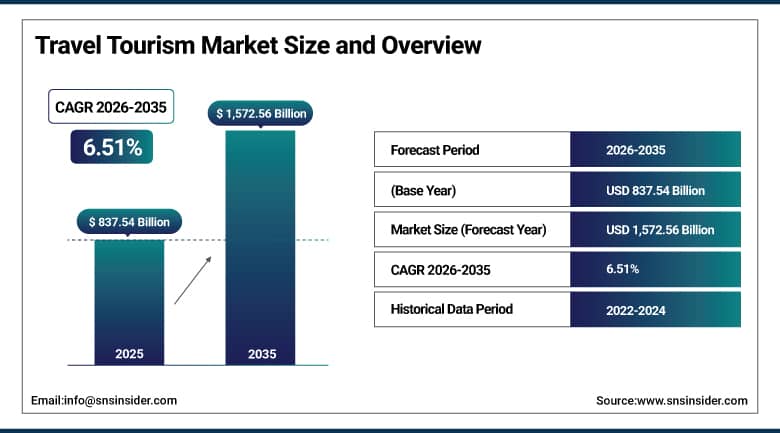
The Travel Tourism Market was valued at USD 837.54 Billion in 2025 and is projected to reach USD 1,572.56 Billion by 2035, expanding at a CAGR of 6.51% during the forecast period 2026–2035.
The travel tourism industry around the world is witnessing a steady growth due to the normalization of global travel, higher disposable incomes, and the government investments in aviation, hospitality and tourism sectors. The digital revolution has transformed the process of searching, comparing and booking trips by introducing online platforms that use artificial intelligence, dynamic pricing and personalized recommendations for improving the customer experience. The rising popularity of experiential trips, wellness travel, cultural tourism, sporting events, and luxury hotel facilities creates the new business opportunities for airlines, hotels, travel technology companies and destination management organizations in developed and developing economies.
There are also technological advances that have an impact on the development of the tourism industry such as itinerary planning using AI, cloud-based reservation management, biometric check-in at airports, digital identification, contactless payments, and real-time travel analytics. Sustainable tourism, smart destination, digital visa, airport modernization, and integrated multimodal transportation are constantly growing the long-term market opportunities. In May 2025, the U.S. Travel Association expressed their appreciation of further federal actions aimed at improving modernization of air travel infrastructure and visitor processing to improve the competitiveness of the U.S. travel sector.
To Get More Information On Travel Tourism Market - Request Free Sample Report
Travel Tourism Market Trends:
-
Rising adoption of AI-powered personalized travel planning and booking platforms.
-
Increasing international tourism supported by improved global air connectivity.
-
Growing demand for sustainable, wellness, and experiential tourism offerings.
-
Expansion of mobile-first travel ecosystems and digital payment solutions.
-
Smart tourism infrastructure transforming destination management and visitor experiences.
U.S. Travel Tourism Market Size Outlook:
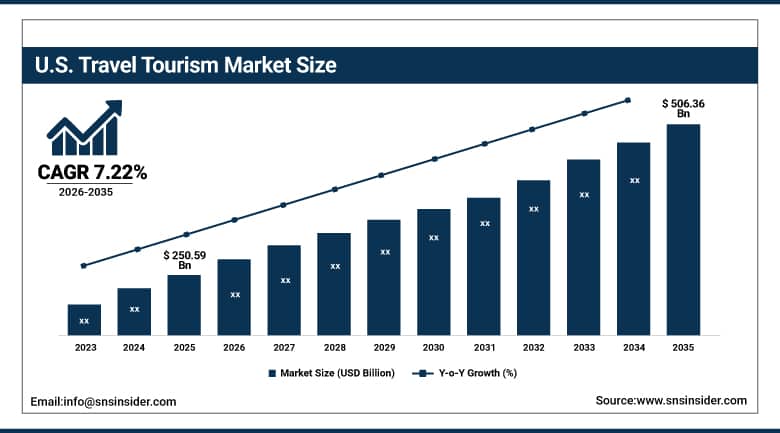
The U.S. Travel Tourism Market was valued at USD 250.59 billion in 2025 and is expected to reach approximately USD 506.36 billion by 2035, expanding at a CAGR of 7.22% during 2026–2035.
The U.S. maintains dominance in the travel tourism sector in North America due to the diverse nature of its tourism environment, an extensive internal travel system, world-class hospitality infrastructure, and high consumer expenditure on travel. Reinvestment in the development of airports, quality accommodations, travel technology, and marketing destinations have helped improve the competitive edge of the U.S. in the tourism sector. Tourism growth in sports tourism, entertainment travel, conventions, visits to national parks, and luxury experiences offers great profit making opportunities for airlines, hotels, online travel agencies, and travel technology firms.
Moreover, adoption of artificial intelligence at a very fast pace in the process of travel bookings, increasing use of passenger biometric checks, smart airports and digital travel experience has led to greater efficiencies and satisfied customers. During 2025, the U.S. Department of Transportation made further advancements in its airport infrastructure investments through the Airport Improvement Program.
Travel Tourism Market Segment Analysis:
-
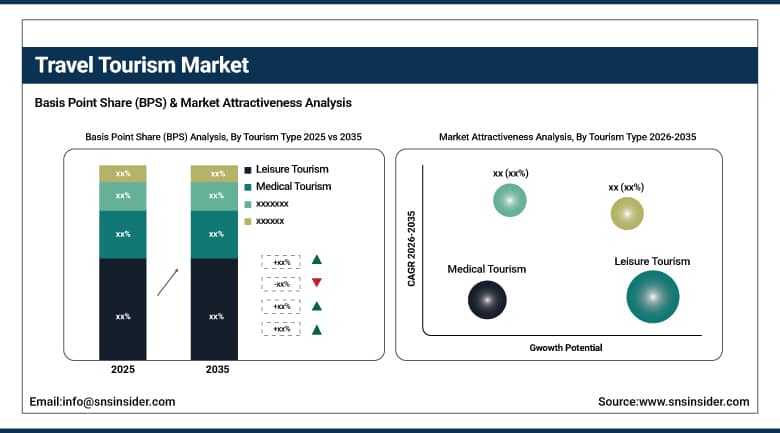
By Tourism Type, leisure tourism dominated the market with 41.00% share in 2025, while medical tourism is projected to witness the fastest growth with a CAGR of 9.22% during the forecast period.
-
By Booking Channel, online booking dominated the market with 71.00% share in 2025, while online booking is also projected to witness the fastest growth with a CAGR of 7.92% during the forecast period.
-
By Travel Destination, domestic travel dominated the market with 63.00% share in 2025, while international travel is projected to witness the fastest growth with a CAGR of 7.59% during the forecast period.
-
By Travel Duration, less than 7 days dominated the market with 46.00% share in 2025, while 16–30 days is projected to witness the fastest growth with a CAGR of 7.85% during the forecast period.
-
By Travel Arrangement, self-planned / independent travel dominated the market with 62.00% share in 2025 and is also projected to witness the fastest growth with a CAGR of 7.49% during the forecast period.
-
By Traveler Type, family travelers dominated the market with 37.00% share in 2025, while solo travelers are projected to witness the fastest growth with a CAGR of 8.46% during the forecast period.
By Tourism Type, leisure tourism dominated, while medical tourism grows fastest.
Leisure tourism was the dominant tourism segment in the travel tourism market in 2025 accounting for 41.00%. Increased disposable income, desire to have experience travels, international air connectivity, and development of the hospitality industry are some of the factors fueling the demand for leisure travels. Individuals are increasingly paying for beach holidays, culture tourism, cruises, eco-tourism, luxury resorts, and entertainment-based tourism experience. Governments of countries with well-developed tourist industries are increasingly investing in destination marketing, tourism infrastructure development, and visa facilitation programs. This further fuels the leisure tourism demand and encourages increased expenditure on accommodations, transport, and entertainment.
Medical tourism is projected to witness the fastest CAGR of 9.22% over 2026–2035. Some of the major driving forces for the market are demand for quality healthcare services at lower costs, reduced time to get treatment, and international accreditation of hospitals. Developing specialized health facilities, digitization of healthcare services, and integration of medical tourism packages continues to gain popularity in countries such as India, Thailand, Turkey, Singapore, and the UAE. As per the World Travel & Tourism Council report, 2025 witnessed an increase in travel expenditure worldwide driven by increasing demand for leisure trips and increasing recovery of international tourism.
By Travel Destination, domestic travel dominated, while international travel grows fastest.
Domestic tourism had a 63.00% market share in the global market in 2025. The strong promotion of domestic tourism, improved transport systems within the regions, and the increasing tendency to travel on short vacations and affordable vacations are helping this industry to flourish. Travelers tend to choose domestic destinations because they offer cheap travel costs, easy visa process, convenience, and also offer good hospitality services. The improvement in the road transport system, airport connectivity, rail transport system, and tourism infrastructure would help in developing the domestic tourist flow.
The international travel segment is estimated to grow at the highest CAGR of 7.59% during the forecast period. The recovery in international flight capacity, less stringent visa rules, increasing business travel, and growing desire for international leisure trips will help sustain growth in the market. Airlines, destination marketing associations, and tourism boards will continue investing in digital visa facilities, collaborations, and luxurious travel services in order to attract international tourists. Growth in long-haul connectivity and revival of intercontinental travel are likely to be among the key drivers of future growth. According to the UN Tourism, the number of international tourist arrivals witnessed an increase in 2025 with several locations receiving higher numbers of travelers than before the pandemic crisis.
By Travel Duration, less than 7 days dominated, while 16–30 days grows fastest.
Trips of duration Less than 7 Days generated 46.00% of market revenue in 2025. Weekend getaways, domestic holidays, business travels, and city break travels will keep generating demand for shorter durations of travel. Travelers prefer flexible travel plans that limit their travel duration while giving them maximum leisure time. The aviation companies, hotel chains, and travel operators are offering customized packages for short durations along with dynamic pricing, mobile bookings, and travel bundles to cater to increasing demand for short travel trips.
The 16–30 Days category is anticipated to record the highest CAGR of 7.85% over 2026–2035. This growth in the category is backed by remote work flexibility, extended international holidays, learning tours, wellness travels, and multination travels among other categories. Digital nomad schemes, long stay stays, and flexible working are motivating travelers to spend longer on their travels. Providers are launching packages for long stays, serviced apartments, and custom travel experiences for longer stays. A number of destinations introduced digital nomad and long stay visas for tourists in 2025.
Regional Analysis:
|
Region |
Major Country |
Share within Region, 2025 (%) |
|---|---|---|
|
North America |
United States |
88.00% |
|
Europe |
Germany |
28.00% |
|
Asia Pacific |
China |
23.00% |
|
Middle East & Africa |
UAE |
7.00% |
|
Latin America |
Brazil |
8.00% |
North America Travel Tourism Market Insights
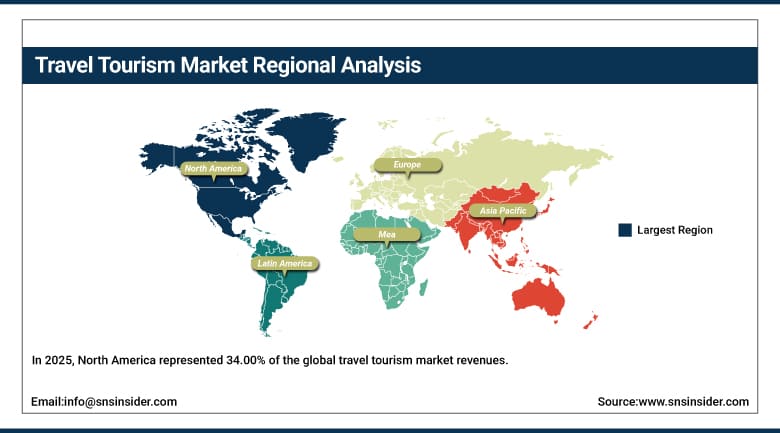
In 2025, North America represented 34.00% of the global travel tourism market revenues, leading in the market owing to the efficient transportation network infrastructure, high level of consumer spending, active participation in domestic tourism, and maturity of digital travel industry. The USA and Canada continue to improve their airports, hospitality sector, smart tourism, and transportation networks, thus creating better conditions for tourists. Active demand for vacation trips, business travels, sports tourism, cruises, and entertainment tourism remains an important source of profits in the airlines, hotels, online travel agencies, and destination management companies.
The region is also characterized by rapid introduction of technologies such as artificial intelligence, cloud reservations, biometric passenger processing, and personal digital travel experiences. In May 2025, U.S. Travel Association expressed its gratitude for the investments into the U.S. aviation infrastructure and visit facilitation initiatives to ensure more efficient travels and increase the competitiveness of tourism industry.
Get Customized Report as Per Your Business Requirement - Enquiry Now
Europe Travel Tourism Market Insights
Europe continued to maintain its position as one of the most important places for tourism in the world in 2025 owing to its cultural heritage, well-established tourism facilities, efficient means of transportation, and many tourist sites. Tourism continued to be a popular activity in such countries as Germany, France, Italy, Spain, and UK, among others, because of their historical sites, luxurious hotels, international fairs, and developed rail and air networks. The continued development of sustainable tourism practices and digital solutions is strengthening the competitive position of Europe in the international tourism market.
Moreover, the introduction of smart destination solutions and AI-based visitor management software, ticketing systems, and mobility programs helps tourists save time during their journeys and minimize the negative impact on the environment. In 2025, the European Travel Commission noted an increased level of demand in domestic tourism in Europe because of the active development of both leisure and international tourism.
Asia Pacific Travel Tourism Market Insights
Asia Pacific travel tourism market is forecasted to have the highest CAGR of 7.06% from 2026 to 2035. China, India, Japan, South Korea, Southeast Asia, and Australia are witnessing high rates of urbanization, higher disposable incomes, expansion of middle class, and growing connectivity from the flights on international routes, leading to high travel demands. Tourism is one of the most lucrative sectors for the government that invests in developing airports, fast trains, hotels, e-tourism, and destination marketing; there are plenty of opportunities for the travel firms and hospitality industry.
The growth is driven by the outbound tourism trend, development of the online travel agencies, the rise of medical tourism, and demand for luxury. Artificial intelligence, mobile-first travel apps, contactless travel, and digital payments are revolutionizing the customer experience. In 2025, Trip.com Group expanded its AI-powered trip planning and multilingual customer support to cope with higher demand for travel in Asia Pacific region.
Middle East & Africa and Latin America Travel Tourism Market Insights
The tourism market of Middle East & Africa has been growing steadily through investments in aviation, luxury hospitality, advanced tourism infrastructure, and global destination development. Countries such as UAE, Saudi Arabia, Qatar, and South Africa have been enhancing their tourism infrastructure through hosting mega events, entertainment zones, cultural sites, and eased entry for tourists. National diversification strategies in tourism and growing private sector investments have helped countries increase international competitiveness as well as promote tourism growth. Advanced travel services, advanced airports, and integrated tourism experience is expected to continue driving expansion of the region.
Tourism in Latin America is experiencing steady growth fueled by international arrivals, eco-tourism, adventure tourism, and cultural travel in countries such as Brazil, Mexico, Argentina, Chile, and Peru. Governments continue making investments in airport upgrades, destination marketing, and sustainable tourism infrastructure, while travel companies continue developing their ability to make bookings digitally and increase regional connectivity. Increasing consumer spending, advanced airline network, and interest in natural and cultural experiences of international visitors will create favorable growth prospects for tourism companies in the region. In 2025, Accor continued expanding its premium and lifestyle hotels in the Middle East and Latin America.
Market Dynamics:
Growth Drivers: Digitalization and rise of customer preference for personalized travel experience.
Digitalization of the travel ecosystem is among the major growth drivers in the Travel Tourism Market. The online travel agencies, airlines, hotels, and destinations management companies use technologies such as artificial intelligence, cloud technology, predictive analytics, and mobile technology to enhance trip planning and engage customers better. Such technologies as itinerary suggestions powered by artificial intelligence, price dynamic engine, virtual travel assistants, multilingual customer support, and real-time travel updates are making trip bookings easier and personalized. They cut down costs for service providers and increase customer satisfaction which leads to higher numbers of bookings of leisure travel, business travel, and international travel.
Preference of customers to have more customized experience is also contributing to the growth of the market. Customers prefer to have flexible itineraries, wellness tourism, adventure travel, premium hospitality, and local experiences rather than standard vacation packages. In 2025, Booking Holdings Inc. introduced the capabilities of generative AI on all of its travel platforms.
Restraints: Economic uncertainties, geopolitical factors, and high cost of travel.
Despite the positive future outlook, travel tourism faces threats from macroeconomic uncertainties, inflationary environment, geopolitics, and volatility of transport costs. The increase in airfare, hotel rates, fuel costs, and foreign exchange rate volatility could impact discretionary spending on travel negatively, especially in price-sensitive consumers. The international events related to aviation operations, border policies, and geopolitics could also affect travel safety and tourism recovery in specific destinations. These issues generate uncertainties for airlines, hotels, tour operators, and destination management organizations planning capacity expansion in the long run.
Moreover, tourism enterprises still experience difficulties associated with labor shortage, seasonality, need for sustainability compliance, and investments into digitization. In 2025, the International Air Transport Association identified such cost-related factors as fuel prices, supply chain, and efficiency as crucial for airlines' performance.
Opportunities: Sustainable tourism, medical tourism, and smart destination development.
Growing investments into sustainable tourism and intelligent destination infrastructure present great opportunities for the Travel Tourism Market. Many governmental and tourism organizations are now investing in environmental friendly tourism through different means like carbon reduction initiatives, green hotels, eco-tourism, and intelligent mobility. Intelligent platforms which facilitate destinations to manage their tourists by measuring the number of tourists and optimizing their tourism capacity are now luring environmentally conscious tourists and making long term investments in tourism infrastructure.
Also, the industry is witnessing some good business opportunities emerging out of medical tourism, wellness tourism, digital nomads’ travel, and long-stay tourism. By 2025, UN Tourism was continuing to promote sustainable tourism investments in the framework of resilient destination development and innovations.
Recent Developments:
-
2026: Airbnb introduced expanded AI-powered travel concierge capabilities and personalized itinerary planning features to improve traveler engagement.
-
2026: Amadeus IT Group enhanced its travel technology portfolio by expanding AI-driven airline retailing and traveler personalization solutions for airlines and travel providers.
-
2025: Booking Holdings Inc. expanded generative AI-powered trip planning capabilities across its digital travel platforms, improving itinerary recommendations and booking experiences.
-
2025: Trip.com Group announced further investments in AI-enabled customer service, smart travel recommendations, and international tourism partnerships supporting global travel recovery.
Travel Tourism Market Key Players are:
-
Booking Holdings Inc.
-
Expedia Group
-
Airbnb
-
Trip.com Group
-
TUI Group
-
Thomas Cook India
-
BCD Travel
-
American Express Global Business Travel
-
Flight Centre Travel Group
-
MakeMyTrip
-
Traveloka
-
Despegar
-
Sabre Corporation
-
Amadeus IT Group
-
Travelport
-
CWT Global
-
Accor
-
Marriott International
-
Hilton Worldwide Holdings
-
IHG
Travel Tourism Market Report Scope:
| Report Attributes | Details |
|---|---|
| Market Size in 2025 | USD 837.54 Billion |
| Market Size by 2035 | USD 1,572.56 Billion |
| CAGR | CAGR of 6.51% From 2026 to 2035 |
| Base Year | 2025 |
| Forecast Period | 2026-2035 |
| Historical Data | 2022-2024 |
| Report Scope & Coverage | Market Size, Segments Analysis, Competitive Landscape, Regional Analysis, DROC & SWOT Analysis, Forecast Outlook |
| Key Segments | • By Tourism Type (Leisure Tourism, Business Tourism, Educational Tourism, Sports Tourism, Medical Tourism, Religious Tourism, Adventure Tourism, Others) • By Booking Channel (Online Booking, Offline Booking) • By Travel Destination (Domestic Travel, International Travel) • By Travel Duration (Less than 7 Days, 8–15 Days, 16–30 Days, More than 30 Days) • By Travel Arrangement (Self-Planned / Independent Travel, Travel Packages) • By Traveler Type (Family Travelers, Couple Travelers, Solo Travelers, Group Travelers) |
| Regional Analysis/Coverage | North America (US, Canada), Europe (Germany, UK, France, Italy, Spain, Russia, Poland, Rest of Europe), Asia Pacific (China, India, Japan, South Korea, Australia, ASEAN Countries, Rest of Asia Pacific), Middle East & Africa (UAE, Saudi Arabia, Qatar, South Africa, Rest of Middle East & Africa), Latin America (Brazil, Argentina, Mexico, Colombia, Rest of Latin America). |
| Company Profiles | Booking Holdings Inc., Expedia Group, Airbnb, Trip.com Group, TUI Group, Thomas Cook India, BCD Travel, American Express Global Business Travel, Flight Centre Travel Group, MakeMyTrip, Traveloka, Despegar, Sabre Corporation, Amadeus IT Group, Travelport, CWT Global, Accor, Marriott International, Hilton Worldwide Holdings, IHG |
Frequently Asked Questions
The Travel Tourism Market was valued at USD 837.54 Billion in 2025.
The market is projected to reach USD 1,572.56 Billion by 2035.
The market is anticipated to expand at a CAGR of 6.51% during the forecast period.
North America dominated the global Travel Tourism Market in 2025.
Leisure Tourism accounted for the largest revenue share of 41.00% in 2025.
