
Healthcare Process Mining Software Market Report Scope & Overview:
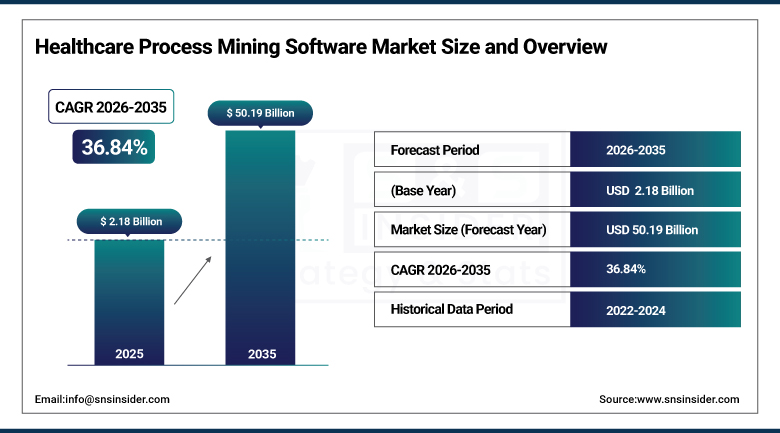
The Healthcare Process Mining Software Market was valued at USD 2.18 Billion in 2025 and is estimated at USD 2.98 Billion in 2026. It is projected to reach USD 50.19 Billion by 2035, advancing at a CAGR of 36.84% from 2026 to 2035. Process mining software reads event logs from electronic health records, billing systems, and scheduling tools to reconstruct how work actually flows through a hospital or payer. Providers use it to find delays in admissions, discharge, claims handling, and prior authorization, and to prove that corrective changes deliver measurable savings.
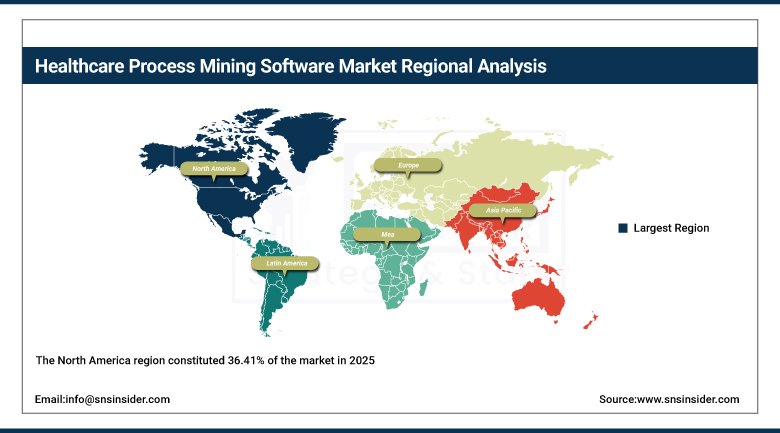
North America was the largest regional market in 2025 with a 36.41% share, supported by large health systems, complex payer workflows, and early use of process intelligence platforms. Europe follows as hospital networks and insurers digitize administrative work. Asia Pacific is expected to register the fastest expansion over the forecast period because China, India, Japan, and Australia are modernizing hospital information systems and investing in cloud analytics. Latin America and Middle East & Africa are smaller but are growing as private hospital groups and national digital health programs introduce analytics tools.
To Get more information On Healthcare Process Mining Software Market - Request Free Sample Report
Key Report Takeaways
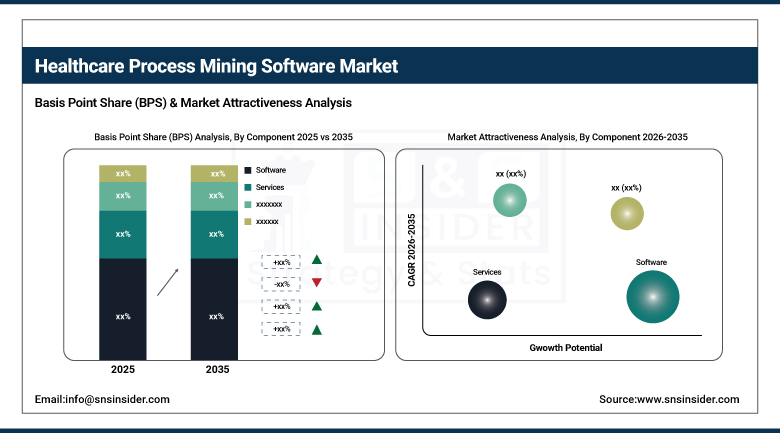
- By component, software held a 70.38% share in 2025, while services are the fastest growing.
- By process type, process discovery accounted for a 46.37% share in 2025, while conformance and compliance monitoring is the fastest growing.
- By application, claims and revenue cycle management represented a 34.52% share in 2025, while patient admissions and discharge management is the fastest growing.
- By end user, hospitals and health systems commanded a 58.14% share in 2025, while payers are the fastest growing.
- By region, North America led with a 36.41% share in 2025, while Asia Pacific is the fastest growing.
Market Trends and Insights
Process mining is converging with artificial intelligence. Vendors are adding language models and software agents that explain bottlenecks in plain language, recommend fixes, and in some cases act on them, which shifts the product from a diagnostic tool to an operational one that works alongside automation platforms.
Revenue cycle and prior authorization have become the first priority. Denied claims, slow approvals, and manual rework are measurable in event data, so finance leaders can build a business case quickly and track returns within a few quarters, which makes these workflows an easy entry point for new customers.
Consolidation is reshaping the supplier base. Large software groups are acquiring independent process mining specialists to embed the technology in broader automation, customer relationship, and enterprise platforms.
Cloud delivery and data sharing partnerships are lowering barriers. Hospitals can connect health record and billing data to cloud analytics platforms without building new infrastructure.
Drivers Impact Analysis
|
Driver |
(~) Percentage Point Impact on Market CAGR |
Geographic Relevance |
Impact Timeline |
|---|---|---|---|
|
Need for Operational Efficiency and Cost Control |
+14.62% |
Global, strongest in North America and Europe |
Short term (2 years or less) |
|
Payer Mandates on Prior Authorization and Interoperability |
+11.48% |
United States and Europe |
Short term (2 years or less) |
|
EHR Data Growth and Process Transparency |
+8.73% |
North America, Europe, and Asia Pacific |
Medium term (2 to 4 years) |
|
Healthcare Workforce Shortage and Burnout |
+6.55% |
Global |
Medium term (2 to 4 years) |
|
Cloud Delivery and AI Integration |
+4.37% |
North America and Asia Pacific |
Long term (4 years or more) |
Need for Operational Efficiency and Cost Control
Hospitals and payers operate under tight margins, and administrative waste is a large share of total spending. Process mining shows exactly where patients wait, where claims stall, and where staff repeat work, which allows managers to target improvements instead of relying on estimates. Leaders can compare departments, test changes, and verify savings with the same data. Because projects often pay back within months, finance teams are willing to fund them, and early successes lead to wider rollouts across emergency, surgical, and revenue cycle operations.
Payer Mandates on Prior Authorization and Interoperability
Regulators are forcing payers and providers to speed up approvals and share data. Under the federal interoperability and prior authorization rule, payers must decide urgent requests within 72 hours and standard requests within seven calendar days, with these timeframes applying from 2026. They must also explain denials and publish performance metrics. Meeting these obligations requires visibility into every step of the approval process, which makes process mining a practical compliance tool for both insurers and the hospitals that submit requests.
EHR Data Growth and Process Transparency
Electronic health records, scheduling platforms, and billing systems now record every action as a timestamped event. This creates a rich source of data that process mining software can turn into maps of real care pathways. Clinicians and administrators can see variation between units, identify delays in imaging or laboratory work, and measure compliance with care protocols. As more hospitals complete digital transformation programs, the volume of usable event data keeps rising, which widens the range of problems that the software can address.
Healthcare Workforce Shortage and Burnout
The World Health Organization projects a shortfall of 11.1 million health workers by 2030, and many hospitals already struggle to staff units. Administrative burden is a major source of burnout, so providers look for ways to remove unnecessary steps, duplicate documentation, and avoidable handoffs. Process mining identifies these inefficiencies and supports automation of repetitive tasks, freeing nurses and clerical staff for patient-facing work. Organizations that reduce friction can also improve retention, which has become a strategic priority for hospital executives.
Cloud Delivery and AI Integration
Cloud platforms allow vendors to deploy process mining without lengthy installations, and subscription pricing lowers the entry cost for mid-sized hospitals. Integration with artificial intelligence makes the results easier to use, since managers can ask questions in natural language and receive suggested actions. Partnerships between process mining vendors, data platform providers, and automation companies connect analysis to execution, so that a detected bottleneck can trigger a software robot or workflow change. These advances broaden the customer base. Mid-sized hospitals benefit most.
Restraints Impact Analysis
|
Restraint |
(~) Percentage Point Impact on Market CAGR |
Geographic Relevance |
Impact Timeline |
|---|---|---|---|
|
Data Privacy and Security Requirements |
-3.62% |
North America and Europe |
Long term (4 years or more) |
|
Fragmented Data and Integration Complexity |
-2.97% |
Global |
Medium term (2 to 4 years) |
|
Shortage of Skilled Analysts and Change Resistance |
-1.64% |
Global, strongest in Latin America and Middle East & Africa |
Medium term (2 to 4 years) |
|
High Implementation Cost |
-0.68% |
Emerging markets and smaller hospitals |
Short term (2 years or less) |
Data Privacy and Security Requirements
Process mining works on event logs that can reveal patient identities, diagnoses, and treatment sequences, so providers must apply strict controls before sharing data with analytics vendors. The European Health Data Space regulation, which entered into force in March 2025, requires permits, secure processing environments, and safeguards against re-identification for secondary use of health data. Compliance reviews lengthen sales cycles, and many hospitals limit projects to anonymized data sets, which reduces the depth of analysis and slows adoption. Vendors respond with privacy-preserving architectures.
Fragmented Data and Integration Complexity
Hospitals typically run dozens of systems for records, billing, laboratory work, imaging, and scheduling, and these systems record events in different formats. Preparing the data so that each patient journey or claim can be followed from start to finish takes considerable effort. Missing timestamps, inconsistent codes, and legacy interfaces can delay projects by months. Until interoperability improves, implementation complexity will limit the speed at which new customers move from pilots to full deployments. Vendors are building prebuilt connectors to reduce this burden.
Shortage of Skilled Analysts and Change Resistance
The implementation of process maps will require analysts who can understand data as well as the clinical processes, but such individuals are rare. Clinicians may also be wary of technologies that seem to rate their performance, while departments may be unwilling to change their processes which have served them for many years. Processes within healthcare differ greatly among patients, making it difficult to create benchmarks. Unless there is good sponsorship and training, projects will get stuck at the discovery phase and fail to realize cost savings.
High Implementation Cost
Licenses, data engineering, integration work, and consulting fees can make initial projects expensive, especially for smaller hospitals and organizations in emerging markets. Budgets are often committed to clinical equipment and core record systems first, leaving less room for analytics. Subscription pricing and cloud delivery are easing the burden, but buyers still need clear evidence of returns before they commit. Smaller hospitals may also lack the internal data engineering staff needed to prepare event logs, so they depend on external partners whose fees add to project cost.
Healthcare Process Mining Software Market Segment Analysis
By Component, Software Dominates Healthcare Process Mining Software Market; Services to Register Fastest Growth.
Software is the main platform for collecting events data, creating process maps, and monitoring conformance becomes the core of the purchasing decision. Licenses and subscriptions represent recurrent income stream for vendors, who keep developing analytics capabilities, dashboards, and health record system connectors. Big health care organizations are inclined to buy the platform and use it company-wide. In 2025, software represented 70.38% of the market share. Compatibility with leading health record systems further increases the value of established platforms for large organizations.
Services are the fastest-growing segment due to the need for assistance with data extraction, project design, change management, and training. Consulting companies and vendors are offering packaged solutions that include both technology and operations management knowledge. Managed services provide even those hospitals that lack analytical capability with an opportunity to benefit from the solution. Services are expected to develop at a CAGR of 39.17% from 2026 to 2035. Programs for training, user community creation, and certification are getting more and more popular.
By Process Type, Process Discovery Dominates Healthcare Process Mining Software Market; Conformance and Compliance Monitoring to Register Fastest Growth.
Process discovery holds the top position because most projects begin by mapping how patients, claims, and orders actually move through systems. Managers use these maps to find delays, rework, and unexpected variants that were not visible in reports. Discovery is relatively easy to demonstrate and requires only event logs, which makes it the standard first step. Process discovery represented 46.37% of the market in 2025. Its results are also easy to share with senior executives and clinical leaders.
Conformance and compliance monitoring is growing fastest as regulators and payers demand evidence that required steps are followed. Software compares actual behavior with approved pathways and alerts managers to deviations in prior authorization, documentation, and billing. Rising audit pressure supports a CAGR of 40.92% from 2026 to 2035. Hospitals must document adherence to protocols for infection control, medication handling, and surgical safety, and automated monitoring reduces the manual sampling that auditors traditionally rely on during routine reviews and inspections.
By Application, Claims and Revenue Cycle Management Dominates Healthcare Process Mining Software Market; Patient Admissions and Discharge Management to Register Fastest Growth.
Claims and revenue cycle management takes precedence as processes involving billing, denials, and collections provide clear financial insight and quick turnaround. The providers deploy process mining to identify issues regarding claim denial reasons, payment delays, and actions causing manual processes. Similarly, payers use process mining for claims adjudication and prior authorization. Application in this area was responsible for 34.52% share of the market in 2025. Another reason for popularity among finance professionals is that benefits of process mining are measured in terms of savings, delays, and denial rates comprehensible to the board.
Patient admission and discharge management is experiencing the fastest growth as hospitals try to shorten waiting times, release beds, and streamline patients' process. ED events, ward events, and transportation events are the sources of the delay causes and improvements provide tangible value. It is expected that segment will progress at CAGR of 41.26% during 2026-2035. Furthermore, analytics team can connect delays to the number of available staff and beds, allowing leadership to target additional resources at most beneficial areas.
By End User, Hospitals and Health Systems Dominate Healthcare Process Mining Software Market; Payers to Register Fastest Growth.
Hospitals and health systems lead because they run the most complex operations, with thousands of daily events across clinical, administrative, and supply processes. Large systems have the data infrastructure and executive support needed to fund enterprise licenses. Pressure to cut costs and improve patient flow makes them the main buyers. Hospitals and health systems held 58.14% of the market in 2025. Dedicated operations excellence teams within these organizations also sponsor projects and track results across many facilities and service lines.
Payers are growing fastest as prior authorization rules, claims volumes, and member service demands raise the need for transparent workflows. Insurers use process mining to shorten decision times, detect avoidable denials, and document compliance. Growing investment in digital operations supports a CAGR of 40.38% from 2026 to 2035. Large national and regional insurers process millions of claims and authorization requests each year, so even small improvements in cycle time produce meaningful savings and better member satisfaction scores for health plans.
Geography Analysis
|
Region |
Major Country |
Share within Region, 2025 (%) |
|---|---|---|
|
North America |
United States |
82.36% |
|
Europe |
Germany |
24.91% |
|
Asia Pacific |
China |
38.27% |
|
Middle East & Africa |
Saudi Arabia |
30.84% |
|
Latin America |
Brazil |
44.63% |
North America Healthcare Process Mining Software Market
The North America region constituted 36.41% of the market in 2025. The region has integrated health systems, complicated payer-provider relationship, and high adoption of electronic records. The vendors operating from the region are offering advanced platforms, and the consulting organizations assist with the implementations. The cost pressure to reduce administrative expenses sustains the demand. The consulting organizations, system integrators, and cloud vendors assist with the projects, and the executives' interest in artificial intelligence makes the health systems move to more sophisticated operations. The successful implementation stories in large hospitals also motivate the peers.
The United States provided a revenue of USD 653.70 Million in 2025 and would register a CAGR of 35.72% between 2026 and 2035. The prior authorization regulations, denial management requirements, and margin pressures of hospitals make the hospitals adopt the solutions. The activities in Canada would come from the provincial health authorities that are analyzing wait times and surgery backlogs. Enterprise implementations have started with the large integrated health networks and academic medical centers, and the payers are using the technology for their utilization management and member services operations.
Get Customized Report as per Your Business Requirement - Enquiry Now
Europe Healthcare Process Mining Software Market
Europe holds the second-largest regional position, with strong activity in Germany, the United Kingdom, the Netherlands, and the Nordic countries. Public hospital networks and statutory insurers use process mining to improve patient pathways and control costs. Digitalization programs have increased the volume of event data available for analysis. Strong public investment in digital health infrastructure, together with efforts to cut waiting times for elective surgery and diagnostic imaging, gives hospital managers a clear and practical reason to adopt process analytics at scale.
Data protection law shapes deployments, since providers must meet strict privacy requirements and often prefer vendors that host data within the region. Several European software groups are active in process mining, and national health systems have run projects on waiting lists, emergency flow, and insurer operations. Insurers in Germany and France are also testing the software on claims handling and fraud detection workflows, while hospital groups use it to coordinate operating rooms, outpatient clinics, and discharge planning across multiple hospital sites.
Asia Pacific Healthcare Process Mining Software Market
Asia Pacific is the region growing at the fastest pace, forecasted to grow at a CAGR of 40.67% during 2026 to 2035. China and India are developing large-scale digital hospitals, while Japan, South Korea, and Australia are investing in efficiency programs for elderly populations. The newly developed systems collect large amounts of event data right from the beginning, making it suitable for process analysis. The financial support for hospital digitization and smart health programs from governments, especially in Singapore and South Korea, provide the basis for providers to implement analytics in their daily activities in large hospital networks.
The cloud is being adopted quickly and international providers are partnering with regional system integrators to access hospitals. Private hospitals are among the first customers, since they are competing on quality of services and cost of treatment. Variations in data localization policies and record standards still require regional approach. Large private hospital chains in India use the technology to compare performance between facilities, while Chinese technology providers develop localized solutions for data-driven hospital operations. Australia and New Zealand include early adoption from the government agencies focused on the efficiency of hospital emergency departments.
Latin America Healthcare Process Mining Software Market
Latin America is dominated by Brazil, where large private hospital networks and insurers have already started leveraging process analytics for cost control and minimizing denials. Mexico, Chile, and Colombia create additional demand due to the digitization of billing and appointment scheduling for private providers. Insurers from the region cope with increasing costs of medical treatment and complicated claims processes, which makes them analyze workflows related to approval and payments. Top Brazilian and Mexican hospitals launch pilots with global vendors and influence budgetary decisions with initial outcomes.
Budget limitations, low adoption of electronic records, and a lack of analytics expertise limit the market growth, especially in public hospitals. Cloud-based offerings with managed services allow lowering upfront cost, and global players cooperate with local partners. With growing digital maturity, process mining is expected to be more popular. Regulatory agencies in Brazil promote electronic medical records and interoperability, which positively influences the quality of data for analytics, and associations of hospitals in Chile and Colombia exchange experience in workflow optimization. Vendor support in Portuguese and Spanish and regional clouds provide competitive advantage.
Middle East & Africa Healthcare Process Mining Software Market
Middle East & Africa remains the smallest region, though Gulf countries are investing in new hospitals and digital health programs. Saudi Arabia and the United Arab Emirates have national strategies that encourage data-driven operations, and large public and private hospital groups are testing process analytics. Healthcare transformation programs linked to national visions encourage hospitals to adopt data platforms, and international vendors and consultants are opening regional offices to support large public and private projects, particularly in the Gulf countries and other fast-growing markets.
In Africa, adoption is limited by funding and infrastructure, but a few large private hospital groups and development projects have started to examine patient flow and supply chains. South Africa has the most developed market. Growth will depend on stronger digital systems and trained analysts. Hospital groups in South Africa, Kenya, and Nigeria are exploring analytics to manage supply chains and patient scheduling, and donor-funded health information systems are slowly generating the structured data needed for future process analysis projects across the continent.
Competitive Landscape
The market is fragmented. Process intelligence specialists, enterprise software groups, automation platforms, and smaller specialist providers all compete, and no single company controls a large share of healthcare revenue. Competition depends on connectors to health record systems, depth of healthcare templates, artificial intelligence features, and pricing. Many buyers evaluate several platforms before choosing one.
Vendors pursue acquisitions, platform launches, and partnerships. Large software companies buy specialists to embed mining in wider offerings, while independent vendors form alliances with data platform providers and consultancies. Product work centers on language model assistants, task mining, and tools that link detection of a problem to automated correction.
Healthcare Process Mining Software Market Industry Leaders
1. Celonis: Process intelligence platform with a dedicated solution for healthcare providers.
2. UiPath: Automation platform that combines process and task mining with agentic automation for healthcare administration.
3. Microsoft: Provider of Power Automate Process Mining within its business applications platform.
4. IBM: Provider of IBM Process Mining for hybrid and on-premises environments.
5. SAP: Provider of SAP Signavio, a process intelligence suite linked to its enterprise applications.
Companies Covered in this Report
- Celonis
- UiPath
- Microsoft
- IBM
- SAP
- ARIS
- Appian
- QPR Software
- Skan AI
- Fluxicon
- iGrafx
- ABBYY
- Pegasystems
- Salesforce
Recent Industry Developments
- March 2025: The European Health Data Space regulation entered into force, setting rules for access to health data for primary and secondary use.
- March 2025: Coronis Health, a revenue cycle management provider, signed for access to the UiPath platform, with task and process mining among the technologies to be integrated.
- May 2025: The World Health Assembly received a report projecting a shortfall of 11.1 million health workers by 2030, strengthening the case for administrative automation.
- October 2025: Salesforce signed a definitive agreement to acquire Apromore, a process mining provider, and completed the acquisition in November 2025.
- January 2026: Payer decision timeframes under the federal interoperability and prior authorization rule began to apply, requiring responses to urgent requests within 72 hours.
- May 2026: An industry analyst ranking of process intelligence platforms was published for the first time, and SAP said Signavio was named a Leader.
- May 2026: Celonis agreed to acquire Ikigai Labs, an artificial intelligence company, and introduced the Celonis Context Model.
- August 2026: Skan AI raised a Series C funding round to expand its computer-vision process and task mining platform, with a stated plan to sell more into healthcare.
Scope and Research Methodology
This report defines the Healthcare Process Mining Software Market as the commercial value of software and related services that analyze event data from healthcare information systems to discover, monitor, and improve clinical, administrative, and financial processes. It covers platforms sold to hospitals, health systems, payers, and life sciences organizations. The base year is 2025, the forecast period runs from 2026 to 2035, and all values are stated in USD. Segmentation covers component, process type, application, end user, and region. Services include implementation, data preparation, and training offered with the software. Stand-alone general-purpose process mining sold outside healthcare is excluded from the scope of this assessment. Hardware is not part of the market definition.
The research program combines secondary and primary work. Secondary research draws on company annual reports, investor presentations and filings, regulator and government databases, trade association data, product documentation, and peer-reviewed and industry publications. Primary research consists of structured interviews and surveys with executives, product and business heads, implementation partners, and end-user stakeholders across the value chain. These conversations validate assumptions, adoption rates, and pricing. Interviews are structured around a consistent discussion guide so that responses can be compared across regions and stakeholder groups, and responses are anonymized before analysis to encourage candid views on pricing and performance.
Market engineering follows a bottom-up build from vendor revenue and deployment data, cross-checked top-down against hospital technology spending and payer administrative cost. Estimates are triangulated across these routes until the results converge within an acceptable range. Forecasts incorporate adoption, regulation, technology change, and macroeconomic conditions, and senior analysts review every estimate and narrative section. Where information is limited, assumptions are documented and tested through scenario analysis. Sensitivity checks examine adoption speed, pricing, and regulatory timelines, and results are cross-checked against expert feedback before they are finalized for publication. Each estimate is reviewed independently by two analysts.
Healthcare Process Mining Software Market Report Scope:
| Report Attributes | Details |
|---|---|
| Market Size in 2025 | USD 2.18 Billion |
| Market Size by 2035 | USD 50.19 Billion |
| CAGR | CAGR of 36.84% From 2026 to 2035 |
| Base Year | 2025 |
| Forecast Period | 2026-2035 |
| Historical Data | 2022-2024 |
| Report Scope & Coverage | Market Size, Segments Analysis, Competitive Landscape, Regional Analysis, DROC & SWOT Analysis, Forecast Outlook |
| Key Segments | • By Component (Software and Services) • By Process Type (Process Discovery, Conformance and Compliance Monitoring, Process Enhancement, and Others) • By Application (Claims and Revenue Cycle Management, Patient Admissions and Discharge Management, Clinical Pathway Analysis, Supply Chain and Procurement, and Others) • By End User (Hospitals and Health Systems, Payers, Life Sciences Organizations, and Others) |
| Regional Analysis/Coverage | North America (US, Canada), Europe (Germany, UK, France, Italy, Spain, Russia, Poland, Rest of Europe), Asia Pacific (China, India, Japan, South Korea, Australia, ASEAN Countries, Rest of Asia Pacific), Middle East & Africa (UAE, Saudi Arabia, Qatar, South Africa, Rest of Middle East & Africa), Latin America (Brazil, Argentina, Mexico, Colombia, Rest of Latin America). |
| Company Profiles | Celonis, UiPath, Microsoft, IBM, SAP, ARIS, Appian, QPR Software, Skan AI, Fluxicon, iGrafx, ABBYY, Pegasystems, Salesforce |

Frequently Asked Questions
The market was valued at USD 2.18 Billion in 2025 and is estimated at USD 2.98 Billion in 2026. It is projected to reach USD 50.19 Billion by 2035.
The market is projected to expand at a CAGR of 36.84% from 2026 to 2035.
North America led with a 36.41% share in 2025. Asia Pacific is the fastest-growing region, with a CAGR of 40.67% from 2026 to 2035.
Software, process discovery, claims and revenue cycle management, and hospitals and health systems lead their axes. Services, conformance and compliance monitoring, patient admissions and discharge management, and payers grow fastest.
Celonis, UiPath, Microsoft, IBM, and SAP are the leading providers.
