
High Content Screening Market Report Scope and Overview:
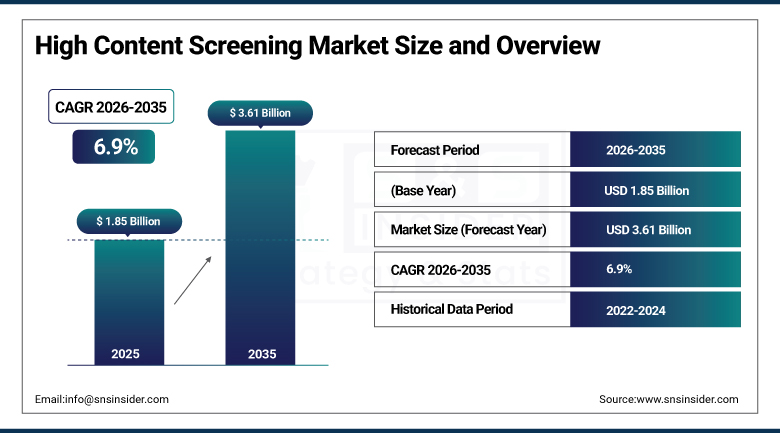
The High Content Screening Market was valued at USD 1.85 Billion in 2025 and is projected to reach USD 3.61 Billion by 2035, registering a CAGR of 6.9% from 2026 to 2035.
The High Content Screening Market is reshaping early-stage drug discovery and cell biology research by combining automated fluorescence microscopy, multiparametric image analysis, and AI-driven data interpretation into a single integrated workflow. The market is characterized by rising adoption of phenotypic screening across oncology, neuroscience, and toxicology programs, growing use of three-dimensional cell models such as organoids and spheroids, and deeper integration of artificial intelligence into image classification and quantification software. Substantial growth is being witnessed in the deployment of confocal and spinning-disk imaging platforms, cloud-connected analytics, and CRO-led screening services, considering that pharmaceutical companies, biotechnology firms, and academic research institutes continue investing heavily in automated, high-throughput imaging infrastructure that can shorten preclinical timelines while extracting deeper biological insight from existing and newly generated compound libraries.
Molecular Devices launched its ImageXpress HCS.ai High-Content Screening System throughout 2025, built on proprietary AgileOptix dual-spinning-disk technology and paired with AI-powered IN Carta image analysis software, giving pharmaceutical and academic laboratories across the United States faster, more automated phenotypic screening workflows.
To Get more information On High Content Screening Market - Request Free Sample Report
High Content Screening Market Trends
-
Growing integration of artificial intelligence continues improving the speed and accuracy of phenotypic image analysis.
-
Rising adoption of three-dimensional organoid and spheroid models continues expanding assay biological relevance.
-
Increasing use of high-content screening in toxicology continues supporting earlier compound attrition decisions.
-
Expanding CRO-led screening services continue giving smaller biotech firms access to advanced imaging infrastructure.
-
Growing deployment of cloud-connected analytics software continues extending the productive life of imaging hardware.
The U.S. High Content Screening Market Outlook
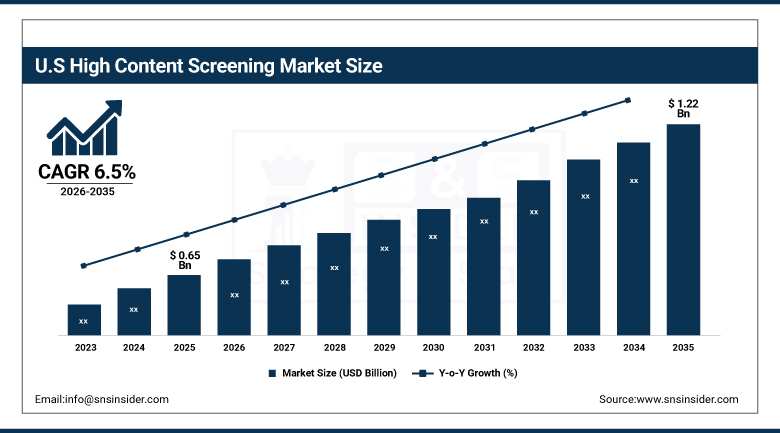
The U.S. High Content Screening Market was valued at approximately USD 0.65 Billion in 2025 and is projected to reach approximately USD 1.22 Billion by 2035, registering a CAGR of approximately 6.5% from 2026 to 2035.
Demand across the United States continued to be shaped by a deep concentration of leading pharmaceutical companies, contract research organizations, and instrument manufacturers headquartered domestically, alongside sustained National Institutes of Health funding for translational and precision-medicine research programs. Rising deployment of AI-enabled imaging platforms by large biopharma organizations running lead-optimization programs continued reinforcing the country's position as both an early adopter and a genuine innovation hub for high-content screening technology. Growing adoption across academic medical centers, government research institutes, and mid-sized biotechnology firms added further layers of sustained domestic demand well beyond the technology's original pharmaceutical-screening use case, with toxicology testing and phenotypic drug-repurposing programs increasingly relying on automated, image-based cellular analysis.
Revvity continued expanding its high-content imaging portfolio throughout the year, unveiling the Opera Phenix OptIQ high-content screening system and Phenologic.AI image analysis software at SLAS2026 in Boston, giving American drug-discovery laboratories quantitative imaging capability across complex 3D organoid and organ-on-chip models.
High Content Screening Market Segment Analysis
-
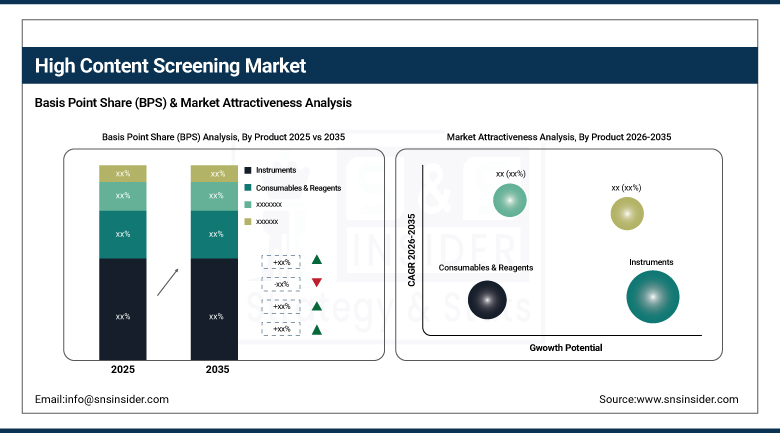
By Product, Instruments segment dominated the High Content Screening Market in 2025 with 43.10% share; Software segment is the fastest growing segment, registering a CAGR of 5.93%.
-
By Technology, 2D Cell Culture-based HCS segment dominated the market in 2025 with 54.23% share; 3D Cell Culture-based HCS segment is the fastest growing segment, registering a CAGR of 8.5%.
-
By Application, Drug Discovery & Development segment dominated the market in 2025 with 47.08% share; Phenotypic, Stem Cell & Cancer Research segment is the fastest growing segment, registering a CAGR of 8.8%.
-
By End-User, Pharmaceutical & Biotechnology Companies segment dominated the market in 2025 with 50.01% share; Contract Research Organizations (CROs) segment is the fastest growing segment, registering a CAGR of 6.74%.
By Product, Instruments Dominated the Market, Software Emerges as Fastest-Growing Segment
The Instruments segment dominated the High Content Screening Market in 2025, driven by sustained capital investment in automated fluorescence microscopes, confocal and spinning-disk imagers, robotic plate handlers, and integrated liquid-handling systems across pharmaceutical, biotechnology, and academic research laboratories. The build-out of high-throughput phenotypic screening capacity across large biopharma organizations has necessitated substantial spending on imaging hardware capable of processing thousands of microplate wells per day with consistent optical quality. Increasing use of confocal and spinning-disk architectures, environmental control chambers, and AI-integrated camera systems in commercial drug-discovery and government-funded research networks has reinforced instrument revenues, which continue to contribute the largest share of total market spending as laboratories replace legacy widefield systems with faster, higher-resolution platforms capable of supporting complex three-dimensional cell models.
The Software segment is the fastest growing in the High Content Screening Market owing to rising demand for AI-powered image classification, cloud-connected analytics, and subscription-based data management platforms that extend the useful life of existing imaging hardware. The increasing commercialization of automated phenotypic screening has driven demand for deep-learning image segmentation, organoid and spheroid quantification algorithms, and remote collaboration tools that let distributed research teams interpret large imaging datasets without duplicating instrument investment. Regular algorithm updates, expanding pre-trained model libraries, and growing regulatory emphasis on reproducible, auditable image-analysis workflows have become crucial as more pharmaceutical companies and contract research organizations scale their screening programs across multiple sites and therapeutic areas.
By Technology, 2D Cell Culture-Based HCS Dominated the Market, 3D Models Gain Fastest Momentum
The 2D Cell Culture-based HCS segment dominated the High Content Screening Market because of its established assay protocols, lower per-well reagent costs, and broad compatibility with existing automated imaging and liquid-handling infrastructure across pharmaceutical and academic laboratories. Decades of validated 2D monolayer assay development have made this technology the default starting point for primary compound screening, toxicity testing, and target-validation programs across most drug-discovery pipelines. High levels of familiarity among laboratory personnel, together with the technology's compatibility with standard microplate formats and existing image-analysis software libraries, sustained its use across pharmaceutical, academic, and contract research screening applications throughout the base year.
The 3D Cell Culture-based HCS segment is the fastest growing due to rising adoption of organoid, spheroid, and organ-on-chip models that better replicate human tissue architecture and drug response than traditional monolayer cultures. Technological innovations in confocal z-stacking, light-sheet imaging, and AI-based volumetric image reconstruction are improving throughput and reducing analysis time for these inherently more complex biological models. Growing pharmaceutical industry interest in translational predictivity, reduced reliance on animal testing, and oncology and neuroscience disease modeling continues boosting the growth of 3D-based screening adoption across the broader high-content imaging market.
By Application, Drug Discovery & Development Dominated the Market, Phenotypic, Stem Cell & Cancer Research Grows Fastest
The Drug Discovery & Development segment dominated the High Content Screening Market due to the central role phenotypic imaging plays in hit identification, lead optimization, mechanism-of-action studies, and early safety profiling across pharmaceutical and biotechnology pipelines. Large biopharma organizations routinely run parallel phenotypic experiments across thousands of compounds each quarter, embedding automated high-content imaging deep into lead-optimization workflows where it accelerates candidate triage and reduces reliance on more expensive downstream biochemical and animal studies. Increased pipeline investment in oncology, neuroscience, and immunology programs, combined with growing use of patient-derived cell models, contributed to sustained segment dominance throughout the base year.
The Phenotypic, Stem Cell & Cancer Research segment is the fastest growing as academic and translational research laboratories increasingly apply high-content imaging to disease modeling, induced pluripotent stem cell characterization, and patient-derived tumor organoid profiling. Rising government and foundation funding for precision oncology and regenerative medicine research continues expanding this segment beyond its traditional pharmaceutical-screening base. Growing use of multiplexed immunofluorescence panels, single-cell resolution analysis, and machine-learning-based phenotype classification is helping researchers extract richer biological insight from limited, often irreplaceable patient-derived samples, driving faster adoption across specialized cancer and stem-cell research centers worldwide.
By End-User, Pharmaceutical & Biotechnology Companies Dominated the Market, Contract Research Organizations (CROs) Grow Fastest
The Pharmaceutical & Biotechnology Companies segment dominated the High Content Screening Market due to their direct control over early-stage research pipelines and substantial internal investment in automated screening infrastructure. Continuous system upgrades toward higher-throughput confocal and spinning-disk architectures, combined with in-house bioinformatics teams capable of managing large imaging datasets, reinforced long-term dependency on internally operated high-content screening infrastructure among large and mid-sized pharmaceutical organizations. Sustained R&D budgets directed toward oncology, immunology, and central-nervous-system drug discovery programs kept internal screening capacity firmly ahead of outsourced alternatives across most major pharmaceutical hubs throughout the base year.
The Contract Research Organizations (CROs) segment is expected to witness the fastest growth in the High Content Screening Market as more phenotypic screening campaigns are being co-developed and outsourced by smaller biotechnology firms lacking the capital budgets for in-house imaging infrastructure. Growing numbers of virtual and asset-centric biotech companies increasingly rely on CRO partners for end-to-end screening, from assay development through data interpretation, allowing them to access state-of-the-art confocal and AI-analysis platforms without large upfront capital commitments. Expanding CRO service portfolios covering toxicology, ADME, and 3D organoid screening continue attracting a broadening base of emerging biopharma clients.
Regional Analysis
|
Region |
Major Country |
Share within Region, 2025 (%) |
|---|---|---|
|
North America |
United States |
84.20% |
|
Europe |
Germany |
23.40% |
|
Asia Pacific |
China |
29.60% |
|
Middle East and Africa |
UAE |
25.10% |
|
Latin America |
Brazil |
33.80% |
North America High Content Screening Market Insights
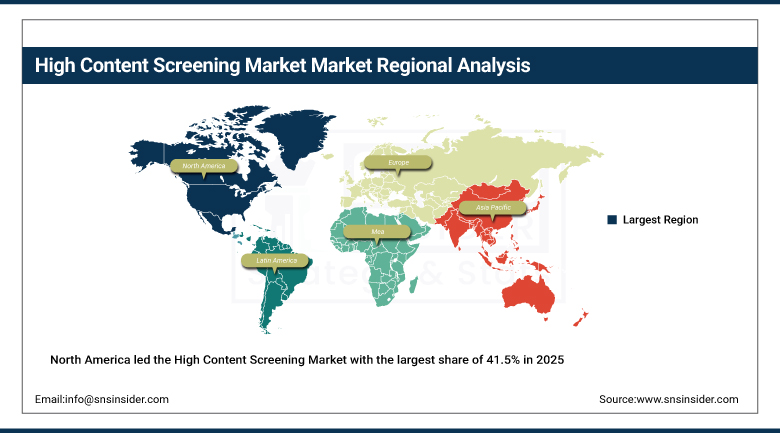
North America led the High Content Screening Market with the largest share of 41.5% in 2025. Strong pharmaceutical and biotechnology R&D spending, a dense concentration of contract research organizations, and sustained National Institutes of Health and Department of Defense funding for translational and precision-medicine research continued reinforcing this dominant regional position. A deep concentration of leading instrument manufacturers, software developers, and academic medical centers headquartered across the continent gave regional laboratories early access to next-generation confocal, spinning-disk, and AI-enabled imaging platforms well ahead of most other regions.
The United States accounted for roughly 84.20% of regional revenue, anchored by a dense cluster of large pharmaceutical companies, well-funded biotechnology startups, and academic research institutions running high-throughput phenotypic screening programs across oncology, neuroscience, and toxicology. Canada added further regional demand through its own growing biotechnology sector and government-backed genomics and precision-medicine initiatives, and that combined strength kept the continent the largest addressable market for high-content screening vendors through the forecast period.
Get Customized Report as per Your Business Requirement - Enquiry Now
Europe High Content Screening Market Insights
Europe held a meaningful share of global revenue, supported by substantial government and European Research Council funding for translational research, precision oncology, and regenerative medicine programs across the region's major economies. Regulatory harmonization around laboratory data standards and continued expansion of academic-industry research consortia continued lowering historically significant barriers to advanced imaging technology adoption across the continent.
Germany led demand at roughly 23.40% of European revenue, supported by its substantial pharmaceutical and academic research base, including leading research institutes running large-scale phenotypic screening programs. The UK and France contributed substantial additional demand through their own well-funded biotechnology clusters, and continued European investment in translational research infrastructure should keep regional demand for high-content screening technology climbing through the forecast period.
Asia Pacific High Content Screening Market Insights
Asia Pacific is advancing at the fastest pace among all regions tracked in this report, growing at a CAGR of approximately 8.7% from 2026 to 2035, driven by rapid expansion of domestic pharmaceutical and biotechnology manufacturing capacity, growing government-backed investment in genomics and precision-medicine research, and rising academic research output across the region's largest economies. That combination of manufacturing scale and genuine research capacity across a rapidly expanding pool of domestic biotechnology firms kept the region's growth trajectory well ahead of every other region tracked in this report.
China led the pack, supported by substantial government investment in domestic biotechnology innovation and expanding contract research organization capacity. Japan and India contributed meaningful additional demand, with India's fast-growing contract research sector and Japan's advanced pharmaceutical manufacturing capability both reinforcing the region's position as the fastest-growing market tracked in this report.
MEA and Latin America High Content Screening Market Insights
The Middle East and Africa and Latin America both showed steady growth, driven by expanding academic research infrastructure, growing government focus on biotechnology self-sufficiency, and rising demand for locally accessible drug-discovery and diagnostic research capability across both areas. As these markets continued building out modern life-sciences infrastructure, high-content screening technology proved a genuinely efficient way to establish advanced research capability without the decades-long buildout wealthier nations required.
The UAE led Middle East and Africa demand, supported by the country's growing biotechnology investment and expanding academic research partnerships. Saudi Arabia contributed further demand through its own life-sciences diversification programs. In Latin America, Brazil accounted for the largest share of regional revenue, with growing pharmaceutical manufacturing capacity and academic research investment continuing to anchor regional demand for high-content screening technology.
Market Dynamics
Growth Drivers: Rising Adoption of AI-Enabled Phenotypic Screening and 3D Cell Models
The industry is driven by rising adoption of artificial intelligence-enabled image analysis, expansion of three-dimensional cell culture models, increasing integration of automated imaging with laboratory informatics systems, and growing adoption across pharmaceutical, biotechnology, academic, and contract research screening programs. As the volume of compound libraries and the complexity of biological models continue to rise, the need for faster, more accurate, and more reproducible phenotypic screening continues driving adoption of high-content screening technologies.
Rising investment in AI-powered image classification continues reinforcing this driver, as deep-learning algorithms increasingly automate cell segmentation, phenotype scoring, and organoid quantification tasks that once required extensive manual review by trained laboratory personnel. Growing standardization of imaging data formats and analysis pipelines across vendor ecosystems continues improving interoperability between instruments, software, and laboratory information management systems, and that combination of automation and standardization is exactly what keeps demand climbing at such a steady, sustained pace.
Restraints: High Instrument Costs and Data Management Complexity
The substantial capital investment required for advanced confocal and spinning-disk imaging instrumentation continues posing a genuine restraint on faster market-wide expansion, particularly for smaller academic laboratories and early-stage biotechnology firms without the capital budgets that established pharmaceutical companies and large contract research organizations can commit. That cost profile has kept large-scale, in-house high-content screening capacity concentrated among a comparatively small number of well-resourced organizations.
Data management complexity across large, multi-terabyte imaging datasets continues posing a further restraint, as storing, curating, and analyzing high-resolution image files across distributed research teams requires genuine informatics investment that remains an ongoing, evolving challenge for many laboratories. That complexity keeps some smaller research organizations reliant on outsourced screening services rather than building independent high-content imaging capability of their own.
Opportunities: 3D Organoid Screening and Emerging Market Research Capacity
Rising investment in three-dimensional organoid and organ-on-chip screening represents a genuinely significant opportunity, as pharmaceutical companies increasingly seek more physiologically relevant preclinical models that better predict human drug response and reduce late-stage clinical trial failure. Vendors positioned early in confocal and light-sheet imaging technology optimized for thick, three-dimensional tissue samples stand to capture meaningful share as this capability continues expanding from specialized research applications into mainstream drug-discovery workflows.
Closing research infrastructure gaps across emerging pharmaceutical markets offers a second substantial opportunity, as government initiatives aimed at building domestic biotechnology innovation capacity continue creating fresh demand for accessible, automated high-content screening infrastructure. Vendors with proven, cost-effective imaging and analysis platforms stand to capture meaningful share as developing economies increasingly view in-house phenotypic screening capability as a genuinely practical way to reduce dependency on outsourced Western research infrastructure.
Recent Developments:
-
2025: Becton, Dickinson and Company signed a collaboration agreement enabling integration of robotic liquid-handling arms with its flow cytometry equipment, aimed at accelerating high-content, high-throughput drug-discovery workflows.
-
2024: Yokogawa Electric Corporation launched its Cell Voyager CQ3000 High-Content Analysis System, combining an updated cell-observation platform with integrated image-analysis software for spinning-disk confocal screening.
-
2024: Thermo Fisher Scientific expanded its CellInsight CX7 LZR high-content analysis platform lineup with new laser-based confocal configurations designed for higher-throughput multiplexed screening applications.
High Content Screening Market key players are:
-
Thermo Fisher Scientific Inc.
-
Danaher Corporation
-
Revvity, Inc.
-
Merck KGaA
-
Becton, Dickinson and Company
-
Sartorius AG
-
Yokogawa Electric Corporation
-
Agilent Technologies, Inc.
-
Bio-Rad Laboratories, Inc.
-
Bruker Corporation
-
Tecan Group Ltd.
-
Corning Incorporated
-
Evident Corporation
-
Nikon Corporation
-
Carl Zeiss AG
-
Molecular Devices, LLC
-
Genedata AG
-
SPT Labtech Ltd.
-
IDEA Bio-Medical Ltd.
-
Vala Sciences, Inc.
High Content Screening Market Report Scope
| Report Attributes | Details |
|---|---|
| Market Size in 2025 | USD 1.85 Billion |
| Market Size by 2035 | USD 3.61 Billion |
| CAGR | CAGR of 6.9% From 2026 to 2035 |
| Base Year | 2025 |
| Forecast Period | 2026-2035 |
| Historical Data | 2022-2024 |
| Report Scope & Coverage | Market Size, Segments Analysis, Competitive Landscape, Regional Analysis, DROC & SWOT Analysis, Forecast Outlook |
| Key Segments | • By Product (Instruments, Consumables & Reagents, Software, Services) • By Technology (2D Cell Culture-based HCS, 3D Cell Culture-based HCS) • By Application (Drug Discovery & Development, Primary and Secondary Screening, Target Identification and Validation, Toxicology Testing, Phenotypic, Stem Cell and Cancer Research, Others) • By End-User (Pharmaceutical & Biotechnology Companies, Contract Research Organizations (CROs), Academic & Research Institutes, Others) |
| Regional Analysis/Coverage | North America (US, Canada), Europe (Germany, UK, France, Italy, Spain, Russia, Poland, Rest of Europe), Asia Pacific (China, India, Japan, South Korea, Australia, ASEAN Countries, Rest of Asia Pacific), Middle East & Africa (UAE, Saudi Arabia, Qatar, South Africa, Rest of Middle East & Africa), Latin America (Brazil, Argentina, Mexico, Colombia, Rest of Latin America). |
| Company Profiles | Thermo Fisher Scientific Inc., Danaher Corporation, Revvity, Inc., Merck KGaA, Becton, Dickinson and Company, Sartorius AG, Yokogawa Electric Corporation, Agilent Technologies, Inc., Bio-Rad Laboratories, Inc., Bruker Corporation, Tecan Group Ltd., Corning Incorporated, Evident Corporation, Nikon Corporation, Carl Zeiss AG, Molecular Devices, LLC, Genedata AG, SPT Labtech Ltd., IDEA Bio-Medical Ltd., Vala Sciences, Inc. |
Frequently Asked Questions
Key Players include Thermo Fisher Scientific Inc., Danaher Corporation, Revvity, Inc., Merck KGaA, and Becton, among others.
Key opportunities include AI-powered image analysis, 3D cell models, automated screening, phenotypic drug discovery, and expansion across toxicology and disease modeling offer significant growth opportunities.
The major growth factor is rising adoption of AI-enabled phenotypic image analysis, expansion of three-dimensional cell culture models, and increasing integration of automated imaging with laboratory informatics systems.
The Instruments segment dominated the High Content Screening Market by product, representing the largest share of revenue in 2025.
North America dominated the High Content Screening Market in 2025, holding an estimated 41.5% share of total global market revenue.
