
Microbial Fuel Cell Market Report Scope & Overview:
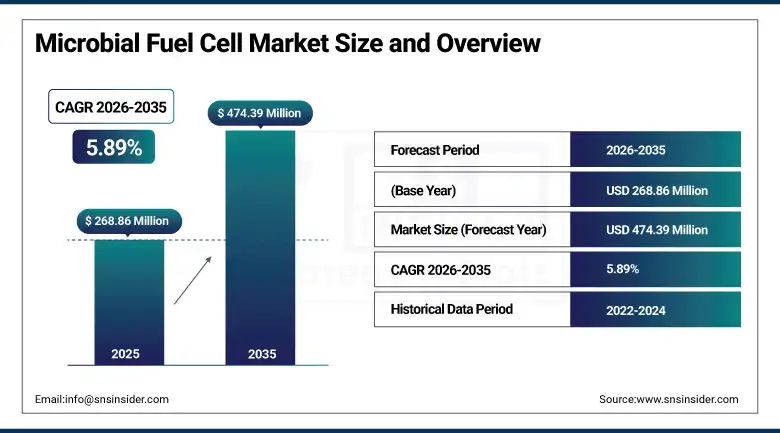
The Microbial Fuel Cell Market size was valued at USD 268.86 Million in 2025 and is expected to reach USD 474.39 Million by 2035, growing at a CAGR of 5.89% from 2026–2035.
The microbial fuel cell market is expanding due to the rising need for eco-friendly wastewater treatment methods and the increasing push for renewable energy. People are really getting behind this tech because it cleans water and makes electricity at the same time helping both industries and cities cut down on their environmental damage and energy bills. Investments in advanced materials like nanotechnology and better electrodes are boosting the market too. Plus, there's a lot more industrial wastewater projects, environmental monitoring efforts, and clean energy programs popping up everywhere. This surge is also being driven by researchers and tech developers working on bigger, more practical microbial fuel cell systems for real-world use.
China's wastewater treatment capacity exceeded 230 million cubic meters per day during 2025, creating significant opportunities for microbial fuel cell technologies in energy-efficient wastewater management.
To Get more information On Microbial Fuel Cell Market - Request Free Sample Report
Microbial Fuel Cell Market Trends
-
Increasing adoption of microbial fuel cells for simultaneous wastewater treatment and renewable electricity generation is driving market expansion.
-
Growing investments in advanced electrode materials and bio electrochemical technologies are improving system efficiency and commercial viability.
-
Rising demand for industrial wastewater treatment solutions is accelerating deployment of energy-efficient microbial fuel cell systems.
-
Expansion of environmental monitoring and biosensor applications is creating new opportunities for microbial fuel cell technology adoption.
-
Growing focus on circular economy initiatives, resource recovery, and low-carbon infrastructure is supporting long-term market growth.
U.S. Microbial Fuel Cell Market Size Outlook:
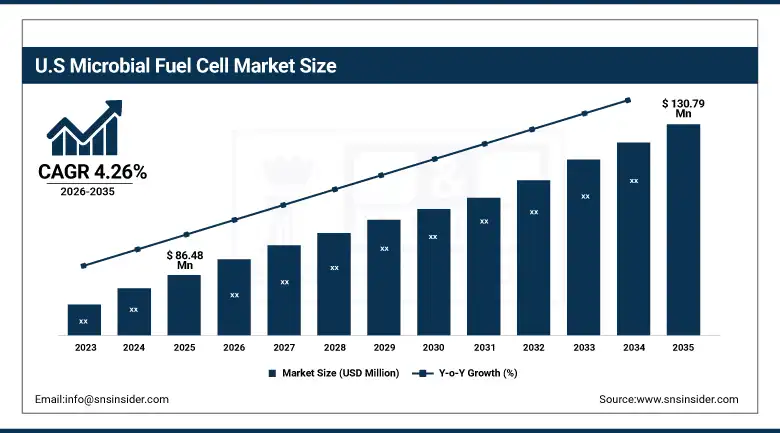
The U.S. Microbial Fuel Cell Market was valued at USD 86.48 Million in 2025 and is expected to reach USD 130.79 Million by 2035 at a CAGR of 4.26%. The U.S. microbial fuel cell industry is really taking off, driven by more investment in green wastewater treatments, a major push for renewable energy and increased research in bio electrochemical systems. Such systems are becoming popular as they can clean water and generate electricity at the same time, helping to cut costs and reduce environmental damage. There’s a lot of money going into clean energy tech, smart monitoring systems and fancy biosensors, too, pushing the market to grow from 2025 to 2026. And, a boom in industrial wastewater projects, university-led research and eco-sustainability programs is rapidly accelerating adoption across the U.S.
More than 16,000 publicly owned wastewater treatment facilities operated across the United States during 2025, supporting demand for advanced wastewater treatment and energy recovery technologies.
Microbial Fuel Cell Market Segment Analysis
-
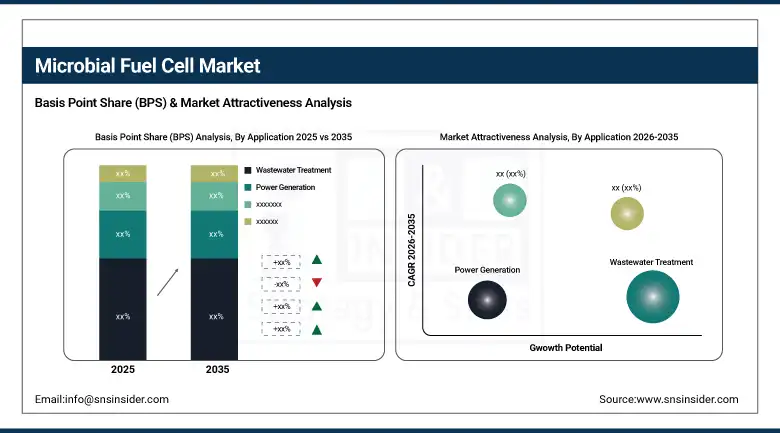
By Application, wastewater treatment dominated with approximately 58.24% revenue share in 2025; power generation are expected to be the fastest-growing type segment at approximately 7.95% CAGR from 2026 to 2035.
-
By Technology Type, mediator-free microbial fuel cells dominated with approximately 61.36% revenue share in 2025; photosynthetic microbial fuel cells are expected to be the fastest-growing type segment at approximately 9.17% CAGR from 2026 to 2035.
-
By Reactor Type, single-chamber microbial fuel cells dominated with approximately 49.36% revenue share in 2025; stacked microbial fuel cells are expected to be the fastest-growing type segment at approximately 8.75% CAGR from 2026 to 2035.
-
By End User, municipal utilities dominated with approximately 46.18% revenue share in 2025; industrial facilities are expected to be the fastest-growing type segment at approximately 6.98% CAGR from 2026 to 2035.
By Application, wastewater treatment dominating while power generation emerging as the fastest-growing
The wastewater treatment segment accounted for approximately 58.24% of the revenue share in 2025, due to increased use of microbial fuel cells in treating wastewater from both cities and industries. These cells help in removing organic pollutants too. The use of microbial fuel cells in wastewater plants increased due to growing demand for better efficiency and cost savings in utilities. Investments in eco-friendly water technology and resource recovery fueled the microbial fuel cell market. Governments are inclined towards energy-saving treatment methods that lead to reduced carbon emissions. Wastewater treatment has emerged as a leader owing to stringent regulations and more wastewater.
In microbial fuel cell market, the power generation will grow fastest with a CAGR of around 7.95% from 2026 to 2035, owing to an increasing demand for bioelectricity from renewable sources. Microbial fuel cell market, which generate power from organic waste, are being developed by scientists. This segment is gaining traction with the increasing demand for decentralized energy and sustainable power. More pilot projects and improved technologies for energy conversion are helping to push commercialization forward. Expect a gradual rise in growth as we get more energy from wastewater and industrial waste in years to come.
By Technology Type, mediator-free microbial fuel cells dominating while photosynthetic microbial fuel cells emerging as the fastest-growing
In microbial fuel cell market, the mediator-free microbial fuel cells Revenue Accounted for About 61.36% in 2025. This was driven by its simple designs, lower operating costs and better environmental profile than mediator-based systems. These systems enable microbes to transfer electrons directly to the electrodes, eliminating the need for chemicals and making them more efficient. High demand for mediator-free systems in wastewater treatment and research was generated by its reliable operation and scalability. Also, the development of advanced electrode materials and bio electrochemical technologies brought the use of these systems. Throughout the year, people began looking for cheap and green solutions, and the uptake of these systems was a big success.
The photosynthetic microbial fuel cells segment is expected to record the highest CAGR of 9.17% during 2026-2035. The segment is projected to witness growth owing to an increased focus on coupling renewable energy with carbon capture and wastewater treatment. These systems use photosynthetic microorganisms to generate bioelectricity, extract CO2 and produce oxygen. Further R&D is encouraging further innovations on algae-based bio electrochemical systems. These initiatives are in line with the growing focus on eco-friendly technology and sustainability, which is helping in the growth of the market. Continued technology innovations are expected to increase commercial appeal and adoption during the forecast period.
By Reactor Type, single-chamber microbial fuel cells dominating while stacked microbial fuel cells emerging as the fastest-growing
Single-chamber microbial fuel cells accounted for approximately 49.36% of revenue in 2025, due to their simple design, lower construction cost, and ease of operation. They have fewer components and are used extensively in laboratory research, small-scale wastewater treatment, and environmental monitoring. This segment is seeing a pickup as people now look more for cheaper setups that can treat wastewater while generating bioelectricity at the same time. With more R&D geared towards increasing their performance and making them bigger, the segment continues to dominate. And let’s not forget, they are super easy to keep running which helped them gain popularity all year round.
The stacked microbial fuel cell market is expected to grow the fastest at around an 8.75% CAGR from 2026 to 2035 due to a growing need for more power output and better scalability. These systems stack multiple fuel cell units together to increase electricity generation and treatment efficiency. Growing commercialization and more successful pilots drive growth in the segment. Progress in reactor engineering, system integration and performance optimization all significantly speed up development of the technology. With pressure mounting for large-scale wastewater treatment and renewable energy recovery, this segment will likely continue to see strong growth over the forecast period.
Regional Insights
|
Region |
Major Country |
Share within Region,2025 (%) |
|---|---|---|
|
North America |
United States |
89% |
|
Europe |
Germany |
24% |
|
Asia Pacific |
China |
34% |
|
Middle East & Africa |
UAE |
16% |
|
Latin America |
Brazil |
37% |
North America Microbial Fuel Cell Market Insights
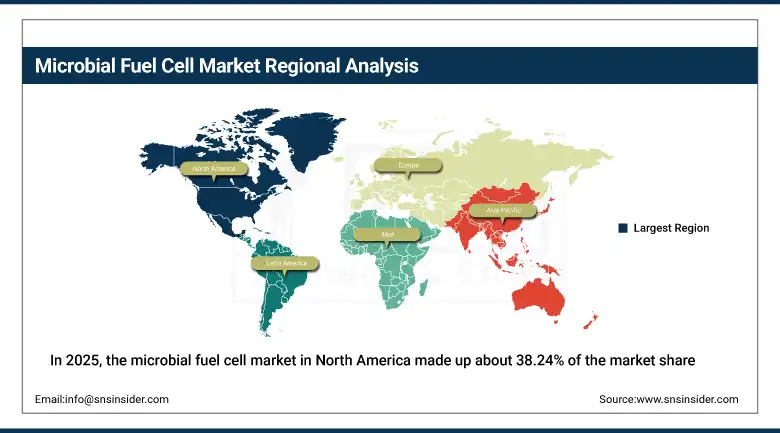
In 2025, the microbial fuel cell market in North America made up about 38.24% of the market share and is forecasted to grow by 4.38% CAGR until 2035. This region leads in bio electrochemical research, innovation in wastewater treatment, and clean energy tech. During 2025, the US processed over 34 billion gallons of wastewater each day, operating more than 16,000 facilities. This makes room for expanding microbial fuel cell use. Universities, national labs, and environmental agencies keep pouring funds into wastewater treatment that’s eco-friendly and efficient. The emphasis on cutting carbon, building sustainable infrastructure, and getting resources from waste helps the market develop in North America.
Get Customized Report as per Your Business Requirement - Enquiry Now
Europe Microbial Fuel Cell Market Insights
In 2025, the microbial fuel cell market in Europe made up around 20.18% of the market share and is forecasted to grow by 4.33% CAGR until 2035. Europe is a big hub for environmental tech innovation and updating wastewater treatments. Over 80% of wastewater is treated in many developed countries there, boosting the need for top-tier tech that can reclaim energy. Research in microbial fuel cells and bio electrochemical systems keeps getting support from places like Germany, the Netherlands, and the UK. As there's more focus on circular economy projects, sustainable water management, and integrating renewable energy, the market looks set for growth across the region.
Asia Pacific Microbial Fuel Cell Market Insights
In 2025, the Asia Pacific held around 27.46% of the microbial fuel cell market and is expected to grow the quickest at an 8.10% CAGR until 2035. The region's rapid industrial growth, along with increased focus on treating wastewater and protecting the environment, is boosting adoption of these cells. During the same year, China treated over 230 million cubic meters of wastewater daily, opening up great chances for microbial fuel cell use. Nations like China, India, Japan, and South Korea keep pouring money into clean water solutions and green energy tech. More studies and test projects are popping up too, further propelling market growth across Asia Pacific.
Middle East & Africa and Latin America Microbial Fuel Cell Market Insights
In 2025, the microbial fuel cell market in Latin America had about a 7.26% share and was forecasted to grow by 6.20% CAGR until 2035. Meanwhile, the Middle East & Africa region held almost a 6.86% share and its CAGR was projected to be 7.62%. During that time, Brazil was beefing up its wastewater treatment projects to boost sanitation and environmental results. The Middle East stepped up too; for instance, the UAE ramped up funding for water reuse and tech improvements to tackle shortages. As demand rises for eco-friendly wastewater management, green energy generation, and environmental monitoring, these markets will expand further.
Market Dynamics
Growth Drivers: Increasing demand for sustainable wastewater treatment and renewable bioelectricity generation accelerating market growth
The microbial fuel cell market is expanding due to the rising need for energy-efficient wastewater treatment and more focus on renewable energy. It’s also seeing strong growth because it allows wastewater treatment and electricity generation at the same time. This helps both industries and cities use less energy and be gentler on the environment. Furthermore, the microbial fuel cell market is being driven in 2025–2026 by a significant amount of money being invested in advanced electrode materials, biosensors, and environmental monitoring. The expansion of large wastewater projects and global sustainability initiatives are also significantly accelerating the adoption of these cells.
The United States treated more than 34 billion gallons of wastewater daily during 2025, creating strong opportunities for microbial fuel cell technologies that recover energy while improving wastewater treatment efficiency and sustainability.
Restraints: High commercialization costs and scalability challenges limiting market expansion
The microbial fuel cell market is hampered by high installation costs, limited commercial applications, and complex reactor design. It is a difficult task to maintain a constant power output on a large scale. Developers also have to contend with costly electrode materials, stringent maintenance requirements, and low electricity yield in comparison to traditional energy sources. Moreover, not everyone is aware of these fuel cells, which limits their widespread adoption. Despite the increase in R&D activities, all these factors might delay their implementation for industrial and municipal applications.
Opportunities: Expansion of industrial wastewater treatment and biosensor applications creating new opportunities
The microbial fuel cell market is experiencing rapid growth due to the increasing investments in industrial wastewater treatment, environmental monitoring, and advanced biosensor technology. The development of advanced reactor systems, nanomaterial electrodes, and next-generation bio electrochemical technologies is also enhancing performance and efficiency. Resource recovery and circular economy initiatives and a focus on low-carbon operations are further fueling the growth of the market, especially from 2025-2026. Pilot projects, unit research, and green business initiatives are all on the rise, creating some significant long-term opportunities. The global push for efficient treatment and smart monitoring systems is also contributing to the growth of the market across the globe.
Pilot-scale microbial fuel cell projects expanded during 2025–2026 across wastewater treatment facilities, demonstrating the potential for simultaneous pollutant removal, renewable electricity generation, and resource recovery from waste streams.
Recent Developments:
-
2026: Cambrian remained active in commercialization efforts for energy-positive wastewater treatment technologies as industries increasingly adopted circular economy and low-carbon infrastructure strategies.
-
2026: MICROrganic Technologies continued supporting wastewater treatment facilities with microbial fuel cell systems emphasizing energy recovery, nutrient recovery, and operational efficiency improvements.
-
2026: Ongoing scale-up initiatives across the microbial fuel cell industry increased demand for high-performance electrochemical materials and reactor components, supporting broader commercial deployment opportunities.
Microbial Fuel Cell Companies are:
-
MICROrganic Technologies, Inc.
-
ElectroChem Solutions, Inc.
-
Prongineer R&D Ltd.
-
Sainergy Tech, Inc.
-
Aquacycl LLC
-
Emefcy Technologies Ltd.
-
Open Cell Technologies, Inc.
-
Microrganic Technologies LLC
-
Triqua International B.V.
-
BioGill Operations Pty Ltd.
-
Qnergy Inc.
-
Cambi ASA
-
Organica Water, Inc.
-
Frontier Environmental Technology LLC
-
Saltworks Technologies Inc.
-
BPC Instruments AB
-
Aqua-Aerobic Systems, Inc.
-
Sustainable Energy Technologies Ltd
Microbial Fuel Cell Market Report Scope:
| Report Attributes | Details |
|---|---|
| Market Size in 2025 | USD 268.86 Million |
| Market Size by 2035 | USD 474.39 Million |
| CAGR | CAGR of 5.89% From 2026 to 2035 |
| Base Year | 2025 |
| Forecast Period | 2026-2035 |
| Historical Data | 2022-2024 |
| Report Scope & Coverage | Market Size, Segments Analysis, Competitive Landscape, Regional Analysis, DROC & SWOT Analysis, Forecast Outlook |
| Key Segments | • By Application (Wastewater Treatment, Power Generation, Biosensors) • By Technology Type (Mediator-based Microbial Fuel Cells, Mediator-free Microbial Fuel Cells, Photosynthetic Microbial Fuel Cells) • By End User (Municipal Utilities, Industrial Facilities, Research & Academic Institutes) • By Reactor Type (Single-Chamber Microbial Fuel Cells, Dual-Chamber Microbial Fuel Cells, Stacked Microbial Fuel Cells) |
| Regional Analysis/Coverage | North America (US, Canada), Europe (Germany, UK, France, Italy, Spain, Russia, Poland, Rest of Europe), Asia Pacific (China, India, Japan, South Korea, Australia, ASEAN Countries, Rest of Asia Pacific), Middle East & Africa (UAE, Saudi Arabia, Qatar, South Africa, Rest of Middle East & Africa), Latin America (Brazil, Argentina, Mexico, Colombia, Rest of Latin America). |
| Company Profiles | Cambrian Innovation, Inc., MICROrganic Technologies, Inc., ElectroChem Solutions, Inc., Prongineer R&D Ltd., Sainergy Tech, Inc., Fluence Corporation Limited, Aquacycl LLC, Emefcy Technologies Ltd., Open Cell Technologies, Inc., Microrganic Technologies LLC, Triqua International B.V., BioGill Operations Pty Ltd., Qnergy Inc., Cambi ASA, Organica Water, Inc., Frontier Environmental Technology LLC, Saltworks Technologies Inc., BPC Instruments AB, Aqua-Aerobic Systems, Inc., Sustainable Energy Technologies Ltd. |

Frequently Asked Questions
The Microbial Fuel Cell Market is expected to grow at a CAGR of 5.89% from 2026 to 2035.
The Microbial Fuel Cell Market was valued at USD 268.86 Million in 2025.
Mediator-free Microbial Fuel Cells dominated the market in 2025 with approximately 61.36% of revenues.
Wastewater Treatment dominated the market in 2025 with approximately 58.24% of revenues.
North America dominated the Microbial Fuel Cell Market in 2025 with approximately 38.24% of global revenues.
