
Single-Cell Multiomics Market Report Scope & Overview:
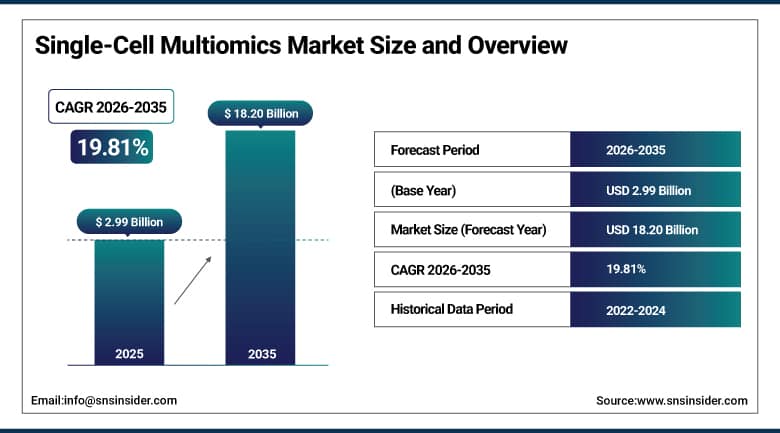
The Single-Cell Multiomics Market was valued at USD 2.99 billion in 2025 and is expected to reach USD 18.20 billion by 2035, growing at a CAGR of 19.81% from 2026–2035.
The single-cell multiomics market is witnessing strong growth in the global market owing to increasing demand for high-resolution cellular analysis. Rising adoption in oncology and immunology research is supporting market expansion. Expanding pharmaceutical and biotechnology R&D activities are driving multiomics demand. Manufacturers are focusing on advanced spatial-omics and sequencing platforms. Growing adoption of single-cell transcriptomics is improving research accuracy. Increasing emphasis on precision medicine and personalized therapeutics is further accelerating market adoption.
According to the U.S. National Institutes of Health Common Fund Single Cell Analysis Program and Human Cell Atlas consortium updates, single-cell sequencing technologies are now capable of profiling tens of thousands of cells per experiment, with some platforms exceeding 1 million cells per study in large-scale atlases. As per Nature Biotechnology and NIH-supported datasets referenced in 2025 biomedical infrastructure reports, over 70% of new single-cell studies integrate multi-omics layers such as transcriptomics and epigenomics. The European Molecular Biology Laboratory also reports that multi-omics integration pipelines are now used in more than 50% of advanced cellular biology research projects, reflecting rapid adoption in precision medicine and immunology research.
To Get More Information On Single-Cell Multiomics Market - Request Free Sample Report
Single-Cell Multiomics Market Trends
-
The growing trend of using precision medicine is encouraging the wide application of single-cell multiomics in diagnostic and research applications across the world.
-
More and more application of genomic profiling techniques is contributing to enhanced resolution at the cellular level and greater understanding of the disease mechanisms.
-
Researches on cancer genomics and immunology are demanding more high throughput single cell sequencing systems within the pharma and biotech industry.
-
The use of multiomics data in the drug discovery pipeline is helping in the process of identifying and validating drug targets.
-
Artificial intelligence and machine learning have brought a revolution in the analysis of multiomics data through rapid biomarker identification and disease pattern recognition.
-
The use of cloud-based bioinformatics platforms for analyzing single cell multiomics data is becoming more common.
U.S. Single-Cell Multiomics Market Outlook.
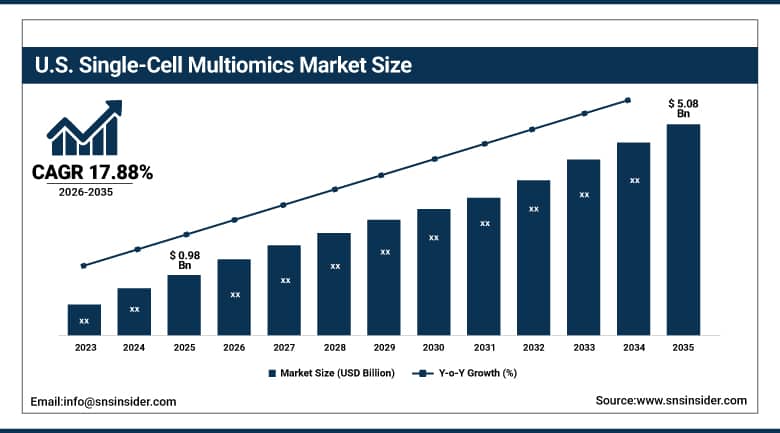
The U.S. Single-Cell Multiomics Market was valued at USD 0.98 billion in 2025 and is expected to reach around USD 5.08 billion by 2035, growing at a CAGR of 17.88% from 2026–2035.
The U.S. single-cell multiomics market is growing rapidly owing to strong demand from advanced biomedical research institutions. Increasing focus on oncology and precision medicine research is supporting market expansion. Rising investments by pharmaceutical and biotechnology companies are driving multiomics adoption. Expanding use of spatial-omics and sequencing platforms is improving analytical capabilities. Strong presence of key market players is accelerating innovation and commercialization. Continuous technological advancements in single-cell analysis are further boosting market growth in the U.S.
According to the U.S. National Institutes of Health and National Human Genome Research Institute’s Human Cell Atlas project, the usage of single-cell sequencing technology is found in more than 70% of the federal research projects on cell biology and genomics up until 2025. According to the portfolio information from the U.S. National Science Foundation biological sciences, the use of multiomics including transcriptomics, proteomics, and epigenomics is part of over 60% of the system biology grant applications.
Single-Cell Multiomics Market Segment Analysis
-
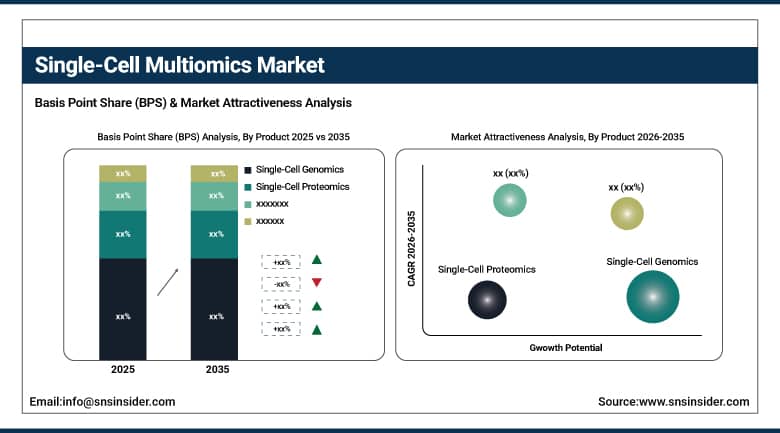
By Product, single-cell genomics dominated the market with 34.20% share in 2025; while single-cell proteomics is the fastest growing segment with CAGR of 23.16% during 2026 to 2035.
-
By Application, oncology dominated the market with 38.90% share in 2025; while immunology is the fastest growing segment with CAGR of 22.16% during 2026 to 2035.
-
By End-user, pharmaceutical & biotechnology companies dominated the market with 39.10% share in 2025; while academic and research organizations is the fastest growing segment with CAGR of 21.29% during 2026 to 2035.
-
By Technology Platform, droplet-based microfluidics dominated the market with 56.30% share in 2025; while spatial-omics platforms are the fastest growing segment with CAGR of 24.50% during 2026 to 2035.
By Product, single-cell genomics dominated the single-cell multiomics market in 2025, while single-cell proteomics is the fastest growing segment.
Single-Cell Genomics Segment held the dominated market revenue share in the single-cell multiomics market in 2025 due to high levels of adoption in cancer research, genome mapping, and disease diagnosis applications. The high accuracy of genomic variation detection increases adoption of Single-Cell Genomics. Well-established genomic sequencing protocols and high availability of genomic data add value to the segment. Continued funding in precision medicine research will keep driving demand for Single-Cell Genomics technology in future years.
Single-Cell Proteomics Segment is projected to record the fastest CAGR between 2026 and 2035 due to growing demand for protein-level information for complex diseases. Increased shortcomings of genomic studies alone are fueling the use of proteomics. Improvements in mass spectrometry and single cell protein detection technology increase the scale. Rising interest in the pharmaceutical sector in finding drug targets and biomarkers is boosting the global Single-Cell Proteomics market.
By Application, oncology dominated the single-cell multiomics market in 2025, while immunology is the fastest growing segment.
The oncology segment accounted for the dominated revenue share in the single-cell multiomics market in 2025 owing to the increase in cancer cases across the globe. Growing use of precision oncology and tumor heterogeneity research is also contributing to the rise in adoption. Single-cell multiomics helps in analyzing the tumor microenvironment in detail. Growing use of genomics and transcriptomics analysis in cancer research is also driving the growth. Robust pipeline of pharma companies focusing on oncology is propelling the segment growth and market dominance.
The immunology segment is projected to register the fastest CAGR during the forecast period owing to increasing attention to immune profiling research. The increasing prevalence of autoimmune and infectious diseases is increasing the demand for research. Single-cell multiomics allows for deeper immune cell profiling and response analysis. Growing use of immunology in immunotherapy and vaccines development is driving the growth. Improvements in spatial and transcriptomic technologies in immunology research are also driving the segment growth.
By End-user, pharmaceutical & biotechnology companies dominated the single-cell multiomics market in 2025, while academic and research organizations is the fastest growing segment.
Pharmaceutical and Biotechnology Companies dominated the single cell multi-omics market with maximum revenue share in 2025 due to their strong pipeline of drug discovery process. These companies use multi-omics approach in order to identify targets, discover biomarkers and develop precision medicines. Strong research and development spending along with advanced infrastructure facilities are some other key factors which have driven the adoption rate of multi-omics technology. Growth in clinical trials and personalized medicine are also fueling their growth dominance.
Academic & Research Organizations segment will grow at the fastest CAGR from 2026 to 2035 due to increasing government funding. The rising interest in genome studies and mechanisms of diseases is propelling the adoption rate. Growth of biotechnology laboratories within universities has also been contributing to market growth. Collaboration with pharmaceutical companies increases access to sophisticated platforms. Availability of research grants and open-source omics technologies has been fueling the adoption rate.
By Technology Platform, droplet-based microfluidics dominated the single-cell multiomics market in 2025, while spatial-omics platforms are the fastest growing segment.
The Droplet-Based Microfluidics segment occupied the dominated revenue share in the Single Cell Multiomics Market in 2025 owing to efficient throughput capacity of single cell isolation. This technique is highly capable of processing several thousand cells at once with great precision. It is used extensively in genomic and transcriptomic analyses. Factors such as cost-effectiveness and scalability add to adoption. Commercially available platforms and widespread usage in laboratory studies contribute significantly to the dominance of the segment in the market. Extensive use in sequencing workflows drives the market dominance.
The Spatial-Omics Platforms segment is predicted to have the fastest CAGR during 2026-2035. Increasing demand for spatial resolution is driving the growth. Researchers now need tissue context to understand the pathophysiology of diseases. Availability with other advanced imaging and sequencing techniques promotes adoption. Growing applications in oncology and neuroscience boost adoption. Rapid commercialization of spatial-omics platforms is being driven by innovations and funding in the field of precision medicine research.
Regional Analysis
|
Region |
Major Country |
Share within Region, 2025(%) |
|---|---|---|
|
North America |
United States |
78.45% |
|
Europe |
Germany |
28.40% |
|
Asia Pacific |
China |
44.10% |
|
Middle East & Africa |
UAE |
19.20% |
|
Latin America |
Brazil |
49.30% |
North America Single-Cell Multiomics Market Insights.
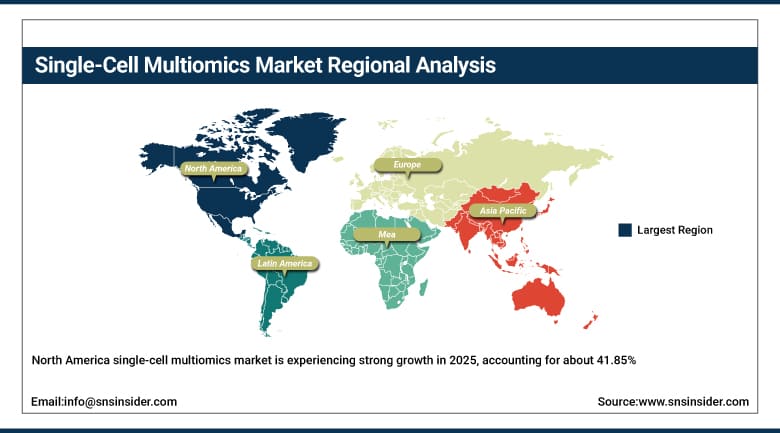
North America single-cell multiomics market is experiencing strong growth in 2025, accounting for about 41.85% share of the global market, owing to advanced biomedical research infrastructure. The region benefits from high adoption of sequencing and spatial-omics platforms. Strong presence of leading biotechnology and pharmaceutical companies is accelerating innovation. Increasing funding for cancer research and precision medicine is driving demand. Expansion of genomics research programs is further supporting market growth.
As indicated by the U.S. National Institutes of Health and the National Human Genome Research Institute, single cell and multi-omics techniques are being utilized to a growing extent in federal-funded biomedical research, as more than 70% of the NIH genomics-related grants make use of next-generation sequencing techniques. Per FDA and NIH Human Cell Atlas projects, over 100 million individual cells have been profiled worldwide through multiomics research that is involved in disease mapping and precision medicine studies.
Get Customized Report as Per Your Business Requirement - Enquiry Now
Europe Single-Cell Multiomics Market Insights.
Europe single-cell multiomics market is characterized by steady growth in 2025 owing to strong academic research networks and regulatory support. Key countries include Germany, United Kingdom, France, and Netherlands. Increasing focus on precision medicine and rare disease research is driving adoption. Rising investments in biotechnology innovation hubs are supporting market expansion. Strong collaboration between universities and pharmaceutical companies is further accelerating multiomics technology utilization across the region.
According to the European Commission Horizon Europe program and European Molecular Biology Laboratory 2025 Research Infrastructure Roadmap, more than 70% of EU-funded life sciences projects have adopted multi-omics strategies, which also include single-cell sequencing methods. Life sciences represent over 20% of total EU research staff according to the Eurostat R&D statistics, making possible the further development of single-cell and multi-omics approaches in the field of oncology, immunology, and neuroscience.
Asia Pacific Single-Cell Multiomics Market Insights.
Asia Pacific is the fastest growing region in the single-cell multiomics market, registering a CAGR of about 23.16% during 2026–2035. Rapid expansion of biotechnology industries and increasing research investments are driving growth across China, India, Japan, and South Korea. Rising demand for precision medicine is boosting adoption of multiomics platforms. Expanding genomics research infrastructure is further accelerating market penetration in academic and clinical applications.
According to the indicators from the Organization for Economic Co-operation and Development for Biotechnology and Health Innovation and the science reports from UNESCO, the Asia Pacific region represents more than 45% of all scientists worldwide, thereby contributing to rapid development in advanced technologies of life sciences, including multiomics. According to the WHO Regional Updates on Biomedical Research, nations like China, Japan, and South Korea together represent more than 50% of the global high-throughput sequencing output.
Middle East & Africa and Latin America Single-Cell Multiomics Market Insights.
The Middle East & Africa along with Latin America regions are witnessing steady growth in 2025 due to rising biotechnology adoption and expanding healthcare research infrastructure. Key contributing countries include Brazil, Mexico, South Africa, UAE, and Saudi Arabia. Increasing demand for advanced disease diagnostics is driving adoption of multiomics platforms. Growth in academic research collaborations is supporting market expansion. Rising investments in genomics research facilities are further strengthening regional capabilities.
According to WHO & UNESCO Science Report 2025, Latin America accounts for nearly 3% of global expenditure on research and development, whereas the entire Middle East & Africa accounts for less than 2%, implying that there is a limited yet growing ability for carrying out biomedical research. According to UNESCO Institute of Statistics, less than 20% of laboratories in these regions have access to next generation sequencing technology.
Market Dynamics
Growth Drivers: Rising adoption of precision medicine and advanced genomic profiling technologies across healthcare systems globally
There is an increase in the demand for precision medicine, which has resulted in the uptake of multiomic analysis of single cells in clinics and research laboratories. The increase in personalized treatment has improved the accuracy of diagnosis and treatment results. There are efforts to study cancer genomics and immunology, which have increased the use of multiomics technologies. Drug discovery is using multiomics data in pharmaceutical firms. Sequencing technologies are making it easier to analyze cells at a higher resolution.
According to the National Institutes of Health Human Cell Atlas program and the U.S. National Human Genome Research Institute, more than 2,000 reference single-cell datasets have been generated globally as of 2025, supporting large-scale cellular mapping initiatives. As per the OECD Health Data 2025 and WHO genomic medicine policy framework, over 50% of high-income countries have integrated precision medicine components into national healthcare strategies. The European Commission’s Horizon Europe biomedical research tracking indicates that over 35% of funded life sciences projects now include single-cell or multi-omics technologies, reflecting accelerating adoption of advanced genomic profiling in clinical and translational research systems.
Restraints: Data management challenges and limited standardization across multiomics workflows affecting market scalability
Generation of big data through multiomics platforms poses a considerable challenge for storage and analysis. Inconsistency of the result is a result of lack of standard analytical pipeline. There is a need for bioinformatics technology to integrate genomics, transcriptomics, and proteomics data. Shortage of data scientists limits the efficiency of the workflow. The problems associated with compatibility of various platforms pose further limitations. The growing regulatory requirement regarding data accuracy poses an extra challenge.
Opportunities: Growing integration of artificial intelligence and machine learning in single-cell multiomics data analysis platforms
The integration of artificial intelligence and machine learning is boosting data analysis in the realm of single-cell multiomics research. Machine learning allows researchers to find out biomarkers and disease patterns more rapidly. Data workflows are automated by the use of AI technologies, which makes research easier. Pharmaceuticals apply artificial intelligence in the process of drug discovery and target validation. The increased popularity of cloud-based bioinformatics systems contributes to scalable analysis.
As per the bioinformatics adoption indicators developed by the U.S. NIH and NHGRI in 2025, more than 70% of genomics research studies that are government-funded involve analytical pipelines using machine learning techniques to interpret big data from genome sequencing projects. The NIH Data Science Strategy further indicates that more than 50% of the new biomedical datasets need computational modeling for integration of genomics, transcriptomics, and proteomics at single-cell levels.
Recent Developments
-
2026: 10x Genomics reported continued single-cell and spatial biology growth momentum driven by expanding platform adoption globally.
-
2025: Danaher expanded life sciences segment capabilities via Cytiva and Beckman Coulter investments supporting advanced bioprocessing and automation platforms.
-
2025: Illumina expanded NovaSeq X series availability and cloud-based DRAGEN secondary analysis ecosystem enhancements for multiomics workflows.
-
2024: Thermo Fisher Scientific expanded bioproduction capacity and advanced single-cell sequencing workflows through continued instrumentation and software upgrades.
Single-Cell Multiomics Market Key Players are:
-
Illumina
-
10x Genomics
-
Thermo Fisher Scientific
-
Danaher
-
Bio-Rad Laboratories
-
Agilent Technologies
-
F. Hoffmann-La Roche
-
QIAGEN
-
Oxford Nanopore Technologies
-
Bruker Corporation
-
Standard BioTools
-
Takara Bio
-
BGI Genomics
-
MGI Tech
-
Element Biosciences
-
Pacific Biosciences
-
Ultima Genomics
-
Revvity
-
Sartorius AG
-
Singleron Biotechnologies
Single-Cell Multiomics Market Report Scope:
| Report Attributes | Details |
|---|---|
| Market Size in 2025 | USD 2.99 Billion |
| Market Size by 2035 | USD 18.20 Billion |
| CAGR | CAGR of 19.81% From 2026 to 2035 |
| Base Year | 2025 |
| Forecast Period | 2026-2035 |
| Historical Data | 2022-2024 |
| Report Scope & Coverage | Market Size, Segments Analysis, Competitive Landscape, Regional Analysis, DROC & SWOT Analysis, Forecast Outlook |
| Key Segments | • By Product (Single-Cell Genomics, Single-Cell Proteomics, Single-Cell Metabolomics, Single-Cell Transcriptomics) • By Application (Immunology, Cell Biology, Oncology, Neurology) • By End-user (Hospital and Diagnostic Laboratories, Academic and Research Organizations, Pharmaceutical & Biotechnology Companies, Others) • By Technology Platform (Droplet-based Microfluidics, Nanowell / Combinatorial Indexing, Spatial-omics Platforms) • By Omics Modality (Genomics, Transcriptomics, Proteomics, Metabolomics) |
| Regional Analysis/Coverage | North America (US, Canada), Europe (Germany, UK, France, Italy, Spain, Russia, Poland, Rest of Europe), Asia Pacific (China, India, Japan, South Korea, Australia, ASEAN Countries, Rest of Asia Pacific), Middle East & Africa (UAE, Saudi Arabia, Qatar, South Africa, Rest of Middle East & Africa), Latin America (Brazil, Argentina, Mexico, Colombia, Rest of Latin America). |
| Company Profiles | Illumina, 10x Genomics, Thermo Fisher Scientific, Danaher, Bio-Rad Laboratories, Agilent Technologies, F. Hoffmann-La Roche, QIAGEN, Oxford Nanopore Technologies, Bruker Corporation, Standard BioTools, Takara Bio, BGI Genomics, MGI Tech, Element Biosciences, Pacific Biosciences, Ultima Genomics, Revvity, Sartorius AG, Singleron Biotechnologies |
Frequently Asked Questions
The single-cell multiomics market is expected to grow at a CAGR of 19.81% from 2026 to 2035.
The single-cell multiomics market was valued at USD 2.99 billion in 2025.
The Major growth factors include precision medicine adoption, high-resolution cellular analysis demand, expanding biotech R&D, oncology and immunology research use, sequencing and spatial-omics advancements, and AI and machine learning integration.
The single-cell genomics segment dominated the market in 2025 due to cancer research adoption, genome mapping, diagnostics, and strong funding support.
North America dominated the single-cell multiomics market in 2025 due to strong research infrastructure, funding, biotech presence, and early adoption.
