
Molecular Electronics Market Report Scope & Overview:
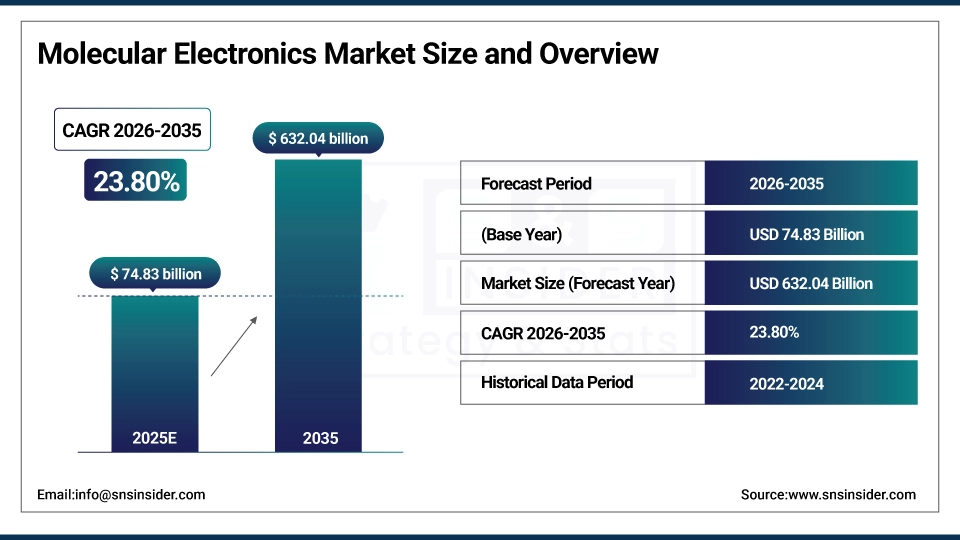
The Molecular Electronics Market size is valued at USD 74.83 Billion in 2025 and is expected to reach USD 632.04 Billion by 2035 and grow at a CAGR of 23.80% over the forecast period 2026-2035.
Molecular Electronics market is expected to grow across advanced computing, sensing and data storage applications with surging need for ultra-miniaturized high-performance electronic devices. Emerging constraints of traditional silicon-based technologies and increasing investment in nanoelectronics and quantum-inspired architectures are likely to help the uptake of molecular-level devices. Advances in molecular self-assembly, nanoscale processing, hybrid molecular–silicon integration, and materials engineering are underpinning increased stability of devices and electrical performance as well as improved scalability for manufacturability to enable more widespread commercialization within the research, industrial, and emerging semiconductor sectors.
Industry research shows that around 65% of market demand is developed from research and advanced R&D applications, which suggests adoption in its initial phase where molecular electronics technology (MET) is mainly used in academic labs and semiconductor industry R&D sectors for nanoelectronics development, advanced computing research and next-generation device prototyping.
To Get more information on Molecular Electronics Market - Request Free Sample Report
Molecular Electronics Market Trends:
-
Growing shift toward ultra-miniaturization beyond silicon limits to enable next-generation nanoelectronic devices
-
Rising adoption of hybrid molecular–silicon architectures for improved performance and scalability
-
Increasing focus on molecular-based memory and logic devices for high-density data storage and computing
-
Expansion of sensor and biosensor applications leveraging molecular-scale sensitivity
-
Advancements in self-assembled monolayers (SAMs) and molecular self-assembly techniques improving device reliability
U.S. Specialty Molecular Electronics Market Size Outlook:
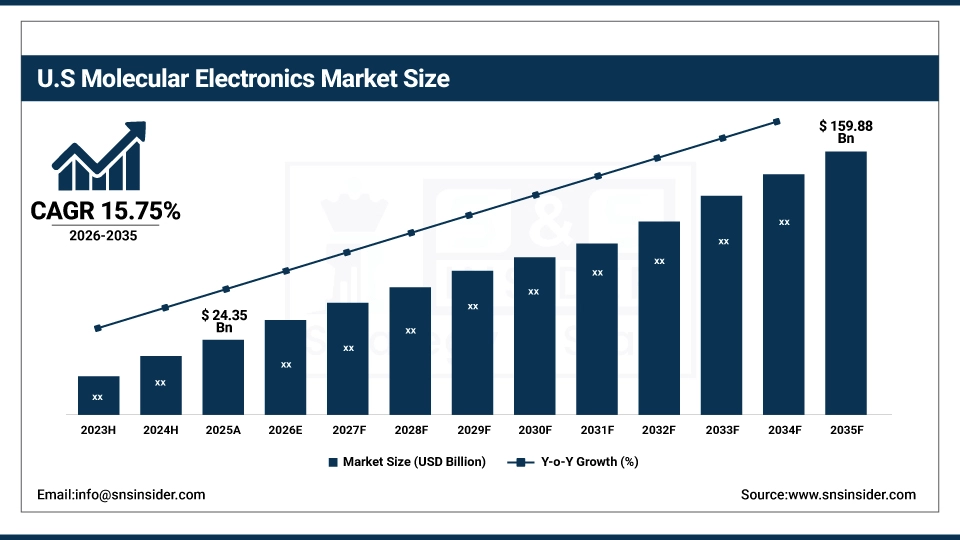
The U.S. Molecular Electronics Market size is USD 24.35 Billion in 2025 and is expected to reach USD 159.88 Billion by 2035, growing at a CAGR of 15.75% over the forecast period of 2026-2035. Growing demand for the U.S. Molecular Electronics market from academic research laboratories, semiconductor R&D centers, and advanced technology companies is anticipated to propel the growth of the US molecular electronics market. Advances in molecular self-assembly, hybrid molecular–silicon integration, and nano-fabrication technology will enable devices to be increasingly fast, small and reliable. These phenomena are fueling the demand for molecular electronics in computing, sensing and memory uses. Heavy R&D spending, strategic partnerships, and government funding for advanced electronics and nanotechnology are making the U.S an emerging domineer in the molecular electronics market.
Molecular Electronics Market Growth Drivers:
-
Growing Need for Ultra-Compact and High Performance Electronics
Rising demand for ultra-small high-performance devices in computing, sensing and memory has led to the emergence of Molecular Electronics market on a global level. Molecular self-assembly, hybrid molecular-silicon processing integration and nanofabrication processing developments have subsequently facilitated the devices with these enhanced stability, precision and power consumptions. Industry survey reveals that more than 65% of market penetration comes from research and advanced R&D labs, which highlights the necessity for molecular electronics in future nanoelectronics. Moreover, growing focus on quantum-based computing, flexible electronics and advanced sensor solutions are additionally propelling the market growth.
Molecular Electronics Market Growth Restraints:
-
High Manufacturing Complexity and Cost
Market restrictions to growth include complicated fabrication and high cost of molecular electronic components, which restricts availability for small research labs and early market manufacturers. The nano-devices demand for specific nano-fabrication infrastructure, strict environmental control, and skilled personnel in design and integration. Production difficulties and technical complexity results as a severe obstacle for adoption and around 40% of potential end-users are reported to recognize it. Moreover, problems of device reproducibility, compatibility with the current silicon technology and absence of standardized protocols still limit the market emergence.
Molecular Electronics Market Growth Opportunities:
-
Growth in Advanced Computing, Sensing, and Flexible Electronics Applications
The market bears a vast potential owing to the growing acceptance of molecular electronics in dense memory, on-molecular logic devices, ultra-sensitive sensors, and flexible electronic platforms. The combination of molecular devices with hybrid CMOS architectures and future computing technologies offers new dimensions for innovation. According to industry research, R&D investment in molecular electronics is now increasing by 20%-plus showing potential future up-take. Strategic partnership activities, including collaborations and government funded programs are likely to help ferment market growth in the developed and emerging countries.
Molecular Electronics Market Segmentation Highlights:
-
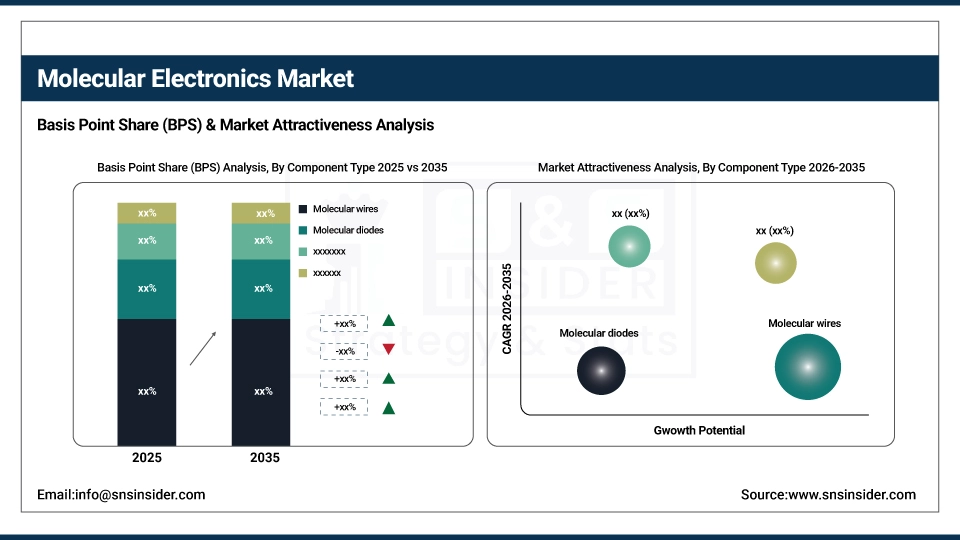
By Component Type: In 2025, molecular wires dominated with 50% share; molecular switches are the fastest-growing segment during 2026–2035.
-
By Technology: In 2025, single-molecule electronics dominated with 45% share; hybrid molecular–silicon electronics are the fastest-growing segment during 2026–2035.
-
By Application: In 2025, memory devices & data storage dominated with 55% share; sensors & biosensors are the fastest-growing segment during 2026–2035.
-
By End User: In 2025, consumer electronics dominated with 60% share; healthcare & biomedical is the fastest-growing segment during 2026–2035.
By Component Type: Molecular Wires Lead as Molecular Switches Expand Rapidly.
Molecular wires contribute to the largest share of the Molecular Electronics market owing to their high conductance, ability to be built into nanociruits and strong established knowledge of researchers and advanced device prototype testers. These materials are widely used in semiconductor R&D centers, universities and advanced electronics companies for memory devices, logic circuits and sensor applications.
The market for molecular switches is projected to grow substantially with the increasing demand for ultra-miniature, energy-efficient switching in computers, memory cells and sensors. Innovations in molecular self-assembly and hybrid integration of molecular with silicon, as well as nano-fabrication methodologies are leading to greater use, notably for flexible electronics, high-density memory and next generation computing.
By Technology: Single-Molecule Electronics Lead as Hybrid Molecular–Silicon Electronics Accelerate.
Single-molecule electronics have continued to be a dominant market leader for their producible ultra miniaturized electronic characteristics and are extensively used in the fields of research, and development of high performance devices. They are at the heart of molecular scale memory, logic and sensor devices.
Hybrid molecular–silicon electronics develops quickly as a key path to integrate molecular devices into the existing silicon processing technology, which can provide both promising scalability and better device performances. Increasing interest in nanoelectronics, quantum inspired architectures and flexible/foldable electronics is driving the need for hybrid molecular systems.
By Application: Memory Devices & Data Storage Lead as Sensors & Biosensors Expand.
Memory devices and data storage are most sought-after product domains, on account of the soaring needs from the computing, semiconductor, research fields for super dense and low-power storage. It is anticipated that molecular electronics can provide the precision reduction in size and current consumption for next-generation memory architectures.
Sensors and biosensors are rapidly growing applications enabled by the ever-increasing need for ultra-sensitive detection in areas such as healthcare, environment- monitoring, and industrial IoT. Molecular-scale building blocks yield excellent signal resolution and small dimensions that can be used to develop new types of sensors and interfacing with flexible electronics.
By End User: Consumer Electronics Lead as Healthcare & Biomedical Expands.
By end user the molecular electronics market to see strongest growth due to high performance, miniature-scalable devices in computing, wearables and flexible technology Molecular electronics throughout the end-user base consumer electronics holds largest market because of miniaturization. Large technology corporations and research centers are developing the molecular device for applications in next generation consumers.
Medical & biomedical applications are expanding at high rates as demand increases for precision diagnostics, molecular sensing and advanced medical instrumentation. Molecular electronics offers scalable, high-sensitivity platforms for medical sensors, implantables and advanced diagnostic devices to speed up the cycle of innovation in healthcare technologies.
Molecular Electronics Market Regional Analysis:
North America Molecular Electronics Market Insights:
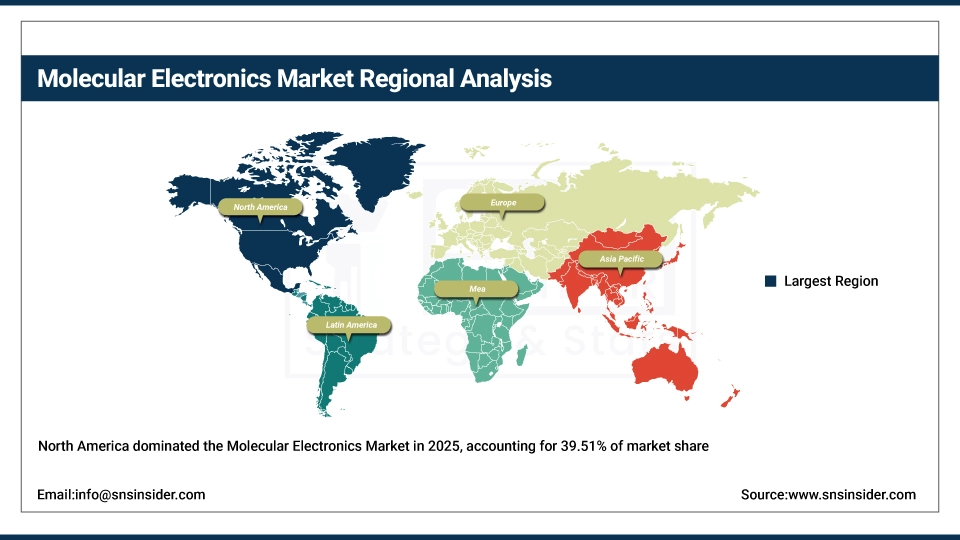
In 2025, North America’s Molecular Electronics Market accounting for the highest regional revenue share of approximately 39.51% in 2025. North America outpaces other regions in the Molecular Electronics Market on account of well developed semiconductor and nanotechnology research centers, best academic and corporate R&D facilities, superior infrastructural base for the development of nanoelectronics, and greater spending on advanced electronic components. Cutting-edge technologies like molecular self-assembly, hybrid molecular silicon technology, nanoscale fabrication and quantum computation device architectures deliver high-performance, ultracompact and energy-saving electronic materials and components in having led to the deep-rooted regional adoption of products based on these materials.
Get Customized Report as per Your Business Requirement - Enquiry Now
U.S. and Canada Molecular Electronics Market insights:
The market in North America with the U.S. and Canada at the forefront is considered to be one of the hottest spots due to world-class R&D facilities in semiconductor and nanoelectronics, high uptake of molecular devices as well as hybrid molecular–silicon technologies, and massive presence of advanced technology companies. Alternatively, strong governmental R&D funding, industry–academic cooperations and large-scale clinical and industrial projects have been other force for the fabrication of high-precision and ultra-miniaturized devices in the region leading to rapid-growing market opportunities.
Asia Pacific Molecular Electronics Market Insights:
Asia Pacific represents a high-growth region for the Molecular Electronics market, registering a CAGR of 26.32% during 2026–2035. This rapid market growth is due to the emergence of semiconductor manufacturing, and nanoelectronics research, as well as an increase use of molecular electronics in memory elements, logic elements and sensors; proliferation of technology companies and academic institutions involved in next generation molecular device development. Increasing electronics and bendable device infrastructure in APAC, growing R&D facilities, high requirement for ultra miniaturized, and high performance devices are some of the factors boosting the growth of the market in this region. In addition, robust government efforts, industry–academia partnerships and progress in molecular self-assembly, hybrid molecular–silicon integration and nanoscale manufacturing are driving market growth between 2026 and 2035.
Europe Molecular Electronics Market Insights:
The Europe Molecular Electronics market is also witnessing rapid growth, having made latent base research in semiconductor and nanoelectronics technology as well as the increased presence of key industry participants with innovative molecular device technologies. Regional uptake has been enhanced via government funding schemes, industry-academia collaborations, and research programs in the advanced electronics, quantum-inspired computing, and flexible device space. In addition, the progress of molecular self-assembly, hybrid molecular–silicon integration, and nanofabrication technologies continue to promote precision, reliability, and scalability trend that contribute to the steady growth of market during 2026 to 2035.
Latin America Molecular Electronics Market Insights:
The Latin America Molecular Electronics market is likely to experience moderate growth on account of increasing R&D spending in nanoelectronics, expanding semiconductor and advanced electronics infrastructure and growing use of molecular devices for research and industrial applications in Brazil, Mexico etc. Technology innovation is being facilitated through government-sponsored programs, academic–industry collaborations as well as development of hybrid molecular–silicon and nanoscale fabrication capabilities which continue to accelerate the market size during 2026–2035.
Middle East and Africa Molecular Electronics Market Insights:
Adoption of Molecular Electronics in the Middle East & Africa is being boosted by investments on advanced electronics research, semiconductor R&D centers and other technology innovation initiatives. Nations like Saudi Arabia, the UAE and South Africa are opening lab space and manufacturing capability to facilitate molecular-scale device innovation. Further impetus is provided by an increasing number of academic-industry partnerships and advances in molecular self-assembly, hybrid molecular-silicon integration, and nanoscale fabrication, which support a gradual rise through 2035.
Molecular Electronics Market Competitive Landscape:
IBM Corporation is a leading global technology company involved in advanced semiconductor research, nanoelectronics, and computing technologies that underpin molecular‑scale electronic innovations. Known for deep R&D capabilities across hybrid cloud, AI, quantum, and next‑generation electronics, IBM drives foundational research that supports molecular electronics and scalable nano‑fabrication techniques.
-
In 2025: IBM extended its strategic collaboration with Tokyo Electron (TEL) through a new five‑year R&D agreement to advance next‑generation semiconductor technologies, focusing on smaller nodes, chiplet architectures, and high‑performance patterning processes that support future ultra‑miniaturized and energy‑efficient device innovations.
Intel Corporation is a major global semiconductor company pushing innovation in device scaling, materials research, and integration technologies relevant to molecular electronics. With extensive collaborations and research into advanced transistor architectures, Intel supports the transition toward ultra‑small devices that could integrate molecular‑scale elements within broader nanoelectronics ecosystems.
-
In 2025: Intel and IMEC demonstrated progress in integrating two‑dimensional (2D) transistors into a 300 mm semiconductor manufacturing environment using transition‑metal dichalcogenides (TMDs), marking a significant step toward the industrial viability of atomic‑scale devices that could influence future molecular electronics technologies.
Samsung Electronics Co. Ltd. is a global leader in semiconductor manufacturing and nanoelectronics, with strong investments in memory, logic processes, and cutting‑edge fabrication capabilities. Its semiconductor division plays a pivotal role in driving advanced device technologies that intersect with molecular‑scale electronics trends, including high‑performance memory and logic innovations.
-
In 2025: Samsung signed a US 16.5 billion contract to supply semiconductors under a long‑term agreement, strengthening its role in advanced semiconductor manufacturing and capacity expansion—efforts that indirectly support the broader advancement of nano and molecular electronics applications in high‑performance computing and AI systems.
Molecular Electronics Companies are:
-
IBM Corporation
-
Intel Corporation
-
Samsung Electronics Co. Ltd.
-
NXP Semiconductors N.V.
-
STMicroelectronics N.V.
-
Taiwan Semiconductor Manufacturing Company (TSMC)
-
Qualcomm Incorporated
-
Micron Technology Inc.
-
Infineon Technologies AG
-
California Molecular Electronics Corporation
-
Novaled GmbH
-
Roswell Biotechnologies Inc.
-
Bruker Corporation
-
Zyvex Labs
-
EV Group (EVG)
-
Oxford Instruments plc
-
Molecular Vista Inc.
-
Nanocraft Inc.
| Report Attributes | Details |
|---|---|
| Market Size in 2025 | USD 74.83 Billion |
| Market Size by 2035 | USD 632.04 Billion |
| CAGR | CAGR of 23.80% From 2026 to 2035 |
| Base Year | 2025 |
| Forecast Period | 2026-2035 |
| Historical Data | 2022-2024 |
| Report Scope & Coverage | Market Size, Segments Analysis, Competitive Landscape, Regional Analysis, DROC & SWOT Analysis, Forecast Outlook |
| Key Segments | • By Component Type: (Molecular wires,Molecular diodes,Molecular switches ) • By Technology : (Single-molecule electronics, Self-assembled monolayers (SAMs), Hybrid molecular–silicon electronics) • By Application: (Memory devices & data storage , Sensors & biosensors, Logic circuits & computing devices) • By End User: (Consumer electronics, Healthcare & biomedical, IT & telecommunications) |
| Regional Analysis/Coverage | North America (US, Canada), Europe (Germany, UK, France, Italy, Spain, Russia, Poland, Rest of Europe), Asia Pacific (China, India, Japan, South Korea, Australia, ASEAN Countries, Rest of Asia Pacific), Middle East & Africa (UAE, Saudi Arabia, Qatar, South Africa, Rest of Middle East & Africa), Latin America (Brazil, Argentina, Mexico, Colombia, Rest of Latin America). |
| Company Profiles | IBM Corporation, Intel Corporation, Samsung Electronics Co. Ltd., Toshiba Corporation, NXP Semiconductors N.V., STMicroelectronics N.V., Taiwan Semiconductor Manufacturing Company (TSMC), Qualcomm Incorporated, Micron Technology Inc., GlobalFoundries Inc., Infineon Technologies AG, California Molecular Electronics Corporation, Novaled GmbH, Roswell Biotechnologies Inc., Bruker Corporation, Zyvex Labs, EV Group (EVG), Oxford Instruments plc, Molecular Vista Inc., Nanocraft Inc. |

Frequently Asked Questions
The Molecular Electronics market is expected to grow at a CAGR of 28.80% during 2026-2035.
The market was valued at USD 74.83 Billion in 2025 and is projected to reach USD 632.04 Billion by 2035.
The key drivers of the Molecular Electronics market are the growing demand for ultra-miniaturized electronics, continued scaling beyond silicon limits, and rising adoption of advanced nanoelectronics in computing, sensing, and healthcare applications.
The molecular devices segment dominated the Molecular Electronics market, driven by strong research adoption of molecular wires, switches, and diodes for ultra-miniaturized electronic and sensing applications.
North-America dominated the Molecular Electronics market in 2025.
