
Molecular Sieves Market Report Scope & Overview:
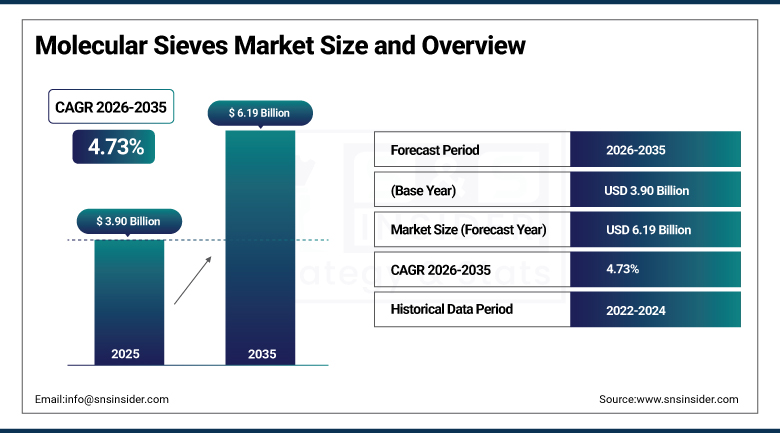
The Molecular Sieves Market was valued at USD 3.90 Billion in 2025 and is projected to reach USD 6.19 Billion by 2035, expanding at a CAGR of 4.73% during the forecast period 2026–2035.
The global molecular sieves market sustained demand driving growth global molecular sieve production is gaining traction, propelled by strong demand for adsorption and separation efficiency, especially from major industries: oil & gas; petrochemicals; industrial gases; pharmaceuticals; and specialties chemicals. Because of uniform pore size enabling targeted capture of components by shape or electrical potential, these synthetic materials can be effectively used for several process technologies that include air/water purification, solvent dehydration, oxygen and nitrogen production, and a host of catalysis solutions.
Technical improvements and innovations which will improve Molecular sieve adsorption capacity, regeneration efficiencies, and operational endurance are an industry focus and are currently helping fuel the expansion of the marketplace. U.S. Department of Energy continues backing hydrogen production, CO2 capture as well as many industrial decarbization efforts. These initiatives continue driving the requirement for advanced industrial gas treatment and industrial adsorption solutions that embrace Molecular Sieves for a more efficient PSA (pressure swing adsorption) and gas processing processes.
To Get more information On Molecular Sieves Market - Request Free Sample Report
Molecular Sieves Market Trends
-
Growing deployment of molecular sieves in hydrogen purification and PSA systems.
-
Rising adoption across LNG, natural gas, and industrial gas processing.
-
Increasing utilization in pharmaceutical and specialty chemical drying applications.
-
Development of advanced zeolite formulations with improved adsorption performance.
-
Expanding investments in carbon capture and industrial decarbization technologies.
The U.S. Molecular Sieves Market Size Outlook
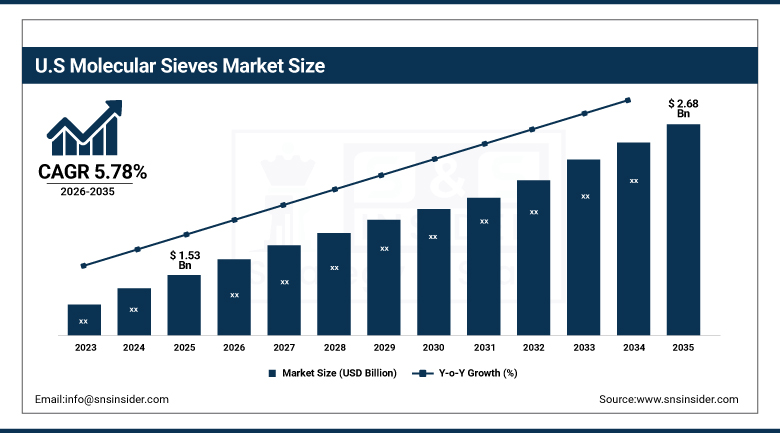
The U.S. Molecular Sieves Market was valued at USD 1.53 billion in 2025 and is expected to reach approximately USD 2.68 billion by 2035, expanding at a CAGR of 5.78% during 2026–2035.
The United States, due to the robust refining infrastructure, established industrial gas production capacity, modern petrochemical manufacturing base, and continued investment in clean energy technologies will continue to be the leader in the North American molecular sieves market. The widespread adoption of adsorption processes in hydrogen generation, natural gas purification, oxygen production, and production of specialty chemicals continues to drive a solid demand for high-grade molecular sieves. The growth in industrial automation, increasing product purity requirements and modernization of gas separation plants continue to promote the increased use of high-performance molecular sieve materials offering longer cycle life and reduced regeneration costs.
Commercialization of hydrogen economy projects, renewable natural gas facilities and carbon capture will present new opportunities in the market for molecular sieve producers throughout the U.S. The most important chemical producers and industrial gas manufacturers will continue to invest in advanced adsorption technology that improve the efficiency of the processes while at the same time reduce the energy consumption and greenhouse gas emissions. Honeywell UOP is continues to further develop advanced gas processing and adsorption technologies utilized in hydrogen purification, natural gas treating and industrial decarbization processes throughout the globe.
Molecular Sieves Market Segment Analysis
-
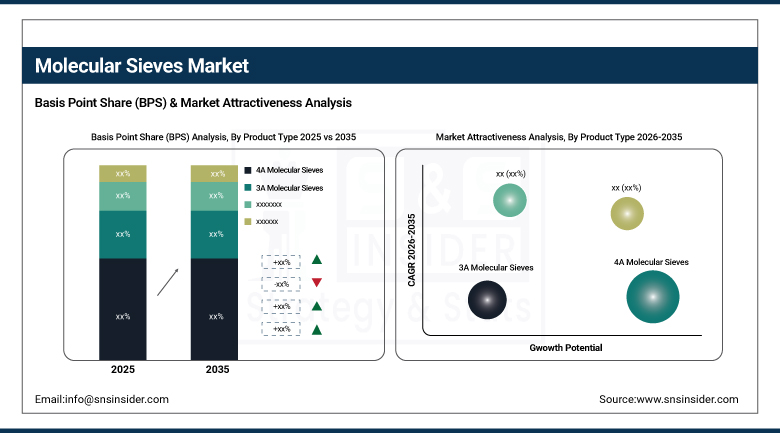
By Product Type, 4A molecular sieves dominated the market with 28.00% share in 2025, while 13X molecular sieves are projected to witness the fastest growth with 6.28% CAGR during the forecast period.
-
By Form, beads dominated the market with 37.00% share in 2025, while powder is projected to witness the fastest growth with 5.30% CAGR during the forecast period.
-
By Application, gas drying & purification dominated the market with 29.00% share in 2025, while industrial gas separation is projected to witness the fastest growth with 6.44% CAGR during the forecast period.
-
By End User, oil & gas dominated the market with 31.00% share in 2025, while industrial gas manufacturers are projected to witness the fastest growth with 6.85% CAGR during the forecast period.
By Product Type, 4A molecular sieves dominated, while 13X molecular sieves grows fastest.
The 4A Molecular Sieves segment is estimated to grow at the second largest market share in 2025, holding 28.00% of the global molecular sieves market share. This segment dominated the global molecular sieve market in 2025owing to their usage in a wide range of applications including industrial dryers, compressed air dehydrators, refrigerator dryers, detergents and natural gas processing. The molecular sieves materials possess better water absorption capacity, higher adsorption capacity per usage and are cost efficient, therefore providing to a popular material choice in various industries.
The 13X Molecular Sieves segment held steady, registering a CAGR of 6.28%, as they have significant application on the oxygen production industry, but the hydrogen production industry, LNG import terminal operations and the growing industrial gas separation sectors are propelling the demand forward. Honeywell UOP maintained momentum, continuing to develop advanced adsorption techniques supporting both the need to create efficient Hydrogen purification systems and also expanding processes focused on gas processing with significant demand for improved molecular sieves.
By Form, beads dominated, while powder grows fastest.
Bead molecular sieves dominate, commanding 37.00% share in global molecular sieves market in 2025 - owing to advantages like exceptional mechanical robustness, smooth flow ability, low pressure drop, enhanced strength across adsorption-regeneration processes, and enhanced consistency in adsorption performances that minimizes wastage through efficient operational management. Used widely for molecular sieves dehydration units, natural and compressed gas treating, LNG refining facilities, petrochemical plant processes, and industrial processes for various drying operations, their compatibility with colossal size industrial molecular sieve adsorption columns coupled with ease of integrating to continuous operations has ensured significant product acceptance in chemical manufacturing, refining & petrochemical industries, and the gas processing industry.
The powder form of molecular sieves are poised for lucrative gains and growth by Registering 5.30% of growth over the forecast years due to increasing application as molecular sieves catalyst binder, component in synthesis of specialty chemical industries, ingredients of formulations of pharmaceutical and advanced process technologies, used in the creation of advanced adsorbents materials, and custom industrial process formulation due to it good dispersion properties. BASF actively pursuing advanced zeolite solutions that improve catalyst design, environmental sustainability, and industrial process.
By Application, gas drying & purification dominated, while industrial gas separation grows fastest.
Gas drying & purification with 29.00% market share occupied the largest market share in 2025 due to extensive usage of molecular sieves in natural gas dehydration, LNG treatment, compressor air treatment, refrigerant drying, solvent purification, and industrial gas treating, driven by the demand for ultra-low moisture contents to enhance process efficiency, minimize the probability of corrosion, protect downstream components and enhance product consistency.
Industrial gas separation showing 6.44% CAGR is expected to rise at the highest CAGR between 2026 and 2035 as industries are increasing their capital expenditure in hydrogen production, air oxygen concentrator, air nitrogen generator, carbon capture technology, pressure swing adsorption based technology. The rising demand for highly pure industrial gases across the healthcare, electronics and semiconductor, renewable energy and chemical industry are further fueling its adoption. As of 2025, DOE has continue providing its support in the context of development of H2 Hubs and implementing various other industrial decarbization technologies that demands efficient gas separation and purification technology.
Regional Analysis
|
Region |
Major Country |
Share within Region, 2025 (%) |
|---|---|---|
|
North America |
United States |
91.00% |
|
Europe |
Germany |
24.00% |
|
Asia Pacific |
China |
25.00% |
|
Middle East & Africa |
UAE |
4.00% |
|
Latin America |
Brazil |
4.00% |
North America Molecular Sieves Market Insights
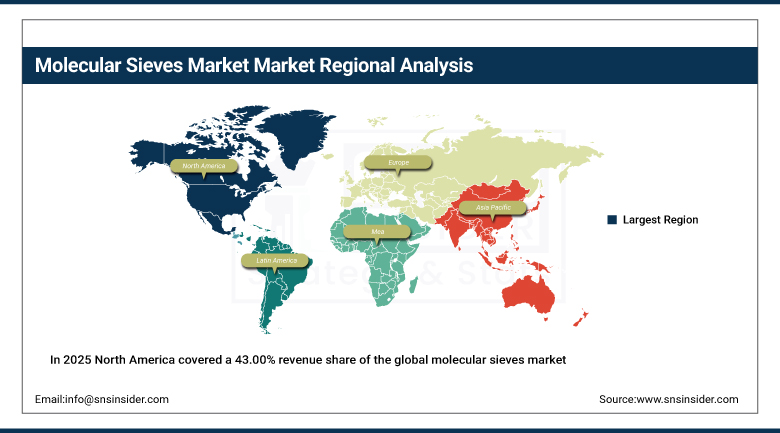
In 2025 North America covered a 43.00% revenue share of the global molecular sieves market and remained dominant in the sector due to its established oil & gas industry, well-developed petrochemical infrastructure, abundant industrial gas production capacity and increasing investments being directed towards the use of hydrogen & carbon capture technologies. Significant application of molecular sieves is still being witnessed across the North American region as natural gas dehydration, LNG processing, refining operations, oxygen generation, and specialty chemicals production activities continue to progress across the region.
The existence of key players and the region's strong R&D base, combined with demand for high-purity industrial gases will further boost North America's dominance throughout the forecast period. Additionally, growing commercialization of hydrogen production, renewable fuels and carbon management initiatives is creating new application arenas for molecular sieves across different industries. In 2025 Honeywell UOP continued with the expansion of advanced gas processing and adsorption technologies for hydrogen purification, natural gas treatment and industrial decarbization activities across North America.
Get Customized Report as per Your Business Requirement - Enquiry Now
Europe Molecular Sieves Market Insights
Europe continues to be a key growth region in a Molecular Sieves market due to various contributing factors, including restrictive emission policies and a maturing oil and gas processing, coupled with a sustained effort towards greener solutions within industries; Germany, France, the UK, the Netherlands, and Italy continue to deploy a range of advanced adsorption material to optimize gas purities and gas dehydrations processes, solvent purification and to the specialized processing requirements of the chemical industry.
Factors like expanding green energy initiatives, stringent rules pertaining to industrial pollution and efficiency improvements are motivating industrial users of this adsorbents material for modern processing plants. Other segment includes a widespread usage of the sieves in application such as Renewable Fuel Production and Decarburization. BASF continues their innovation and leadership role in providing high performance adsorbent solutions.
Asia Pacific Molecular Sieves Market Insights
The Asia Pacific Molecular Sieves Market is estimated to grow at the highest CAGR of 4.83% during the stipulated period. Extensive development of industrial applications, significant expansion of refining capacity, increased petrochemical production and massive investment in industrial gas manufacturing is bolstering significant growth in the market in China, India, Japan, South Korea and Southeast Asia respectively. Demand for natural gas processing, manufacture of electronics, production of chemicals and pharma as well as for chemical exports have increased significantly over the last few years, which continue to drive the adoption of molecular sieves across Asia Pacific.
This region is also witnessing immense growth in terms of investment, which in turn is leading to growth of hydrogen production, LNG terminals, and manufacture of semiconductors and in Specialty Chemicals. Tosoh Corporation is continually expanding production capabilities for advanced zeolite and specialty materials which are crucial to applications in industrial gases, petrochemical applications and environmental applications in Asia Pacific.
Middle East & Africa and Latin America Molecular Sieves Market Insights
Middle East & Africa molecule sieve growing investment in natural gas processing, refining enhancement, petrochemical activities & diversification in U.A.E., Saudi Arabia, Qatar and South Africa increasing long production, hydrogen initiatives and industrial gas production supporting sustained demand for effective adsorption media. ADNOC maintains investment in gas processing upgrades and less emission industrials operations fostering molecular adsorption and separation solutions.
Latin America’s solid and sustained growth is mainly due to its efforts toward refining upgrade projects, chemical manufacturing development and gas infrastructure expansion in Brazil, Mexico, Argentina and Chile increasing demand in the petrochemical industry, pharmaceutical production as well as natural gas development activities supporting this field on dehydration, separation and adsorption media application. Petrobras is strengthening refinery development projects and natural gas processing advancement thus the use of gas purifying technological innovations will see greater utilization across Brazil, the region's main industrial gas player.
Market Dynamics
Growth Drivers: Increasing demand for industrial gas separation and high purity gas.
The burgeoning demand for high purity industrial gases across several verticals that include hydrogen, oxygen, nitrogen, argon, semiconductor fabrication, medical applications and the electronics industry is one of the most notable drivers propelling the growth of the Molecular Sieves market. Molecular sieves offer superior selectivity, efficient adsorption process and regeneration benefits, which consequently, have led them to replace other adsorption media in PSA and TSA applications.
As the world looks towards adopting better cleaner production processes along with the growing demand for high purity gases from the end use industries will bolster the overall molecular sieve products’ market. Besides that, growth in LNG capacities worldwide along with several industrial projects and renewable energy initiatives that advocate the generation of clean fuel in 2025, support commercial progress of adsorption technologies in full vigor.
Restraints: High manufacturing costs, energy-intensive regeneration.
Despite their superb adsorption capabilities and extended life span, molecular sieves rely on precise manufacturing processes involving careful synthesis of the zeolite structure, precise activated control and high temperature calcination. Therefore molecular sieves production cost is comparatively high over usual desiccants. For the end user, setting up requires purchase of dedicated adsorption vessels, regeneration and process control systems thereby increasing the capital investment needed for implementation.
Large energy required during the regenerative step of an industrial application, especially for oil & gas refining and petrochemical operations, increases operating cost. These factors are decisive in cost-sensitive industries and in developing countries to some extent, making end user consider cheaper alternative adsorption options which can limit fast penetration although they are of much inferior capacity over the molecular sieves.
Opportunities: To build out hydrogen economy and carbon capture infrastructure globally.
Rapidly growing commercialization of low-carbon hydrogen generation, CCUS, renewables- fuels, and sustainable industrial manufacturing is driving long-term opportunities in the molecular sieves market. Molecular sieves are becoming an integral part of hydrogen separation, CO2 removal, renewable natural gas upgrades, oxygen generation systems, providing excellent selectivity under rigorous operating conditions. Numerous governments are providing capital to implement their programs for industrial decarburization.
Meanwhile, additional commercial opportunities are being created by rising demand from pharmaceutical manufacturing, semiconductor fabrication, and specialty chemicals markets for custom molecular sieve solutions. Ongoing advances in synthetic zeolite chemistry and adsorptions systems design are anticipated to unlock further commercial opportunities over the projected timeframe of the analysis. The U.S. Dept. of Energy provides ongoing funding support to hydrogen hubs and carbon management programs in 2025 that utilize advanced adsorption, purification and gas cleanup technology.
Recent Developments
-
2026: Honeywell UOP introduced advancements in its gas processing and adsorption technologies to improve hydrogen purification efficiency, natural gas dehydration, and industrial decarburization performance.
-
2025: BASF expanded its portfolio of advanced catalyst and adsorption materials designed to improve industrial gas purification, chemical processing efficiency, and sustainability across manufacturing industries.
-
2025: Tosoh Corporation strengthened production capabilities for specialty zeolite materials supporting industrial gas separation, environmental technologies, and petrochemical processing applications.
-
2025: Arkema's CECA business continued expanding molecular sieve solutions for gas drying, solvent purification, and industrial adsorption applications with enhanced operational efficiency.
Molecular Sieves Market Key Players are:
-
Honeywell International Inc.
-
Arkema S.A.
-
BASF SE
-
Tosoh Corporation
-
Zeochem AG
-
Chemiewerk Bad Köstritz GmbH
-
KNT Group
-
Luoyang Jalon Micro-Nano New Materials Co., Ltd.
-
Sorbead India
-
W. R. Grace & Co.
-
Clariant AG
-
Zeolyst International
-
Hengye Inc.
-
PQ Corporation
-
Shanghai Hengye Molecular Sieve Co., Ltd.
-
Dalian Haixin Chemical Industrial Co., Ltd.
-
Ningbo Jiahe New Materials Technology Co., Ltd.
-
Union Showa K.K.
-
Pingxiang Xintao Chemical Packing Co., Ltd.
-
Axens
Molecular Sieves Market Report Scope:
| Report Attributes | Details |
|---|---|
| Market Size in 2025 | USD 3.90 Billion |
| Market Size by 2035 | USD 6.19 Billion |
| CAGR | CAGR of 4.73% From 2026 to 2035 |
| Base Year | 2025 |
| Forecast Period | 2026-2035 |
| Historical Data | 2022-2024 |
| Report Scope & Coverage | Market Size, Segments Analysis, Competitive Landscape, Regional Analysis, DROC & SWOT Analysis, Forecast Outlook |
| Key Segments | • By Product Type (4A Molecular Sieves, 3A Molecular Sieves, 13X Molecular Sieves, 5A Molecular Sieves, Others) • By Form (Beads, Pellets, Powder, Extrudates) • By Application (Gas Drying & Purification, Petroleum Refining & Petrochemicals, Industrial Gas Separation, Pharmaceutical & Chemical Processing, Others) • By End User (Oil & Gas, Chemical & Petrochemical, Industrial Gas Manufacturers, Pharmaceutical Industry, Others) |
| Regional Analysis/Coverage | North America (US, Canada), Europe (Germany, UK, France, Italy, Spain, Russia, Poland, Rest of Europe), Asia Pacific (China, India, Japan, South Korea, Australia, ASEAN Countries, Rest of Asia Pacific), Middle East & Africa (UAE, Saudi Arabia, Qatar, South Africa, Rest of Middle East & Africa), Latin America (Brazil, Argentina, Mexico, Colombia, Rest of Latin America). |
| Company Profiles | Honeywell International Inc., Arkema S.A., BASF SE, Tosoh Corporation, Zeochem AG, Chemiewerk Bad Köstritz GmbH, KNT Group, Luoyang Jalon Micro-Nano New Materials Co., Ltd., Sorbead India, W. R. Grace & Co., Clariant AG, Zeolyst International, Hengye Inc., PQ Corporation, Shanghai Hengye Molecular Sieve Co., Ltd., Dalian Haixin Chemical Industrial Co., Ltd., Ningbo Jiahe New Materials Technology Co., Ltd., Union Showa K.K., Pingxiang Xintao Chemical Packing Co., Ltd., Axens |
Frequently Asked Questions
The market is projected to reach USD 6.19 Billion by 2035.
The Molecular Sieves Market was valued at USD 3.90 Billion in 2025.
The market is anticipated to expand at a CAGR of 4.73% during the forecast period.
North America dominated the global Molecular Sieves Market in 2025 with a 43.00% revenue share.
4A Molecular Sieves accounted for the largest revenue share of 28.00% in 2025.
