
Hybrid Cloud Orchestration Market Report Scope & Overview:
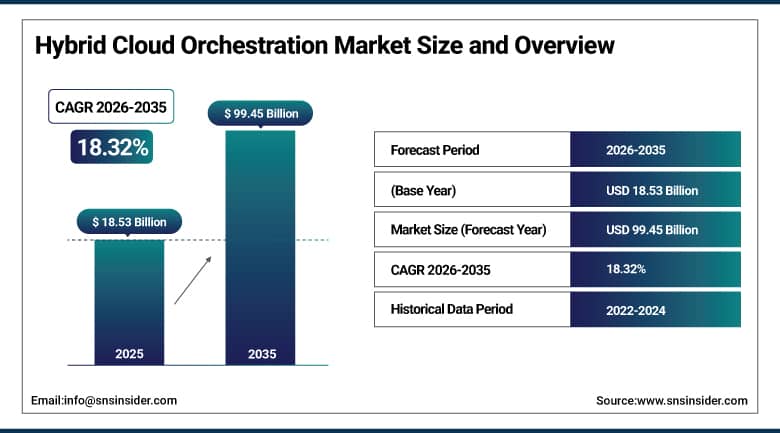
Hybrid Cloud Orchestration Market was valued at USD 18.53 Billion in 2025 and is expected to reach USD 99.45 Billion by 2035, growing at a CAGR of 18.32% from 2026–2035.
Drivers such as rising adoption of hybrid cloud infrastructure, growing demand for centralization of workload management, increasing need for flexibility in resource allocation, and rising focus on reducing costs associated with cloud infrastructure management are contributing to the expansion of the hybrid cloud orchestration market. Hybrid cloud orchestration solutions allow enterprises to manage and integrate workloads, applications, data, and computing resources deployed on public cloud, private cloud, and on-premise environment without much manual intervention.
The increasing deployment of cloud-native applications, multi-cloud architectures, AI workloads, data-driven applications, and distributed enterprise systems is creating the need for automation of provisioning, workload management, resource optimization, security management, and policy-driven governance of resources. Moreover, enterprises operating in BFSI, IT and telecoms, healthcare, retail, manufacturing, governments, and other industries are increasingly relying on hybrid cloud architecture to enhance scalability, business continuity, operational agility, and efficiency of infrastructure, thereby driving the adoption of hybrid cloud orchestration solutions.
In February 2025, Amazon Web Services expanded AWS Deadline Cloud with support for Adobe After Effects in service-managed fleets, enabling creative teams to submit rendering projects without managing their own render farm infrastructure. The update also introduced support for custom fonts and adjustable image-sequence rendering, while AWS Deadline Cloud automatically provisions and elastically scales compute resources, supporting the broader adoption of cloud-based workload orchestration and resource management. For the hybrid cloud orchestration market, such capabilities highlight the growing emphasis on automated workload provisioning, elastic resource allocation, centralized management, and infrastructure optimization across distributed computing environments.
To Get More Information On Hybrid Cloud Orchestration Market - Request Free Sample Report
Hybrid Cloud Orchestration Market Trends
-
Increasing adoption of hybrid and multi-cloud environments is driving demand for efficient workload orchestration and centralized infrastructure management.
-
Growing complexity of distributed IT environments is encouraging enterprises to automate workload provisioning, resource allocation, application deployment, and infrastructure monitoring.
-
Rising adoption of cloud-native applications, containers, Kubernetes, and virtualization is increasing demand for flexible orchestration across public cloud, private cloud, and on-premises environments.
-
Growing focus on infrastructure optimization, operational efficiency, scalability, and cost reduction is creating opportunities for hybrid cloud orchestration providers.
-
Advancements in artificial intelligence, automation, machine learning, and infrastructure-as-code are improving workload management, resource utilization, interoperability, and scalability.
The U.S. Hybrid Cloud Orchestration Market Outlook
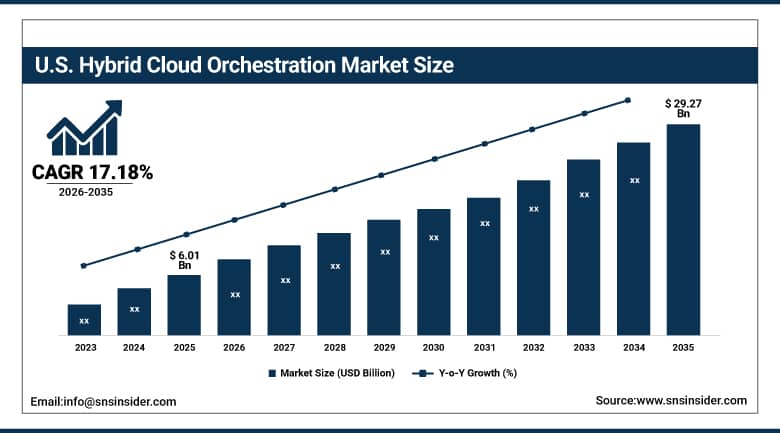
The U.S. hybrid cloud orchestration market was valued at USD 6.01 Billion in 2025 and is expected to reach around USD 29.27 Billion by 2035, growing at a CAGR of 17.18% from 2026–2035.
There are several factors responsible for making the US hybrid cloud orchestration market a highly attractive space in the coming years. One such factor is the rising need for scalability, automation, and efficiency of workload management in public, private, and on-premises clouds. The presence of many technology firms, banks, healthcare organizations, retail establishments, manufacturing firms, government organizations, and other enterprises in the US makes use of hybrid cloud infrastructure for digital transformation efforts. Increasing investments in cloud computing, artificial intelligence, containerization, virtualization, and cloud-native apps have compelled many organizations to adopt hybrid cloud orchestration systems for automated workload provisioning, resource allocation, application deployment, infrastructure management, and cost savings.
In April 2026, Google Cloud introduced enhancements to its cross-cloud infrastructure capabilities at Google Cloud Next ’26 in Las Vegas, focusing on fluid compute, cross-cloud connectivity, unified data management, and digital sovereignty. These capabilities are designed to help enterprises operate workloads and data across distributed and hybrid environments while improving infrastructure flexibility, governance, and resource utilization. The developments support demand for hybrid cloud orchestration by strengthening the need for centralized coordination, automated workload placement, cross-cloud connectivity, and consistent management across heterogeneous infrastructure.
Hybrid Cloud Orchestration Market Segment Analysis
-
By Component, solutions dominated the market with a 68.40% share in 2025, while services is projected to be the fastest-growing segment, registering a 20.77% CAGR during 2026–2035.
-
By Service Type, hybrid hosting dominated the market with a 45.20% share in 2025, while cloud management and orchestration is projected to be the fastest-growing segment, registering a 21.48% CAGR during 2026–2035.
-
By Service Model, SaaS dominated the market with a 52.30% share in 2025, while PaaS is projected to be the fastest-growing segment, registering a 20.30% CAGR during 2026–2035.
-
By Organization Size, large enterprises dominated the market with a 72.60% share in 2025, while small and medium-sized enterprises (SMEs) is projected to be the fastest-growing segment, registering a 21.15% CAGR during 2026–2035.
-
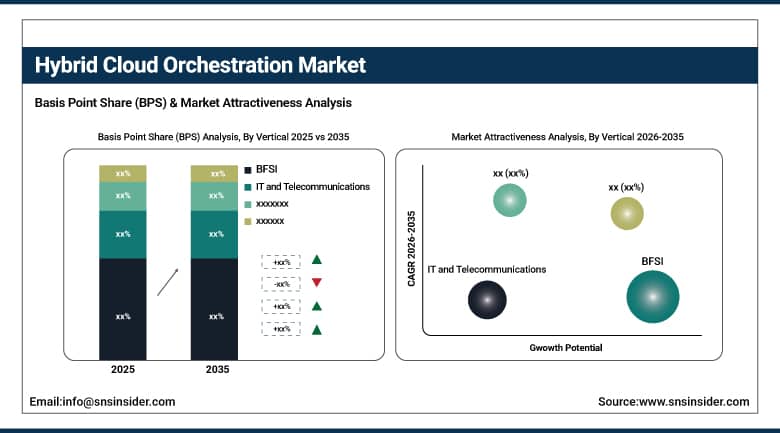
By Vertical, BFSI dominated the market with a 24.80% share in 2025, while IT and telecommunications is projected to be the fastest-growing segment, registering a 25.54% CAGR during 2026–2035
By Vertical, BFSI dominated the hybrid cloud orchestration market, while IT and telecommunications is expected to grow fastest.
The BFSI sector contributed to the highest market share in 2025 because of the rising demand for effective handling of huge volumes of sensitive financial data and critical applications in secure and scalable IT systems. BFSI firms prefer to use hybrid cloud infrastructures to ensure better security, compliance, performance, recovery, and operational flexibility. The orchestration of hybrid cloud helps banks, insurers, and financial firms to align their workloads and optimize the deployment of their resources.
IT & Telecommunications is predicted to experience the fastest growth rate during the forecast period. This is due to the fast expansion of cloud native applications, networks, data workloads, 5G infrastructure, edge computing, and AI, which makes the environment more complex in terms of IT infrastructures. The orchestration of hybrid clouds helps telecommunication operators and technology companies to automate the placement of workloads and resources management.
By Service Type, hybrid hosting dominated the hybrid cloud orchestration market, while cloud management and orchestration is expected to grow fastest.
The hybrid hosting segment held the largest market share in 2025 owing to the rising popularity of cloud environments combining the use of public cloud, private cloud, and on-premises environment. Enterprises are adopting hybrid hosting to leverage scalability, performance, security, compliance, and infrastructure control. With dynamic allocation of workloads, organizations can manage their resources effectively while retaining more control over sensitive applications and data. Moreover, initiatives towards digital transformation in the BFSI, IT & Telecommunications, healthcare, retail, manufacturing, government, and other industries are propelling the adoption of hybrid hosting solutions.
The cloud management & orchestration segment is projected to grow at the highest CAGR in the forecast period. Rising complexity in hybrid and multi-cloud environments is prompting enterprises to leverage orchestration to enable provisioning, scheduling, allocation, deployment, monitoring, and policy management of their workloads. Increasing adoption of cloud-native applications, containers, Kubernetes, artificial intelligence workloads, and infrastructure-as-code solutions is fuelling the demand for automated cloud management & orchestration solutions.
By Service Model, SaaS dominated the hybrid cloud orchestration market, while PaaS is expected to grow fastest.
In 2025, the SaaS segment had the largest market share, backed by the growing adoption of cloud-based applications by enterprises and the need for easy access to business applications in distributed IT infrastructures. With the help of SaaS, organizations can lower their infrastructure management needs, make it easier for application deployment, and facilitate operations that involve geographic locations. The rising adoption of collaboration cloud solutions, CRM, cloud analytics, enterprise applications, and vertical applications is driving the demand for SaaS in hybrid cloud deployments.
The PaaS segment will grow at the highest rate during the forecast period. Cloud-native applications, containers, APIs, and microservices are increasingly being developed which are compelling enterprises to switch to PaaS offerings. The PaaS environment helps organizations retain selected applications on their private infrastructure while making use of public cloud computing and development.
Regional Analysis
|
Region |
Major Country |
Share within Region, 2025(%) |
|---|---|---|
|
North America |
United States |
84.63% |
|
Europe |
Germany |
27.38% |
|
Asia Pacific |
China |
45.72% |
|
Middle East & Africa |
Saudi Arabia |
22.84% |
|
Latin America |
Brazil |
21.63% |
North America Hybrid Cloud Orchestration Market Insights
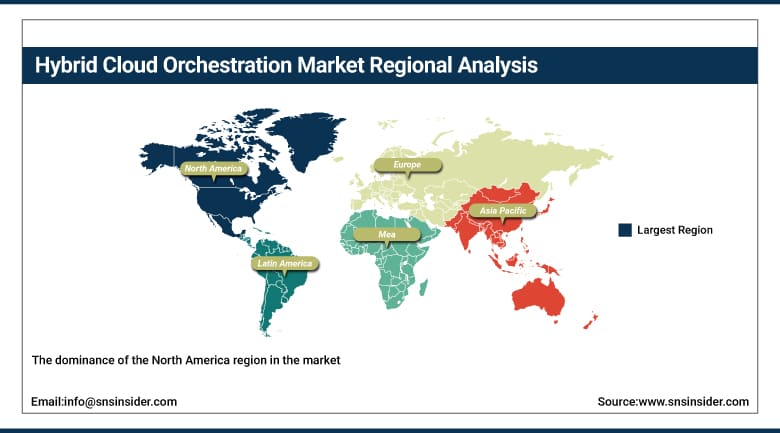
The dominance of the North America region in the market of hybrid cloud orchestration will be sustained throughout the forecast period of 2025-2035, with a 38.34% share of the overall global market in 2025. This domination is driven by high quality of cloud infrastructure, digital transformation of enterprises, and presence of technology firms, banks, health care service providers, telecom operators, manufacturers, and governments.
The country market of the US is the largest in the region, with a leading position in the North American market in 2025 driven by high usage of hybrid and multi-cloud infrastructure, artificial intelligence, cloud-native applications, containerization, virtualization, and automatic infrastructure management. The growing demand for central orchestration of workload, optimization of resources, deployment of applications, infrastructure management, and policy-based governance drives market growth.
Get Customized Report as Per Your Business Requirement - Enquiry Now
Europe Hybrid Cloud Orchestration Market Insights
The need for hybrid cloud orchestration will persist in Europe well into 2035, backed by the increasing usage of cloud, digital transformation, data governance, and IT complexity. Germany is among the dominant country markets owing to its highly developed manufacturing, automotive, engineering, finance services, and industrial technology industries.
Hybrid cloud orchestration is being implemented across organizations in the region as it increases infrastructure flexibility, application modernization, and data management. The UK, France, Italy, and several other European countries are adding to the demand in the region via cloud infrastructure, cybersecurity, artificial intelligence, digital services, and cloud-native solutions.
Asia Pacific Hybrid Cloud Orchestration Market Insights
The Asia Pacific region is forecast to witness the fastest growth among all regions, with a CAGR of 19.47% between 2026 and 2035. The reason for growth includes the rapid digital transformation of the region, increased use of cloud technology, development of data center infrastructure, and growth in the implementation of artificial intelligence, cloud native applications, and distributed computing systems. China has been identified as the biggest country market share in the region, owing to its huge technology sector, growing digital economy, data centers, and hybrid/multi-cloud infrastructure.
Japan and South Korea are other key markets, owing to their advanced technology sector, electronics sector, automotive sector, telecommunications sector, and enterprise IT sector. India is poised for significant growth, with enterprises adopting more cloud computing, AI workloads, and containerized applications.
Middle East & Africa and Latin America Hybrid Cloud Orchestration Market Insights
Both the Middle East & Africa and Latin America regions will witness continuous growth of hybrid cloud orchestration through 2035 due to such trends like digital transformation, cloud infrastructure development, more investments into enterprise technology, and growth of hybrid and multi-cloud solutions usage. In terms of the Middle East & Africa region, Saudi Arabia will be an important country market due to such factors as digital infrastructure investment, smart city projects, data center initiatives, artificial intelligence adoption, and digital transformation program at the state level.
As far as Latin America is concerned, Brazil will be an important country market because of the growth of cloud usage in such industries as finance, telecom, retail, manufacturing, healthcare, and public sector. Other Latin American countries like Mexico will also make a contribution into the regional market growth.
Market Dynamics
Growth Driver: Increasing adoption of hybrid cloud environments and automated workload management is driving market growth
The rising implementation of hybrid cloud infrastructure in organizations is an important factor contributing to the rising demand for the hybrid cloud orchestration market. Organizations have started to leverage their combination of public clouds, private clouds, and on-premises infrastructures for better scalability, flexibility, security, and cost savings. Rising use of cloud-native applications, artificial intelligence, containers, databases, and distributed applications is also contributing to the rising need for hybrid cloud orchestration.
Technological advancements in areas of cloud automation, Kubernetes, virtualization, infrastructure as code, artificial intelligence, and machine learning have enabled better workload provisioning, resource allocation, deployment, monitoring, and use of infrastructure. Moreover, the rising requirement of automated workload placement, dynamic resource allocation, business continuity, and policy management is pushing enterprises towards hybrid cloud orchestration solutions.
Restraint: Security, integration complexity, and high implementation costs can limit market adoption
Issues of security and compliance which come up when handling the workload and sensitive information across different infrastructure such as public cloud, private cloud, and on-premises computing could limit hybrid cloud orchestration. For organizations operating in a regulated environment, there may be challenges with data sovereignty, access to data, compliance needs, and security policies. Furthermore, the integration of old software and existing cloud infrastructure and APIs could pose some implementation challenges.
The exorbitant cost of software licensing, upgrading infrastructure, migration costs, skilled IT personnel, and maintaining the whole system could act as a deterrent to small companies.
Opportunity: Growing adoption of AI workloads, multi-cloud infrastructure, and intelligent automation creates new market opportunities
Growing usage of artificial intelligence, machine learning, cloud-native applications, containerization, and computationally intensive workloads is generating new opportunities for hybrid cloud orchestration companies. Companies need to have a flexible architecture that can dynamically allocate computational resources between public clouds, private clouds, and on-premise systems according to performance, costs, and other factors.
The growth of edge computing, distributed computing, digital transformation, and multi-cloud is raising demand for automated workload management and centralized infrastructure management. AI-powered orchestration, resource allocation, intelligent workload placement, automation via policies, and FinOps capabilities could allow firms to increase efficiency of infrastructure use and manage cloud spend. This trend is likely to generate additional opportunities for hybrid cloud orchestration players in technology, BFSI, healthcare, manufacturing, telecom, retail, and government industries.
Recent Developments
-
2026: Amazon Web Services enhanced AWS Deadline Cloud with new fleet-scaling controls, including worker idle duration, standby worker count, and scale-out rate, enabling organizations to optimize workload capacity, rendering performance, and infrastructure utilization across cloud environments.
-
2026: Amazon Web Services introduced an AI-powered troubleshooting assistant for AWS Deadline Cloud that analyzes render-job logs and metrics to identify common failures and provide recommendations, demonstrating the growing use of AI-driven automation for workload monitoring and operational management.
-
2026: CoreWeave expanded its cloud capabilities for creative and AI-intensive workloads, leveraging its GPU-focused infrastructure to support scalable computing requirements across media, entertainment, gaming, and other data-intensive applications.
-
2026: Amazon Web Services expanded AWS Deadline Cloud capabilities with support for Blender 5.1, Autodesk Maya plugin synchronization, persistent storage, and NVIDIA GRID R580, strengthening its support for GPU-accelerated workloads and professional digital-content workflows.
Hybrid Cloud Orchestration Market key players are:
-
Amazon Web Services Inc.
-
Microsoft Corporation
-
Google LLC
-
IBM Corporation
-
Oracle Corporation
-
Cisco Systems Inc.
-
Red Hat Inc.
-
VMware Inc.
-
Dell Technologies Inc.
-
Hewlett Packard Enterprise Company
-
Alibaba Cloud Ltd.
-
SAP SE
-
ServiceNow Inc.
-
Nutanix Inc.
-
Fujitsu Ltd.
-
Huawei Technologies Co. Ltd.
-
NetApp Inc.
-
BMC Software Inc.
-
CloudBolt Software Inc.
-
Morpheus Data LLC.
Hybrid Cloud Orchestration Market Report Scope:
| Report Attributes | Details |
|---|---|
| Market Size in 2025 | USD 18.53 Billion |
| Market Size by 2035 | USD 99.45 Billion |
| CAGR | CAGR of 18.32% From 2026 to 2035 |
| Base Year | 2025 |
| Forecast Period | 2026-2035 |
| Historical Data | 2022-2024 |
| Report Scope & Coverage | Market Size, Segments Analysis, Competitive Landscape, Regional Analysis, DROC & SWOT Analysis, Forecast Outlook |
| Key Segments | • By Component (Solutions, Services) • By Service Type (Cloud Management and Orchestration, Disaster Recovery, Hybrid Hosting) • By Service Model (Infrastructure-as-a-Service (IaaS), Platform-as-a-Service (PaaS), Software-as-a-Service (SaaS)) • By Organization Size (Small and Medium-sized Enterprises (SMEs), Large Enterprises) • By Vertical (BFSI, IT and Telecommunications, Healthcare, Retail, Manufacturing, Government, Media and Entertainment, Transportation and Logistics, Others) |
| Regional Analysis/Coverage | North America (US, Canada), Europe (Germany, UK, France, Italy, Spain, Russia, Poland, Rest of Europe), Asia Pacific (China, India, Japan, South Korea, Australia, ASEAN Countries, Rest of Asia Pacific), Middle East & Africa (UAE, Saudi Arabia, Qatar, South Africa, Rest of Middle East & Africa), Latin America (Brazil, Argentina, Mexico, Colombia, Rest of Latin America) |
| Company Profiles | Amazon Web Services Inc., Microsoft Corporation, Google LLC, IBM Corporation, Oracle Corporation, Cisco Systems Inc., Red Hat Inc., VMware Inc., Dell Technologies Inc., Hewlett Packard Enterprise Company, Alibaba Cloud Ltd., SAP SE, ServiceNow Inc., Nutanix Inc., Fujitsu Ltd., Huawei Technologies Co. Ltd., NetApp Inc., BMC Software Inc., CloudBolt Software Inc., Morpheus Data LLC. |

Frequently Asked Questions
The Hybrid Cloud Orchestration Market is expected to grow at a CAGR of 18.32% from 2026 to 2035.
The Hybrid Cloud Orchestration Market was valued at approximately USD 99.45 billion in 2025.
The market is primarily driven by increasing adoption of hybrid and multi-cloud environments, growing demand for automated workload management, cloud infrastructure optimization, and the need to improve scalability, operational efficiency, and resource utilization.
Hybrid Hosting dominated the Hybrid Cloud Orchestration Market in 2025, accounting for a 45.20% share.
North America dominated the Hybrid Cloud Orchestration Market in 2025, accounting for a 38.34% share.
