
GPU Orchestration Platform Market Report Scope & Overview:
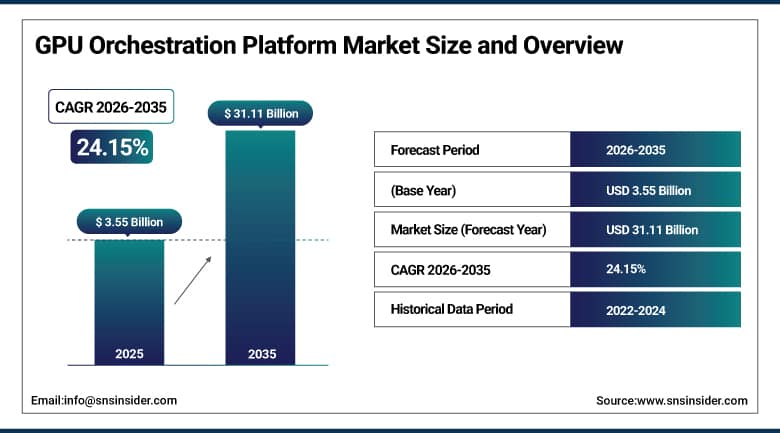
The GPU Orchestration Platform Market was valued at USD 3.55 Billion in 2025 and is expected to reach USD 31.11 Billion by 2035, growing at a CAGR of 24.15% from 2026–2035.
The GPU orchestration platform market are the increase in demand for efficient GPU resource utilization, adoption of AI and machine learning workloads, rise in HPC environments, and the increase in demand for centralizing GPU scheduling, allocation, and workloads. The use of GPU orchestration platforms allows enterprises, cloud service providers, research institutions, and technology firms to make GPU resources available, dynamically allocate computing resources, manage workloads, decrease underutilization of resources, and enhance overall infrastructure efficiency. Additionally, the increase in the adoption of generative AI, large language models, deep learning, and other GPU-intensive workloads is driving demand for platforms that can manage large GPU clusters in different computing environments.
Furthermore, the increase in GPU infrastructure in the cloud, hybrid computing environments, containerization of applications, and Kubernetes deployment environment is also driving the GPU orchestration platform market. Adoption of GPU orchestration platforms has increased among organizations in order to achieve automation of resource allocation, workload scheduling, GPU sharing for multiple tenants, capacity management, and infrastructure monitoring. Innovation in AI, machine learning, distributed computing, cloud computing, edge computing, and container orchestration is further boosting adoption. GPU orchestration platforms offer support to applications such as AI and machine learning, HPC, data analytics, graphics rendering, and other computationally intensive workloads.
In April 2025, NVIDIA open-sourced its KAI Scheduler, a Kubernetes-native GPU scheduling solution developed within the Run:ai platform, to improve the management and utilization of GPU and CPU resources for AI workloads. The scheduler dynamically allocates computing resources based on changing workload requirements and supports capabilities such as workload prioritization, resource guarantees, bin-packing, consolidation, and preemption. The initiative highlights the growing need for advanced GPU orchestration platforms to reduce resource fragmentation, improve GPU utilization, shorten compute wait times, and efficiently manage large-scale AI infrastructure.
To Get More Information On GPU Orchestration Platform Market - Request Free Sample Report
GPU Orchestration Platform Market Trends:
-
Increasing demand for efficient GPU resource utilization across AI, cloud computing, data centers, research, and enterprise workloads is driving adoption of GPU orchestration platforms.
-
Rapid growth of generative AI, large language models, deep learning, and other GPU-intensive applications is increasing demand for intelligent GPU scheduling, allocation, and workload management.
-
Expanding cloud GPU infrastructure, Kubernetes environments, containerized workloads, and hybrid computing deployments is creating greater need for centralized GPU orchestration and resource optimization.
-
Growing adoption of GPU virtualization, multi-tenant computing, dynamic resource allocation, and workload consolidation creates opportunities for advanced GPU orchestration solutions.
-
Advancements in artificial intelligence, machine learning, distributed computing, cloud computing, edge computing, container orchestration, and GPU virtualization are accelerating GPU orchestration platform adoption across industries.
U.S. GPU Orchestration Platform Market Outlook:
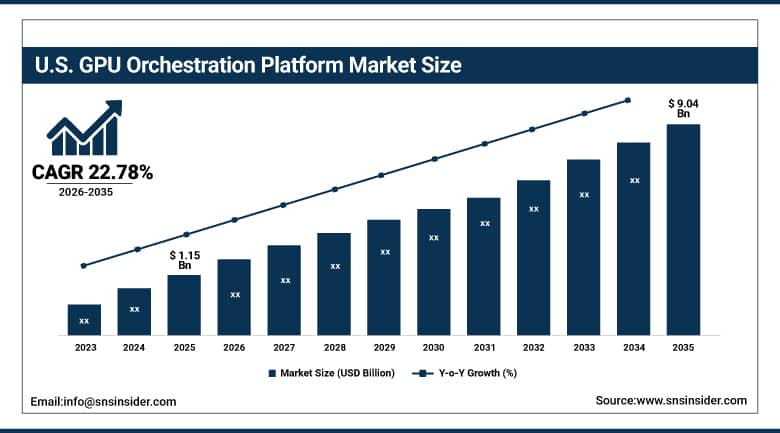
The U.S. GPU Orchestration Platform Market was valued at USD 1.15 Billion in 2025 and is expected to reach around USD 9.04 Billion by 2035, growing at a CAGR of 22.78% from 2026–2035.
There is great future potential for the U.S. GPU orchestration platform market because of the growing need for effective GPU utilization for applications such as artificial intelligence, machine learning, cloud computing, high-performance computing, data analytics, and graphics. Growing investments made by technology firms, cloud computing services, data centers, research firms, and enterprises are driving the need for GPU orchestration platforms that can help in optimizing resources, maximizing GPU utilization, saving on costs, and improving workload performance.
GPU orchestration platforms are gaining greater importance for managing complex GPU environments through intelligent workload scheduling, dynamic resource allocation, GPU monitoring, multi-tenancy resource management, workload prioritization, and capacity management. Besides, the quick growth in generative AI, large language models, deep learning, and other GPU-intensive workloads is adding to market growth. Growing use of GPU infrastructure in cloud environments, Kubernetes environments, containerized applications, hybrid computing, and GPU virtualization is helping the market to grow. Apart from this, continued investments in AI infrastructure, accelerated computing, and next-generation data centers are likely to create great opportunities for GPU orchestration platforms in the U.S. market.
In August 2025, the U.S. Federal Communications Commission’s Technological Advisory Council highlighted the role of AI and machine learning in optimizing 5G and emerging 6G networks, including applications for spectrum management, network performance, and more efficient wireless resource utilization. The development underscores growing U.S. interest in AI-enabled spectrum optimization as wireless networks become more complex and spectrum demand increases.
GPU Orchestration Platform Market Segment Analysis:
-
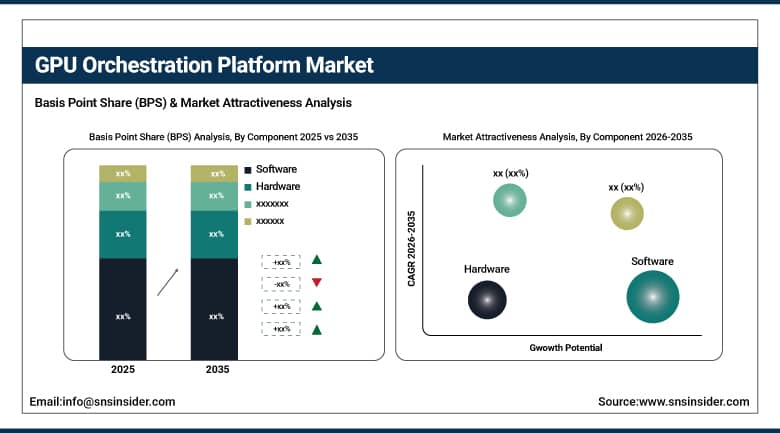
By component, software is dominant at 47.30% in 2025, while software is also the fastest-growing segment with an indicative CAGR of 26.13% during 2026–2035.
-
By deployment mode, cloud is dominant at 58.70% in 2025, while cloud is also the fastest-growing segment with an indicative CAGR of 26.03% during 2026–2035.
-
By enterprise size, large enterprises are dominant at 71.80% in 2025, while small and medium enterprises are the fastest-growing segment with an indicative CAGR of 28.36% during 2026–2035.
-
By application, AI and Machine Learning is dominant at 43.90% in 2025, while AI and Machine Learning is also the fastest-growing segment with an indicative CAGR of 26.98% during 2026–2035.
-
By end-user, IT and Telecommunications is dominant at 26.40% in 2025, while Automotive is the fastest-growing segment with an indicative CAGR of 28.28% during 2026–2035.
By Component, software dominated the GPU orchestration platform market, while software is expected to grow fastest.
The software segment is anticipated to hold the largest market share owing to the crucial nature of scheduling, allocating, monitoring and optimization of GPU resources in complex computing setups. GPU orchestration software allows enterprises to manage GPU clusters, manage workload priorities, allocate resources automatically, monitor utilization of GPU and enhance overall infrastructural efficiency. The increasing usage of artificial intelligence, machine learning, generative AI and high-performance computing is expected to fuel the demand for centralized solutions in managing GPU resources. The integration with Kubernetes, containerized computing, cloud infrastructure and hybrid computing environments would contribute towards the rising demand for software orchestration solutions.
The software solution is projected to witness fastest growth rate during the forecast period on account of enterprises deploying AI-driven workloads requiring efficient management of GPU resources. The fast-growing usage of large language models, deep learning, generative AI and accelerated computing is going to increase the demand for intelligent scheduling, workload prioritization, GPU sharing, resource provisioning and performance monitoring.
By Application, AI and Machine Learning dominated the GPU orchestration platform market, while AI and Machine Learning is expected to grow fastest.
The AI and Machine Learning segment held the largest market share, owing to the huge need for GPU resources in model training, inference, deep learning, generative AI, and large-scale data processing. Companies have been increasingly adopting GPU-intensive AI loads in their data centers and clouds, leading to a rising need for systems that enable efficient scheduling and distribution of GPU resources. GPU orchestration tools allow organizations to prioritize workloads, optimize the utilization of GPUs, compute tasks distribution, and increase infrastructure efficiency. The fast evolution of large language models and generative AI applications is driving the demand for GPU resource management solutions.
The AI and Machine Learning segment will witness the fastest growth during the forecast period due to the growing spending by enterprises on generative AI, deep learning, foundation models, and intelligent automation. The growing complexity and size of AI loads call for advanced GPU scheduling, resource sharing, workload balancing, and cluster management capabilities.
By End-User, IT and Telecommunications dominated the GPU orchestration platform market, while Automotive is expected to grow fastest.
IT & Telecommunication was observed to have the largest market share because of the wide adoption of data centers, cloud infrastructure, AI workloads, high-performance computing, and GPU intensive applications in this industry. It is being seen that technology and telecommunications industries require GPU orchestration for efficient management of their compute environment, optimizing resource allocation, developing AI, and optimizing their infrastructure. The growing adoption of cloud services, generative AI platforms, intelligent network applications, and data intensive workloads is contributing towards the demand for GPU orchestration solutions in this industry.
Automotive is projected to grow at the fastest rate over the forecast period owing to the rising adoption of autonomous driving technologies, advanced driver assistance systems, connected vehicles, digital twins, simulations, and vehicle development with the use of AI. All these applications require considerable GPU computing resources for computer vision, model training, simulations, and perception systems. GPU orchestration solution would be useful for automakers for efficient management of GPU resources.
Regional Insights:
|
Region |
Major Country |
Share within Region, 2025(%) |
|---|---|---|
|
North America |
United States |
84.63% |
|
Europe |
Germany |
27.38% |
|
Asia Pacific |
China |
45.72% |
|
Middle East & Africa |
Saudi Arabia |
22.84% |
|
Latin America |
Brazil |
21.63% |
North America GPU Orchestration Platform Market Insights
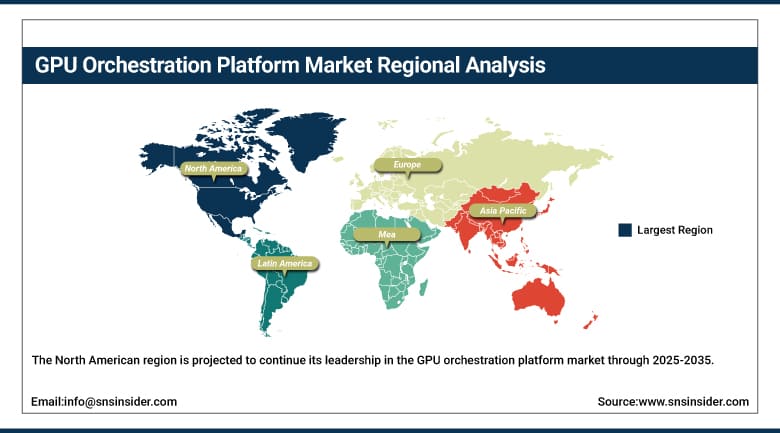
The North America region is projected to continue its leadership in the GPU orchestration platform market through 2025-2035 driven by the availability of advanced data center infrastructure, investments in artificial intelligence, cloud computing, high-performance computing, and accelerated computing systems. The region is estimated to have captured 38.34% share of the worldwide GPU orchestration platform market in 2025. The U.S. country constitutes the largest market in the North American region due to the presence of key technology firms, cloud service providers, AI companies, data center providers, and research institutes.
Investments in generative AI, large language models, GPU computing, and AI infrastructure-as-a-service are driving the adoption of GPU orchestration platforms. Such platforms are gaining traction for GPU scheduling, workload management, cluster monitoring, and utilization of GPU infrastructure.
Get Customized Report as Per Your Business Requirement - Enquiry Now
Europe GPU Orchestration Platform Market Insights
It is expected that Europe will continue being an important region for the GPU orchestration platform market till 2035 because of the adoption of artificial intelligence, the development of cloud computing infrastructure, investment in high-performance computing, and advancement in data center ecosystems. The leading country market in the region is Germany due to its industrial strength, automotive industry, manufacturing strengths, and research organizations.
In addition, other countries in the region such as the UK, France, Italy, and others are contributing to the demand in the region because of the investments in generative AI, cloud infrastructure, digitalization, scientific computing, and enterprise AI applications. In addition, increasing adoption of Kubernetes, containerized workload, and hybrid computing is creating demand for GPU orchestration platforms.
Asia Pacific GPU Orchestration Platform Market Insights
The growth in the adoption of AI, the growth in cloud infrastructure, investment in data centers, and demand for acceleration computing are some of the factors that will fuel the demand in the GPU orchestration platform market in Asia Pacific, thereby making it the fastest growing region. In 2025, Asia Pacific accounted for 26.18% of the total market share in the GPU orchestration platform market and will increase during the forecast period. Growing need for efficient management of GPU resources due to the rapid adoption of generative AI, machine learning, high-performance computing, cloud-based GPU infrastructure, and digital services are some of the drivers of the market in the region.
In terms of countries, China is one of the largest markets for GPUs as it accounts for vast AI infrastructure, growing data center capacity, advanced technology ecosystem, and considerable investments in generative AI, machine learning, cloud computing, and high-performance computing. The other major countries in the region are Japan and South Korea, and they are driven by advanced technology industry, semiconductor ecosystem, automotive, robotics, and investments in AI and accelerated computing. In the coming years, India will witness high growth rate as enterprises, cloud providers, technology companies, and research institutes invest in AI infrastructure, cloud-based GPU resources, and high-performance computing.
Middle East & Africa and Latin America GPU Orchestration Platform Market Insights
It is expected that the market for GPU orchestration platform will experience stable growth in Middle East & Africa and Latin America until 2035 due to the growth in data center investments, cloud infrastructure deployments, digital transformation processes, AI investments, and the demand for accelerated computing. The Middle East & Africa will see Saudi Arabia as one of the leading country markets for the deployment of GPU orchestration platforms due to investments in the digital infrastructure, AI projects, cloud computing, smart cities infrastructure, data centers, and advanced computing infrastructure.
Similarly, Latin America will see consistent growth, with Brazil being one of the leading country markets in the region due to the well-developed technology sector, cloud infrastructure deployments, AI deployment, and the demand for high computing power. Other countries from Latin America, including Mexico, will continue to invest in digital transformations, cloud services, data centers, and enterprise-level AI solutions, which will contribute to the gradual adoption of GPU orchestration platforms.
Growth Driver: Increasing adoption of AI, generative AI, and GPU-intensive workloads driving market demand
Rapid implementation of artificial intelligence, generative AI, machine learning, deep learning, and other GPU-centric workloads is a crucial factor for the rising demand of the GPU orchestration platform market. Companies, cloud services providers, technology firms, research organizations, and data centers are adopting GPU-based infrastructure for training their models, running inference, analytics, scientific computations, and accelerations. As GPU clusters grow and become distributed, organizations need efficient orchestration platforms that can help them schedule workloads, provision GPUs, monitor utilization, manage capacity, and optimize the overall infrastructure. Further, the increasing implementation of large language models, foundation models, computer vision, and AI-based applications is creating a demand for GPU resource management.
The rising implementation of cloud computing, containerized applications, Kubernetes environments, and hybrid infrastructure is one of the most important factors driving the market. Also, the rising requirement for real-time workload scheduling, resource allocation, GPU sharing, and infrastructure optimization will increase the implementation of GPU orchestration platform.
Restraint: High implementation costs and complex integration with existing IT infrastructure hinder GPU orchestration adoption
The high cost of implementation and complex technical nature of integrating GPU orchestration platforms into existing IT infrastructure could pose a hindrance to further market penetration. The deployment of GPU orchestration solutions can entail costs in the form of GPU infrastructure, software platforms, cloud computing facilities, networking, storage, monitoring software, integration, staffing, and maintenance, all resulting in increased cost of implementation. Large scale GPU environment operations may be met with additional hurdles such as infrastructure compatibility, workload migration, security, and resource management issues.
Such issues can pose special problems for small and medium-sized businesses that have restricted budgets and technical capabilities. In addition to these issues, the problem lies in integrating GPU orchestration platforms with the existing legacy infrastructures, GPU architecture, containerization, Kubernetes, cloud, and workload management solutions.
Opportunity: Growing adoption of generative AI, cloud GPU infrastructure, and autonomous resource optimization creates new market opportunities
The growing adoption of generative AI, large language models, high-performance computing, cloud-based GPU infrastructure, and applications enabled by AI is driving huge growth potential for the GPU orchestration platform market. GPU orchestration platforms allow enterprises to dynamically allocate computing resources, optimize GPU resource usage, prioritize workloads, manage GPU clusters, and enhance the performance of the infrastructure. The rising complexity of AI workloads will drive the demand for automated scheduling, workload balancing, GPU sharing, and capacity management.
The rising popularity of GPU-as-a-Service offerings, AI infrastructure based on Kubernetes, hybrid clouds, and multi-tenant computing will drive the addressable market to new heights. Additionally, the increasing spending on AI data centers, accelerated computing, edge AI, and future cloud infrastructure will create more growth potential for the players in the market. The creation of intelligent orchestration capabilities using AI and machine learning for prediction of workloads and optimization of resource allocations is likely to drive long-term growth in the market.
Recent Developments:
-
2026: NVIDIA continued expanding its AI computing and GPU orchestration ecosystem, with advancements in GPU scheduling, resource management, and accelerated computing infrastructure supporting large-scale AI workloads across cloud and data center environments.
-
2026: Amazon Web Services, Inc. expanded its cloud-based accelerated computing capabilities, providing scalable GPU infrastructure and management services that support AI, machine learning, and high-performance computing workloads.
-
2026: Microsoft Corporation continued strengthening its AI infrastructure and cloud GPU capabilities through Azure, supporting large-scale AI workloads with GPU resource management, scalable computing, and workload optimization.
-
2026: Google LLC advanced its AI infrastructure and GPU-based computing capabilities through Google Cloud, supporting AI model development, high-performance computing, and distributed workloads requiring efficient accelerator resource management.
GPU Orchestration Platform Market Key Players:
-
NVIDIA Corporation
-
Amazon Web Services, Inc.
-
Google LLC
-
IBM Corporation
-
Hewlett Packard Enterprise Company
-
Red Hat, Inc.
-
Anyscale, Inc.
-
CoreWeave, Inc.
-
Crusoe Energy Systems LLC
-
RunPod, Inc.
-
Rafay Systems, Inc.
-
DigitalOcean Holdings, Inc.
-
Vast AI, Inc.
-
Lambda Labs, Inc.
-
ClearML, Inc.
-
Domino Data Lab, Inc.
-
Lightning AI
-
Together AI
GPU Orchestration Platform Market Report Scope:
| Report Attributes | Details |
|---|---|
| Market Size in 2025 | USD 3.55 Billion |
| Market Size by 2035 | USD 31.11 Billion |
| CAGR | CAGR of 24.15% From 2026 to 2035 |
| Base Year | 2025 |
| Forecast Period | 2026-2035 |
| Historical Data | 2022-2024 |
| Report Scope & Coverage | Market Size, Segments Analysis, Competitive Landscape, Regional Analysis, DROC & SWOT Analysis, Forecast Outlook |
| Key Segments | • By Component (Software, Hardware, Services) • By Deployment Mode (On-Premises, Cloud) • By Enterprise Size (Small and Medium Enterprises, Large Enterprises) • By Application (AI and Machine Learning, High-Performance Computing, Data Analytics, Graphics Rendering, Other Applications) • By End-User (BFSI, Healthcare, IT and Telecommunications, Media and Entertainment, Automotive, Manufacturing, Other End-Users) |
| Regional Analysis/Coverage | North America (US, Canada), Europe (Germany, UK, France, Italy, Spain, Russia, Poland, Rest of Europe), Asia Pacific (China, India, Japan, South Korea, Australia, ASEAN Countries, Rest of Asia Pacific), Middle East & Africa (UAE, Saudi Arabia, Qatar, South Africa, Rest of Middle East & Africa), Latin America (Brazil, Argentina, Mexico, Colombia, Rest of Latin America) |
| Company Profiles | NVIDIA Corporation; Amazon Web Services, Inc.; Microsoft Corporation; Google LLC; IBM Corporation; Hewlett Packard Enterprise Company; Red Hat, Inc.; Anyscale, Inc.; CoreWeave, Inc.; Crusoe Energy Systems LLC; RunPod, Inc.; Rafay Systems, Inc.; DigitalOcean Holdings, Inc.; Vast AI, Inc.; Lambda Labs, Inc.; ClearML, Inc.; Databricks, Inc.; Domino Data Lab, Inc.; Lightning AI; Together AI. |
Frequently Asked Questions
The GPU Orchestration Platform Market is expected to grow at a CAGR of approximately 24.15% from 2026 to 2035.
The GPU Orchestration Platform Market was valued at approximately USD 3.55 billion in 2025.
The market is primarily driven by growing generative AI adoption, GPU-intensive workloads, cloud infrastructure, and the need for efficient GPU resource management.
Software dominated the GPU Orchestration Platform Market in 2025, driven by rising demand for GPU scheduling, resource allocation, workload optimization, and utilization monitoring.
North America dominated the GPU Orchestration Platform Market in 2025, accounting for a 38.34% share.
