
AI Agent Orchestration Platform Market Report Scope & Overview:
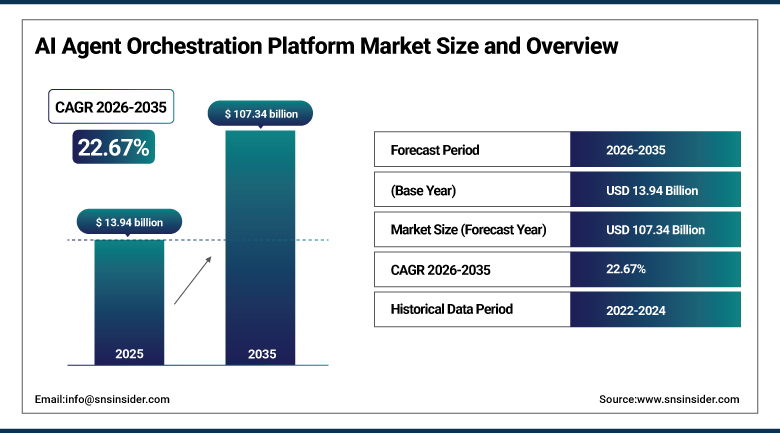
The AI Agent Orchestration Platform Market was valued at USD 13.94 Billion in 2025 and is expected to reach USD 107.34 Billion by 2035, growing at a CAGR of 22.67% from 2026–2035.
The key factors contributing to the growth of the global AI agent orchestration platform market include the increasing adoption of generative AI technologies across enterprises, rising demand for intelligent workflow automation, and the growing need to coordinate multiple AI agents across complex business environments. Organizations are increasingly deploying AI agent orchestration platforms to streamline enterprise operations, automate decision-making, and improve collaboration between AI models, enterprise applications, and human users. Furthermore, the rapid adoption of cloud-native architectures, expansion of multi-agent systems, and growing implementation of human-in-the-loop orchestration are accelerating market growth.
In May 2026, UiPath introduced UiPath for Coding Agents, enabling enterprises to orchestrate, deploy, monitor, and govern AI coding agents through a unified visual orchestration platform, improving enterprise automation, collaboration between AI agents, and end-to-end workflow management.
Market Size and Forecast
-
Market Size 2026E: USD 17.07 Billion
-
Market Size 2035: USD 107.34 Billion
-
CAGR: 22.67% from 2026 to 2035
-
Fastest Growing Region: Asia-Pacific
-
Largest Region: North America
To Get more information AI Agent Orchestration Platform Market - Request Free Sample Report
AI Agent Orchestration Platform Market Trends
-
Growing generative AI adoption is accelerating demand for intelligent AI agent orchestration platforms across enterprise workflows.
-
AI-powered automation improves workflow efficiency, task coordination, and enterprise decision-making across diverse business operations.
-
Integration with LLMs, APIs, and enterprise applications enables seamless orchestration across interconnected AI ecosystems.
-
Human-in-the-loop orchestration strengthens governance, transparency, compliance, and responsible enterprise AI deployment across regulated industries.
-
Cloud-native and hybrid deployments enable scalable, secure, and flexible AI orchestration across distributed enterprise environments.
U.S. AI Agent Orchestration Platform Market Outlook
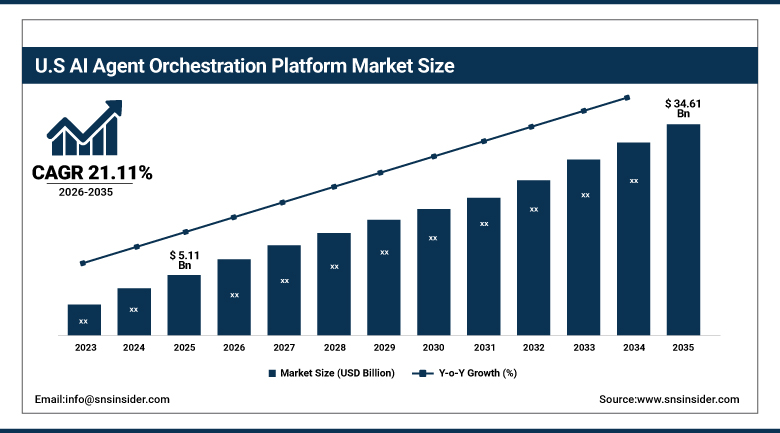
The U.S. AI Agent Orchestration Platform Market was valued at USD 5.11 Billion in 2025 and is expected to reach around USD 34.61 Billion by 2035, growing at a CAGR of 21.11% from 2026–2035.
The US market for AI agent orchestration platforms is experiencing rapid growth due to increasing enterprise adoption of generative AI, multi-agent systems, and intelligent workflow automation. Organizations across industries are deploying AI agent orchestration platforms to coordinate autonomous AI agents, streamline business processes, and improve operational efficiency. These platforms enable seamless integration of large language models (LLMs), enterprise applications, APIs, and cloud services while strengthening governance, security, and scalability. Furthermore, increasing investments in cloud-native AI infrastructure, human-in-the-loop orchestration, and enterprise AI governance are accelerating market growth.
In May 2026 UiPath introduced UiPath for Coding Agents in the United States, enabling enterprises to orchestrate AI coding agents through visual workflows, conversational interfaces, and centralized governance to accelerate enterprise automation and software development.
AI Agent Orchestration Platform Market Segment Analysis
-
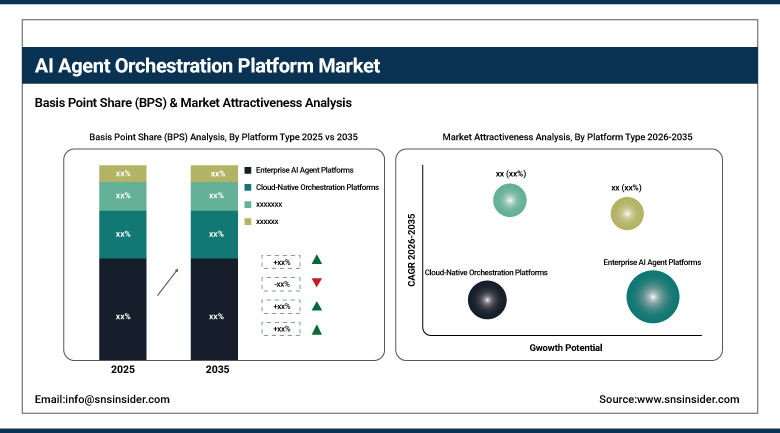
By Platform Type, enterprise AI agent platforms dominated the ai agent orchestration platform market with a 37.80% share in 2025, while cloud-native orchestration platforms are projected to be the fastest-growing segment, registering a CAGR of 26.51% during 2026–2035.
-
By Orchestration Architecture, multi-agent orchestration dominated the ai agent orchestration platform market with a 39.50% share in 2025, while hybrid orchestration is projected to be the fastest-growing segment, registering a CAGR of 26.95% during 2026–2035.
-
By Deployment Model, cloud-based deployment dominated the ai agent orchestration platform market with a 48.70% share in 2025, while hybrid deployment is projected to be the fastest-growing segment, registering a CAGR of 24.90% during 2026–2035.
-
By Application, customer service & cx dominated the ai agent orchestration platform market with a 30.10% share in 2025, while cybersecurity automation is projected to be the fastest-growing segment, registering a OF CAGR 27.92% during 2026–2035.
-
By Industry Vertical, BFSI dominated the AI agent orchestration platform market with a 25.40% share in 2025, while healthcare & life sciences is projected to be the fastest-growing segment, registering a CAGR of 25.49% during 2026–2035.
By Platform Type, enterprise AI agent platforms dominated the AI agent orchestration platform market, while the cloud-native orchestration platforms segment is expected to grow fastest
In 2025, the enterprise AI agent platforms segment dominated the market for AI agent orchestration platforms as an outcome of the increasing use of centralized platforms for the orchestration and monitoring of AI agents. With the increasing need for scalable AI governance, multi-agent collaboration, automation of workflows, and seamless integration of AI agents into enterprise applications, the significance of this segment is expected to rise further.
With an increasing rate of adoption of cloud-native architectures, containerized AI workloads, and Kubernetes-based orchestration, the cloud-native orchestration platforms segment is expected to dominate the market for AI agent orchestration platforms at a higher growth rate than other segments in the coming years.
By Orchestration Architecture, multi-agent orchestration dominated the ai agent orchestration platform market, while the hybrid orchestration segment is expected to grow fastest
As per Orchestration Architecture, multi-agent orchestration accounted for the highest market share in the ai agent orchestration platform market, while the hybrid orchestration segment is anticipated to have the fastest growth rate during the forecast period. Multi-agent orchestration was estimated to be the largest segment in 2025 since there was increased adoption of collaborative AI agents that can perform multi-step workflows in enterprise applications. Multi-agent orchestration was preferred in the AI orchestration architecture since it helped automate tasks, optimize decision making, provide scalability and effective coordination among different AI models.
Hybrid orchestration will be the fastest growing segment in the coming years because of the growing need to combine AI agents' autonomy with human control to increase the level of governance and regulation.
By Deployment Model, cloud-based deployment dominated the AI agent orchestration platform market, while the hybrid deployment segment is expected to grow fastest
the cloud-based deployment segment held the largest share of the ai agent orchestration platform market owing to its scalability, centralized management, lower infrastructure costs, and seamless integration with cloud-native AI environments. Enterprises increasingly adopted cloud-based deployment to orchestrate AI agents across distributed workloads, enable real-time monitoring, accelerate deployment, and support multi-cloud operations, strengthening the segment's market leadership.
The hybrid deployment segment is expected to register the highest growth rate during the forecast period due to the increasing adoption of hybrid IT environments that combine on-premises infrastructure with public and private clouds. Organizations are investing in hybrid deployment models to ensure secure AI operations, regulatory compliance, low-latency processing, and flexible orchestration of AI agents across diverse enterprise environments.
Regional Insights
|
Region |
Major Country |
Share within Region, 2025(%) |
|---|---|---|
|
North America |
United States |
88.70% |
|
Europe |
Germany |
27.80% |
|
Asia Pacific |
China |
44.60% |
|
Middle East & Africa |
Saudi Arabia |
31.80% |
|
Latin America |
Brazil |
40.20% |
North America AI Agent Orchestration Platform Market Insights
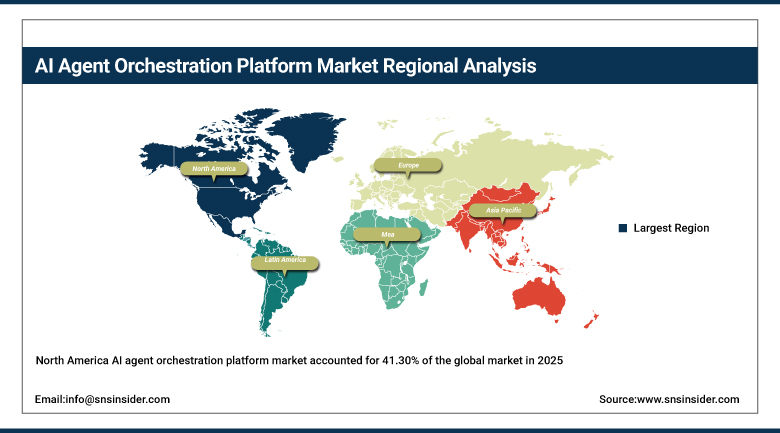
The North America AI agent orchestration platform market accounted for 41.30% of the global market in 2025, driven by rapid enterprise adoption of generative AI, cloud-native infrastructure, MLOps platforms, and advanced AI automation technologies. Furthermore, the United States accounted for 88.70% of the North America ai agent orchestration platform market in 2025, supported by the strong presence of leading AI technology providers, extensive investments in artificial intelligence, and early adoption of enterprise AI orchestration solutions.
Growing deployment of multi-agent AI systems, increasing demand for scalable AI workflow automation, rising adoption of hybrid and multi-cloud environments, and expanding investments in large language model (LLM) applications are driving market growth across the region. In addition, increasing implementation of AI governance frameworks, enterprise MLOps, autonomous AI agents, and cloud-based orchestration platforms is accelerating the adoption of AI agent orchestration solutions, supporting continued market growth in the United States and across North America.
Get Customized Report as per Your Business Requirement - Enquiry Now
Europe AI Agent Orchestration Platform Market Insights
Europe remains a key region in the ai agent orchestration platform market due to its strong digital infrastructure, widespread enterprise AI adoption, expanding cloud ecosystems, and increasing focus on AI governance and regulatory compliance. Germany accounted for 27.80% of the Europe ai agent orchestration platform market in 2025, supported by its advanced industrial base, strong Industry 4.0 initiatives, and growing investments in generative AI, automation, and cloud-native technologies.
The growth of the ai agent orchestration platform market in Europe is driven by increasing adoption of multi-agent AI systems, rising demand for enterprise AI workflow automation, and expanding investments in MLOps and large language model (LLM) deployments. Furthermore, growing digital transformation initiatives, hybrid and multi-cloud adoption, and the implementation of AI orchestration platforms across manufacturing, BFSI, healthcare & life sciences, information technology & telecommunications, and retail & e-commerce are expected to support sustained market growth over the forecast period.
Asia Pacific AI Agent Orchestration Platform Market Insights
The Asia-Pacific AI agent orchestration platform market is expected to register the highest CAGR 44.60% during the forecast period, driven by rapid digital transformation, expanding cloud infrastructure, and increasing adoption of generative AI and enterprise automation solutions. Enterprises across the region are investing in AI agent orchestration platforms, multi-agent AI systems, and Mops technologies to automate complex workflows, improve operational efficiency, and accelerate AI deployment. China accounted for 44.60% of the Asia-Pacific ai agent orchestration platform market in 2025, supported by its large enterprise base, expanding cloud ecosystem, and substantial investments in artificial intelligence, data centres, and digital infrastructure.
Growing adoption of large language models (LLMs), increasing implementation of autonomous AI agents, rising investments in smart manufacturing, and government-led AI initiatives are creating significant growth opportunities across the region. Furthermore, expanding use of cloud-native applications, hybrid and multi-cloud environments, enterprise AI governance frameworks, and AI-powered business process automation is expected to accelerate the adoption of ai agent orchestration platforms throughout the forecast period.
Middle East & Africa and Latin America Insights
Middle East & Africa and Latin America are emerging markets for the ai agent orchestration platform market, driven by accelerating digital transformation, expanding cloud adoption, and increasing investments in enterprise artificial intelligence across both regions. Organizations are deploying AI agent orchestration platforms to automate AI workflows, manage multi-agent systems, improve operational efficiency, and ensure secure, scalable AI deployments. Saudi Arabia accounted for 31.80% of the Middle East & Africa ai agent orchestration platform market in 2025, supported by national AI strategies and growing investments in cloud infrastructure, while Brazil represented 40.20% of the Latin America ai agent orchestration platform market due to its expanding enterprise IT ecosystem and increasing adoption of generative AI and cloud-based automation solutions.
Growing investments in cloud computing, large language model (LLM) applications, enterprise automation, and digital infrastructure modernization are creating significant growth opportunities across both regions. In addition, rising demand for AI-powered workflow orchestration, increasing adoption of hybrid and multi-cloud environments, and the need for AI governance, security, and scalable deployment are expected to support steady growth of the ai agent orchestration platform market throughout the forecast period.
Growth Driver: Rising adoption of enterprise AI automation and multi-agent systems driving demand for AI agent orchestration platforms
The growing adoption of enterprise AI automation and multi-agent systems has become a key factor driving the demand for AI agent orchestration platforms across industries. Organizations are increasingly deploying orchestration platforms to coordinate AI agents, automate complex workflows, manage large language model (LLM) applications, and improve operational efficiency across cloud and hybrid environments. The rapid expansion of generative AI, autonomous agents, and enterprise AI applications is further accelerating market growth.
The increasing implementation of MLOps and LLMOps frameworks, rising demand for scalable AI workflow automation, and continuous growth of cloud-native infrastructure and hybrid deployment models are further supporting the ai agent orchestration platform market. Additionally, growing investments in digital transformation, AI governance, intelligent business automation, and secure enterprise AI deployment are expected to drive sustained market growth over the forecast period.
Restraints: High implementation costs, integration complexity, and AI governance challenges may restrain ai agent orchestration platform market growth
High implementation costs and integration complexity remain major challenges for the ai agent orchestration platform market. Deploying AI agent orchestration platforms often requires significant investments in AI infrastructure, cloud resources, orchestration software, large language models (LLMs), and skilled AI professionals, making adoption costly for small and medium-sized enterprises. In addition, compatibility issues with legacy enterprise systems, fragmented data environments, and existing business applications can delay implementation and increase deployment complexity.
Furthermore, organizations must address challenges related to AI governance, data privacy, security, regulatory compliance, and seamless integration with enterprise applications while managing multiple AI agents across hybrid and multi-cloud environments. The availability of standalone AI automation tools, concerns over operational complexity, and uncertainty regarding return on investment may further restrain the growth of the ai agent orchestration platform market during the forecast period.
Opportunities: Growing adoption of generative AI, multi-agent systems, and enterprise AI automation platforms
The increasing adoption of generative AI and multi-agent systems presents significant growth opportunities for the ai agent orchestration platform market. Organizations are deploying advanced AI agent orchestration platforms to automate complex workflows, coordinate autonomous AI agents, optimize enterprise operations, and accelerate AI application deployment. Continuous advancements in large language models (LLMs), MLOps, LLMOps, and intelligent workflow automation are further expanding the capabilities of AI orchestration platforms.
In addition, rising investments in digital transformation, expanding adoption of cloud-native and hybrid infrastructures, and increasing enterprise demand for scalable AI governance are creating new opportunities for market participants. Growing demand for unified AI workflow management across cloud and on-premises environments, increasing adoption of autonomous AI agents, and continuous innovation in enterprise AI automation are expected to support the long-term growth of the ai agent orchestration platform market.
Recent Developments
-
2026: Microsoft expanded its Azure AI Foundry with enhanced AI agent orchestration capabilities, enabling coordinated multi-agent workflows, enterprise governance, and seamless integration across business applications.
-
2025: Google Cloud introduced advanced Agent Development Kit (ADK) and Agent Engine capabilities, simplifying multi-agent orchestration, tool integration, and deployment of enterprise AI agents.
-
2025: Salesforce enhanced its Agent force platform with AI agent orchestration capabilities, enabling autonomous multi-agent collaboration, workflow automation, and customer service optimization.
-
2024: IBM strengthened its watsonx platform with AI agent orchestration capabilities, improving enterprise AI governance, agent coordination, and integration across hybrid cloud environments.
AI Agent Orchestration Platform Market Key Players
-
Microsoft Corporation
-
Google LLC
-
Amazon Web Services, Inc.
-
IBM Corporation
-
Oracle Corporation
-
Salesforce, Inc.
-
SAP SE
-
ServiceNow, Inc.
-
Fujitsu Limited
-
VMware LLC
-
HashiCorp, Inc.
-
ActiveEon SAS
-
BMC Software, Inc.
-
Wipro Limited
-
TIBCO Software Inc.
-
Hewlett Packard Enterprise (HPE)
-
Databricks, Inc.
-
NVIDIA Corporation.
AI Agent Orchestration Platform Market Report Scope:
| Report Attributes | Details |
|---|---|
| Market Size in 2025 | USD13.94 Billion |
| Market Size by 2035 | USD 107.34 Billion |
| CAGR | CAGR of 22.67% From 2026 to 2035 |
| Base Year | 2025 |
| Forecast Period | 2026-2035 |
| Historical Data | 2022-2024 |
| Report Scope & Coverage | Market Size, Segments Analysis, Competitive Landscape, Regional Analysis, DROC & SWOT Analysis, Forecast Outlook |
| Key Segments | • By Platform Type (Enterprise AI Agent Platforms, Open-Source Orchestration Frameworks, Cloud-Native Orchestration Platforms, Vertical-Specific Orchestration Platforms) • By Orchestration Architecture (Single-Agent Orchestration, Multi-Agent Orchestration, Human-in-the-Loop Orchestration, Hybrid Orchestration) • By Deployment Model (Cloud-Based, On-Premises, Hybrid Deployment) • By Application (Customer Service & CX, IT & DevOps Automation, Business Process Automation, Cybersecurity Automation, Knowledge & Research Automation) • By Industry Vertical (BFSI, Healthcare & Life Sciences, IT & Telecommunications, Manufacturing, Retail & E-commerce) |
| Regional Analysis/Coverage | North America (US, Canada, Mexico), Europe (Eastern Europe [Poland, Romania, Hungary, Turkey, Rest of Eastern Europe] Western Europe] Germany, France, UK, Italy, Spain, Netherlands, Switzerland, Austria, Rest of Western Europe]), Asia Pacific (China, India, Japan, South Korea, Vietnam, Singapore, Australia, Rest of Asia Pacific), Middle East & Africa (Middle East [UAE, Egypt, Saudi Arabia, Qatar, Rest of Middle East], Africa [Nigeria, South Africa, Rest of Africa], Latin America (Brazil, Argentina, Colombia, Rest of Latin America) |
| Company Profiles | Microsoft Corporation, Google LLC, Amazon Web Services, Inc., IBM Corporation, Oracle Corporation, Salesforce, Inc., SAP SE, ServiceNow, Inc., Accenture plc, Fujitsu Limited, VMware LLC, HashiCorp, Inc., ActiveEon SAS, BMC Software, Inc., Wipro Limited, TIBCO Software Inc., New Relic, Inc., Hewlett Packard Enterprise (HPE), Databricks, Inc., NVIDIA Corporation.. |
Frequently Asked Questions
North America dominated the AI agent orchestration platform market in 2025 with a 41.30% share.
The market is driven by the increasing adoption of enterprise AI agents, multi-agent orchestration, and cloud-native AI automation across industries.
The AI agent orchestration platform market was valued at USD 13.94 billion in 2025.
