
Hybrid Renewable Power Plant Market Report Scope and Overview:
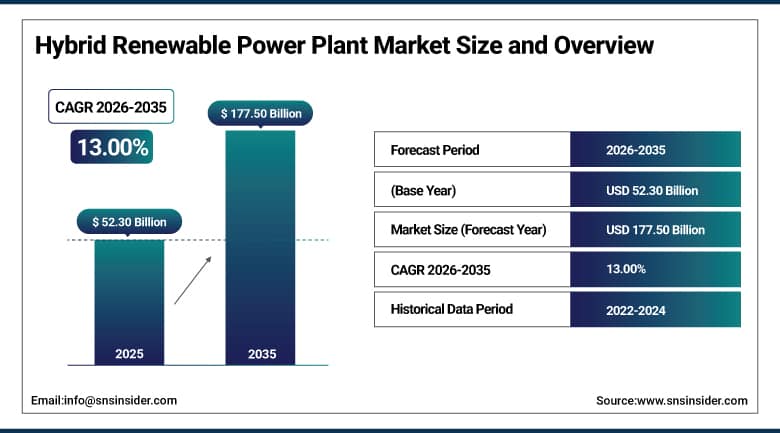
The Hybrid Renewable Power Plant Market was valued at USD 52.30 Billion in 2025 and is projected to reach USD 177.50 Billion by 2035, registering a CAGR of 13.00% from 2026 to 2035.
Market Growth of the Hybrid Renewable Power Plant Market include the increasing utility-scale co-location of solar and wind assets, the increasing integration of long-duration energy storage, the electrification of remote and off-grid communities, and the various use cases from utility power generation, industrial captive power generation, and resilient microgrids. These facilities have emerged as an important technology that allows utilities and IPPs to generate dispatchable, around-the-clock renewable energy by integrating solar and wind facilities together with batteries and, in some off-grid applications, diesel power with a common control and dispatch platform.
The declining cost of solar PV panels, wind turbines, and lithium-ion batteries, along with the increasing power purchase agreements of around-the-clock renewable power generation and increased cooperation of EPC contractors with technology vendors, have been observed after massive investments in hybrid power plants made by utilities, IPPs, and industrial energy buyers.
To Get More Information On Hybrid Renewable Power Plant Market - Request Free Sample Report
Hybrid Renewable Power Plant Market Trends
-
Rising deployment of co-located solar-wind-storage plants continues reducing curtailment and improving dispatchable renewable capacity.
-
Growing utility preference for long-duration battery storage continues strengthening round-the-clock hybrid plant reliability.
-
Expanding hybrid project pipelines across island and off-grid regions continue accelerating solar-wind-diesel adoption.
-
Increasing use of AI-based forecasting and energy management software continues optimizing multi-source generation dispatch.
-
Growing corporate power purchase agreements for firm renewable supply continue driving utility-scale hybrid investment.
U.S. Hybrid Renewable Power Plant Market Outlook
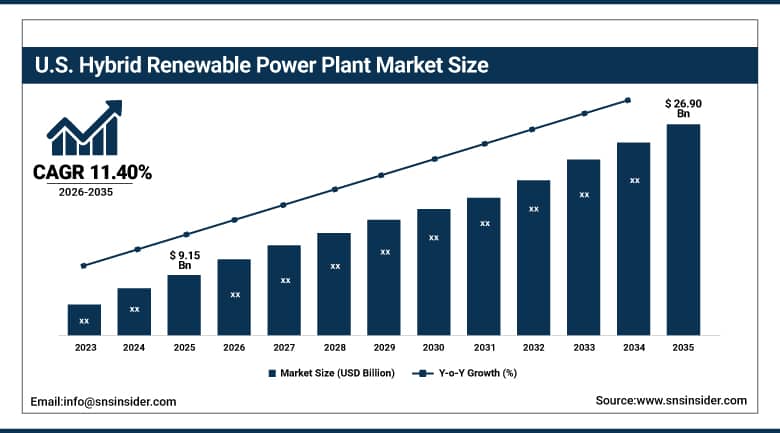
The U.S. Hybrid Renewable Power Plant Market was valued at approximately USD 9.15 Billion in 2025 and is projected to reach approximately USD 26.90 Billion by 2035, registering a CAGR of approximately 11.40% from 2026 to 2035.
The U.S. demand has been fueled by the increasing number of utility-scale solar and wind installations that are co-located with battery energy storage systems, corporate demand for around-the-clock carbon-neutral PPA contracts, and microgrids' investments in resiliency projects by businesses and critical infrastructure providers who experienced weather-related grid outages. The expanding range of financial incentives for clean energy at federal and state levels along with changes to the interconnection process that benefit hybrid and co-located renewable plus storage systems have added to the investments of utilities and independent power producers in hybrid renewable power plants.
The application of AI-powered dispatch optimization and forecasting solutions for multi-source generation was an extremely important factor in establishing the leadership of the U.S. hybrid renewable power plant market. Furthermore, an increase in the adoption of long-duration energy storage solutions combined with utility-scale solar-wind generation portfolios was one more factor stimulating demand for the product domestically.
Hybrid Renewable Power Plant Market Segment Analysis
-
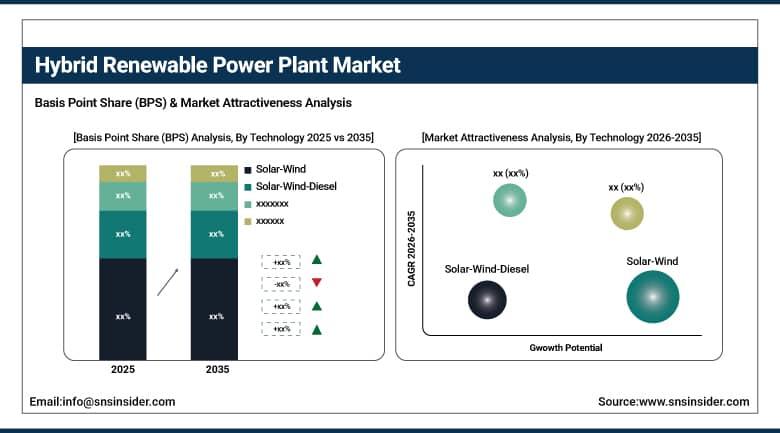
By Technology, Solar-Wind segment dominated the Market in 2025 with 38.40% share; Solar-Wind-Diesel segment is the fastest growing segment, registering a CAGR of approximately 16.40%.
-
By Component, Power Generation segment dominated the market in 2025 with 46.70% share; Energy Storage segment is the fastest growing segment, registering a CAGR of approximately 17.90%.
-
By Application, Utility segment dominated the market in 2025 with 44.80% share; Commercial segment is the fastest growing segment, registering a CAGR of approximately 15.70%.
-
By Power Capacity, Above 50 MW segment dominated the market in 2025 with 49.20% share; 10-50 MW segment is the fastest growing segment, registering a CAGR of approximately 14.60%.
By Technology, Solar-Wind Leads While Solar-Wind-Diesel Grows Fastest
The Solar-Wind configuration held the largest market share in the Hybrid Renewable Power Plants market at approximately 38.40% in 2025 because of the synergy that can be achieved between PV and wind generation profiles that allow a balancing of output during day and night hours without having to depend on only energy storage solutions. In addition, there has been an increase in co-location of both wind and solar capacity at one point of connection for utilities and IPPs with the purpose of reducing transmission costs, accelerating project approvals, and optimizing land usage.
The Solar-Wind-Diesel technology will grow at the fastest rate of 16.40% CAGR in the technology market owing to increasing installation of three-resource systems in remote areas, mining, and on islands in order to achieve maximum utilization of renewables while keeping diesel generation as a reserve source in case of low resource availability. Increasing cost of diesel fuel, availability of modular hybrid control systems, and increasing rural electrification programs in Africa, Latin America, and Southeast Asia are further driving its growth trend.
By Component, Power Generation Dominates While Energy Storage Accelerates Fastest
Power Generation components, comprising solar PV modules, wind turbines, and diesel generator sets, held the largest component share in 2025 at approximately 46.70%, reflecting their role as the core capital investment in any hybrid renewable power plant. Continued declines in the levelized cost of solar and wind generation equipment, alongside improvements in turbine and module efficiency, have sustained strong procurement volumes across utility-scale and distributed hybrid projects. Vendors such as Vestas Wind Systems A/S and Canadian Solar Inc. continue expanding modular, site-adaptable generation portfolios that allow developers to configure hybrid plants around specific resource profiles and land constraints, reinforcing generation hardware as the anchor investment across new project pipelines.
Energy Storage is projected to expand at a CAGR of approximately 17.90%, the fastest pace among component categories, as developers increasingly pair solar and wind assets with lithium-ion and, increasingly, long-duration storage technologies to firm output, shift energy to peak-demand periods, and participate in ancillary service markets. Falling battery costs and the emergence of integrated storage platforms such as Sungrow Power Supply Co., Ltd.'s PowerTitan systems, purpose-built for large-scale hybrid plant integration, are accelerating this shift, as utilities and industrial buyers place growing value on the dispatchability and grid-support capability that storage adds to variable renewable generation.
By Application, Utility Leads While Commercial Gains Fastest Traction
The utility- sector represented the highest application share in 2025 at approximately 44.80%, with utilities and independent power producers developing and installing larger hybrid systems to comply with renewable portfolio standards, offer reliable capacity, and ensure grid stability in view of the increasing shares of renewable generation sources. The signing of long-term power purchasing agreements by utilities and hybrid systems developers, as well as involvement in the capacity and ancillary service markets, made utility-scale deployments the most lucrative area for hybrid renewable power plant technology in both established and emerging power markets, backed by investments from large-scale developers such as NextEra Energy Resources, LLC and EDF Renewables.
Commercial applications are expected to demonstrate the fastest growth rate with a CAGR of approximately 15.70%, thanks to the growing popularity of on-site hybrid systems with solar-wind-storage components installed by retail operators, data centers, and corporate campuses to reduce peak demand rates and hedge against electricity price volatility. The spread of energy-as-a-service business models that enable commercial organizations to install hybrid systems with minimal upfront investments has helped break down the barriers to adoption and will continue driving strong growth in the commercial segment throughout the forecast period.
By Power Capacity, Above 50 MW Dominates While 10-50 MW Expands Fastest
Above 50 MW constituted the largest share of the power capacity market at 49.20% in 2025 due to consistent investment by utilities and independent power producers in such projects that have the ability to provide firm power and are integrated in wholesale power and capacity markets. They usually integrate several hundred megawatts of wind and solar power generation along with grid-scale battery energy storage system backed by long-term PPA contracts and availability of financing which small players find difficult to access. Hybrid projects have therefore continued to dominate the market in established regions of North America, Europe, and Asia Pacific.
Projects with capacity of 10-50 MW are expected to register the highest CAGR at 14.60% owing to increasing adoption of hybrid plants by medium-size industries, community scale and regional utilities which are able to strike a balance between size, cost effectiveness and permitting requirements of these systems. Increasing availability of hybrid plant kits in established regions from EPC firms and technology providers has reduced time of implementation of these projects making them an attractive option for independent power producers and energy service companies venturing into new regions.
Regional Analysis:
|
Region |
Major Country |
Share within Region, 2025 (%) |
|---|---|---|
|
Asia Pacific |
China |
36.80% |
|
North America |
United States |
78.50% |
|
Europe |
Germany |
24.60% |
|
Middle East and Africa |
Saudi Arabia |
29.40% |
|
Latin America |
Brazil |
33.10% |
Asia Pacific Hybrid Renewable Power Plant Market Insights
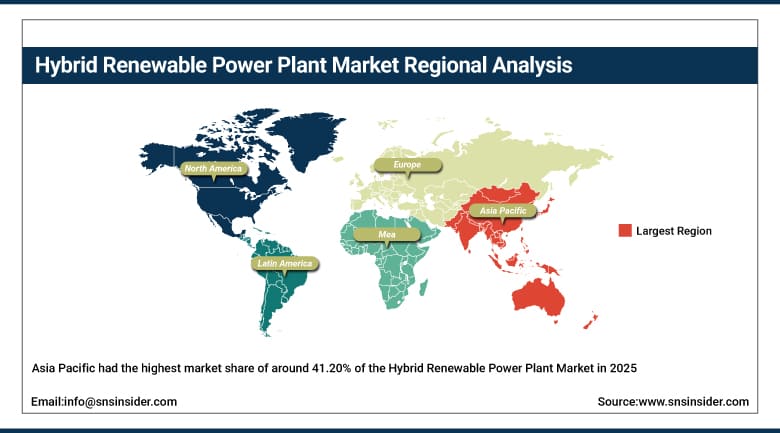
Asia Pacific had the highest market share of around 41.20% of the Hybrid Renewable Power Plant Market in 2025 and will also continue to lead in terms of growth, with an approximate CAGR of 14.90% from 2026 to 2035. Such a combination has been a result of fast-paced industrial development, highly aggressive renewable energy targets, and extensive rural electrification/grid up-gradation plans in China, India, Japan, and South Korea. There have been significant investments made by regional utilities, independent power producers, and government-backed developers in setting up solar-wind-storage systems in order to meet rising electricity demand and decarbonization commitments.
China contributed the largest market revenue share in the Asia Pacific region with an approximate market share of around 36.80%, on account of continuous investments made by the state in capacity expansions of renewables, domestic manufacturing capabilities for solar modules, wind turbines, and battery storage systems, along with rapid development of hybrid renewable plants in its western provinces. The rapid renewable integration efforts in India, with the help of national auction processes which clearly favored the provision of 24/7 hybrid and firm renewable power supplies, were also a significant factor behind fast-paced growth in the region.
Get Customized Report as Per Your Business Requirement - Enquiry Now
North America Hybrid Renewable Power Plant Market Insights
The Hybrid Renewable Power Plant Market occupied a significant portion of market revenues in North America during 2025 on account of the presence of an advanced power network, abundance of renewable sources, and strong business interest in non-stop carbon-neutral power due to increasing retirements of existing traditional power generation capacity. Co-location of hybrid solar, wind, and energy storage facilities has been leading in the U.S. and Canada, with initiatives towards the upgrading of the aging electric grid infrastructure, alleviating interconnection queue logjams, and shifting towards a greater proportion of dispatchable renewables on regional transmission systems.
Around 78.50% of the total North American revenues were contributed by the U.S., as a result of growing co-location of utility-scale solar-wind-storage capacity, business interest in corporate power purchase agreements by technology and industrial buyers interested in firm renewables, and the use of AI-based software for dispatch optimization of independent power producers with multiple hybrid facilities in resource-abundant states.
Europe Hybrid Renewable Power Plant Market Insights
Europe contributed a significant chunk of the Hybrid Renewable Power Plant Market, which features strict decarbonization goals, advanced grid network and extensive integration of renewable energy into its member countries' energy portfolio. Some of the most active participants of the regional market in regard to installation of co-located and hybrid power plants are Germany, the United Kingdom, France and the Nordics due to their desire to tackle grid stability issues, become less dependent on imported fossil fuel and achieve ever stricter renewable energy targets.
Germany accounted for the lion's share of the revenues earned within the European market due to massive investments into renewable energy capacity, which is related to the country's own energy transition plan and battery storage systems that were installed next to the already operating wind and solar systems due to the need to handle grid instability. The United Kingdom was also a considerable participant of the regional market because of its offshore wind farm construction plans.
MEA and Latin America Hybrid Renewable Power Plant Market Insights
The Middle East & Africa and Latin America experienced sustained demand growth as a result of increasing investments into renewable energy diversification programs, expansion of rural electrification programs, and increased cooperation between regional utilities and foreign suppliers of hybrid technologies. Areas that suffer from capacity constraints, grid weaknesses, and lack of grid infrastructure have become an increasingly important market for hybrid renewable plants capable of producing cost-effective power independently from costly investments into transmission infrastructure.
In the Middle East & Africa, Saudi Arabia was the leading regional market because of its big renewable energy investment program aimed at energy diversification of the country. Grid modernization and off-grid electrification programs in the UAE helped to increase the regional market share. In Latin America, Brazil remained the leading market in the region due to its abundant resources of renewables and needs for hybrid solar-wind-storage solutions.
Market Dynamics:
Growth Drivers: Rising Demand for Firm, Round-the-Clock Renewable Power
Market dynamics include increasing utility and corporate demand for firm and dispatchable renewable energy, decreasing costs of solar and wind energy and battery storage systems, increasing co-location of generation assets and storage assets at common points of interconnections, and increased rural electrification and off-grid programs that require reliability from multi-source power generation. Considering the increasing trend of renewable auction programs and power purchase agreements for round-the-clock or firm renewable energy, demand for hybrid renewable energy plants is projected to stay strong through the forecast period in all customer types.
Other evidences consist of the growing ties between EPC contractors, battery storage companies, and renewable technology companies, along with government-sponsored grid modernization and rural electrification projects in various regions. Global emphasis on reducing curtailment and enhancing bankability of variable renewable energy through storage and multi-source system integration represents another critical driver of demand and growth during the forecast period.
Restraints: High Capital Costs and Integration Complexity
One of the reasons for slow implementation of the technology is the capital costs involved in installing hybrid renewable power plants, which pose a challenge in terms of the complexity of such installations and hence delay market adoption. The process of integrating a variety of generation sources, storage, and control mechanisms might prove difficult and necessitate significant financial input into engineering, site evaluation, and software for energy management.
Another problem is one of delays in interconnection queue and other regulatory barriers related to differences in regional regulations and policies for developers of hybrid plants and technology providers. The integration of hybrid plant control system with the rest of grid infrastructure poses additional challenges for utilities with multivendor generation and storage fleet.
Opportunities: Storage Integration and Digital Optimization
The continual growth in the development of batteries for storage that lasts for a long period of time and lithium-ion batteries for storage provides an excellent opportunity for vendors who can develop hybrid renewable power plants by integrating storage, artificial intelligence, and predictive dispatch software to minimize curtailment and make projects more bankable. Platform offerings from companies, such as Wärtsilä Energy and Siemens Energy AG, which combine AI-powered dispatch optimization and multi-source generation control, highlight how companies are taking advantage of this growing opportunity in order to differentiate themselves.
Moreover, the global transition to electricity and the corporate commitment to net-zero emissions is providing a great deal of opportunity for companies that can offer hybrid systems which are scalable, interoperable, and affordable enough to provide electricity around the clock through renewables. Companies that are able to show reduced curtailment and better capacity factors through hybrid solutions will find themselves in a great position for investment.
Recent Developments:
-
2025: ACWA Power commissioned a new solar-wind-storage hybrid facility within its Al Shuaibah complex in Saudi Arabia, integrating utility-scale battery storage with renewable generation.
-
2025: Sungrow Power Supply Co., Ltd. unveiled its PowerTitan 3.0 hybrid energy storage system, designed for large-scale solar-wind hybrid power plant integration.
-
2025: NextEra Energy Resources, LLC completed construction of a new hybrid solar-plus-storage facility in Texas, pairing photovoltaic generation with grid-scale battery capacity.
-
2026: ReNew Energy Global Plc commissioned a hybrid wind-solar-storage power plant in Gujarat, India, supporting round-the-clock renewable power supply under a long-term PPA.
-
2026: Wärtsilä Energy launched an enhanced GEMS Digital Energy Platform update, adding predictive analytics for multi-source hybrid renewable plant optimization.
Hybrid Renewable Power Plant Market key players are:
-
Siemens Energy AG
-
GE Vernova Inc.
-
Vestas Wind Systems A/S
-
ABB Ltd.
-
Schneider Electric SE
-
Suzlon Energy Limited
-
Enel Green Power S.p.A.
-
ACWA Power
-
EDF Renewables
-
NextEra Energy Resources, LLC
-
Ørsted A/S
-
Invenergy LLC
-
Wärtsilä Energy
-
Mitsubishi Power, Ltd.
-
Sungrow Power Supply Co., Ltd.
-
Canadian Solar Inc.
-
Tata Power Solar Systems Ltd.
-
ReNew Energy Global Plc
-
Juwi AG
-
Tesla, Inc.
Hybrid Renewable Power Plant Market Report Scope:
| Report Attributes | Details |
|---|---|
| Market Size in 2025 | USD 52.30 Billion |
| Market Size by 2035 | USD 177.50 Billion |
| CAGR | 13.00% from 2026 to 2035 |
| Base Year | 2025 |
| Forecast Period | 2026-2035 |
| Historical Data | 2022-2024 |
| Report Scope & Coverage | Market Size, Segments Analysis, Competitive Landscape, Regional Analysis, DROC & SWOT Analysis, Forecast Outlook |
| Key Segments | •By Technology, Solar-Wind segment dominated the Market in 2025 with 38.40% share; Solar-Wind-Diesel segment is the fastest growing segment, registering a CAGR of approximately 16.40%. •By Component, Power Generation segment dominated the market in 2025 with 46.70% share; Energy Storage segment is the fastest growing segment, registering a CAGR of approximately 17.90%. •By Application, Utility segment dominated the market in 2025 with 44.80% share; Commercial segment is the fastest growing segment, registering a CAGR of approximately 15.70%. •By Power Capacity, Above 50 MW segment dominated the market in 2025 with 49.20% share; 10-50 MW segment is the fastest growing segment, registering a CAGR of approximately 14.60%. |
| Regional Analysis/Coverage | North America (US, Canada), Europe (Germany, UK, France, Italy, Spain, Russia, Poland, Rest of Europe), Asia Pacific (China, India, Japan, South Korea, Australia, ASEAN Countries, Rest of Asia Pacific), Middle East & Africa (UAE, Saudi Arabia, Qatar, South Africa, Rest of Middle East & Africa), Latin America (Brazil, Argentina, Mexico, Colombia, Rest of Latin America). |
| Company Profiles | Siemens Energy AG, GE Vernova Inc., Vestas Wind Systems A/S, ABB Ltd., Schneider Electric SE, Suzlon Energy Limited, Enel Green Power S.p.A., ACWA Power, EDF Renewables, NextEra Energy Resources, LLC, Ørsted A/S, Invenergy LLC, Wärtsilä Energy, Mitsubishi Power, Ltd., Sungrow Power Supply Co., Ltd., Canadian Solar Inc., Tata Power Solar Systems Ltd., ReNew Energy Global Plc, Juwi AG, Tesla, Inc. |

Frequently Asked Questions
Key players in the Hybrid Renewable Power Plant Market include Siemens Energy AG, GE Vernova Inc., Vestas Wind Systems A/S, ABB Ltd., and ACWA Power, among others.
Key opportunities in the Hybrid Renewable Power Plant Market include expansion of long-duration storage integration and AI-based dispatch optimization, alongside growing demand for round-the-clock renewable supply to support corporate net-zero and energy-security goals.
The market is driven by rising utility and corporate demand for firm, dispatchable renewable electricity, falling costs of solar, wind, and battery storage technologies, and expanding renewable auction schemes favoring round-the-clock power supply.
The Solar-Wind segment dominated the Hybrid Renewable Power Plant Market, accounting for approximately 38.40% market share.
The Asia Pacific region dominated the Hybrid Renewable Power Plant Market in 2025 with a 41.20% share, driven by rapid industrialization and large-scale renewable energy investment across China and India.
