
Hybrid Photonic-Electronic Computing Market Report Scope & Overview:
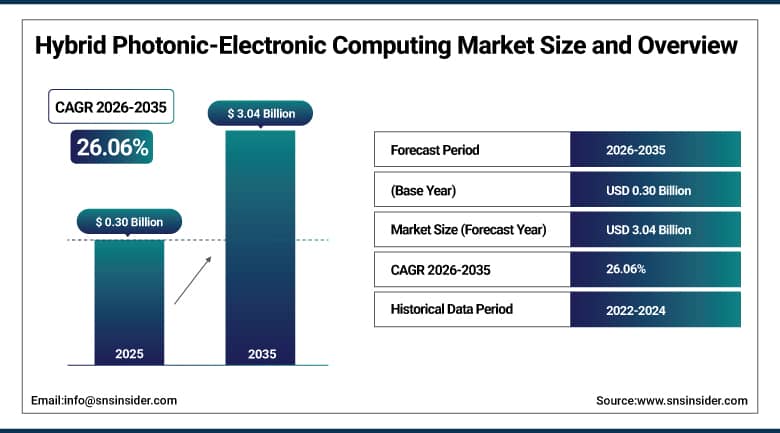
The Hybrid Photonic-Electronic Computing Market was valued at USD 0.30 Billion in 2025 and is expected to reach USD 3.04 Billion by 2035, growing at a CAGR of 26.06% from 2026–2035.
Several factors are driving substantial growth in the hybrid photonic-electronic computing market. Rising demand for powerful, efficient, and high-speed computing systems is a major growth driver. Increasing adoption of artificial intelligence, machine learning, high-performance computing, and advanced data center infrastructure is accelerating market expansion as traditional electronic architectures face performance and efficiency limitations. Growing demand for photonic processors, optical interconnects, electro-optical computing, and photonic-electronic accelerators is further supporting market growth. Increased investments in advanced computing architectures are enabling hybrid systems that combine the high-speed data processing capabilities of photonics with the flexibility and programmability of electronic computing.
In August 2026, Lightmatter and a 19-company industry coalition launched the Open Silicon Photonics for AI Systems initiative within the Open Compute Project (OCP). The initiative aims to establish a common co-packaged optics architecture for AI infrastructure and support scaling AI clusters from 72 to more than 1,024 nodes. The development is expected to accelerate adoption of photonic-electronic computing and optical interconnect technologies by improving interoperability, scalability, and high-bandwidth connectivity.
To Get More Information On Hybrid Photonic-Electronic Computing Market - Request Free Sample Report
Hybrid Photonic-Electronic Computing Market Trends
-
Growing adoption of photonic-electronic computing is driving demand for high-speed, energy-efficient, and low-latency computing solutions.
-
Rising AI and machine learning workloads are increasing demand for photonic processors, optical matrix processing, and photonic-electronic accelerators.
-
Increasing demand for high-performance computing and data-center acceleration is supporting adoption of hybrid photonic-electronic architectures.
-
Growing focus on processing efficiency, scalability, bandwidth, and energy consumption is creating opportunities for technology providers.
-
Advancements in photonic processors, optical interconnects, modulators, and heterogeneous computing are improving performance and accelerating market adoption.
U.S. Hybrid Photonic-Electronic Computing Market Outlook
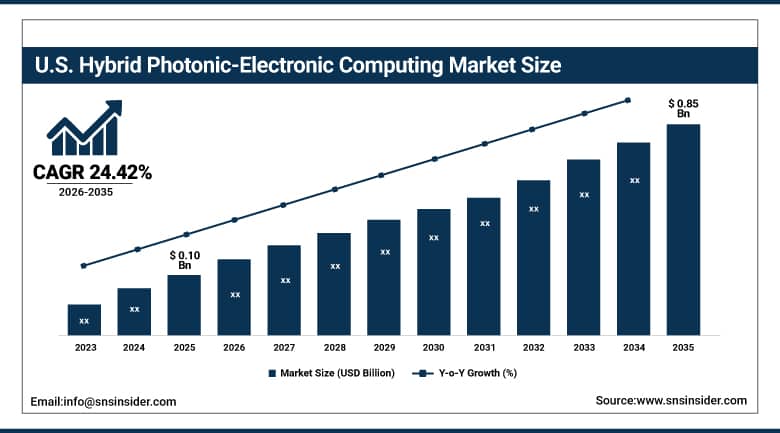
The U.S. Hybrid Photonic-Electronic Computing Market was valued at USD 0.10 Billion in 2025 and is expected to reach around USD 0.85 Billion by 2035, growing at a CAGR of 24.42% from 2026–2035.
The American market for hybrid photonic-electronic computing systems is developing steadily because of the rising need for highly efficient and high-performance computing technology. The development and use of artificial intelligence, machine learning, high-performance computing, and data center infrastructure has been responsible for the increased demand for advanced photonic-electronic computing systems. The development of photonic processors, optical interconnects, and hybrid computing architecture is responsible for the improved performance of these computing systems. The rise in the development of infrastructure and applications of AI and advanced computing in America will continue to create demand for the market.
In June 2026, Lightmatter joined NVIDIA’s NVLink Fusion ecosystem to support next-generation AI infrastructure with co-packaged optics (CPO) and near-packaged optics (NPO). The collaboration is designed to provide high-bandwidth optical connectivity for AI accelerators while reducing fiber and connector requirements, supporting the growing deployment of photonic-electronic computing technologies in U.S. AI data centers.
Hybrid Photonic-Electronic Computing Market Segment Analysis
-
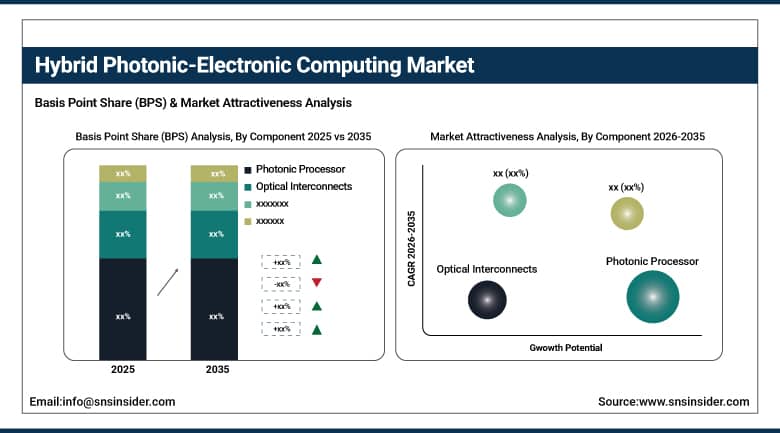
By Component, electronic processor dominated the hybrid photonic-electronic computing market with a 34.62% share in 2025, while photonic processor is projected to be the fastest-growing segment, registering a 32.80% CAGR during 2026–2035.
-
By Computing Architecture, photonic-electronic accelerators dominated the hybrid photonic-electronic computing market with a 31.75% share in 2025, while optical matrix processing is projected to be the fastest-growing segment, registering a 32.09% CAGR during 2026–2035.
-
By Application, artificial intelligence and machine learning dominated the hybrid photonic-electronic computing market with a 35.48% share in 2025, while neuromorphic computing is projected to be the fastest-growing segment, registering a 34.47% CAGR during 2026–2035.
-
By Deployment, data centers dominated the hybrid photonic-electronic computing market with a 42.35% share in 2025, while edge infrastructure is projected to be the fastest-growing segment, registering a 35.69% CAGR during 2026–2035.
-
By End User, IT and telecommunications dominated the hybrid photonic-electronic computing market with a 32.85% share in 2025, while cloud service providers are projected to be the fastest-growing segment, registering a 31.34% CAGR during 2026–2035.
By Computing Architecture, photonic-electronic accelerators dominated the hybrid photonic-electronic computing market, while optical matrix processing is expected to grow fastest.
Photonic-electronic accelerators were the leading segment within the hybrid photonic-electronic computing market in 2025 due to their ability to integrate the high speed and parallel computing capabilities of photonic technology with the programmable nature and control of electronic computing systems. Such architectures have been increasingly popular for computationally heavy applications that require high throughput, low latencies, and increased energy efficiency. The demand for dedicated accelerator technologies for AI and machine learning applications, large data processing, and high-performance computing is rising due to the increasing deployment of such applications.
Photonic-electronic accelerators can help with achieving higher speeds of computations and data movement along with the reduction of power consumption associated with traditional electronic architecture solutions. Investments in photonic processors, optical interconnects, modulators, photodetectors, and advanced electronic processors will continue to drive technological innovation in the market. Optical matrix processing is expected to witness the fastest growth from 2026 to 2035 due to its capability of performing matrix multiplication and other parallel mathematical operations effectively.
By Application, artificial intelligence and machine learning dominated the hybrid photonic-electronic computing market, while neuromorphic computing is expected to grow fastest.
In 2025, artificial intelligence and machine learning were responsible for having the biggest application market share of the hybrid photonic electronic computing market owing to the fact that there is a rapid increase in computational needs that come with training, inferring, data processing, and large-scale neural networks. Traditional computing architecture is being put under pressure owing to increasing model complexity, increasing data volume, and the energy needs, which gives way for hybrid photonic-electronic architecture that will offer high-speed and energy efficiency.
Photonic processors and optical matrix processing are relevant for the application of AI since they allow high degrees of parallelism and high-speed data transfer. Therefore, the rise in infrastructure for AI in places such as data centers, clouds, research facilities, and advanced computing systems is boosting the market. High-performance computing and signal processing are also among other factors driving the growth in hybrid architectures. Neuromorphic computing will grow at the fastest rate between 2026 and 2035.
By Deployment, data centers dominated the hybrid photonic-electronic computing market, while edge infrastructure is expected to grow fastest.
In 2025, the share of the data center segment in the hybrid photonic-electronic computing market was highest due to the rising requirement for high-performance, high-bandwidth, and energy-efficient computing infrastructure. There is an increase in the demand for computing infrastructure that supports applications such as artificial intelligence, machine learning, cloud workloads, high-performance computing, and large-scale data processing. Hybrid photonic-electronic computing technology can help fulfill these needs through the integration of optical data transfer and processing with electronic computing and control.
The edge infrastructure segment is expected to witness the highest CAGR between 2026 and 2035. There is rising demand for real-time processing, low-latency computing, distributed AI, and localized data processing. This is fueling the adoption of hybrid photonic-electronic computing technology closer to end-users and connected devices.
Regional Analysis
|
Region |
Major Country |
Share within Region, 2025(%) |
|---|---|---|
|
North America |
United States |
82.40% |
|
Europe |
Germany |
34.30% |
|
Asia Pacific |
China |
48.54% |
|
Middle East & Africa |
Saudi Arabia |
23.50% |
|
Latin America |
Brazil |
23.00% |
North America hybrid photonic-electronic computing market insights
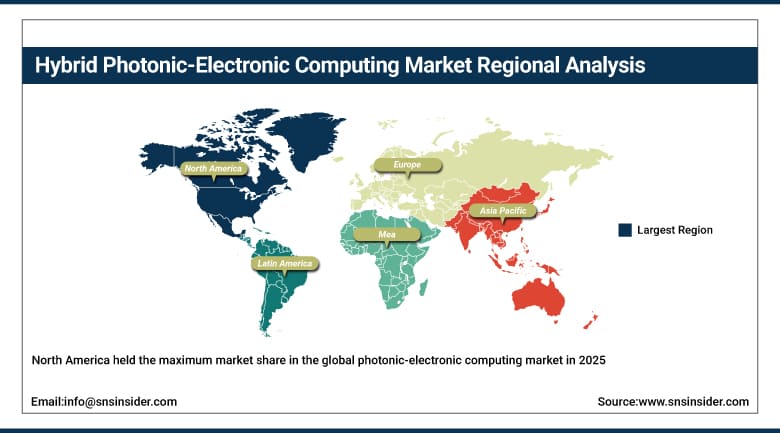
North America held the maximum market share in the global photonic-electronic computing market in 2025, accounting for 38.64% of the market, and is likely to continue dominating the market throughout the forecast period of 2026–2035. This strong position is owing to robust demand for AI, machine learning, high-performance computing, advanced data center technology, and energy-efficient computing solutions. North America has substantial investments in photonic processors, optical interconnects, photonic-electronic accelerators, and advanced semiconductor technologies.
The development of AI infrastructure and increasing demand for high-bandwidth and low-latency computing will further fuel regional market growth. In 2025, the United States held the leading position in North America, supported by its advanced technology infrastructure, strong presence of semiconductor and computing players, well-established data center infrastructure, and significant investments in AI and photonic computing. Canada is also anticipated to contribute to regional market growth through increasing investments in AI, advanced computing, cloud infrastructure, and photonic technologies.
Get Customized Report as Per Your Business Requirement - Enquiry Now
Europe hybrid photonic-electronic computing market insights
The Europe hybrid photonic-electronic computing market will witness steady growth from 2026-2035 due to higher investment made in computing, AI, semiconductor, and energy efficient data center infrastructures. Europe holds a market share in 2025. Growing demand for high-performance computing, optical interconnects, and next generation computing architectures has increased the use of hybrid photonic-electronic technologies.
Germany is expected to be one of the leading countries in Europe due to their strong industrial and technology environment, semiconductor technology development initiatives, and growing demand for computing infrastructure. Other European countries such as the UK, France, Italy, and many others are contributing to the demand in the region through investments made in AI, photonic, cloud computing, and high-performance computing technologies.
Asia-Pacific hybrid photonic-electronic computing market insights
The Asia-Pacific is estimated to grow at the highest CAGR among all regional markets over the forecast period from 2026 to 2035 due to rapid growth in the sectors of artificial intelligence, semiconductor fabrication, data centers, cloud infrastructure, and electronics. In 2025, the Asia-Pacific contributed to 26.94% CAGR and is estimated to show significant increase during the forecast period. The growth in the region is attributed to increased investments in photonic computing, optical communication systems, semiconductor manufacturing, and artificial intelligence infrastructure.
The leading market in the region will continue to be China owing to its well-established ecosystem of electronics and semiconductors, growth in AI infrastructure, and investments in advanced computing technologies. Japan and South Korea are also leading markets in the region because of their well-established ecosystem of electronics, semiconductors, telecom, and photonics. India will witness increasing demand for photonic electronic computing due to rapid digitalization, growth in data centers and cloud services, AI, and advanced computing and semiconductor infrastructures.
Middle East & Africa and Latin America hybrid photonic-electronic computing market insights
Consistent growth in the Middle East & Africa and Latin America photonic electronic computing markets is anticipated between 2026 and 2035 driven by the factors such as digitalization, data center growth, adoption of cloud computing, and artificial intelligence. Need for efficient computer solutions is gradually rising with growth in digitalization and adoption of data-intensive applications by businesses. In the Middle East & Africa market, Saudi Arabia and the United Arab Emirates will continue to be significant players due to the investments made in artificial intelligence, cloud computing infrastructure, smart city solutions, data centers, and digitalization of business operations. In Latin American region, Brazil will continue to be a significant player due to the increasing digital economy, data center infrastructure, telecommunications industry, and growing use of AI and cloud computing in the country.
Market Dynamics
Growth Driver: Increasing demand for high-performance and energy-efficient computing is driving market growth
Some of the primary factors fueling the expansion of the global hybrid photonic-electronic computing market include the rise in demand for effective, efficient, and fast computing solutions. With the advent of applications such as artificial intelligence, machine learning, high-performance computing, etc., the demand for innovative computing solutions that can cater to the drawbacks of traditional electronic systems is growing. By harnessing the benefits of photonic and electronic computing, hybrid photonic-electronic computing helps in overcoming the challenges involved in efficient computation of workloads.
Moreover, innovations in photonic processors, optical interconnects, modulators and photodetectors, optical matrix processing, and photonic-electronic accelerators are fueling the growth of the market. Rising investment in AI infrastructure, advanced data centers, semiconductor technology, etc., is further driving the market.
Restraint: Complex integration and high development costs can limit market adoption
The complex integration of both photonic and electronic components becomes a considerable barrier in the development of hybrid photonic-electronic computer systems. It demands a very advanced technology that would allow for the successful integration of such components as photonic processors, electronic processors, optical links, modulators, photodetectors, ADC/DAC components and control systems into one working unit. Moreover, different requirements in terms of operation, signals' conversion, heat dissipation, packaging and communication interface could increase the complexity of the system.
In addition, the research and development process of hybrid photonic-electronic computer systems can be associated with quite high costs of research and development process as well as high costs of manufacturing and packaging, which can become a barrier for smaller providers of technology and research institutions.
Opportunity: Growing AI workloads and demand for advanced computing create new market opportunities
The explosive growth in the applications of artificial intelligence and machine learning technologies has opened up many opportunities for hybrid photonic-electronic computing. The rise in model complexity, data-processing needs, and faster inference and training needs are opening up new opportunities for photonic processing, optical matrix processing, and photonic-electronic computing. Photonic technologies can aid in high-speed parallel computing and effective data transmission; hence, their relevance is growing for computationally intensive AI algorithms.
Moreover, the growth in high-performance computing, data center operations, cloud computing, and edge computing is generating more opportunities for hybrid photonic-electronic computing. The increasing need for high-bandwidth, low-latency, and power-efficient computing platforms is leading to the development of optical interconnects and heterogeneous computing systems. Investments in photonics, semiconductor technologies, AI platforms, and future computing technologies will open up many new opportunities for hybrid photonic-electronic computing.
Recent Developments
-
2026: Lightmatter advanced its silicon photonics and co-packaged optics technologies for next-generation AI infrastructure, supporting high-bandwidth and energy-efficient photonic-electronic computing.
-
2026: Lightelligence continued advancing photonic AI computing technologies designed to accelerate artificial intelligence and machine learning workloads with high-speed, energy-efficient processing.
-
2026: Celestial AI expanded its photonic fabric technology for AI infrastructure, enabling high-bandwidth optical connectivity and efficient data movement between computing and memory resources.
-
2026: Ayar Labs advanced its optical I/O technology for AI and high-performance computing, supporting low-latency and energy-efficient connectivity between processors.
-
2026: Intel continued developing silicon photonics and optical interconnect technologies to support higher-bandwidth and energy-efficient data-center computing.
Hybrid Photonic-Electronic Computing Market key players are:
-
Lightmatter
-
Lightelligence
-
Celestial AI
-
Ayar Labs
-
Intel Corporation
-
IBM Corporation
-
NVIDIA Corporation
-
AMD
-
Hewlett Packard Enterprise
-
Cisco Systems, Inc.
-
Lumentum Holdings Inc.
-
Coherent Corp.
-
Marvell Technology, Inc.
-
Broadcom Inc.
-
Nokia Corporation
-
Ciena Corporation
-
DustPhotonics
-
Lightwave Logic, Inc.
-
Q.ANT
-
Optalysys
Hybrid Photonic-Electronic Computing Market Report Scope:
| Report Attributes | Details |
|---|---|
| Market Size in 2025 | USD 0.30 Billion |
| Market Size by 2035 | USD 3.04 Billion |
| CAGR | CAGR of 26.06% From 2026 to 2035 |
| Base Year | 2025 |
| Forecast Period | 2026-2035 |
| Historical Data | 2022-2024 |
| Report Scope & Coverage | Market Size, Segments Analysis, Competitive Landscape, Regional Analysis, DROC & SWOT Analysis, Forecast Outlook |
| Key Segments | • By Component (Photonic Processor, Electronic Processor, Optical Interconnects, Modulators and Photodetectors, ADC/DAC, Control and Memory) • By Computing Architecture (Photonic-Electronic Accelerators, Optical Matrix Processing, Electro-Optical Computing, Heterogeneous Computing, Photonic Co-Processing) • By Application (Artificial Intelligence and Machine Learning, High-Performance Computing, Signal Processing, Neuromorphic Computing, Scientific Computing, Edge Computing) • By Deployment (Data Centers, Cloud Computing, On-Premises Computing, Edge Infrastructure, Research and Development Facilities) • By End-User (IT and Telecommunications, Cloud Service Providers, Research Institutions, Government and Defense, Manufacturing and Industrial, Healthcare) |
| Regional Analysis/Coverage | North America (US, Canada), Europe (Germany, UK, France, Italy, Spain, Russia, Poland, Rest of Europe), Asia Pacific (China, India, Japan, South Korea, Australia, ASEAN Countries, Rest of Asia Pacific), Middle East & Africa (UAE, Saudi Arabia, Qatar, South Africa, Rest of Middle East & Africa), Latin America (Brazil, Argentina, Mexico, Colombia, Rest of Latin America) |
| Company Profiles | Lightmatter, Lightelligence, Celestial AI, Ayar Labs, Intel Corporation, IBM Corporation, NVIDIA Corporation, AMD, Hewlett Packard Enterprise, Cisco Systems, Inc., Lumentum Holdings Inc., Coherent Corp., Marvell Technology, Inc., Broadcom Inc., Nokia Corporation, Ciena Corporation, DustPhotonics, Lightwave Logic, Inc., Q.ANT, Optalysys |

Frequently Asked Questions
Key players in the Hybrid Photonic-Electronic Computing Market include Lightmatter, Lightelligence, Celestial AI, Intel Corporation, NVIDIA Corporation, IBM Corporation, and Marvell Technology, Inc., among others.
Key opportunities in the hybrid photonic-electronic computing market include the rapid expansion of artificial intelligence and machine learning, growth of AI data centers, increasing demand for high-performance computing, and advancements in photonic processors and optical interconnects.
The market is driven by increasing demand for high-speed, energy-efficient, high-bandwidth, and low-latency computing solutions for AI, machine learning, high-performance computing, and data-center applications.
North America dominated the Hybrid Photonic-Electronic Computing Market in 2025 with a 38.64% share, supported by strong AI infrastructure, advanced data centers, semiconductor capabilities, and investments in photonic and next-generation computing technologies.
