
Hygienic Pumps and Valves Market Report Scope & Overview:
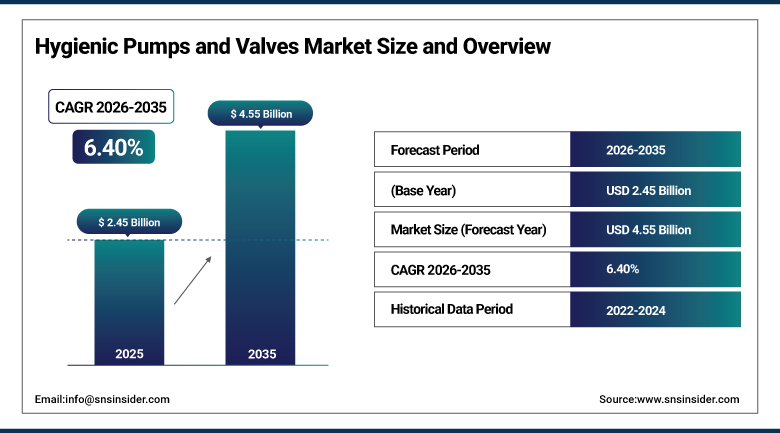
The Hygienic Pumps and Valves Market was valued at USD 2.45 Billion in 2025 and is expected to reach USD 4.55 Billion by 2035, growing at a CAGR of 6.40% from 2026-2035.
Hygienic Pumps and Valves Market is witnessing stable growth owing to rising demand for contaminant-free fluid handling in the food and beverages industry, pharmaceutical, biotechnology, dairy industry, and personal care products industry. Hygienic pumps and valves help in ensuring product purity along with efficient processing, cleaning, and sanitization activities. Food safety and pharmaceutical manufacturing regulations are making the industries use equipment with smooth finish, sanitary connections, easy cleanability, and dead space reduction. Increasing consumption of processed food, dairy, beverages, and biopharmaceuticals has led to the creation of new application areas. Apart from that, increasing adoption of automation in processing operations, sanitary equipment, and energy-efficient fluid handling solutions is aiding market growth.
Krones AG completed its acquisition of Ampco Pumps in 2025, adding specialized hygienic pump manufacturing capability directly to its broader food and beverage processing equipment portfolio.
To Get more information Hygienic Pumps and Valves Market - Request Free Sample Report
Hygienic Pumps and Valves Market Trends
- Growing replacement of cast-iron and older sanitary equipment with polished stainless steel systems meeting tightening safety audit standards
- Rising adoption of single-use and low-shear pump designs supporting biopharmaceutical and cell therapy manufacturing processes
- Increasing integration of automation and Industry 4.0 connectivity into hygienic valve monitoring and clean-in-place system control
- Growing demand for modular, customizable hygienic equipment configurations tailored to specific processing line requirements
- Expanding focus on preventive maintenance programs supported by intuitive, sensor-equipped hygienic valve monitoring products
- Continued industry consolidation as larger processing equipment manufacturers acquire specialized hygienic pump and valve makers
U.S. Hygienic Pumps and Valves Market Outlook
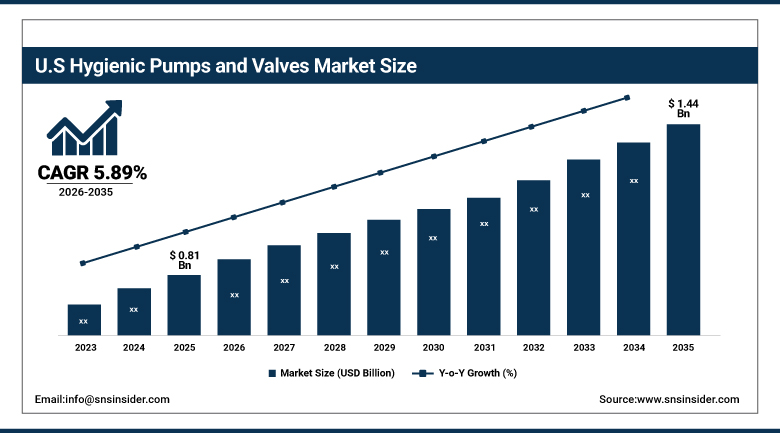
The U.S. Hygienic Pumps and Valves Market was valued at approximately USD 0.81 Billion in 2025 and is expected to reach approximately USD 1.44 Billion by 2035, growing at a CAGR of approximately 5.89% from 2026-2035.
The U.S. Hygienic Pumps and Valves Market benefits from high demand from the food & beverages, dairy, pharmaceuticals, biotech, and cosmetics sectors. Hygiene and product safety demands are driving companies to implement hygienic pumps and valves which provide efficient cleaning, avoid contamination, and handle fluids reliably. Increase in food production and biopharmaceuticals is adding up to this demand. In addition, process line automation, adoption of CIP/SIP systems, and investments in efficient processes are contributing to market development. The manufacturers of pumps and valves focus on implementing sanitary design principles, energy efficiency, resistance to corrosion, and industry standards.
SPX FLOW, headquartered in Charlotte, North Carolina, continues to supply hygienic pumps and valves across the domestic food, beverage, and pharmaceutical processing sector, competing directly against Alfa Laval and other global sanitary equipment manufacturers for major processor contracts.
Hygienic Pumps and Valves Market Segment Analysis
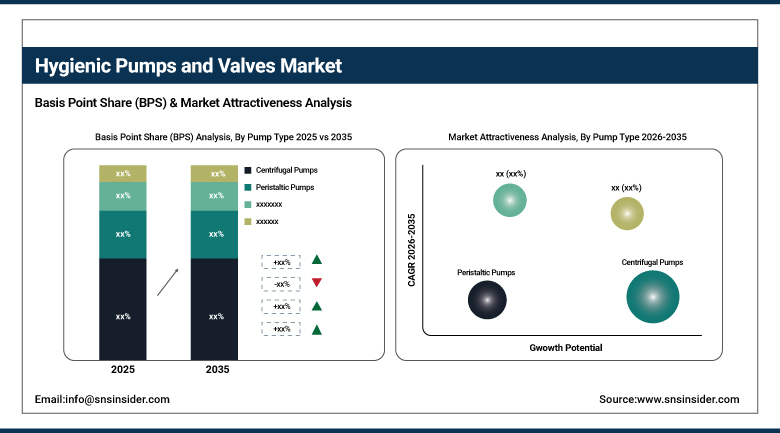
- By Pump Type, the Centrifugal Pumps segment dominated the Hygienic Pumps and Valves Market with approximately 44.20% share in 2025, while the Peristaltic Pumps segment is the fastest growing with a CAGR of approximately 7.60%.
- By Valve Type, the Butterfly Valves segment dominated the Hygienic Pumps and Valves Market with approximately 36.40% share in 2025, while the Diaphragm Valves segment is the fastest growing with a CAGR of approximately 7.20%.
- By Material, the Stainless Steel segment dominated the Hygienic Pumps and Valves Market with approximately 72.60% share in 2025, while the Specialty Alloys segment is the fastest growing with a CAGR of approximately 7.40%.
- By Hygiene Class, the Standard segment dominated the Hygienic Pumps and Valves Market with approximately 48.60% share in 2025, while the Aseptic segment is the fastest growing with a CAGR of approximately 8.20%.
- By Application, the Food and Beverage segment dominated the Hygienic Pumps and Valves Market with approximately 38.60% share in 2025, while the Pharmaceutical segment is the fastest growing with a CAGR of approximately 8.60%.
By Pump Type, Centrifugal Pumps dominates, Peristaltic Pumps grows fastest
Centrifugal pumps continue to be the preferred option for use across the hygienic process lines because of their ability to provide continuous flow, reliable performance, and easy maintenance. They are commonly used in the dairy, beverage, food and other hygienic process operations for pumping fluids that have low to moderate viscosity. Due to their high flow rate capabilities, centrifugal pumps can be used in the transfer of milk, water, juices, food products and cleaning solutions. Standard hygienic design, stainless steel material construction and compatibility with automated clean-in-place systems make them popular pumps.
Peristaltic pumps are becoming more common in the processes that require low-shear and gentle fluid transfer, especially in the biopharmaceuticals, biotech, cell therapy and other pharmaceutical processes. The nature of operation of this pump reduces contamination risks due to the low risk of direct mechanical interaction between the fluid being handled and the pump internal parts. Therefore, they are ideal in transferring biological fluids, suspensions and viscous formulations. Sterile processing and single use are some of the factors driving the use of this pump technology.
By Valve Type, Butterfly Valves dominates, Diaphragm Valves grows fastest
The butterfly valves are still being used extensively in different hygienic applications in processing industries due to the efficient combination of low cost, adequate regulation of the flow, compact size, and cleanability. The simple design and low spatial requirements of the butterfly valves allow their usage in food and beverage processing, dairies, pharmaceutical and chemical industries. Their stainless-steel design and capability to be used with automated cleaning systems ensure wide use of butterfly valves. Butterfly valves are convenient to use in the processes of flow regulation and shutoff and their minimal maintenance is the advantage of butterfly valves in the typical sanitary processing.
Diaphragm valves are becoming more widely used with each passing year thanks to the unique crevice-free and drainable design. This design ensures minimum product retention, contamination, and possibility of bacteria harborage, which allows using diaphragm valves in very strict sanitary environments. These valves may also provide the accurate flow regulation and isolation and may be used in clean-in-place and sterilize-in-place processes. Increase of production of biologics, vaccines, cell and gene therapies, and other pharmaceutical products increases the need of sanitary valves with such qualities as sterility and high process reliability.
By Material, Stainless Steel dominates, Specialty Alloys grows fastest
Stainless steel remains the predominant material specification for hygienic pump and valve construction, owing to its strong corrosion resistance, durability, cleanability, and suitability for stringent sanitary processing environments. Stainless-steel equipment is extensively used across food and beverage, dairy, pharmaceutical, and biotechnology applications, where frequent cleaning and sterilization are required. Its smooth, non-porous surfaces help minimize contamination and product retention. Established compatibility with sanitary design requirements, including 3-A and EHEDG principles, further supports its widespread adoption across modern hygienic fluid-handling systems.
Specialty alloys, including Hastelloy and Monel, are gaining adoption in applications exposed to highly corrosive chemicals, aggressive cleaning agents, and demanding processing conditions. These materials provide enhanced resistance to corrosion, chemical attack, and degradation compared with conventional stainless-steel grades in specific operating environments. Their use is particularly relevant to fine chemical, pharmaceutical, and specialty processing applications involving repeated sanitization or exposure to aggressive media. Growing requirements for longer equipment service life, reduced maintenance, and reliable operation under harsh conditions are supporting increased adoption of specialty alloy hygienic pumps and valves.
By Hygiene Class, Standard dominates, Aseptic grows fastest
The use of standard hygiene-class equipment still dominates traditional food and beverage production processes, which need effective sanitary design, cleanability, and contamination control, but do not involve the extreme sterility of pharmaceutical manufacturing. The equipment in question is used in many processes such as dairy, beverages, processed foods, sauces, and other applications requiring routine cleaning and sanitization. Cost-effectiveness, good performance, and capability to work in the environment that involves clean-in-place processes also justify the use of such equipment, especially at high-production facilities where quality and proper sanitary manufacturing processes are vital.
The expansion of aseptic class equipment usage occurs very quickly because of the development of biopharmaceutical, injectable drugs, vaccines, and advanced therapy manufacturing. Sterility assurance, contamination prevention, and the ability to perform a clean and sterilize-in-place process on a fluid path are among the characteristics aseptic pumps and valves need to have. Thus, growing production of biologic medicines, cell and gene therapy, and other sterile pharmaceuticals creates an increased demand for very specialized equipment.
By Application, Food and Beverage dominates, Pharmaceutical grows fastest
The food and beverages segment continues to be the most dominant category for hygienic pumps and valves, as the processing of dairy products, beer production, bottling of beverages, and processed food continues on a large scale around the world. Food and beverage manufacturing requires hygienic pumps and valves to handle fluids during the entire process of production, transport, filling, and cleaning. Increased consumption of packaged food items, dairy products, beverages, and prepared foods, especially in developing nations, is helping drive investments into sanitary fluid handling infrastructure and equipment.
The pharmaceutical segment is seeing rapid growth with growing production of biopharmaceuticals, injectables, vaccines, and cell and gene therapy applications. Such pharmaceutical operations need to maintain highly controlled environments during fluid handling activities with strict requirements of sterility, contamination prevention, cleanability, and validation. Hygienic pumps and valves are being increasingly deployed in aseptic fluid handling applications such as drug formulation, filling, and transportation. Increasing investment in biologic production and advanced therapy facilities is also increasing demand for hygienic fluid handling equipment in the pharmaceutical industry.
Regional Analysis
|
Region |
Major Country |
Share within Region, 2025 (%) |
|
North America |
United States |
80.40% |
|
Europe |
Germany |
26.80% |
|
Asia Pacific |
China |
40.60% |
|
Latin America |
Brazil |
34.40% |
|
Middle East & Africa |
UAE |
30.20% |
North America Hygienic Pumps and Valves Market Insights
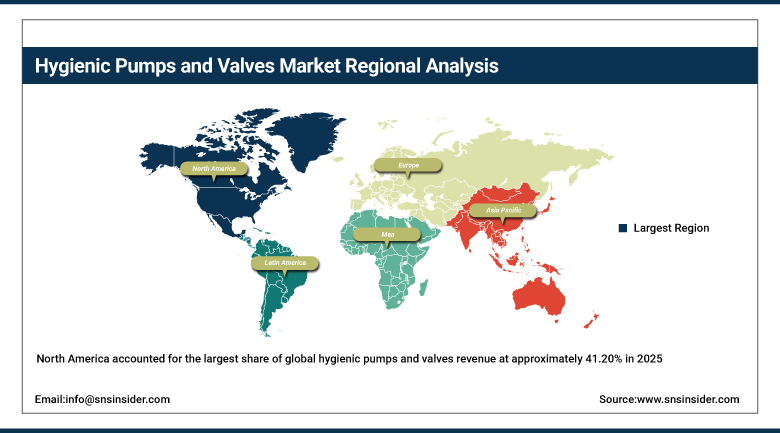
North America accounted for the largest share of global hygienic pumps and valves revenue at approximately 41.20% in 2025, reinforced by stringent FDA sanitary processing requirements and a substantial concentration of dairy, brewing, and pharmaceutical manufacturing operations across the United States. The region's deep biopharmaceutical manufacturing base, particularly concentrated in established life sciences hubs, continues to sustain demand for aseptic-grade hygienic equipment meeting the most rigorous contamination-control standards.
The United States represents the dominant contributor to North American demand, driven by extensive food processing, beverage production, pharmaceutical manufacturing, and biotechnology activities. Strong regulatory requirements for sanitation, contamination control, and product quality encourage adoption of hygienic pumps and valves. Expanding biopharmaceutical production, advanced therapy manufacturing, and automated processing systems are further creating opportunities for high-performance sanitary fluid-handling equipment.
Get Customized Report as per Your Business Requirement - Enquiry Now
Asia Pacific Hygienic Pumps and Valves Market Insights
Asia-Pacific is expected to witness the fastest growth rate, with a CAGR of around 8.38% between 2026 and 2035, owing to rising food & beverages, dairy, pharmaceuticals, and biotechnology production activities in the region. Investment in clean process infrastructure, stringent food safety standards, and need for contamination-free processing are fueling the use of hygienic pumps & valves.
China offers a significant base-demand, owing to its growing food processing, dairy, and pharmaceutical industry segments, while India has been witnessing rising investment in biotech, pharmaceutical, and aseptic processes. Japan and South Korea offer established markets, owing to their technology-driven nature, high levels of manufacturing capability, and automation of hygienic process equipment.
Europe Hygienic Pumps and Valves Market Insights
Europe represents a significant Hygienic Pumps and Valves Market, supported by established food and beverage, dairy, pharmaceutical, and biotechnology manufacturing industries. The region’s stringent hygiene and product-safety requirements, together with strong emphasis on sanitary equipment design, encourage adoption of advanced pumps and valves. Germany, France, the Netherlands, Italy, and the United Kingdom contribute substantially to regional demand through extensive processing infrastructure, pharmaceutical production, and engineering capabilities.
Germany anchors European demand through its substantial dairy, brewing, food processing, and pharmaceutical manufacturing base. The country also benefits from a strong industrial engineering ecosystem and the presence of established hygienic equipment manufacturers. Increasing adoption of sanitary processing technologies, automated fluid-handling systems, and equipment designed around stringent European hygiene requirements continues to support demand across food, beverage, and pharmaceutical production facilities.
MEA & Latin America Hygienic Pumps and Valves Market Insights
The MEA hygienic pumps and valves market is driven by continuous upgradation in dairy and food processing equipment on account of processors emphasizing on food safety, hygiene, and modernization. Investment in automated plants and hygienic equipment is prompting the upgrading from traditional equipment to hygienic equipment. The increase in the dairy industry, beverages production, and packed food sector is driving the demand for hygienic pumps and valves in the region.
In Latin America, the market leader is Brazil, which is witnessing the growth in the dairy, beverages, and food processing industries, leading to slow but steady adoption of hygienic pumps and valves. Investments in food safety regulations and modernization are encouraging companies to invest in fluid handling equipment. México and Argentina also contribute to the demand in the region with their well-developed dairy and food processing industry.
Market Dynamics
Growth Drivers: Contamination-control regulation and biopharmaceutical growth fueling adoption
Accelerating demand for contamination control across food, beverage, pharmaceutical, and biotechnology industries represents a key driver of market growth. Manufacturers are increasingly investing in hygienic pumps and valves to minimize microbial contamination, product retention, and cross-contamination risks throughout processing. Stringent food-safety and pharmaceutical quality requirements, combined with the potential financial, regulatory, and reputational consequences of product contamination, are encouraging adoption of sanitary fluid-handling equipment.
Growth of the biopharmaceutical industry represents another significant market driver, as expanding production of injectable drugs, vaccines, biologics, and advanced therapies increases requirements for aseptic-grade fluid-handling systems. Hygienic pumps and valves are essential for maintaining sterile processing conditions and supporting validated cleaning and sterilization procedures. Rising investments in biopharmaceutical manufacturing facilities worldwide are therefore creating sustained demand for high-performance equipment meeting stringent quality and regulatory requirements.
Restraints: High equipment costs and specialized maintenance requirements limiting adoption
The large cost premiums of hygienic pumps and valves vis-à-vis conventional industrial fluid handling equipment constitute an important market constraint, especially for small and medium scale processors facing tight capital budgets. Increased cost of procurement is attributed to the use of sanitary materials, precise construction, certification, finishing, and the requirement of hygienic design. This increased cost can affect the upgrading and renewal of equipment, especially in cost-conscious food and beverage processors and smaller scale processors.
Technical requirements of specialized maintenance and cleaning along with validation processes for aseptic equipment constitute another market constraint. Hygienic processing equipment requires highly sophisticated clean-in-place and sterilize-in-place processes, regular inspection, and process validation for maintaining the sanitary performance. Technical skills and services may increase cost of operation and pose implementation problems. Small-scale processing plants might face difficulties in maintaining required technical know-how and validation setup.
Opportunities: Single-use system adoption and smart monitoring technology opening new growth avenues
The rise in popularity of single-use systems can be seen as a great business opportunity, especially within the field of biopharmaceutical production, since disposable and pre-sterilized fluid path components can eliminate the possibility of cross contamination and also decrease the cleaning and sterilization needs of some processing stages. The growing need for flexible manufacturing, quick changeovers and simplified facilities is driving the use of single-use pumps and valves. Expansion in the area of biologic products, vaccines and advanced treatments also contributes to this opportunity.
Hygienic valves that are equipped with sensors are another area of growth for the company to consider, as manufacturers are in increasing need of information about their equipment and process performance. Sensors integrated into valves can monitor parameters such as valve position, temperature, pressure, leakage and cycle counting, which would allow for earlier detection of any deviations.
Recent Developments:
- 2026: GEA highlighted its Hilge hygienic pump portfolio for pharmaceutical applications, including drainable positive-displacement and centrifugal pumps with low-ferrite stainless-steel options, fine surface finishes, and designs supporting high-purity processing.
- 2026: Alfa Laval reported a large-scale upgrade by a European sauce manufacturer to more than 40 DuraCirc hygienic positive-displacement pumps, emphasizing improved cleanability, gentle product handling, and compatibility with predictive-maintenance monitoring.
Hygienic Pumps and Valves Market Key Players are:
- Alfa Laval AB
- GEA Group Aktiengesellschaft
- SPX FLOW, Inc.
- Emerson Electric Co.
- Spirax-Sarco Engineering plc
- Flowserve Corporation
- KSB SE & Co. KGaA
- Krones AG
- Ampco Pumps Company
- Watson-Marlow Fluid Technology Group
- Fristam Pumps
- Waukesha Cherry-Burrell (SPX FLOW)
- Definox SAS
- Burkert Fluid Control Systems
- Pentair plc
- Xylem Inc.
- CSF Inox S.p.A.
- Inoxpa S.A.U.
- Tapflo Group
- Netzsch Group
Hygienic Pumps and Valves Market Report Scope:
| Report Attributes | Details |
|---|---|
| Market Size in 2025 | USD 2.45 Billion |
| Market Size by 2035 | USD 4.55 Billion |
| CAGR | CAGR of 6.40% From 2026 to 2035 |
| Base Year | 2025 |
| Forecast Period | 2026-2035 |
| Historical Data | 2022-2024 |
| Report Scope & Coverage | Market Size, Segments Analysis, Competitive Landscape, Regional Analysis, DROC & SWOT Analysis, Forecast Outlook |
| Key Segments | • By Pump Type (Centrifugal Pumps, Positive Displacement/Diaphragm Pumps, Peristaltic Pumps, Air-Operated Double Diaphragm Pumps, Others) • By Valve Type (Single-Seat, Double-Seat, Butterfly, Diaphragm, Ball, Control Valves, Others) • By Material (Stainless Steel, Specialty Alloys, Plastics & Polymers, Elastomers, Others) • By Hygiene Class (Aseptic, Standard, Ultraclean) • By Application (Food and Beverage, Dairy, Pharmaceutical, Biotechnology, Cosmetics & Personal Care, Chemical, Others) |
| Regional Analysis/Coverage | North America (US, Canada), Europe (Germany, UK, France, Italy, Spain, Russia, Poland, Rest of Europe), Asia Pacific (China, India, Japan, South Korea, Australia, ASEAN Countries, Rest of Asia Pacific), Middle East & Africa (UAE, Saudi Arabia, Qatar, South Africa, Rest of Middle East & Africa), Latin America (Brazil, Argentina, Mexico, Colombia, Rest of Latin America). |
| Company Profiles | Alfa Laval AB; GEA Group Aktiengesellschaft; SPX FLOW, Inc.; Emerson Electric Co.; Spirax-Sarco Engineering plc; Flowserve Corporation; KSB SE & Co. KGaA; Krones AG; Ampco Pumps Company; Watson-Marlow Fluid Technology Group; Fristam Pumps; Waukesha Cherry-Burrell (SPX FLOW); Definox SAS; Burkert Fluid Control Systems; Pentair plc; Xylem Inc.; CSF Inox S.p.A.; Inoxpa S.A.U.; Tapflo Group; Netzsch Group. |
Frequently Asked Questions
Leading companies include Alfa Laval AB, GEA Group Aktiengesellschaft, SPX FLOW, Inc., Emerson Electric Co., and Spirax-Sarco Engineering plc, among other major sanitary equipment manufacturers.
Opportunities include growing focus on single-use systems for biopharmaceutical manufacturing and intuitive, sensor-equipped valve monitoring technology offering predictive maintenance capability.
Growth is driven by accelerating contamination-control demand across food, beverage, pharmaceutical, and biotechnology industries alongside biopharmaceutical industry expansion.
