
Hyperscale Cloud Market Report Scope & Overview:
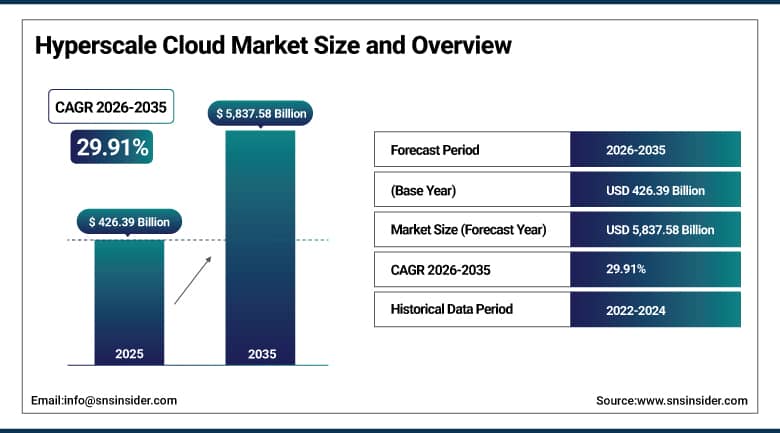
The Hyperscale Cloud Market was valued at USD 426.39 Billion in 2025 and is expected to reach USD 5,837.58 Billion by 2035, growing at a CAGR of 29.91% from 2026 to 2035.
The Hyperscale Cloud Market is growing at an unprecedented rate due to the migration of compute-heavy workloads to hyperscale infrastructure platforms, which can provide elastic computing, storage, and networking services in real-time. The increasing workload generated from generative AI training and inference, together with the transition of SaaS applications to hyperscale infrastructure, is pushing many years of planned investments into one cycle of investment in each of the geographies. The hyperscalers are competing with each other for expansion in data center footprint, securing long-term power supplies, and deploying new AI accelerators, because hyperscale cloud has become the default choice for digital transformations and data analytics.
In 2026, AWS advanced its proprietary Trainium accelerator program while hyperscalers across the industry accelerated integration of NVIDIA Blackwell GPUs into their infrastructure, intensifying the AI-driven infrastructure race and reshaping capital allocation strategies across the hyperscale cloud landscape.
To Get More Information On Hyperscale Cloud Market - Request Free Sample Report
Hyperscale Cloud Market Trends:
-
Generative AI training and inference workloads are becoming the single largest driver of new hyperscale capacity expansion.
-
Providers are aggressively securing dedicated power and cooling infrastructure to support high-density GPU deployments.
-
Sovereign and regional cloud offerings are proliferating in response to tightening national data-residency requirements.
-
Enterprises are adopting multi-cloud strategies to reduce vendor lock-in and strengthen operational resilience.
-
Proprietary AI silicon programs are gaining prominence as hyperscalers seek to reduce dependency on third-party chipmakers.
U.S. Hyperscale Cloud Market Outlook:
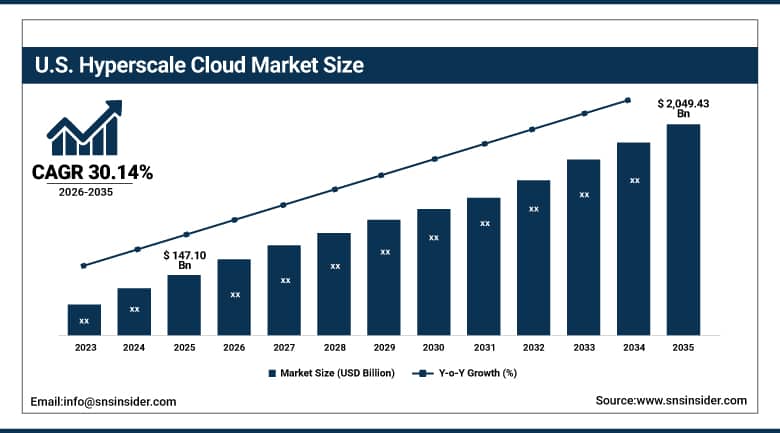
The U.S. Hyperscale Cloud Market was valued at USD 165.31 Billion in 2025 and is projected to reach USD 2,303.60 Billion by 2035, growing at a CAGR of 30.14% during 2026–2035.
The U.S. remains the epicenter of global hyperscale investment, home to the largest cloud platform operators and the single biggest concentration of operational hyperscale data centers worldwide. Aggressive capital expenditure commitments from leading domestic hyperscalers, combined with continued build-out of AI-optimized campuses across multiple states, are reinforcing the country's dominant supply-side position. Rising enterprise demand for large language model training capacity, expanding government cloud modernization programs, and the presence of a mature ecosystem of chip designers, data-center developers, and power-infrastructure partners are collectively sustaining an unprecedented pace of capacity expansion across the domestic market.
In April 2026, Microsoft brought online its USD 3.3 billion Fairwater AI data center in Wisconsin, described as one of the most powerful AI-optimized facilities built to date, reinforcing the scale of domestic hyperscale infrastructure investment underway across the country.
Hyperscale Cloud Market Segment Analysis:
-
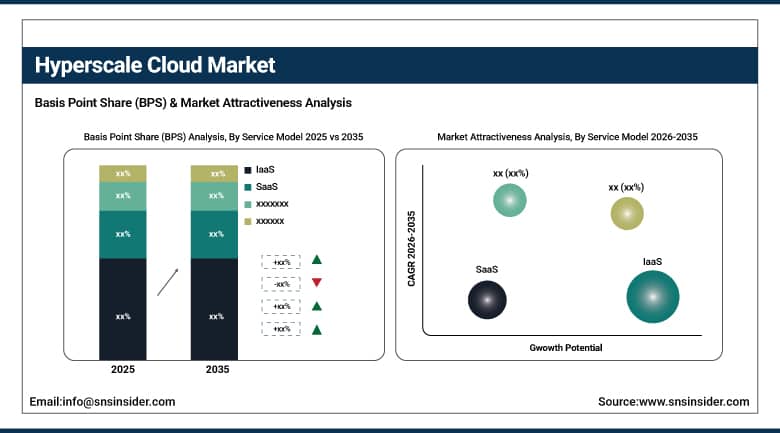
By Service Model, IaaS dominated the Hyperscale Cloud Market with a 46.20% share in 2026, while SaaS is the fastest-growing service model with a CAGR of 32.40% from 2026–2035.
-
By Deployment Model, Public Cloud dominated the Hyperscale Cloud Market with a 71.50% share in 2025, while Hybrid Cloud is the fastest-growing deployment segment with a CAGR of 34.10% from 2026–2035.
-
By Enterprise Size, Large Enterprises dominated the Hyperscale Cloud Market with a 64.80% share in 2025, while Small & Medium Enterprises is the fastest-growing segment with a CAGR of 33.60% from 2026–2035.
-
By Industry Vertical, IT & Telecom dominated the Hyperscale Cloud Market with a 24.90% share in 2025, while Retail & E-commerce is the fastest-growing vertical with a CAGR of 35.20% from 2026–2035.
By Service Model, IaaS leads while SaaS grows fastest.
The IaaS segment held the leading position in the Hyperscale Cloud Market in 2025. Enterprises are still leaning toward IaaS to get control of scalable computing, storage, and networking facilities, especially when training AI workloads require immense infrastructure capacity to provision and de-provision on the fly without any capital expenditure. The availability of GPU instances and global high-speed networking infrastructure provided by major hyperscalers has made enterprises prefer IaaS to become the basic building block of digital operations.
The SaaS segment is anticipated to witness the highest CAGR in the forecast period from 2026 to 2035. The rapid migration of software vendors to hyperscaler platforms and increasing demand from enterprises for software products embedded with AI models and delivered through hyperscale global networks has contributed to the success of this segment. More vendors are migrating their software applications to hyperscalers to take advantage of the access to AI models and global reach through the SaaS model.
By Deployment Model, Public Cloud leads while Hybrid Cloud grows fastest.
The Public Cloud segment accounted for majority share of the Hyperscale Cloud Market in 2025. The public cloud is the deployment route of choice for those companies which wish to avoid having to invest in capital intensive infrastructures while simultaneously getting access to flexible compute and storage resources that can be instantly scaled up to support AI workloads which involve scaling up GPU-based clusters which most enterprises cannot afford to have.
The Hybrid Cloud category is expected to witness the highest growth rate in terms of CAGR. Enterprises operating in the regulated industry and with some of their workloads being run on premises are increasingly relying on hybrid clouds that allow them to use the best of both worlds; their own on-premises infrastructures for handling sensitive workloads and hyperscale infrastructures for AI and analytics for other workloads.
By Enterprise Size, Large Enterprises lead while SMEs grow fastest.
The Large Enterprises accounted for largest share of the Hyperscale Cloud Market in 2025. Widespread presence across the world, demanding requirements regarding data processing, and high current budgets related to IT services still favor large enterprises as the leading buyers of the hyperscale environment due to their need to train AI models on a proprietary basis as well as to implement enterprise data platforms in different regions.
Small & Medium Enterprises are expected to witness the fastest CAGR through 2026-2035. Declining per-unit compute costs, growing availability of pay-as-you-go pricing models, and expanding access to pre-built AI tools hosted on hyperscale infrastructure are enabling smaller organizations to adopt enterprise-grade cloud capabilities that were previously accessible only to large corporations, accelerating their share of overall market consumption.
By Industry Vertical, IT & Telecom leads while Retail & E-commerce grows fastest.
The IT & Telecom segment led the Hyperscale Cloud Market in 2025. Technology and telecommunications companies remain the earliest and most intensive consumers of hyperscale infrastructure, leveraging it to support global network operations, large-scale software delivery, and AI model development across the industry's core operating environments.
The Retail & E-commerce segment is projected to expand at the fastest CAGR during 2026-2035. The growing demand for personalized systems, inventory, logistics and customer engagement solutions using AI is compelling retailers and e-commerce players to use hyperscale cloud services on a fast-growing basis, especially during high-demand times when the need arises for instantly scalable infrastructure capacity.
Regional Insights:
|
Region |
Major Country |
Share within Region, 2025 (%) |
|
North America |
United States |
84.10% |
|
Europe |
Germany |
22.30% |
|
Asia Pacific |
China |
34.60% |
|
Middle East & Africa |
UAE |
26.50% |
|
Latin America |
Brazil |
33.20% |
North America Hyperscale Cloud Market Insights
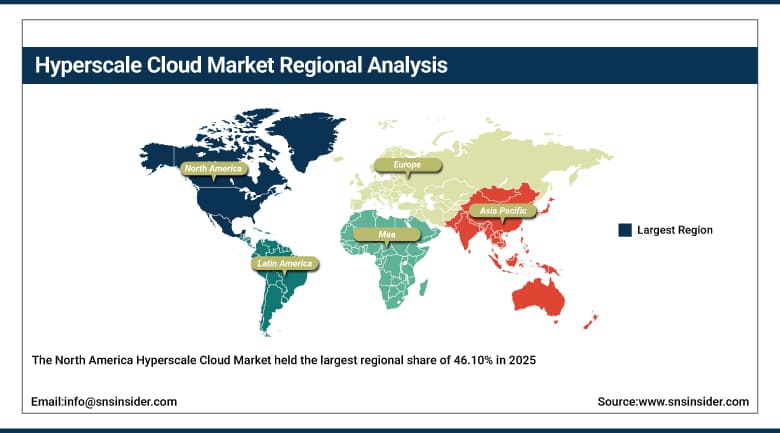
The North America Hyperscale Cloud Market held the largest regional share of 46.10% in 2025, underpinned by the region's unmatched concentration of leading hyperscale providers, mature power and data-center infrastructure and aggressive capital expenditure commitments directed toward AI-optimized campuses. Enterprises and government agencies across the region are rapidly expanding consumption of hyperscale compute for large language model training, enterprise data platforms and mission-critical application hosting, supported by an established ecosystem of chip designers, cooling-technology providers, and renewable-energy partners capable of sustaining continuous capacity expansion at scale.
The United States was the leading country within the North America Hyperscale Cloud Market in 2025 of the regional market, driven by the domestic presence of the world's largest hyperscale operators, sustained multi-hundred-billion-dollar annual capital expenditure programs, and rapid build-out of new AI-optimized data-center campuses across multiple states. Canada is contributing to regional growth through expanding sovereign cloud offerings and growing enterprise demand for domestically hosted AI infrastructure that satisfies national data-residency preferences.
Get Customized Report as Per Your Business Requirement - Enquiry Now
Europe Hyperscale Cloud Market Insights
The Europe region remained a significant contributor to the Hyperscale Cloud Market in 2025 and is expected to witness consistent growth over the forecast period due to the increasing use of hyperscale cloud infrastructure by businesses for AI and analytics workloads in the region. This can be attributed to the presence of strict data sovereignty regulations in the region, the increasing investments of hyperscalers in region-based sovereign cloud regions and the increasing demand for compliance-based EU-hosted AI capacity from enterprises.
Germany is one of the major markets in Europe owing to its large industrial and financial-services enterprise base actively expanding hyperscale cloud consumption, along with substantial hyperscaler investment in dedicated sovereign cloud capacity within the country. Other countries such as the United Kingdom, France, and the Netherlands, home to sizable financial, telecommunications, and technology sectors, are also contributing to market growth through expanding enterprise AI adoption and continued build-out of regional hyperscale data-center capacity.
Asia Pacific Hyperscale Cloud Market Insights
The Asia Pacific Hyperscale Cloud Market is expected to register the fastest growth rate during the forecast period 2026-2035, with a projected CAGR of 33.80%, supported by rapidly expanding enterprise cloud adoption, large-scale government-led digital-infrastructure initiatives, and aggressive investment by regional technology conglomerates in proprietary hyperscale platforms designed to serve fast-growing domestic digital economies. The region's expanding e-commerce, fintech, and manufacturing sectors are further accelerating enterprise migration toward hyperscale-hosted infrastructure.
China is one of the main growth drivers in the Asia Pacific Hyperscale Cloud Market, owing to its expansive domestic hyperscale ecosystem and continued large-scale investment by leading regional cloud providers serving both state-owned enterprises and a rapidly expanding private technology sector. India and Japan, both major global technology and services hubs, are also contributing to regional growth through expanding domestic hyperscale capacity, growing AI adoption across banking and manufacturing sectors, and rising enterprise demand for locally hosted cloud infrastructure.
Middle East & Africa and Latin America Hyperscale Cloud Market Insights
Middle East & Africa and Latin American regions are gradually expanding hyperscale cloud adoption as national digital-economy strategies and growing enterprise cloud migration continue to accelerate across both regions, supported by rising hyperscaler investment in new regional data-center capacity aimed at serving fast-growing domestic enterprise and government demand.
Brazil is set to be a prominent Latin American market fueled by its large financial-services and telecommunications sectors requiring scalable hyperscale infrastructure and growing domestic enterprise cloud adoption. The Middle East & Africa region has the UAE and Saudi Arabia investing heavily in national AI and cloud strategies, including newly announced hyperscale regions, that are rapidly increasing enterprise and government demand for hyperscale cloud platforms across banking, energy, and public-sector organizations.
Market Dynamics
Growth Drivers: Accelerating generative AI workloads and enterprise cloud migration fueling market expansion
The rapid proliferation of generative AI training and inference workloads, combined with the continuous, economy-scale migration of enterprise applications from on-premises infrastructure to hyperscale platforms, are among the primary drivers of the Hyperscale Cloud Market. Hyperscale infrastructure offers organizations the ability to provision massive, elastic compute capacity on demand, dramatically reducing the marginal cost of scaling AI training clusters, data-analytics pipelines, and globally distributed applications, while eliminating the multi-year lead times traditionally associated with building proprietary data-center capacity.
Continuous advancement in AI accelerator technology, including custom silicon programs developed directly by leading hyperscalers alongside integration of next-generation GPUs from established chip vendors, has significantly expanded the compute density and cost-efficiency achievable within hyperscale environments. Rising enterprise investment in re-platforming software-as-a-service applications directly onto hyperscale infrastructure, growing government-led cloud-first policies across major economies, and expanding demand for globally distributed content-delivery and edge-integrated hyperscale capacity are further reinforcing demand across the forecast period, as digital infrastructure needs continue to outpace what most organizations can economically build independently.
Restraints: Power availability constraints and regulatory fragmentation limiting expansion pace
One of the most significant obstacles to market growth is the widening gap between hyperscale capacity ambitions and available electrical power infrastructure. Numerous planned hyperscale data-center projects have faced delays or cancellations due to insufficient grid capacity, extended equipment lead times for critical power and cooling components, and growing local opposition tied to land use, water consumption, and community energy-cost concerns, particularly in regions where hyperscale build-out has accelerated fastest.
Moreover, the increasing fragmentation of national and regional data-sovereignty regulations continues to complicate global hyperscale expansion strategies, requiring providers to establish dedicated sovereign cloud regions and localized data-handling architectures on a country-by-country basis. This regulatory complexity, combined with the substantial capital intensity required to establish new hyperscale campuses and the ongoing global competition for scarce advanced semiconductor supply, continues to constrain the pace at which providers can bring new capacity online relative to underlying enterprise and AI-driven demand.
Opportunities: Sovereign cloud expansion and edge-integrated hyperscale infrastructure creating new growth avenues
The rise in the need for sovereign cloud space and regionally based clouds, coupled with the creation of multi-cloud solutions that help avoid single-vendor risk, and government spending on domestic AI and cloud infrastructure, will offer plenty of opportunities for growth within the hyperscale cloud market. The need for hyperscale cloud regions that are compliant with national data regulations, and can therefore serve industries like banking, healthcare, and government sectors, will be a major factor that will fuel future growth in this market.
The opportunities for the growth of an edge-integrated hyperscale infrastructure that can facilitate low latency computing closer to end users while lightening the burden on the centralized core infrastructure, at the same time supporting new-generation AI applications in real-time, is very high. The continued growth of hyperscale cloud infrastructure in emerging economies in the Asia Pacific, Latin American and Middle Eastern regions, along with the increasing government backing of digital economy, will continue to fuel the demand for hyperscale infrastructures.
Recent Developments:
-
2025: Amazon Web Services announced an investment of more than USD 4 billion to launch its first cloud infrastructure region in Chile, expanding hyperscale cloud capacity across Latin America.
-
2026: AWS confirmed plans for a new Saudi Arabia region representing a USD 5.3 billion investment, alongside the AWS European Sovereign Cloud in Germany backed by a around USD 7.8 billion commitment through 2040.
Hyperscale Cloud Market key players are:
-
Amazon Web Services, Inc.
-
Microsoft Corporation
-
Alphabet Inc. (Google Cloud)
-
Alibaba Group Holding Limited
-
Oracle Corporation
-
International Business Machines Corporation (IBM)
-
Tencent Holdings Limited
-
Huawei Technologies Co., Ltd.
-
Salesforce, Inc.
-
Broadcom Inc. (VMware)
-
Dell Technologies Inc.
-
Hewlett Packard Enterprise Company
-
Fujitsu Limited
-
DigitalOcean Holdings, Inc.
-
OVH Groupe S.A.
-
Rackspace Technology, Inc.
-
Cloudflare, Inc.
-
SAP SE
-
Equinix, Inc.
-
NTT Data Corporation
Hyperscale Cloud Market Report Scope:
| Report Attributes | Details |
|---|---|
| Market Size in 2025 | USD 426.39 Billion |
| Market Size by 2035 | USD 5,837.58 Billion |
| CAGR | CAGR of 29.91% From 2026 to 2035 |
| Base Year | 2025 |
| Forecast Period | 2026-2035 |
| Historical Data | 2022-2024 |
| Report Scope & Coverage | Market Size, Segments Analysis, Competitive Landscape, Regional Analysis, DROC & SWOT Analysis, Forecast Outlook |
| Key Segments | • By Service Model (IaaS, PaaS, SaaS) • By Deployment Model (Public Cloud, Private Cloud, Hybrid Cloud) • By Enterprise Size (Large Enterprises, Small & Medium Enterprises) • By Industry Vertical (IT & Telecom, BFSI, Retail & E-commerce, Healthcare) |
| Regional Analysis/Coverage | North America (US, Canada), Europe (Germany, UK, France, Italy, Spain, Russia, Poland, Rest of Europe), Asia Pacific (China, India, Japan, South Korea, Australia, ASEAN Countries, Rest of Asia Pacific), Middle East & Africa (UAE, Saudi Arabia, Qatar, South Africa, Rest of Middle East & Africa), Latin America (Brazil, Argentina, Mexico, Colombia, Rest of Latin America). |
| Company Profiles | Amazon Web Services, Inc., Microsoft Corporation, Alphabet Inc. (Google Cloud), Alibaba Group Holding Limited, Oracle Corporation, International Business Machines Corporation (IBM), Tencent Holdings Limited, Huawei Technologies Co., Ltd., Salesforce, Inc., Broadcom Inc. (VMware), Dell Technologies Inc., Hewlett Packard Enterprise Company, Fujitsu Limited, DigitalOcean Holdings, Inc., OVH Groupe S.A., Rackspace Technology, Inc., Cloudflare, Inc., SAP SE, Equinix, Inc., NTT Data Corporation. |

Frequently Asked Questions
The market is driven by rapid proliferation of generative AI training and inference workloads, continuous enterprise migration from on-premises infrastructure to hyperscale platforms, and ongoing advancement in AI accelerator technology.
The IT & Telecom segment dominated the Hyperscale Cloud Market in 2025, accounting for approximately 24.90% market share.
The North America region dominated the Hyperscale Cloud Market in 2025 with a 46.10% market share, driven by the region's unmatched concentration of leading hyperscale providers and aggressive AI infrastructure investment.
