
Telecom Cloud Market Report Scope & Overview:
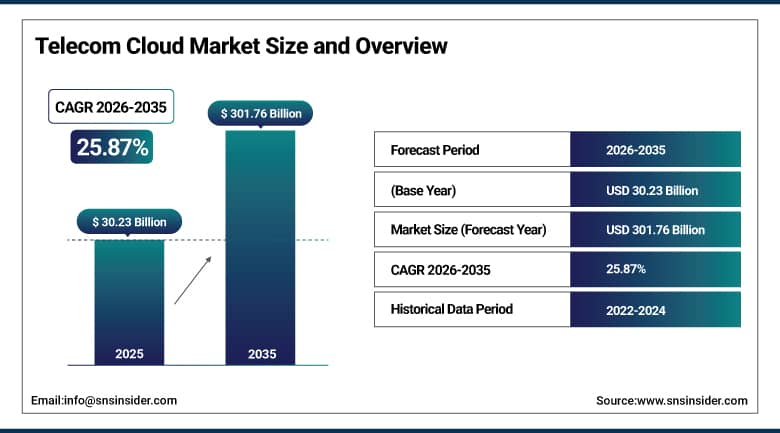
The Telecom Cloud Market was valued at USD 30.23 Billion in 2025 and is expected to reach USD 301.76 Billion by 2035, growing at a CAGR of 25.87% from 2026 to 2035.
The Telecom Cloud Market is experiencing rapid growth owing to the increased adoption of 5G networking, cloud-native telecom infrastructure, and virtualization technologies like NFV and SDN. The telecom providers are moving towards cloud platforms in order to increase their scalability, cut down on costs, and enhance their service delivery capabilities. There is also an increasing demand for edge computing, IoT connectivity, and AI-powered networking which is contributing to the adoption of cloud services by telecom operators. Furthermore, there is increased investment in digital transformation, hybrid cloud, and data security solutions which helps the telecom operators provide better customer experience and advanced communication services.
Telecom cloud adoption reached roughly 12,000 enterprise deployments in 2025, according to industry tracking data, driven by unified communications demand, accelerating 5G integration, and enterprises' growing appetite for scalable, secure cloud telecom solutions across both service provider and business customer segments.
To Get More Information On Telecom Cloud Market - Request Free Sample Report
Telecom Cloud Market Trends
-
Increasing acceptance of cloud telecom services is bringing about digital transformation across both enterprise customers and the service provider segment itself.
-
Growing adoption of unified communication, collaboration, and managed network services is driving demand for scalable telecom cloud platforms.
-
Focused integration of 5G, IoT, and artificial intelligence is enabling an experiential shift in how telecom services are actually delivered.
-
Scalable, secure, and flexible cloud environments, combined with broader digital transformation initiatives, are improving efficiency and reliability across telecom operations.
-
Enterprises are increasingly shifting from on-premise telecom infrastructure toward cloud-based solutions to reduce capital expenditure and improve deployment flexibility.
The U.S. Telecom Cloud Market Outlook
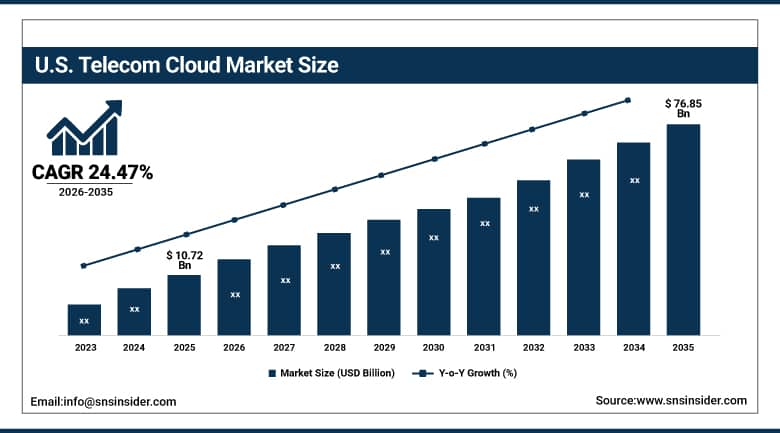
The U.S. Telecom Cloud Market was valued at approximately USD 10.72 Billion in 2026 and is expected to reach approximately USD 76.85 Billion by 2035, growing at a CAGR of approximately 24.47%.
Growth is primarily fueled by continued enterprise migration to cloud-based telecom services, accelerated integration of 5G connections, and rising appetite for unified communications and AI- or IoT-based network solutions across American businesses of every size. Growing use of unified communication, managed network services, and collaboration platforms is driving adoption through both enterprises and service providers, and focused integration of 5G, IoT, and artificial intelligence is enabling an experiential shift in services that's making cloud-native telecom infrastructure the clear preference over legacy dedicated hardware. Scalable, secure, and flexible cloud environments, combined with ongoing digital transformation initiatives, keep improving efficiency and reliability across the U.S. telecom landscape.
AT&T signed a USD 14 billion Open RAN agreement with Ericsson, a deal that signals the sheer capital intensity reshaping telecom cloud infrastructure investment as U.S. carriers accelerate their transition toward software-defined, containerized network platforms running on commercial off-the-shelf servers rather than proprietary hardware stacks.
Telecom Cloud Market Segment Analysis
-
By Service Type, SaaS (Software as a Service) segment dominated the Telecom Cloud Market in 2025 with 36% share; UCaaS (Unified Communications as a Service) segment is the fastest growing segment.
-
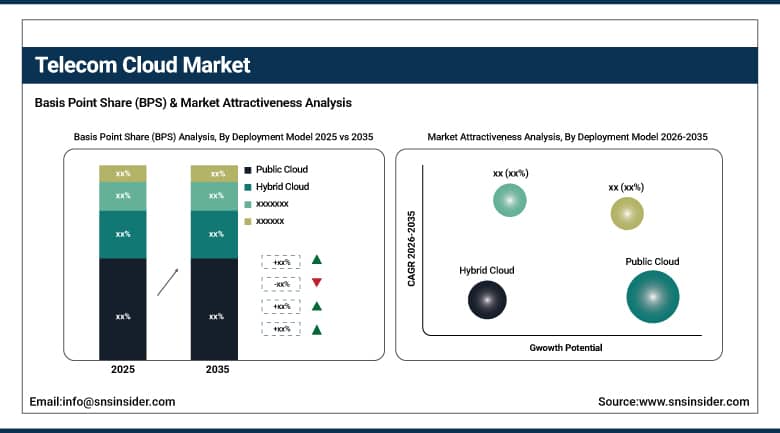
By Deployment Model, Public Cloud segment dominated the market in 2025 with 47% share; Hybrid Cloud segment is the fastest growing segment.
-
By Organization Size, Large Enterprises segment dominated the market in 2025 with 66% share; SMEs segment is the fastest growing segment.
-
By Industry Vertical, IT & Telecom segment dominated the market in 2025 with 32% share; Healthcare segment is the fastest growing segment.
By Service Type, SaaS (Software as a Service) segment dominates the Market, UCaaS (Unified Communications as a Service) segment expected to grow fastest
SaaS (Software as a Service) dominates the Telecom Cloud Market as a result of its extensive use in customer relationship management, billing, network management, business support systems, and collaboration applications. SaaS is preferred by telecom operators owing to its low infrastructure requirements, easy software deployment, automatic updates, and increased operational efficiency. In addition, the subscription-based pricing, scalability, and integration with telecoms' cloud platforms help telecom providers introduce new digital services rapidly. As such, SaaS makes up the largest service segment that generates revenue for telecoms globally.
UCaaS (Unified Communications as a Service) is the fastest-growing service type as companies embrace cloud-based voice, messaging, video conferencing, and collaboration applications. The increasing need for AI-enabled communication platforms, integrated employee experience, and secure connections is driving the adoption of UCaaS. Providers of telecom services constantly increase UCaaS functionality through analytics, automation, and collaboration features and make it a necessary part of communication technology in the age of digital transformation.
By Deployment Model, Public Cloud segment dominates the Telecom Cloud Market, Hybrid Cloud segment expected to grow fastest
Public Cloud dominates the Telecom Cloud Market due to its highly scalable, cost-effective, and flexible nature for telecom providers dealing with huge workload and digital services. The use of public clouds allows providers to cut down on expenses, deploy services fast, and make use of emerging technologies like AI, automation, analytics, and edge computing. The increasing adoption of network functions, customer management solutions, and other applications in the public cloud environment helps this segment gain more leadership in the market.
Hybrid Cloud is the fastest-growing deployment model as telecom providers try to merge both private and public cloud infrastructures in order to combine scalability, security, and regulations. The use of hybrid architecture enables organizations to secure their sensitive data but take advantage of public cloud facilities for innovations and flexibility. The increasing deployments of 5G network, edge computing, network virtualization, and mission-critical communication solutions push telecom providers towards using hybrid clouds.
By Organization Size, Large Enterprises segment dominates the Telecom Cloud Market, SMEs segment expected to grow fastest
Large Enterprises dominate the Telecom Cloud Market because of their robust communication infrastructure, massive number of customers, and heavy investment in digital transformation initiatives. For such companies, cloud computing services provide an effective solution to manage networking, customer interactions, service delivery, and business applications. Financial strength will allow consistent spending on artificial intelligence, automation, network virtualization, and cloud native technology, hence making large enterprises the biggest adopters and biggest earners in the telecom cloud industry.
SMEs are the fastest-growing organization size because small and medium-sized businesses are rapidly adopting telecom cloud services in order to cut down costs, increase operational agility, and enhance their business communication. The subscription model of cloud computing allows such businesses to avoid investing heavily in costly infrastructure. Increased digitalization, increased use of remote working models, and increasing reliance on cloud-based collaboration, communication, and customer engagement platforms drive SMEs towards cloud computing services.
By Industry Vertical, IT & Telecom segment dominates the Telecom Cloud Market, Healthcare segment expected to grow fastest
IT & Telecom dominates the Telecom Cloud Market as telecom companies and IT enterprises are leading adopters of cloud solutions for network virtualization, subscriber management, service orchestration, and automation. Ongoing investments in 5G, cloud-native core, SDN, and artificial intelligence have greatly fueled the adoption of cloud solutions. The constant requirement for scalable, reliable, and high-performing communication infrastructure remains as the reason for IT and telecom being the largest end user verticals.
Healthcare is the fastest-growing industry vertical all the industries that have been leveraging telecom cloud solutions for telemedicine, remote patient monitoring, digital consultation, e-health records, and medical data transfer over reliable and high-performing communication infrastructure. Increased investments in connected infrastructure for healthcare, healthcare applications using artificial intelligence, and patient services through cloud solutions are the key drivers of telecom cloud solutions.
Regional Analysis
|
Region |
Major Country |
Share within Region, 2025 (%) |
|---|---|---|
|
North America |
United States |
79.90% |
|
Europe |
Germany |
24.55% |
|
Asia Pacific |
China |
30.20% |
|
Middle East & Africa |
UAE |
27.15% |
|
Latin America |
Brazil |
36.05% |
North America Telecom Cloud Market Insights
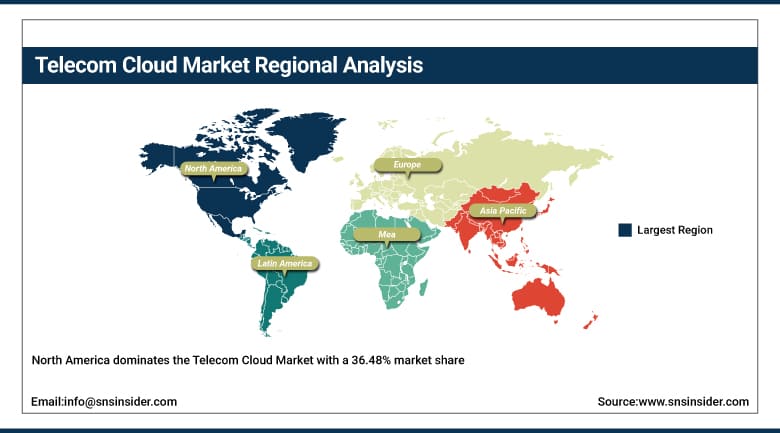
North America dominates the Telecom Cloud Market with a 36.48% market share, due to the high prevalence of cloud infrastructure, advanced IT & telecom industry presence, and heavy investments from enterprises in digital transformation, which results in high demand for Communication Platform as a Service and other telecom cloud solutions. The presence of leading hyperscale cloud players and telecom companies in North America has further established its dominance in almost all telecom cloud solutions.
United States holds around 79.90% of regional revenue due to high migration of enterprises to telecom cloud solutions, high growth in 5G adoption, and high demand for unified communications and artificial intelligence or IoT-enabled telecom cloud solutions. Canada generates additional demand for the telecom cloud market due to the adoption of enterprise cloud solutions. This regional dominance will continue in the forecasted period as well.
Get Customized Report as Per Your Business Requirement - Enquiry Now
Europe Telecom Cloud Market Insights
Europe holds a meaningful share of the global telecom cloud market, driven by the increasing number of 5G rollouts, digitization of enterprises, and the regulatory frameworks such as Digital Decade of EU that are pushing towards the deployment of native cloud-based network infrastructure. Open RAN trials conducted by many national carriers have added to this trend in the region.
Germany is the largest regional market with around 24.55% of European revenues, with its highly industrialized economy and high levels of investments in telecommunications infrastructure. The UK and France are other major demand centers in Europe, and investments in digital infrastructure and 5G rollouts in Europe will help to ensure steady growth in the demand for telecom clouds in the coming years.
Asia Pacific Telecom Cloud Market Insights
Asia Pacific is the fastest-growing region, with a CAGR of approximately 28.61%, due to high enterprise demand for cloud-based telecom solutions, high 5G network deployment, and advancements in IoT and AI solutions in some of the biggest economies in the region. Growth is driven by the digital transformation initiative being carried out in China and India in particular, though Australia and Japan have their fair share in making the region grow much faster than other regions in this report.
China has the largest market share of about 30.20% in the region, and the growth is attributed to growing acceptance of cloud-based telecom solutions, extending 5G networks, and AI and IoT solutions. Digitalization in the IT, BFSI, and manufacturing industries is what is fueling the growth in China and making it one of the key contributors in the region together with India, Japan, and South Korea.
MEA & Latin America Telecom Cloud Market Insights
The Middle East & Africa and Latin America are recording steady growth, which is being driven by increasing 5G deployment and investments in cloud services among enterprises in both the regions along with increasing government interest in modernizing the digital infrastructure. As the region continues to deploy modern telecommunications infrastructure, it has become an efficient approach to bypass legacy network infrastructure built around hardware-based systems through the use of cloud native platforms.
In the MEA market, the UAE dominates the demand with a regional revenue share of about 27.15%, backed by the country’s digital infrastructure initiatives and large-scale 5G deployment investments. The other two countries in the region driving demand include Saudi Arabia and South Africa. In the LATAM market, Brazil takes up about 36.05% of the regional revenue due to growing cloud adoption among enterprises in the region.
Market Dynamics
Growth Drivers: 5G integration and enterprise cloud migration
Increasing acceptance of cloud telecom services to bring about digital transformation in businesses and the service provider segment sits at the core of this market's rapid growth. Growing adoption of unified communication, collaboration, and managed network services is driving demand for scalable telecom cloud platforms, and carriers worldwide are channeling substantial capital toward cloud-native network cores as 5G standalone deployments accelerate and edge computing use cases keep proliferating across industries.
Focused integration of 5G, Internet of Things, and artificial intelligence is enabling an experiential shift in services that's reinforcing this driver further, as legacy monolithic network architectures give way to software-defined, containerized platforms running on commercial off-the-shelf servers. This shift compresses operational expenditure cycles considerably and gives operators the flexibility to deploy new services faster than proprietary hardware-based infrastructure ever allowed, which is exactly why enterprise and carrier appetite for telecom cloud keeps climbing at such a rapid pace.
Restraints: Data security concerns and integration complexity with legacy networks
Shifting the telecom infrastructure to cloud-native systems is indeed a very complicated process, and this very complexity continues being an obstacle to a faster adoption of the cloud, especially on the part of incumbent operators who have built up significant amounts of legacy infrastructure over the course of many years. Issues related to data security and privacy, specifically when it comes to customer communication and control network data, prevent some risk-averse carriers from moving to the cloud.
Another complication resulting from the integration of the cloud services into the telecom infrastructure, which acts as an additional obstacle to faster adoption, is the potential danger associated with a service interruption during the process of migration for a telecom carrier. Compliance issues and the lack of professionals who could operate cloud telecom services continue hindering the adoption process in some organizations, and this is one of the reasons behind the gradual implementation of the cloud by the incumbent telecom carriers as compared with their cloud-native rivals.
Opportunities: Healthcare telemedicine expansion and Open RAN adoption
The adoption of telemedicine services, secure transport of medical data, and remote monitoring systems by the healthcare sector creates a legitimate opportunity for telecom cloud players because the vertical's growth is currently growing faster than any other industry monitored in this market. Players capable of proving their reliability and compliance capabilities in response to the demands of the vertical will take a piece of an increasingly large pie beyond the telecom cloud's historical comfort zone of IT & Telecom verticals.
Carrier investments into Open RAN and software defined network architectures create a second major opportunity based on deals such as the USD 14 billion Open RAN deal between AT&T and Ericsson and the USD 1.5 billion multi-cloud deal between Vodafone and Microsoft. With more and more carriers committed to re-platforming core and edge computing workloads to cloud-native architecture supported by hyperscalers, the telecom cloud vendors will capture a much larger share of telecom capex budgets than hardware vendors have ever enjoyed.
Recent Developments:
-
2025: AT&T signed a USD 14 billion Open RAN agreement with Ericsson, reshaping capital investment in telecom cloud infrastructure at a carrier-scale level.
-
2025: Vodafone entered a USD 1.5 billion multi-cloud partnership with Microsoft, illustrating how carriers are re-platforming core and edge workloads to meet performance, sovereignty, and compliance requirements simultaneously.
-
2025: AWS introduced Amazon Quick Suite, an AI-powered workspace integrating QuickSight and advanced business automation tools, enabling natural language workflow automation and comprehensive data analysis across multiple platforms.
Telecom Cloud Market key players are:
-
Amazon Web Services, Inc. (AWS)
-
Google Cloud Platform (GCP)
-
IBM Corporation
-
Oracle Corporation
-
Cisco Systems, Inc.
-
AT&T Inc.
-
Verizon Communications Inc.
-
Huawei Technologies Co., Ltd.
-
Ericsson AB
-
Salesforce.com, Inc.
-
VMware, Inc.
-
NEC Corporation
-
Mitel Networks Corporation
-
RingCentral, Inc.
-
Twilio Inc.
-
Zoom Video Communications, Inc.
-
8x8, Inc.
-
DigitalOcean, Inc.
Telecom Cloud Market Report Scope:
| Report Attributes | Details |
|---|---|
| Market Size in 2025 | USD 30.23 Billion |
| Market Size by 2035 | USD 301.76 Billion |
| CAGR | CAGR of 25.87% From 2026 to 2035 |
| Base Year | 2025 |
| Forecast Period | 2026-2035 |
| Historical Data | 2022-2024 |
| Report Scope & Coverage | Market Size, Segments Analysis, Competitive Landscape, Regional Analysis, DROC & SWOT Analysis, Forecast Outlook |
| Key Segments | • By Service Type (IaaS, PaaS, SaaS, UCaaS, CaaS, Others) • By Deployment Model (Public Cloud, Private Cloud, Hybrid Cloud, Multi-Cloud) • By Organization Size (SMEs, Large Enterprises) • By Industry Vertical (BFSI, IT & Telecom, Healthcare, Retail, Manufacturing, Government & Public Sector, Others) |
| Regional Analysis/Coverage | North America (US, Canada), Europe (Germany, UK, France, Italy, Spain, Russia, Poland, Rest of Europe), Asia Pacific (China, India, Japan, South Korea, Australia, ASEAN Countries, Rest of Asia Pacific), Middle East & Africa (UAE, Saudi Arabia, Qatar, South Africa, Rest of Middle East & Africa), Latin America (Brazil, Argentina, Mexico, Colombia, Rest of Latin America). |
| Company Profiles | Microsoft Corporation, Amazon Web Services, Inc. (AWS), Google Cloud Platform (GCP), IBM Corporation, Oracle Corporation, Cisco Systems, Inc., AT&T Inc., Verizon Communications Inc., Huawei Technologies Co., Ltd., Ericsson AB, Nokia Corporation, Salesforce.com, Inc., VMware, Inc., NEC Corporation, Mitel Networks Corporation, RingCentral, Inc., Twilio Inc., Zoom Video Communications, Inc., 8x8, Inc., DigitalOcean, Inc. |

Frequently Asked Questions
The Telecom Cloud Market is expected to grow at a CAGR of 25.87% from 2026 to 2035.
The Telecom Cloud Market was valued at USD 30.23 Billion in 2025.
The major growth factor is increasing acceptance of cloud telecom services, growing adoption of unified communications, and accelerating 5G and IoT integration.
The SaaS segment dominated the Telecom Cloud Market in 2025.
North America dominated the Telecom Cloud Market in 2025 with a 36.48% share of total global market revenue.
