
Integrated Sensing and Communication Market Report Scope & Overview:
The Integrated Sensing and Communication Market was valued at USD 4.57 Billion in 2025 and is expected to reach USD 17.83 Billion by 2035, growing at a CAGR of 14.62% from 2026–2035.
The Integrated Sensing and Communication Market is experiencing consistent growth due to increasing demand for integrated sensing, high-speed connectivity, low-latency communication, and reliable wireless infrastructure. The expansion of 5G networks, 5G-Advanced networks, emerging 6G networks, edge computing, autonomous systems, smart cities, and industrial automation is driving demand for advanced sensing and communication capabilities. Investments in radar systems, RF sensing, millimeter wave (mmWave) sensing, LiDAR systems, optical sensing, and wireless communication technologies are enhancing sensing accuracy, connectivity, network efficiency, scalability, and real-time data processing. Companies are focusing on higher sensing precision, communication efficiency, network flexibility, spectrum utilization, and low-latency performance.
In May 2026, Samsung Electronics and LG Uplus announced a joint initiative to advance integrated sensing and communication (ISAC) technologies for 6G networks. The collaboration focuses on leveraging existing communication infrastructure for wireless sensing, supporting the development of environment-aware networks and next-generation applications. The initiative is expected to accelerate global ISAC adoption by improving sensing capabilities, network efficiency, spectrum utilization, and the integration of sensing functions into future 6G communication systems.
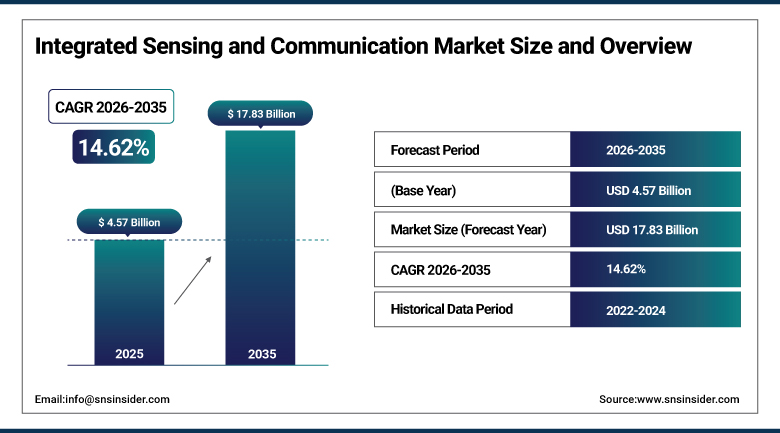
To Get more information Integrated Sensing and Communication Market - Request Free Sample Report
Integrated Sensing and Communication Market Trends
-
Growing demand for real-time sensing, high-speed connectivity, low latency, and reliable data transmission is driving the adoption of integrated sensing and communication technologies.
-
Rising deployment of 5G, 5G-Advanced, emerging 6G, edge computing, autonomous systems, smart cities, and industrial automation is increasing demand for ISAC solutions.
-
Advancements in RF sensing, mmWave sensing, radar, LiDAR, optical sensing, and wireless communication are supporting more accurate and efficient ISAC systems.
-
Growing focus on sensing accuracy, spectrum efficiency, network scalability, low latency, and energy efficiency is creating new opportunities for ISAC technology providers.
-
Increasing integration of ISAC with autonomous vehicles, robotics, drones, and intelligent infrastructure is expanding its applications across transportation, defense, and industrial environments.
The U.S. Integrated Sensing and Communication Market Outlook
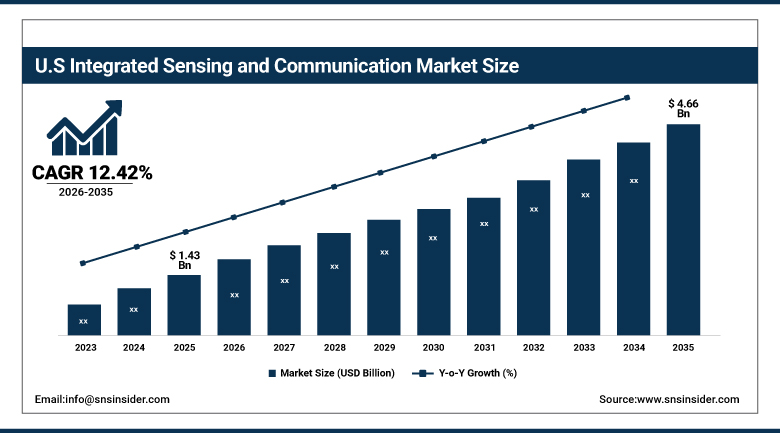
The U.S. Integrated Sensing and Communication Market was valued at USD 1.43 Billion in 2025 and is expected to reach around USD 4.66 Billion by 2035, growing at a CAGR of 12.42% from 2026–2035.
The U.S. Integrated Sensing and Communication Market is growing steadily due to rising demand for low-latency connectivity, real-time sensing, and advanced wireless infrastructure. The expansion of 5G, 5G-Advanced, emerging 6G networks, edge computing, autonomous systems, and smart-city infrastructure is driving demand for integrated sensing and communication capabilities. Investments in next-generation wireless infrastructure and network upgrades are improving sensing accuracy, connectivity, scalability, and efficiency. Growing deployment across telecommunications, automotive, aerospace and defense, industrial automation, and healthcare is supporting market demand. Companies are focusing on radar systems, RF sensing, mmWave sensing, LiDAR, optical sensing, and advanced wireless technologies to enhance sensing performance and network flexibility. The adoption of 5G-Advanced, 6G, private networks, edge-based systems, and cloud-based architectures is further supporting market growth in the U.S.
In July 2026, AT&T and Ericsson demonstrated integrated sensing and communication technology over a commercial 5G network in Arlington, Texas, enabling real-time detection and tracking of multiple drones using existing cellular infrastructure. The demonstration highlights the ability of 5G networks to provide sensing capabilities without dedicated standalone sensors and is expected to support further development of ISAC for critical infrastructure protection, public safety, smart-city applications, and future 6G networks in the United States.
Integrated Sensing and Communication Market Segment Analysis
-
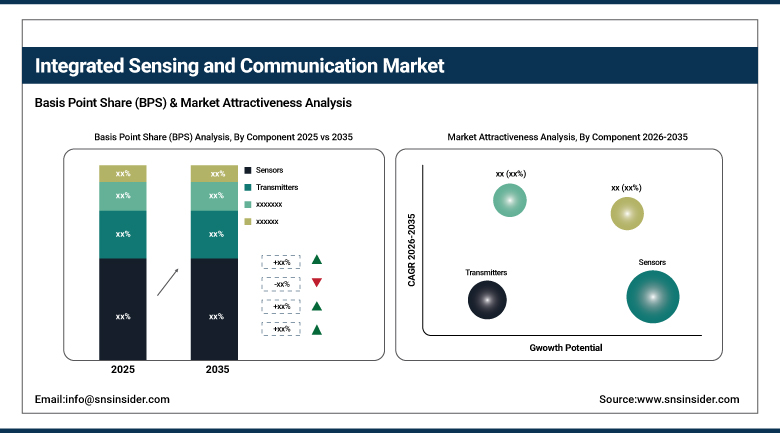
By Component, sensors dominated the integrated sensing and communication market with a 34.17% share in 2025, while software is projected to be the fastest-growing segment, registering a 24.27% CAGR during 2026–2035.
-
By Technology, RF sensing dominated the integrated sensing and communication market with a 42.17% share in 2025, while millimeter wave (mmWAVE) sensing is projected to be the fastest-growing segment, registering a 21.73% CAGR during 2026–2035.
-
By Application, telecommunications dominated the integrated sensing and communication market with a 38.17% share in 2025, while automotive is projected to be the fastest-growing segment, registering a 22.63% CAGR during 2026–2035.
-
By Deployment, 5G networks dominated the integrated sensing and communication market with a 41.83% share in 2025, while 6G networks are projected to be the fastest-growing segment, registering a 28.55% CAGR during 2026–2035.
-
By End Use, commercial dominated the integrated sensing and communication market with a 42.13% share in 2025, while government is projected to be the fastest-growing segment, registering a 21.12% CAGR during 2026–2035.
By Component, sensors dominated the integrated sensing and communication market, while software is expected to grow fastest.
Sensors held the leading position in the integrated sensing and communication market, supported by their critical role in enabling real-time environmental detection, object identification, positioning, and monitoring within integrated wireless systems. Growing deployment of sensing-enabled 5G, 5G-Advanced, automotive systems, industrial automation, smart-city infrastructure, and defense applications is increasing demand for advanced sensors. Improvements in sensing accuracy, detection range, signal processing, and integration with communication networks are further supporting sensor adoption.
Software is anticipated to register the highest growth during the forecast period. Growing adoption of AI-enabled sensing, real-time data processing, edge computing, network intelligence, and software-defined architectures is increasing demand for advanced ISAC software. Software solutions enable intelligent signal processing, sensing data analytics, resource optimization, and coordination between sensing and communication functions, supporting the transition toward more flexible 5G-Advanced and 6G networks.
By Technology, RF sensing dominated the integrated sensing and communication market, while millimeter wave (mmWave) sensing is expected to grow fastest.
RF sensing accounted for the dominant position in the integrated sensing and communication market, driven by its ability to utilize wireless communication signals for environmental detection, object tracking, positioning, and situational awareness. Growing deployment of 5G infrastructure, advanced antennas, signal processing technologies, and sensing-enabled communication systems is supporting RF sensing adoption across telecommunications, automotive, industrial automation, aerospace and defense, and smart-city applications.
Millimeter wave (mmWave) sensing is projected to exhibit the highest growth during the forecast period. The technology provides high spatial resolution, accurate object detection, and improved sensing capabilities, making it suitable for autonomous vehicles, robotics, industrial monitoring, smart infrastructure, and advanced wireless networks. Increasing deployment of 5G-Advanced and emerging 6G technologies is expected to further accelerate mmWave sensing adoption.
By Application, telecommunications dominated the integrated sensing and communication market, while automotive is expected to grow fastest.
Telecommunications held the dominant position in the integrated sensing and communication market, supported by the expansion of 5G networks, increasing demand for network intelligence, and the integration of sensing capabilities into existing wireless infrastructure. ISAC enables communication networks to support environmental monitoring, object detection, positioning, and network optimization while improving spectrum utilization and infrastructure efficiency.
Automotive is projected to register the highest growth during the forecast period. Growing adoption of autonomous driving, advanced driver-assistance systems, vehicle detection, collision avoidance, and high-resolution environmental sensing is increasing demand for integrated sensing and communication technologies. The expansion of connected vehicles, 5G connectivity, edge computing, radar sensing, and mmWave technologies is expected to create significant opportunities for automotive ISAC deployment.
Regional Analysis
|
Region |
Major Country |
Share within Region, 2025(%) |
|---|---|---|
|
North America |
United States |
82.00% |
|
Europe |
Germany |
34.30% |
|
Asia Pacific |
China |
48.54% |
|
Middle East & Africa |
Saudi Arabia |
23.50% |
|
Latin America |
Brazil |
23.00% |
North America integrated sensing and communication market insights
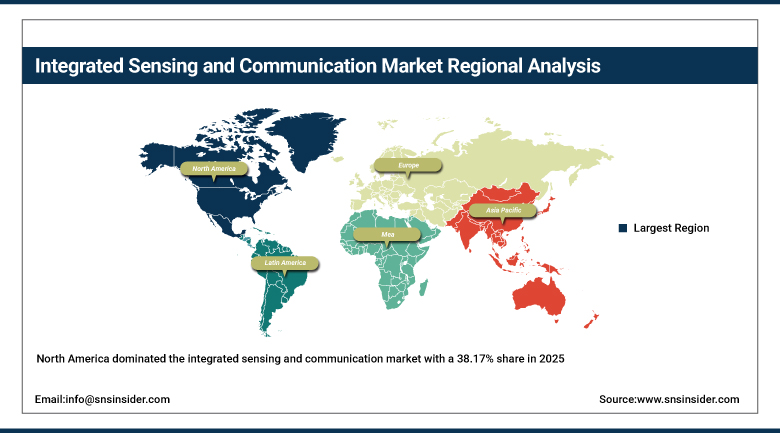
North America dominated the integrated sensing and communication market with a 38.17% share in 2025, supported by advanced telecommunications infrastructure, extensive 5G deployment, strong technology capabilities, and significant investment in next-generation wireless networks. The region has been an early adopter of advanced wireless technologies, edge computing, artificial intelligence, autonomous systems, and smart-city infrastructure, creating strong demand for integrated sensing and communication solutions. Growing investments in 5G-Advanced and emerging 6G technologies are supporting the integration of sensing capabilities into communication networks. The presence of major telecommunications companies, technology providers, defense organizations, and research institutions is further strengthening regional development.
Get Customized Report as per Your Business Requirement - Enquiry Now
Europe integrated sensing and communication market insights
The integrated sensing and communication market in Europe is expected to witness steady growth, supported by expanding 5G and 5G-Advanced networks, increasing adoption of edge computing, industrial automation, connected mobility, and investments in next-generation wireless technologies. European countries are focusing on integrating sensing capabilities into communication infrastructure to improve positioning, environmental monitoring, object detection, network optimization, and real-time data processing. Growing demand across automotive, telecommunications, aerospace and defense, manufacturing, smart cities, and healthcare is creating opportunities for ISAC technologies. Germany is anticipated to remain a key national market, supported by its advanced industrial ecosystem, strong automotive sector, telecommunications infrastructure, and increasing adoption of smart manufacturing and connected systems.
Asia Pacific Integrated Sensing and Communication Market Insights
Asia Pacific is expected to grow at the fastest CAGR of 17.88% during 2026–2035, supported by rapid digital transformation, expanding 5G infrastructure, increasing investments in 5G-Advanced and 6G technologies, and growing adoption of intelligent connected systems. China, Japan, South Korea, India, Singapore, and other Asian economies are investing substantially in advanced wireless networks, edge computing, artificial intelligence, autonomous systems, industrial automation, and smart-city infrastructure. Rising adoption of connected vehicles, robotics, intelligent transportation, and real-time monitoring is creating strong demand for integrated sensing capabilities. Increasing deployment of RF sensing, mmWave sensing, radar systems, LiDAR systems, and advanced wireless communication technologies is further supporting regional market development.
Middle East & Africa and Latin America integrated sensing and communication market insights
The integrated sensing and communication market in the Middle East & Africa and Latin America is expected to witness consistent growth during the forecast period, supported by expanding 5G networks, digital transformation initiatives, smart-city development, industrial modernization, and increasing adoption of connected technologies. Growing investments in advanced wireless infrastructure are creating opportunities for sensing-enabled communication systems across telecommunications, transportation, industrial automation, public safety, and smart infrastructure applications. Saudi Arabia is expected to remain an important market in the Middle East & Africa, supported by investments in 5G networks, smart cities, autonomous systems, digital infrastructure, and national technology initiatives.
In Latin America, Brazil is anticipated to remain a key country-level market due to its large telecommunications sector, expanding 5G coverage, growing smart-city initiatives, industrial digitalization, and increasing demand for connected infrastructure. Other countries across both regions are also expected to contribute to market growth through investments in advanced wireless networks, IoT, edge computing, automation, and emerging 6G technologies.
Market Dynamics
Growth Driver: Increasing demand for integrated sensing and low-latency communication is driving market growth
One of the key factors driving the growth of the global integrated sensing and communication market is the increasing demand for low-latency connectivity, real-time sensing, accurate positioning, and intelligent network capabilities across telecommunications, automotive, aerospace and defense, industrial automation, and smart-city applications. The expansion of 5G, 5G-Advanced, emerging 6G networks, edge computing, autonomous systems, and connected infrastructure is creating substantial demand for communication networks that can simultaneously support data transmission and environmental sensing. ISAC enables wireless networks to detect objects, monitor environments, estimate locations, and collect real-time information while maintaining communication functions.
Restraint: High deployment costs and technological complexity can limit market adoption
The high cost and technical complexity associated with deploying integrated sensing and communication systems can restrict market adoption, particularly among smaller network operators and enterprises. Advanced sensors, antennas, RF systems, signal processors, edge computing infrastructure, and specialized software require significant investment and technical expertise. Integrating sensing functions with existing communication networks may also require network architecture modifications, advanced signal processing capabilities, synchronization mechanisms, and upgraded computing resources. Moreover, managing ISAC systems requires specialized expertise in wireless communication, sensing algorithms, artificial intelligence, data processing, and network optimization. Compatibility challenges between sensing and communication technologies, evolving standards, spectrum management requirements, data-processing demands, and power consumption considerations can further increase deployment complexity.
Opportunity: Rapid expansion of 6G, autonomous systems, and intelligent infrastructure creates new market opportunities
The rapid development of 5G-Advanced and emerging 6G technologies presents significant opportunities for integrated sensing and communication solution providers. Next-generation wireless networks are increasingly being designed to incorporate sensing capabilities for environmental monitoring, object detection, positioning, tracking, and situational awareness. Growing deployment of autonomous vehicles, robotics, smart infrastructure, industrial automation, connected transportation, and intelligent public-safety systems is creating additional demand for integrated sensing capabilities. Furthermore, advancements in mmWave sensing, AI-enabled signal processing, edge computing, advanced antennas, and sensing-aware network architectures are creating opportunities for technology providers. The integration of sensing and communication functions can improve spectrum utilization, reduce dependence on dedicated sensing infrastructure, and support real-time decision-making.
Recent Developments
-
2026: Ericsson continued advancing integrated sensing and communication capabilities by demonstrating sensing over 5G infrastructure, supporting applications such as object detection, tracking, public safety, defense, and future 6G networks.
-
2026: Nokia continued developing integrated sensing and communication technologies for 5G-Advanced and 6G networks, focusing on network-based sensing, positioning, environmental awareness, and intelligent wireless connectivity.
-
2026: Samsung Electronics continued advancing integrated sensing and communication research for 6G networks, focusing on the integration of sensing capabilities with wireless communication infrastructure and next-generation intelligent network applications.
-
2026: Huawei Technologies Co., Ltd. continued developing integrated sensing and communication technologies for next-generation wireless networks, supporting sensing-enabled connectivity, intelligent transportation, industrial applications, and emerging 6G use cases.
Integrated Sensing and Communication Market key players are:
-
Huawei Technologies Co., Ltd.
-
Ericsson
-
Nokia Corporation
-
Qualcomm Technologies, Inc.
-
Samsung Electronics Co., Ltd.
-
ZTE Corporation
-
NEC Corporation
-
NTT DOCOMO, Inc.
-
Keysight Technologies, Inc.
-
Rohde & Schwarz GmbH & Co. KG
-
Anritsu Corporation
-
VIAVI Solutions Inc.
-
NXP Semiconductors N.V.
-
MediaTek Inc.
-
Intel Corporation
-
NVIDIA Corporation
-
Analog Devices, Inc.
-
Texas Instruments Incorporated
-
LG Electronics Inc.
-
InterDigital, Inc.
Integrated Sensing and Communication Market Report Scope:
| Report Attributes | Details |
|---|---|
| Market Size in 2025 | USD 4.57 Billion |
| Market Size by 2035 | USD 17.83 Billion |
| CAGR | CAGR of 14.62% From 2026 to 2035 |
| Base Year | 2025 |
| Forecast Period | 2026-2035 |
| Historical Data | 2022-2024 |
| Report Scope & Coverage | Market Size, Segments Analysis, Competitive Landscape, Regional Analysis, DROC & SWOT Analysis, Forecast Outlook |
| Key Segments | • By Component (Sensors, Transmitters, Receivers, Antennas, Processors, Software) • By Technology (Radar Systems, RF Sensing, Millimeter Wave (mmWave) Sensing, LiDAR Systems, Optical Sensing, Wireless Communication) • By Application (Telecommunications, Automotive, Aerospace and Defense, Industrial Automation, Smart Cities, Healthcare) • By Deployment (5G Networks, 5G-Advanced Networks, 6G Networks, Private Networks, Edge-Based Systems, Cloud-Based Systems) • By End Use (Government, Commercial, Military, Manufacturing, Transportation, Healthcare) |
| Regional Analysis/Coverage | North America (US, Canada), Europe (Germany, UK, France, Italy, Spain, Russia, Poland, Rest of Europe), Asia Pacific (China, India, Japan, South Korea, Australia, ASEAN Countries, Rest of Asia Pacific), Middle East & Africa (UAE, Saudi Arabia, Qatar, South Africa, Rest of Middle East & Africa), Latin America (Brazil, Argentina, Mexico, Colombia, Rest of Latin America) |
| Company Profiles | Huawei Technologies Co., Ltd., Ericsson, Nokia Corporation, Qualcomm Technologies, Inc., Samsung Electronics Co., Ltd., ZTE Corporation, NEC Corporation, NTT DOCOMO, Inc., Keysight Technologies, Inc., Rohde & Schwarz GmbH & Co. KG, Anritsu Corporation, VIAVI Solutions Inc., NXP Semiconductors N.V., MediaTek Inc., Intel Corporation, NVIDIA Corporation, Analog Devices, Inc., Texas Instruments Incorporated, LG Electronics Inc., InterDigital, Inc. |

Frequently Asked Questions
Key players include Huawei Technologies Co., Ltd., Ericsson, Nokia Corporation, Qualcomm Technologies, Inc., Samsung Electronics Co., Ltd., ZTE Corporation, NEC Corporation, NTT DOCOMO, Inc., among others.
Key opportunities include the expansion of 5G-Advanced and 6G networks, autonomous systems, smart cities, industrial automation, edge computing, intelligent transportation, and AI-enabled sensing.
The market is primarily driven by increasing demand for real-time sensing, low-latency connectivity, network intelligence, precise positioning, and integrated sensing capabilities across wireless networks.
The RF sensing segment dominated the integrated sensing and communication market in 2025 with a 42.17% share, supported by its use of wireless communication signals for object detection, positioning, tracking, environmental monitoring, and network sensing.
North America dominated the integrated sensing and communication market in 2025 with a 38.17% share, supported by advanced 5G infrastructure, strong technology capabilities, investments in 5G-Advanced and 6G, and growing adoption of sensing-enabled wireless networks.
