
Intra-abdominal Pressure Measurement Devices Market Report Scope & Overview:
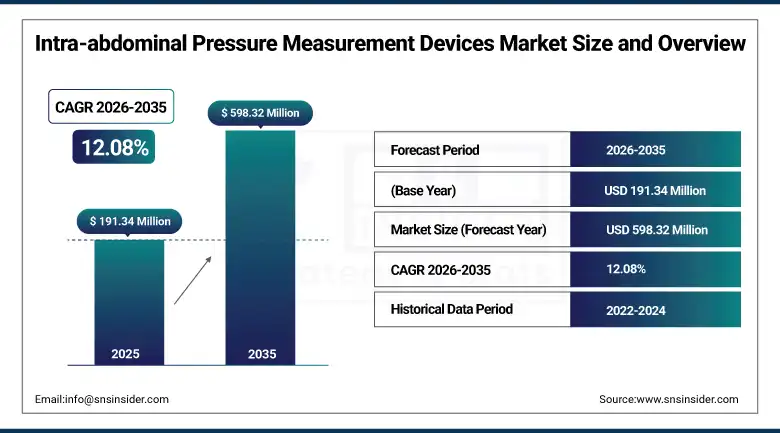
The Intra-abdominal Pressure Measurement Devices Market was valued at USD 191.34 Million in 2025 and is expected to reach USD 598.32 Million by 2035, growing at a CAGR of 12.08% from 2026–2035.
The Intra-abdominal Pressure Measurement Devices Market is growing steadily owing to the increased occurrence of intra-abdominal hypertension (IAH) and abdominal compartment syndrome (ACS), especially among critical and trauma patients. Growth drivers include increased intensive care unit admissions, growing awareness of pressure measurements for early detection, and increasing use of minimally invasive pressure measurements. Technical developments in pressure measurements, critical care improvements, and increasing surgeries are also boosting the market's development. Moreover, higher health care spending, better patient safety standards, and increasing incidence of serious abdominal problems are major market growth factors.
According to the World Health Organization (WHO), an estimated 20–30 million people worldwide develop sepsis each year, making it a major risk factor for intra-abdominal hypertension and organ dysfunction that require continuous monitoring in critical care settings. The World Society of the Abdominal Compartment Syndrome (WSACS) reports that intra-abdominal hypertension is frequently observed among critically ill patients, particularly those suffering from severe trauma, burns, pancreatitis, sepsis, and major abdominal surgeries, increasing the need for accurate pressure monitoring devices. Furthermore, the WHO estimates that more than 300 million major surgical procedures are performed globally every year, creating substantial demand for postoperative monitoring solutions to detect complications early and improve patient outcomes.
Intra-abdominal Pressure Measurement Devices Market Size and Forecast
-
Market Size in 2026E: USD 214.47 Million
-
Market Size by 2035: USD 598.32 Million
-
CAGR: 12.08% from 2026 to 2035
-
Fastest Growing Region: Asia Pacific
-
Largest Region: North America
To Get more information On Intra-abdominal Pressure Measurement Devices Market - Request Free Sample Report
Intra-abdominal Pressure Measurement Devices Market Trends
-
Rising incidence of abdominal compartment syndrome (ACS) and intra-abdominal hypertension (IAH) driving demand for accurate intra-abdominal pressure monitoring solutions
-
Growing adoption of minimally invasive and continuous monitoring technologies to improve critical care management and patient outcomes
-
Increasing use of intra-abdominal pressure measurement devices in intensive care units and emergency departments for early detection of complications
-
Expanding focus on postoperative monitoring and management of trauma, sepsis, and critically ill patients boosting device utilization across healthcare facilities
-
Continuous advancements in pressure monitoring systems, including automated and integrated digital solutions, enhancing measurement accuracy and clinical workflow efficiency
U.S. Intra-abdominal Pressure Measurement Devices Market Outlook
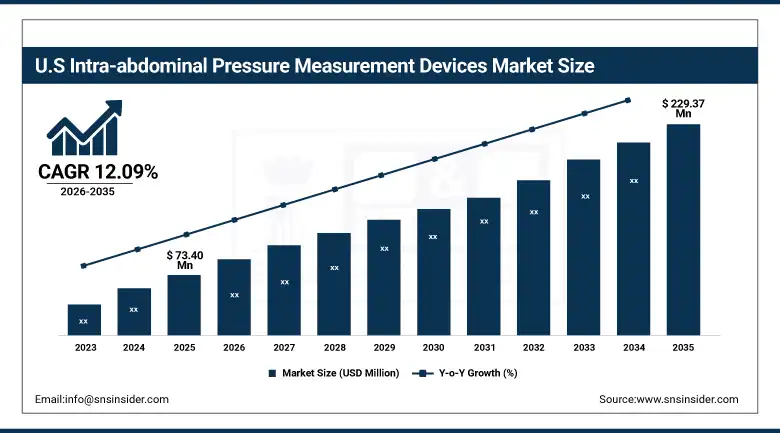
The U.S. Intra-abdominal Pressure Measurement Devices Market was valued at approximately USD 73.40 Million in 2025 and is expected to reach approximately USD 229.37 Million by 2035, growing at a CAGR of approximately 12.09%.
The U.S. Intra-abdominal Pressure Measurement Devices Market is growing because of the increase in cases of intra-abdominal hypertension and abdominal compartment syndrome, increasing Intensive Care Unit admissions, and expansion of critical care. The increasing use of advanced monitoring techniques, increased awareness of early pressure measurement, and increase in surgery are contributing to the demand for these devices. Further, positive health care expenditure, excellent infrastructure, and patient outcome improvement initiatives are fueling the growth of the market.
According to the Centers for Disease Control and Prevention (CDC), approximately 1.7 million adults develop sepsis annually in the country, with many patients requiring intensive monitoring and critical care management
Intra-abdominal Pressure Measurement Devices Market Segment Analysis
-
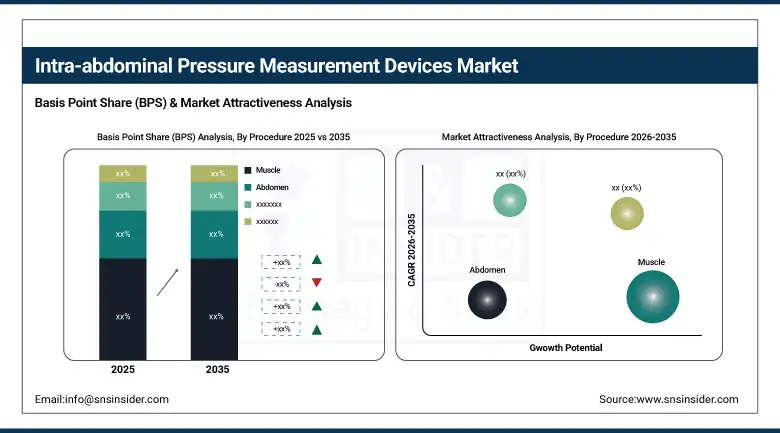
By Procedure, Abdomen segment dominated the Intra-abdominal Pressure Measurement Devices Market in 2025 with 71% share; Muscle segment is the fastest growing segment.
-
By Product, Disposables segment dominated the market in 2025 with 59% share; Equipment segment is the fastest growing segment.
-
By Application, Intra-abdominal Hypertension segment dominated the market in 2025 with 66% share; Intra-compartment Pressure segment is the fastest growing segment.
By Procedure, abdomen segment dominates the market, while muscle segment is the fastest-growing segment
The Abdomen segment dominated the market in 2025 owing to the prevalent practice of measuring abdominal pressures for assessing conditions such as intra-abdominal hypertension and abdominal compartment syndrome. The need for abdominal pressure measurements arises from the fact that these measurements provide clinically proven and precise assessment of pressure variations within the abdomen. The rise in incidence of trauma, major surgeries, sepsis, and critical care patients requiring monitoring continuously has added to its dominance. Clinical guidelines along with its usage in the ICU setting have aided in its dominance in the market.
The Muscle segment is the fastest growing owing to the increasing importance being laid on the monitoring of compartment pressures in musculoskeletal disorders and compartment syndrome. Growth in sporting activities, rising incidences of injuries due to accidents, and increasing emphasis on early detection of pressure have fueled market growth. The development of minimally invasive techniques and increased applications in orthopedics and emergency medicine have accelerated market growth.
By Product, disposables segment dominates the market, while equipment segment is the fastest-growing segment
The Disposables segment dominated the market in 2025 because of the increased awareness about prevention of infections among health care professionals. These devices not only eliminate any risks associated with cross contamination, but also make the measurement processes easier since they do not require sterilization. They are easy to use and integrate well into regular health monitoring procedures. Growing awareness of the need to adhere to certain hygiene standards also helps the segment to take up the market lead position.
The Equipment segment is the fastest growing due to rapid developments in measuring technology and rising requirements for precise monitoring. The development of advanced equipment allows for improved results since it ensures accuracy and reliability of measurements. Growing investment into health care and modernizing health institutions contribute greatly to the segment growth. Increased attention paid to early detection of complications caused by excess pressures is also helping the equipment market grow.
By Application, intra-abdominal hypertension segment dominates the market, while intra-compartment pressure segment is the fastest-growing segment
The Intra-abdominal Hypertension segment dominated the market in 2025 owing to the clinical relevance of monitoring the increased pressure in the abdomen of critically ill patients. This condition typically occurs in association with trauma, sepsis, burns, surgical cases, and admissions to the intensive care unit; consequently, there is high demand for the monitoring of the same. Accurate and prompt diagnosis of this condition is crucial for avoiding serious complications and organ dysfunction, making this segment a leader in the field.
The Intra-compartment Pressure segment is the fastest growing because of the growing instances of compartment syndrome, which require prompt detection to avoid irreparable damage to the tissues involved. Growing incidence of fractures, crush injury, sports injury, and orthopedic surgery are some of the factors fueling the demand for pressure monitoring equipment. More application of advanced diagnostic methods in the treatment of orthopedics and trauma patients is contributing to the fast-paced growth of this segment.
Regional Analysis
|
Region |
Major Country |
Share within Region, 2025 (%) |
|---|---|---|
|
North America |
United States |
87.4% |
|
Europe |
Germany |
22.3% |
|
Asia Pacific |
China |
44.8% |
|
Middle East & Africa |
Saudi Arabia |
31.2% |
|
Latin America |
Brazil |
44.2% |
North America Intra-abdominal Pressure Measurement Devices Market Insights
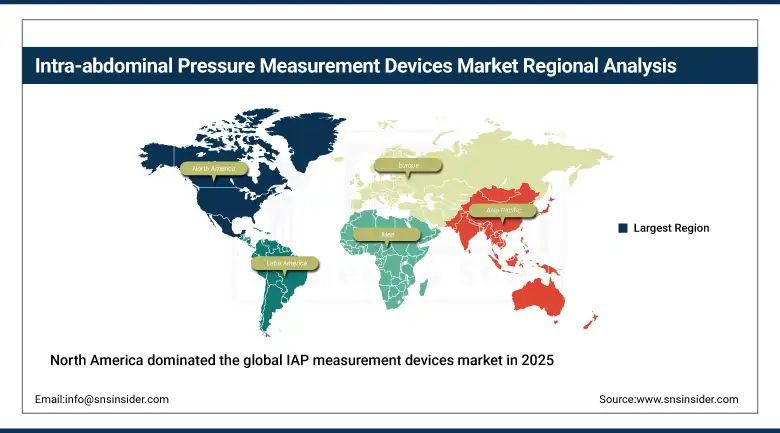
North America dominated the global IAP measurement devices market in 2025 through its advanced critical care infrastructure, SCCM evidence-based practice guidelines creating protocol-driven procurement, and the commercial presence of Potrero Medical and ConvaTec AbViser. The United States accounts for approximately 87.4% of North American revenues through its large ICU bed count, active trauma centre network, and major liver transplant programme’s post-operative monitoring protocols.
The American Hospital Association (AHA) states that the United States has more than 6,000 hospitals, including thousands of intensive care units equipped with advanced patient monitoring systems, supporting the adoption of specialized pressure monitoring technologies.
Canada contributes approximately 12.6% of North American revenues through its critical care network’s IAP monitoring adoption, the trauma centre’s orthopaedic monitoring procurement, and the academic medical centre’s clinical research programme investment.
Furthermore, the National Institutes of Health (NIH) highlights that trauma remains one of the leading causes of hospitalization and critical care admission among younger populations, increasing the need for continuous monitoring of intra-abdominal pressure to detect complications early and improve clinical outcomes.
Get Customized Report as per Your Business Requirement - Enquiry Now
Europe Intra-abdominal Pressure Measurement Devices Market Insights
Europe is a technically sophisticated IAP market where WSACS European membership, the European Society of Intensive Care Medicine’s clinical practice guidelines, and Holtech Medical’s European commercial presence create structured institutional demand. Germany accounts for approximately 22.3% of European revenues through its advanced ICU infrastructure, ESICM guideline adoption, and the hospital sector’s evidence-based critical care investment.
According to the European Society of Intensive Care Medicine (ESICM), millions of patients receive intensive care treatment annually across Europe, increasing the need for advanced monitoring solutions in intensive care units.
Furthermore, Eurostat reports that more than 21% of the European Union population is aged 65 years and older, a demographic group that is more susceptible to critical illnesses, postoperative complications, and complex surgical procedures requiring continuous monitoring.
The United Kingdom, France, and the Netherlands are significant secondary markets where NHS critical care quality improvement programmes, ESICM member ICU adoption, and the trauma surgery sector’s monitoring investment create consistent IAP device procurement.
Additionally, the European Commission continues to support investments in patient safety initiatives and advanced monitoring technologies, encouraging the adoption of intra-abdominal pressure measurement systems across hospitals and critical care environments to improve clinical outcomes and patient management.
Asia Pacific Intra-abdominal Pressure Measurement Devices Market Insights
Asia Pacific is the fastest-growing regional IAP market, driven by rapid ICU infrastructure expansion in China, India, Japan, and South Korea, growing critical care specialist community adoption of WSACS guidelines, and increasing awareness of ACS as a preventable critical care complication. China accounts for approximately 44.8% of Asia Pacific revenues through its extraordinary ICU bed expansion, the critical care physician community’s growing WSACS guideline awareness, and the domestic medical device sector’s monitoring product development.
According to the World Health Organization (WHO), the South-East Asia Region accounts for approximately 8.5 million deaths annually from noncommunicable diseases, many of which require hospitalization, intensive care, and advanced patient monitoring. The National Health Commission of China reports that China has more than 38,000 hospitals, supporting one of the world's largest healthcare and critical care infrastructures.
India’s rapidly expanding private hospital ICU infrastructure and the critical care medical community’s growing evidence-based practice adoption create above-average IAP monitoring market development that compounds with India’s healthcare infrastructure investment trajectory.
Furthermore, the Ministry of Health and Family Welfare indicates that India operates over 70,000 public and private hospitals, with continued expansion of intensive care units and emergency care facilities under national healthcare initiatives.
MEA & Latin America Intra-abdominal Pressure Measurement Devices Market Insights
Saudi Arabia leads MEA revenues at approximately 31.2% through its advanced hospital sector’s critical care infrastructure, King Faisal Specialist Hospital’s trauma and surgical ICU monitoring investment, and the Ministry of Health’s intensive care quality improvement programme.
Brazil leads Latin American revenues at approximately 44.2% through its large hospital network’s ICU infrastructure, the trauma surgery centre’s monitoring adoption, and the critical care medical community’s growing WSACS guideline implementation. Growing ICU infrastructure investment across both regions collectively sustains market development through 2035.
Market Dynamics
Growth Drivers: Rising IAH and ACS prevalence in critically ill patients and WSACS guideline adoption creating protocol-driven procurement
The rising prevalence of intra-abdominal hypertension in critically ill patient populations, whose retrospective data indicates IAH occurrence in 30-50% of ICU patients with identifiable risk factors, creates structured IAP monitoring demand whose scale compounds with ICU admission growth globally. Abdominal compartment syndrome’s documented mortality impact, whose associated organ failure creates 40-60% ICU mortality rates in established ACS, creates compelling patient safety justification for IAP monitoring investment whose early detection enabling intervention before ACS development is demonstrated in clinical outcome studies.
WSACS consensus guideline adoption creating protocol-driven IAP monitoring in high-risk ICU patient populations transforms IAP measurement from optional surveillance into standard of care procurement whose institutional guideline adherence creates predictable device procurement across progressive critical care programmes.
Restraints: Limited awareness in developing countries and catheter-associated complication risk from invasive measurement
Limited IAP monitoring awareness in developing country critical care settings, where WSACS guideline dissemination is incomplete and evidence-based critical care protocols remain in development, creates adoption barriers that moderate market penetration below theoretical prevalence-driven demand. Each ICU whose critical care physicians have limited WSACS guideline exposure creates procurement absence whose commercial impact sustains below-potential market penetration in emerging healthcare markets.
Catheter-associated complications including urinary tract infection risk from prolonged transurethral measurement and nursing workflow burden from manual measurement frequency create clinical implementation barriers that limit IAP monitoring adoption to facilities with sufficient nursing resources to execute measurement protocols reliably.
Opportunities: Continuous electronic monitoring and non-invasive measurement technology
Continuous electronic IAP monitoring represents the most commercially premium technology direction whose automated real-time pressure tracking eliminates nursing measurement burden while providing superior clinical decision support data quality. Each ICU that adopts continuous monitoring creates equipment procurement whose per-installation value substantially exceeds disposable-only measurement programme economics.
Non-invasive IAP measurement technology represents the most commercially transformative emerging opportunity whose elimination of urinary catheter requirement expands monitoring accessibility to patient populations where invasive measurement creates contraindication and to healthcare settings where catheter management resources are constrained.
Recent Developments:
-
2024: Potrero Medical received FDA clearance for its AccuCath bladder pressure monitoring system with enhanced real-time continuous IAP tracking and EHR connectivity in 2024, enabling automated monitoring without repeated manual measurement procedures.
-
2024: ConvaTec expanded its AbViser AutoValve IAP monitoring product range in 2024 with enhanced measurement accuracy and simplified nursing workflow integration, targeting ICU protocol adoption in trauma and surgical critical care settings.
-
2023: Holtech Medical received European CE Mark approval in 2023 for its Abdominal Pressure Monitor with novel non-invasive measurement capability using abdominal wall displacement sensing, creating a catheter-free IAP assessment alternative.
-
2023: Pulsion Medical Systems (Getinge) integrated intra-abdominal pressure monitoring capability into its PiCCO advanced haemodynamic monitoring platform in 2023, enabling combined cardiovascular and abdominal pressure surveillance from a unified critical care monitoring interface.
-
2023: The World Society of the Abdominal Compartment Syndrome published updated consensus definitions and clinical recommendations in 2023 reinforcing serial IAP monitoring protocols in high-risk ICU populations, creating institutional guideline-driven procurement motivation across WSACS member institutions globally.
Intra-abdominal Pressure Measurement Devices Market Key Players
-
Becton, Dickinson and Company (BD)
-
Baxter International Inc.
-
Cardinal Health, Inc.
-
Medtronic plc
-
ConvaTec Group PLC
-
Laborie Medical Technologies Corp.
-
Potrero Medical, Inc.
-
Holtech Medical
-
Centurion Medical Products Corporation
-
Smiths Medical (ICU Medical)
-
Cook Medical
-
Teleflex Incorporated
-
Vygon Group
-
Fuji Systems Corporation
-
Medline Industries, LP
-
B. Braun SE
-
Merit Medical Systems, Inc.
-
Edwards Lifesciences Corporation
-
Utah Medical Products, Inc.
-
Argon Medical Devices, Inc.
Intra-abdominal Pressure Measurement Devices Market Report Scope:
| Report Attributes | Details |
|---|---|
| Market Size in 2025 | USD 191.34 Million |
| Market Size by 2035 | USD 598.32 Billion |
| CAGR | CAGR of 12.08% From 2026 to 2035 |
| Base Year | 2025 |
| Forecast Period | 2026-2035 |
| Historical Data | 2022-2024 |
| Report Scope & Coverage | Market Size, Segments Analysis, Competitive Landscape, Regional Analysis, DROC & SWOT Analysis, Forecast Outlook |
| Key Segments | • By Procedure (Muscle, Abdomen) • By Product (Disposables, Equipment) • By Application (Intra-compartment Pressure, Intra-abdominal Hypertension) |
| Regional Analysis/Coverage | North America (US, Canada), Europe (Germany, UK, France, Italy, Spain, Russia, Poland, Rest of Europe), Asia Pacific (China, India, Japan, South Korea, Australia, ASEAN Countries, Rest of Asia Pacific), Middle East & Africa (UAE, Saudi Arabia, Qatar, South Africa, Rest of Middle East & Africa), Latin America (Brazil, Argentina, Mexico, Colombia, Rest of Latin America). |
| Company Profiles | Becton, Dickinson and Company (BD), Baxter International Inc., Cardinal Health, Inc., Medtronic plc, ConvaTec Group PLC, Laborie Medical Technologies Corp., Potrero Medical, Inc., Holtech Medical, Centurion Medical Products Corporation, Smiths Medical (ICU Medical), Cook Medical, Teleflex Incorporated, Vygon Group, Fuji Systems Corporation, Medline Industries, LP, B. Braun SE, Merit Medical Systems, Inc., Edwards Lifesciences Corporation, Utah Medical Products, Inc., Argon Medical Devices, Inc. |
Frequently Asked Questions
The Intra-abdominal Pressure Measurement Devices Market is expected to grow at a CAGR of 12.08% from 2026 to 2035.
The Intra-abdominal Pressure Measurement Devices Market was valued at USD 191.34 Million in 2025.
Rising prevalence of intra-abdominal hypertension in ICU patients and WSACS consensus guideline adoption creating protocol-driven serial IAP monitoring procurement across progressive critical care institutions globally.
Disposables dominated the Intra-abdominal Pressure Measurement Devices Market with in 2025.
North America dominated the Intra-abdominal Pressure Measurement Devices Market in 2025, while Asia Pacific is the fastest-growing region.
