
Laboratory Supplies Market Report Scope & Overview:
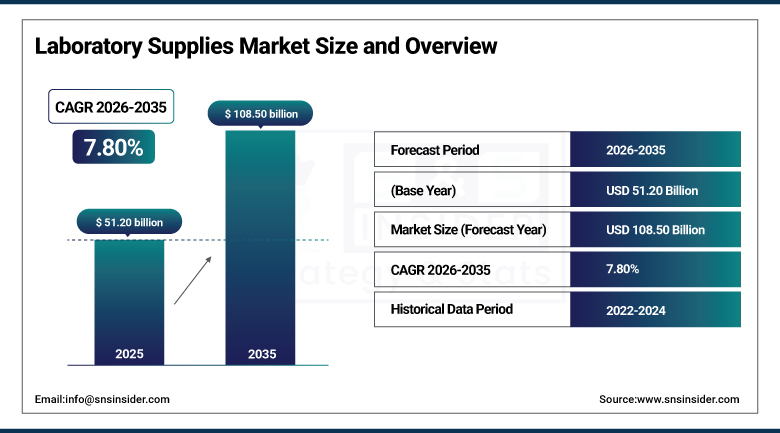
The Laboratory Supplies Market was valued at USD 51.20 Billion in 2025 and is expected to reach USD 108.50 Billion by 2035, growing at a CAGR of 7.80% from 2026 to 2035.
The Laboratory Supplies Market is growing steadily because of high investments made in life sciences research, expansion of the pharmaceutical and biotechnology industry, and increased demand for clinical diagnostics in global markets. Academic and research institution growth, emphasis on precision medicines, and testing of infections and chronic diseases through laboratories are some factors that are increasing the demand for laboratory equipment and supplies. Advancements in laboratory automation technology, drug discovery and development, and stringent quality requirements in the healthcare, food safety, and environmental testing sectors are also contributing to the growth of this market.
According to the World Health Organization (WHO), approximately 20 million new cancer cases and 9.7 million cancer deaths were recorded globally in 2022, substantially increasing the demand for pathology, molecular diagnostics, genomics, and clinical laboratory testing. This rising disease burden is driving the adoption of advanced laboratory equipment, reagents, and consumables, thereby supporting continued growth of the Laboratory Supplies Market.
To Get more information on Laboratory Supplies Market - Request Free Sample Report
Laboratory Supplies Market Trends
-
Rising investments in pharmaceutical, biotechnology, and life sciences research driving demand for high-quality laboratory supplies and consumables
-
Growing adoption of automated laboratory workflows increasing the need for compatible disposable labware, reagents, and sample handling products
-
Increasing focus on molecular diagnostics, genomics, and clinical testing supporting sustained demand for laboratory consumables and analytical supplies
-
Expanding research activities in academic institutions, contract research organizations (CROs), and diagnostic laboratories boosting procurement of laboratory equipment and supplies
-
Continuous advancements in sustainable laboratory products, sterile consumables, and high-performance materials improving laboratory efficiency, safety, and regulatory compliance
The U.S. Laboratory Supplies Market Outlook
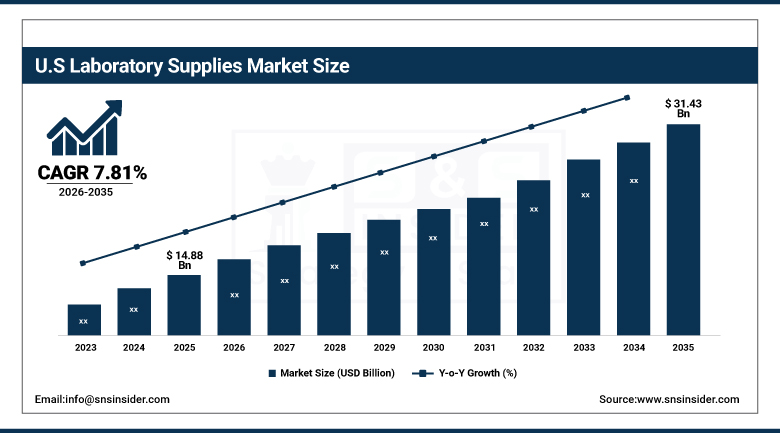
The U.S. Laboratory Supplies Market was valued at approximately USD 14.88 Billion in 2025 and is expected to reach approximately USD 31.43 Billion by 2035, growing at a CAGR of approximately 7.81%.
The United States is the world's largest national laboratory supplies market, sustained by the combination of the highest per-capita pharmaceutical and biotechnology R&D investment globally, the most extensive clinical diagnostics laboratory network whose annual diagnostic test volume exceeds 8 billion tests, the National Institutes of Health's research funding programme whose 2025 budget of approximately USD 47 billion sustains the academic research laboratory ecosystem that is among the most intensive laboratory supplies consumers per researcher globally, and the domestic headquarters of major laboratory supplies manufacturers including Thermo Fisher Scientific, Agilent Technologies, Danaher, and Bio-Rad whose product development, manufacturing, and commercial operations create a dense domestic laboratory supplies commercial ecosystem.
Laboratory Supplies Market Segment Analysis
-
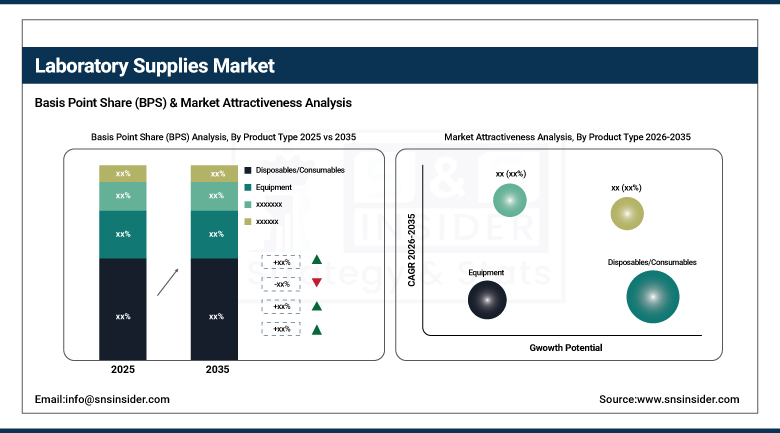
By Product Type, Disposables/Consumables segment dominated the Laboratory Supplies Market in 2025 with 64% share; Equipment segment is the fastest growing segment.
-
By End User, Pharmaceutical & Biotechnology Companies segment dominated the market in 2025 with 38% share; Clinical & Diagnostic Laboratories segment is the fastest growing segment.
By Product Type, Disposables/Consumables segment dominates the Laboratory Supplies Market, Equipment segment expected to grow fastest
The Disposables/Consumables segment dominated the Laboratory Supplies Market owing to the steady demand for disposable laboratory supplies including pipette tips, test tubes, gloves, culture media, and reagents. High levels of testing activity in research, diagnostic, drug discovery, and quality control laboratories necessitate regular consumption of these disposables to ensure precision and avoid contamination. Higher laboratory activities, enhanced safety concerns, and expanded biotechnology research are helping the segment to maintain its dominance in the market.
The Equipment segment is the fastest growing in the Laboratory Supplies Market due to increasing investments in laboratory automation, advanced analytical instruments, and high throughput testing technologies. The increasing demand for precise diagnosis, molecular biology research, and pharmaceutical developments is prompting the use of advanced laboratory equipment. The technological innovations in digital laboratory systems, automation systems, and intelligent instruments are further boosting the growth of this segment.
By End User, Pharmaceutical & Biotechnology Companies segment dominates the Market, Clinical & Diagnostic Laboratories segment expected to grow fastest.
The Pharmaceutical & Biotechnology Companies segment dominated the Laboratory Supplies Market because of the high investment in drugs, vaccines, clinical research, and biologics manufacture. These entities need a constant supply of laboratory supplies and tools to enable their activities of research and quality control. The increased investment in R&D, increase in biopharmaceutical manufacture, and demand for novel therapies have helped maintain their dominance in the laboratory supplies market globally.
The Clinical & Diagnostic Laboratories segment is the fastest growing in the Laboratory Supplies Market because of the demand for early diagnosis of the disease and personalized medicine. The increase in the incidence of chronic and communicable diseases has driven up laboratory test volumes, thus the demand for sophisticated laboratory supplies and equipment. The development in molecular diagnostics, automation technology, and point-of-care diagnostics helps drive the growth of diagnostic laboratories fast.
Regional Analysis
|
Region |
Major Country |
Share within Region, 2025 (%) |
|---|---|---|
|
North America |
United States |
84.73% |
|
Europe |
Germany |
27.84% |
|
Asia Pacific |
China |
38.47% |
|
Middle East & Africa |
UAE |
22.84% |
|
Latin America |
Brazil |
43.84% |
North America Laboratory Supplies Market Insights
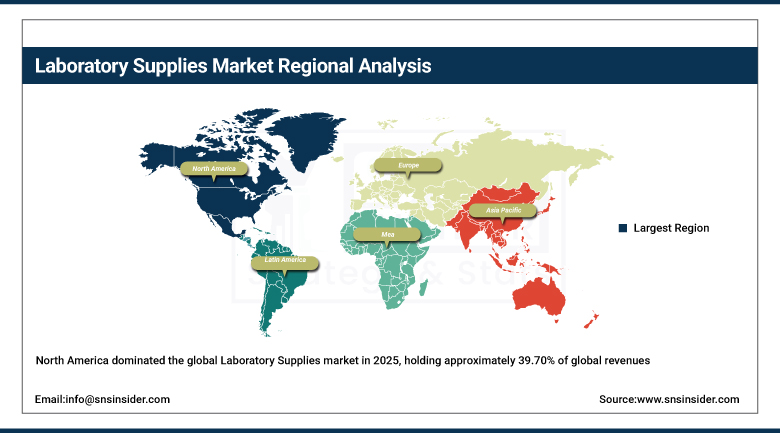
North America dominated the global Laboratory Supplies market in 2025, holding approximately 39.70% of global revenues. The United States accounts for approximately 84.73% of regional revenue through the world's most concentrated pharmaceutical and biotechnology R&D ecosystem, the NIH's substantial research funding sustaining academic laboratory investment, and the domestic presence of Thermo Fisher Scientific, Agilent Technologies, Danaher, Bio-Rad, and Waters Corporation whose combined revenue scale and product portfolio breadth makes them globally dominant laboratory supplies providers. Canada contributes meaningful supplementary regional demand through its growing biotech sector, university research programmes, and healthcare diagnostics laboratory network.
According to the National Cancer Institute (NCI), approximately 2 million new cancer cases are diagnosed annually in the United States, driving increased demand for pathology laboratories, molecular diagnostics, genomics, and specialized laboratory consumables used in cancer detection, diagnosis, and treatment monitoring.
Get Customized Report as per Your Business Requirement - Enquiry Now
Europe Laboratory Supplies Market Insights
Europe held approximately 27% of global Laboratory Supplies revenues in 2025. Germany accounts for approximately 27.84% of European revenues through its pharmaceutical industry whose R&D expenditure ranks among the highest nationally within Europe, its extensive university and public research institute network, and the domestic presence of Sartorius AG, Merck KGaA, and Eppendorf AG whose laboratory instrument and consumable product lines are globally distributed.
The EU's Horizon Europe research funding programme, which allocated EUR 95.5 billion for 2021 to 2027, sustains research laboratory investment across EU member states. The United Kingdom, France, Switzerland, and the Netherlands each contribute meaningful European demand through their pharmaceutical, biotechnology, and academic research sectors.
Asia Pacific Laboratory Supplies Market Insights
Asia Pacific is the fastest-growing regional Laboratory Supplies market, projected to expand at a CAGR of approximately 8.30% through 2035. China accounts for approximately 38.47% of Asia Pacific revenues through its rapidly expanding pharmaceutical and biotechnology industry, growing government investment in scientific research infrastructure, and the expanding Chinese university and public research laboratory network whose procurement scale is increasing with annual research funding growth.
Japan contributes precision laboratory instrument demand through its advanced analytical chemistry and life sciences industries. India and South Korea are growing rapidly through pharmaceutical sector expansion, increasing government research investment, and growing clinical diagnostics infrastructure.
MEA & Latin America Laboratory Supplies Market Insights
Middle East and Latin America are growing Laboratory Supplies markets where healthcare infrastructure investment, pharmaceutical manufacturing expansion, and increasing research funding are creating growing laboratory supply demand. The UAE leads MEA revenues at approximately 22.84% of the regional total through its healthcare investment programmes, medical research institution development, and growing pharmaceutical sector.
Saudi Arabia's Vision 2030 science and technology investment initiative is expanding the Kingdom's research laboratory infrastructure. Brazil leads Latin American revenues at approximately 43.84% of the regional total through its extensive university research network, large public health laboratory system for disease surveillance and diagnostics, and growing pharmaceutical and biotechnology sector.
Market Dynamics
Growth Drivers: Expanding pharmaceutical R&D and rising precision diagnostics demand are driving laboratory supplies market growth globally
Higher research and development spending from the pharmaceuticals and biotech industries is by far the largest commercial contributor to premium laboratory supplies demand growth. Drug discovery and development projects need ongoing purchases of analytical tools, cell biology tools, molecular biology reagents, and characterisation supplies, and the total cost per active drug development project could easily be over $1 million per year.
The growth of cell and gene therapies, mRNA therapies, and antibody-drug conjugate projects which have high biological manufacturing and testing needs and therefore generate unusually high laboratory supplies demand growth is generating higher-than-normal growth in specialized laboratory equipment and consumables. Clinical diagnostics test volume growth, which is being driven by ageing of the world’s population, chronic diseases, preventative health screening adoption, and access to healthcare in emerging markets, is creating corresponding demand for diagnostic tools, reagent kits, and specimen collection consumables.
Restraints: High instrument costs and limited laboratory budgets slow equipment upgrades and advanced technology adoption
The budget constraints associated with the cost of sophisticated analysis laboratory equipment like high-resolution mass spectrometers, next-generation sequencers, and cryo-electron microscopes, which often costs more than USD 500,000 to USD 2 million per unit, is such that the purchase decisions involve lengthy institutional process approvals and are subject to competing funding needs within the institution.
Supply chain disruptions, which were so pronounced from 2020 to 2022 that they resulted in lead times of several months for laboratory consumables like pipette tips, microplates, and PCR reagents, have demonstrated the impact of concentrated supply chains in manufacturing and raw materials on laboratory procurement.
Opportunities: Laboratory automation and expanding genomics diagnostics are creating strong demand for advanced laboratory supplies and equipment
Laboratory automation, which involves liquid handling robots, automated plate readers, workcells, and AI-powered laboratory management systems, has generated a hardware and consumables supply chain that expands along with automation uptake in pharmaceutical, clinical, and academic labs.
Automated laboratories generally result in increased consumption of consumables per unit of research compared to non-automated laboratories because increased throughput allows conducting more experiments in the same amount of time, and each experiment uses the same amounts of consumables as would be used in the corresponding experiment conducted manually. Genomics-based diagnostics that include cancer liquid biopsy, pharmacogenomics testing, rare disease, and infectious disease diagnostics are generating novel classes of instruments and reagents for the clinical laboratory markets which are at the early stages of their adoption.
Recent Developments:
-
2025: PHC Corporation of North America launched the MCO-171AICUVD-PA CO2 incubator with UV-LED disinfection, copper-enriched antimicrobial chamber surfaces, and 180-degree Celsius sterilisation cycle addressing zero-contamination requirements of cell therapy manufacturing and advanced biologics development programmes.
-
2025: Dynarex Corporation launched the LabChoice series of laboratory consumables and equipment covering pipettes, sample collection tubes, specimen containers, and protective equipment for clinical, research, and industrial laboratory markets at pricing competitive with established laboratory supply distributors.
-
2025: Waters Corporation launched the TGA Smart-Seal Pans enabling benchtop analysis of atmosphere-sensitive materials with system cost and footprint reduction of up to 50 percent, improving laboratory throughput for thermal gravimetric analysis in pharmaceutical and materials science research applications.
Laboratory Supplies Market Key Players are:
-
Thermo Fisher Scientific Inc.
-
Danaher Corporation
-
Merck KGaA
-
Avantor, Inc.
-
Agilent Technologies, Inc.
-
Corning Incorporated
-
Eppendorf SE
-
Sartorius AG
-
PerkinElmer, Inc.
-
Waters Corporation
-
Bio-Rad Laboratories, Inc.
-
QIAGEN N.V.
-
Shimadzu Corporation
-
Bruker Corporation
-
Carl Zeiss AG
-
Mettler-Toledo International Inc.
-
Cole-Parmer Instrument Company, LLC
-
Gilson, Inc.
-
Hamilton Company
-
DWK Life Sciences GmbH
Laboratory Supplies Market Report Scope:
| Report Attributes | Details |
|---|---|
| Market Size in 2025 | USD 51.20 Billion |
| Market Size by 2035 | USD 108.50 Billion |
| CAGR | CAGR of 7.80% From 2026 to 2035 |
| Base Year | 2025 |
| Forecast Period | 2026-2035 |
| Historical Data | 2022-2024 |
| Report Scope & Coverage | Market Size, Segments Analysis, Competitive Landscape, Regional Analysis, DROC & SWOT Analysis, Forecast Outlook |
| Key Segments | • By Product Type (Equipment (Incubators, Centrifuges, Microscopes, Autoclaves & Sterilizers, Laminar Flow Hoods, Spectrophotometers, Others), Disposables/Consumables (Pipettes, Tips, Tubes, Cuvettes, Gloves, Masks, Cell Culture Consumables, Others)) • By End User (Academic & Research Institutes, Pharmaceutical & Biotechnology Companies, Clinical & Diagnostic Laboratories, Food & Beverage Testing, Environmental Testing, Others) |
| Regional Analysis/Coverage | North America (US, Canada), Europe (Germany, UK, France, Italy, Spain, Russia, Poland, Rest of Europe), Asia Pacific (China, India, Japan, South Korea, Australia, ASEAN Countries, Rest of Asia Pacific), Middle East & Africa (UAE, Saudi Arabia, Qatar, South Africa, Rest of Middle East & Africa), Latin America (Brazil, Argentina, Mexico, Colombia, Rest of Latin America). |
| Company Profiles | Thermo Fisher Scientific Inc., Danaher Corporation, Merck KGaA, Avantor, Inc., Agilent Technologies, Inc., Corning Incorporated, Eppendorf SE, Sartorius AG, PerkinElmer, Inc., Waters Corporation, Bio-Rad Laboratories, Inc., QIAGEN N.V., Shimadzu Corporation, Bruker Corporation, Carl Zeiss AG, Mettler-Toledo International Inc., Cole-Parmer Instrument Company, LLC, Gilson, Inc., Hamilton Company, DWK Life Sciences GmbH |
Frequently Asked Questions
The Laboratory Supplies Market is expected to grow at a CAGR of 7.80% from 2026 to 2035.
The Laboratory Supplies Market was valued at USD 51.20 Billion in 2025.
Expanding pharmaceutical R&D, rising diagnostic testing, genomics adoption, laboratory automation, and single-use bioprocessing technologies are driving Laboratory Supplies Market growth.
The equipment segment dominated the Laboratory Supplies Market.
North America dominated the Laboratory Supplies Market in 2025.
