
Lithium Hydroxide Market Report Scope & Overview:
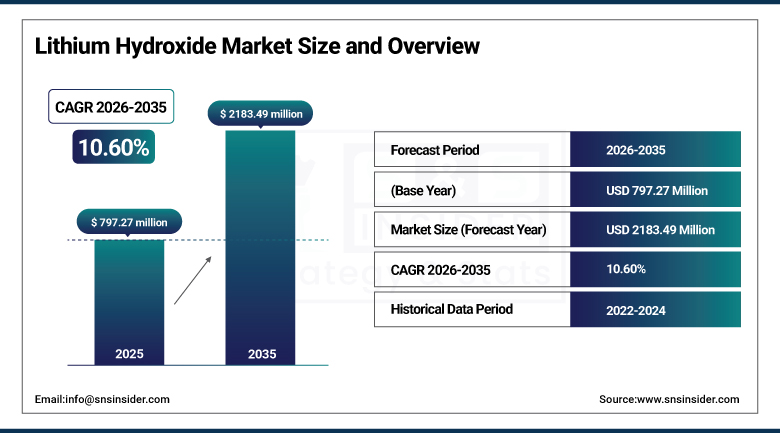
The Lithium Hydroxide Market was valued at USD 797.27 Million in 2025 and is expected to reach USD 2,183.49 Million by 2035, growing at a CAGR of 10.60% from 2026 to 2035.
Lithium hydroxide is a strongly alkaline inorganic compound with the chemical formula LiOH, commercially produced as both the anhydrous form and the more common monohydrate LiOH·H₂O, an odorless white solid that forms highly alkaline aqueous solutions. This is produced through the metathesis reaction of lithium carbonate with calcium hydroxide or through the electrolysis of lithium chloride solutions at modern direct-conversion lithium hydroxide refining facilities. The compound's commercial significance has been transformed over the past decade from a specialty industrial chemical used primarily in lubricating grease thickening, glass and ceramics manufacturing, and submarine atmosphere management to the most strategically important lithium compound for electric vehicle battery cathode material production. A positioning shift driven by the battery chemistry innovation of high-nickel nickel-manganese-cobalt and nickel-cobalt-aluminium cathode formulations.
SQM signed a multi-year lithium hydroxide supply agreement with Ford in late 2023 covering over 35,000 metric tons of battery-grade hydroxide annually starting 2025, the scale of which represents approximately 5 percent of global battery-grade lithium hydroxide production capacity and reflects Ford's strategic commitment to securing lithium hydroxide supply for its North American battery manufacturing programme. Syensqo and Cylib announced in July 2025 a milestone achievement in circular battery materials processing by successfully producing high-purity lithium hydroxide from spent EV batteries through a hydrometallurgical recycling process, demonstrating that battery-grade lithium hydroxide can be recovered from end-of-life battery materials at purity specifications meeting cathode precursor manufacturing requirements, creating a sustainable secondary supply chain.
To Get more information on Pepper Spray Market - Request Free Sample Report
Lithium Hydroxide Market Trends
-
Battery-grade lithium hydroxide demand is rising with the adoption of high-nickel EV battery chemistries.
-
Regional lithium refining capacity is expanding to strengthen localized battery supply chains.
-
New refining projects are increasing global battery-grade lithium hydroxide production capacity.
-
Lithium recycling is emerging as a sustainable secondary source for battery-grade lithium hydroxide.
-
Solid-state battery development is creating future demand for ultra-high-purity lithium hydroxide.
The U.S. Lithium Hydroxide Market Outlook
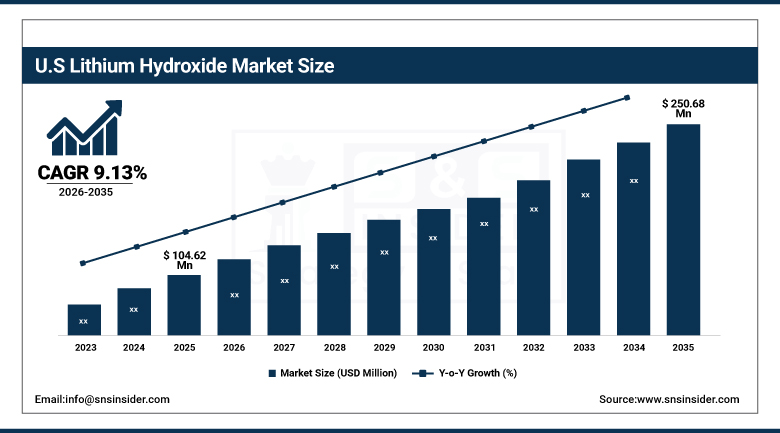
The U.S. Lithium Hydroxide Market was valued at approximately USD 104.62 Million in 2025 and is expected to reach approximately USD 250.68 Million by 2035, growing at a CAGR of approximately 9.13%.
The United States lithium hydroxide market is undergoing the most concentrated domestic capacity development investment in the compound's commercial history, driven by the Inflation Reduction Act's clean vehicle tax credit provisions whose advanced manufacturing production credit and critical mineral sourcing requirements create commercial incentives for domestic lithium hydroxide refining capacity that reduce the domestic battery supply chain's dependence on imported processed material. Albemarle Corporation's Kings Mountain, North Carolina spodumene lithium resource and associated hydroxide conversion facility development, Livent Corporation's (now Arcadium Lithium) Pennsylvania hydroxide production, and Piedmont Lithium's North Carolina resource development each represent components of the emerging domestic lithium hydroxide supply chain.
Albemarle Corporation expanded its lithium hydroxide production capacity by approximately 27 percent in 2024 across its global operations, including investments at its Kemerton lithium hydroxide refinery in Western Australia and U.S. facility development in preparation for the North Carolina lithium resource development programme. Livent Corporation's strategic collaboration with Tesla, disclosed in September 2023, secured a stable battery-grade lithium hydroxide supply for Tesla's battery production through 2030, with the agreement providing Tesla with supply certainty for high-nickel cathode battery production and Livent with revenue visibility supporting its capacity expansion investment. The collaboration reflected the broader pattern of EV manufacturer vertical integration into battery raw material supply that characterizes the post-2022 EV supply chain strategy of major OEMs.
Lithium Hydroxide Market Segment Analysis
-
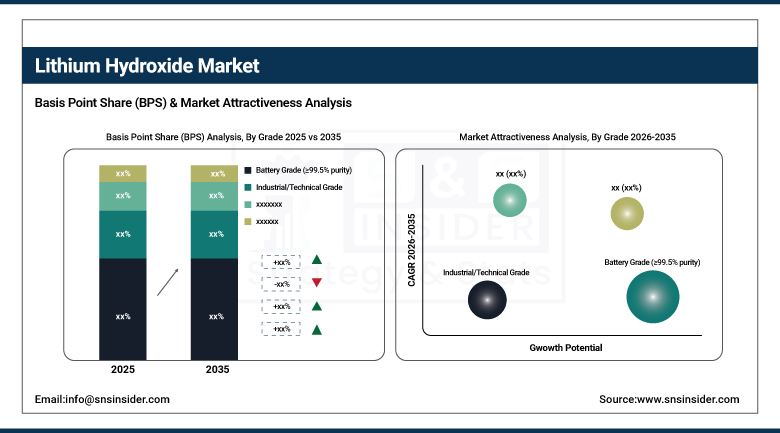
By Grade, the battery grade segment dominated the lithium hydroxide market with over 80.00% share in 2025, while the industrial/technical grade segment serves niche applications including lubricating greases and ceramics.
-
By Form, the lithium hydroxide monohydrate segment dominated the lithium hydroxide market in 2025, while the anhydrous form is growing in applications requiring the lowest moisture content.
-
By Application, the lithium batteries segment dominated the lithium hydroxide market with approximately 72.00% share in 2025, while the energy storage systems sub-segment is growing fastest at over 15.00% CAGR during 2026 to 2035.
-
By End Use Industry, the transportation/automotive segment dominated the lithium hydroxide market in 2025, while the energy storage & power segment is growing fastest.
By Grade, battery grade dominates overwhelmingly
Battery grade lithium hydroxide retained the dominant position with over 80.00% of Lithium Hydroxide market revenue in 2025, reflecting the structural coupling between global EV production growth and high-nickel cathode chemistry adoption whose combined demand creates the largest and fastest-growing application for lithium hydroxide at the premium purity specifications battery manufacturers require. Battery grade lithium hydroxide specification requirements, including lithium hydroxide content above 56.5 percent by weight, total impurity content below 300 parts per million including specific heavy metal limits for iron, calcium, potassium, and sulphate whose cathode performance impact drives increasingly stringent quality assurance testing by major cell manufacturers, sustain a price premium above technical grade material that reflects the additional processing, filtration, and quality control investment required for pharmaceutical-equivalent purity at industrial scale.
Industrial and technical grade lithium hydroxide serves the legacy applications of lithium-based lubricating grease thickening, specialty glass and ceramic manufacturing, and industrial chemical synthesis at price points and purity specifications below battery grade whose lower value-add creates competitive pressure on industrial grade producers relative to battery grade converter economics.
By Application, batteries dominate, energy storage grows fastest
Lithium batteries retained the dominant application position with approximately 72.00% of Lithium Hydroxide market revenue in 2025, sustained by the global EV fleet's expansion from approximately 40 million vehicles in 2025 toward over 300 million by 2035 whose proportional battery production volume growth creates directly proportional lithium hydroxide demand growth for each cathode chemistry tonne produced using hydroxide as the lithiation reagent. The passenger EV segment represents the largest single lithium hydroxide demand application through the combination of the largest vehicle production volume and the highest nickel content cathode chemistry adoption rate among vehicle categories whose range performance requirements justify premium high-energy-density battery chemistry investment.
Energy storage systems represent the fastest growing sub-application at a CAGR exceeding 15.00% as grid-scale battery storage deployment for renewable energy integration creates new large-scale NCM battery demand in utility-scale ESS projects whose power and energy density specifications favour high-nickel cathodes over LFP alternatives.
Regional Analysis
|
Region |
Major Country |
Share within Region, 2025 (%) |
|---|---|---|
|
North America |
United States |
82.00% |
|
Europe |
Germany |
27.84% |
|
Asia Pacific |
China |
42.84% |
|
Middle East & Africa |
Chile |
27.84% |
|
Latin America |
Chile |
43.84% |
North America Lithium Hydroxide Market Insights
North America held approximately 16.00% of global lithium hydroxide market revenues in 2025, with significant capacity expansion investment underway. The United States accounts for approximately 82.00% of regional revenue through domestic battery manufacturing investment, Albemarle's and Livent/Arcadium's production operations, and the IRA's critical mineral sourcing incentives driving domestic supply chain development. Lithium hydroxide consumption in the U.S. exceeded 95,000 metric tonnes in 2024, with 82 percent directed toward EV battery production, while government-backed initiatives increased domestic refining capacity by 34 percent between 2022 and 2025.
Get Customized Report as per Your Business Requirement - Enquiry Now
Europe Lithium Hydroxide Market Insights
Lithium Hydroxide revenue was considerable in Europe in 2025. The percentage of Lithium Hydroxide revenue generated by Germany in Europe is about 27.84%, owing to the construction of the automotive battery Gigafactory, which includes lithium hydroxide production facilities at the Volkswagen Salzgitter battery plant and BASF cathode active materials, as well as lithium hydroxide offtake agreements for German Automotive Industry for the production of NCM 811 cathode production capacity. The Cinovec Project in the Czech Republic from European Lithium aims to produce 41,658 tonnes annually.
Asia Pacific Lithium Hydroxide Market Insights
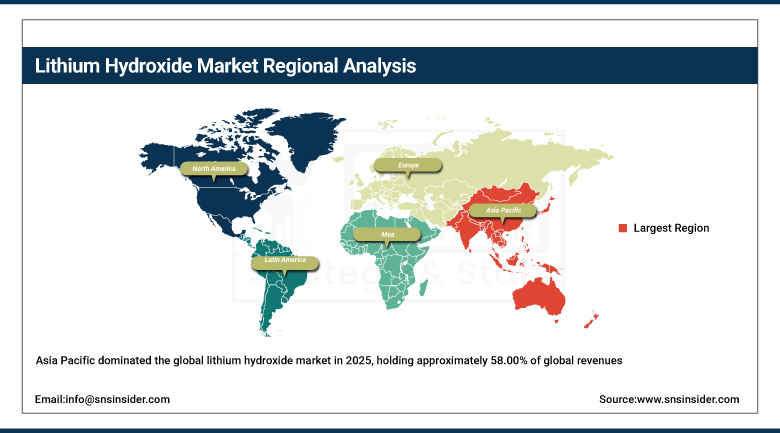
Asia Pacific dominated the global lithium hydroxide market in 2025, holding approximately 58.00% of global revenues through China's world-leading lithium hydroxide conversion capacity, South Korea's cathode active material manufacturing, and Japan's battery production for consumer electronics and hybrid vehicles. China accounts for approximately 42.84% of Asia Pacific revenues through Ganfeng Lithium, Tianqi Lithium, and CITIC Guoan's conversion operations whose combined capacity processed the majority of global lithium hydroxide production. Tianqi's Kwinana Phase II facility and Ganfeng's international refinery investments represent the geographic diversification of Asia Pacific hydroxide production capacity beyond China.
MEA & Latin America Lithium Hydroxide Market Insights
Latin America holds a unique position in the lithium hydroxide market as home to the world's largest lithium brine resources in Chile and Argentina's Lithium Triangle. Chile leads Latin American revenues at approximately 43.84% of the regional total through SQM's and Albemarle's lithium brine production operations in the Atacama Desert whose lithium carbonate and hydroxide conversion represents Latin America's primary contribution to global lithium supply. Argentina is developing its lithium hydroxide conversion capability through LIEX and Lithium Americas' Cauchari-Olaroz project. The Middle East contribution comes through Saudi Arabia and the UAE's strategic investments in battery supply chain assets and chemical processing.
Market Dynamics
Growth Drivers: High-nickel NCM cathode battery chemistry adoption in EVs requiring lithium hydroxide as the preferred lithiation reagent and global EV fleet expansion multiplying total battery cathode production volume.
The technical requirement for lithium hydroxide in high-nickel cathode synthesis arises from the solid-state sintering chemistry of NCM 811 and higher-nickel cathode materials whose lithiation reaction with lithium hydroxide at lower temperatures of 750 to 800 degrees Celsius achieves more complete lithium incorporation and more uniform lithium distribution across cathode particle cross-sections than the lithium carbonate lithiation reaction whose higher required temperatures and CO2 evolution during sintering create porosity and compositional inhomogeneity in high-nickel cathode particles. The consequence of NCM 811 cathode adoption globally is a structural shift in cathode precursor procurement specifications that progressively replaces lithium carbonate in cathode manufacturing supply chains with lithium hydroxide.
This is creating demand growth substantially above the underlying EV production volume growth rate as cathode nickel content transitions from NCM 622 through NCM 811 toward NCM 9 series at each successive cathode chemistry generation.
Restraints: Lithium price cycle volatility creating battery manufacturer procurement risk management complexity and the competing LFP cathode chemistry not requiring lithium hydroxide limiting hydroxide share of total cathode precursor demand.
Lithium hydroxide prices experienced extreme volatility between 2021 and 2024, rising from approximately USD 10,000 per tonne in early 2021 to a peak above USD 80,000 per tonne in late 2022 before declining to below USD 15,000 per tonne in 2024 as new refinery capacity additions outpaced EV demand growth. The price collapse of 2023 to 2024 reduced the profitability of new lithium hydroxide refinery investments whose economic models assumed higher price levels, creating project delays and deferrals at marginal supply capacity that may create future supply tightness as EV demand growth resumes its structural trajectory. Lithium iron phosphate cathode chemistry's resurgence, particularly in Chinese and now Western EV markets where BYD's Blade Battery LFP and Tesla's LFP standard range variants demonstrate competitive performance at lower cost than high-nickel alternatives.
This represents a competing cathode trajectory that does not require lithium hydroxide and whose growing market share moderates the pace of lithium hydroxide demand growth relative to total EV battery production growth.
Opportunities: Battery recycling secondary lithium hydroxide recovery and lithium hydroxide refining capacity development in North America and Europe to serve IRA and EU Battery Regulation local sourcing requirements represent growth opportunities.
Closed-loop battery recycling programmes that recover lithium as battery-grade lithium hydroxide from hydrometallurgical processing of spent EV battery black mass create a secondary supply source whose economic value increases proportionally with both the expanding global EV fleet size and the lithium hydroxide price, aligning recycler profitability with market conditions that make primary mined production attractive. The IRA's advanced manufacturing production credit for critical mineral processing, which provides USD 35 per kilogram for battery-grade lithium hydroxide produced domestically from qualifying sources, creates a structural cost subsidy for domestic U.S. hydroxide refining whose value at scale of USD 35,000 per tonne substantially improves the economics of new domestic refinery construction versus the unsubsidized cost structure of imported material.
Recent Developments:
-
2025: Syensqo and Cylib successfully produced high-purity lithium hydroxide from spent EV batteries through hydrometallurgical recycling, achieving battery-grade purity specifications and demonstrating the commercial viability of secondary lithium hydroxide recovery as a circular battery supply chain element.
-
2025: Albemarle Corporation expanded lithium hydroxide production capacity by approximately 27% across global operations including the Kemerton refinery in Western Australia, while advancing its Kings Mountain North Carolina lithium resource development programme targeting domestic U.S. battery-grade hydroxide supply.
-
2024: European Lithium commissioned its Cinovec battery-grade lithium hydroxide plant in the Czech Republic, the first fully operational hydroxide facility within EU borders, and European Metals announced a 42% production increase plan targeting 41,658 tonnes annually to support the EU's domestic battery supply chain development.
Lithium Hydroxide Market Key Players are:
-
Albemarle Corporation
-
SQM (Sociedad Química y Minera de Chile)
-
Ganfeng Lithium Co. Ltd. (Jiangxi Ganfeng)
-
Tianqi Lithium Corporation
-
Arcadium Lithium PLC (Livent/Allkem merger)
-
Pilbara Minerals Ltd.
-
Nemaska Lithium Inc. (Livent JV)
-
CITIC Guoan Information Industry Co.
-
American Battery Technology Company (ABTC)
-
Piedmont Lithium Inc.
-
Lithium Americas Corp.
-
Sigma Lithium Corporation
-
FMC Lithium (Arcadium)
-
Koch Industries Inc.
-
Compass Minerals International Inc.
-
Core Lithium Ltd.
-
Cypress Development Corp.
-
European Lithium Ltd.
-
Liex SRL (Argentina)
-
Ioneer Ltd.
Lithium Hydroxide Market Report Scope:
| Report Attributes | Details |
|---|---|
| Market Size in 2025 | USD 797.27 Million |
| Market Size by 2035 | USD 2.18 Billion |
| CAGR | CAGR of 10.60% From 2026 to 2035 |
| Base Year | 2025 |
| Forecast Period | 2026-2035 |
| Historical Data | 2022-2024 |
| Report Scope & Coverage | Market Size, Segments Analysis, Competitive Landscape, Regional Analysis, DROC & SWOT Analysis, Forecast Outlook |
| Key Segments | • By Grade (Battery Grade (≥99.5% purity), Industrial/Technical Grade) • By Form (Lithium Hydroxide Monohydrate (LiOH·H₂O), Anhydrous Lithium Hydroxide (LiOH)) • By Application (Lithium Batteries, Lubricating Greases, Glass & Ceramics, Air Purification/CO₂ Scrubbers, Others) • By End Use Industry (Transportation/Automotive, Consumer Electronics, Energy Storage & Power, Nuclear, Chemical & Industrial, Others) |
| Regional Analysis/Coverage | North America (US, Canada), Europe (Germany, UK, France, Italy, Spain, Russia, Poland, Rest of Europe), Asia Pacific (China, India, Japan, South Korea, Australia, ASEAN Countries, Rest of Asia Pacific), Middle East & Africa (UAE, Saudi Arabia, Qatar, South Africa, Rest of Middle East & Africa), Latin America (Brazil, Argentina, Mexico, Colombia, Rest of Latin America). |
| Company Profiles | Albemarle Corporation, SQM (Sociedad Química y Minera de Chile), Ganfeng Lithium Co. Ltd. (Jiangxi Ganfeng), Tianqi Lithium Corporation, Arcadium Lithium PLC (Livent/Allkem merger), Pilbara Minerals Ltd., Nemaska Lithium Inc. (Livent JV), CITIC Guoan Information Industry Co., American Battery Technology Company (ABTC), Piedmont Lithium Inc., Lithium Americas Corp., Sigma Lithium Corporation, FMC Lithium (Arcadium), Koch Industries Inc., Compass Minerals International Inc., Core Lithium Ltd., Cypress Development Corp., European Lithium Ltd., Liex SRL (Argentina), and Ioneer Ltd. |
Frequently Asked Questions
The battery grade segment dominated the Lithium Hydroxide Market with over 80.00% share in 2025.
The Lithium Hydroxide Market is expected to grow at a CAGR of 10.60% from 2026 to 2035.
The Lithium Hydroxide Market was valued at USD 797.27 Million in 2025.
The primary growth factors are high-nickel NCM and NCA cathode chemistry adoption in EV batteries requiring lithium hydroxide as the technically preferred lithiation reagent over lithium carbonate, global EV fleet expansion multiplying total cathode production volume.
Asia Pacific dominated the Lithium Hydroxide Market in 2025, holding approximately 58.00% of global revenues.
