
Magnesium Oxide Board Market Report Scope & Overview:
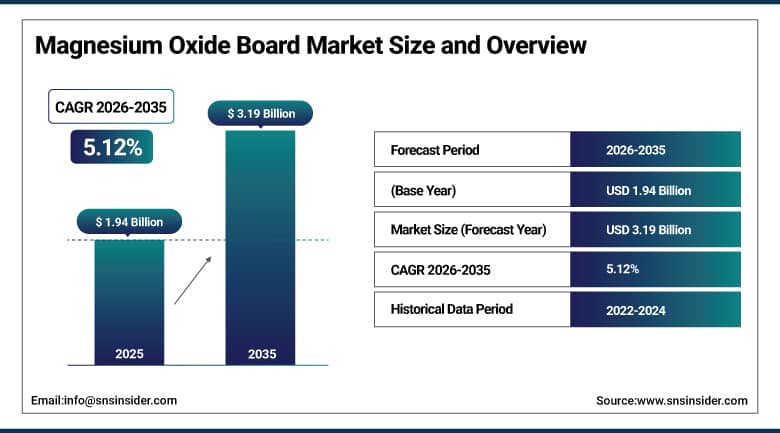
The Magnesium Oxide Board Market was valued at USD 1.94 Billion in 2025 and is anticipated to climb to USD 2.04 Billion in 2026 and USD 3.19 Billion by 2035, registering a CAGR of 5.12% over 2026–2035. Magnesium oxide board is a mineral panel made from magnesium oxide, a magnesium salt binder and reinforcing fibers, and it is used for walls, ceilings, floors, roofing and fire-rated assemblies. Builders choose it because it resists fire, moisture, mold and insects without the paper facing found on gypsum board. It is also lighter than cement board.
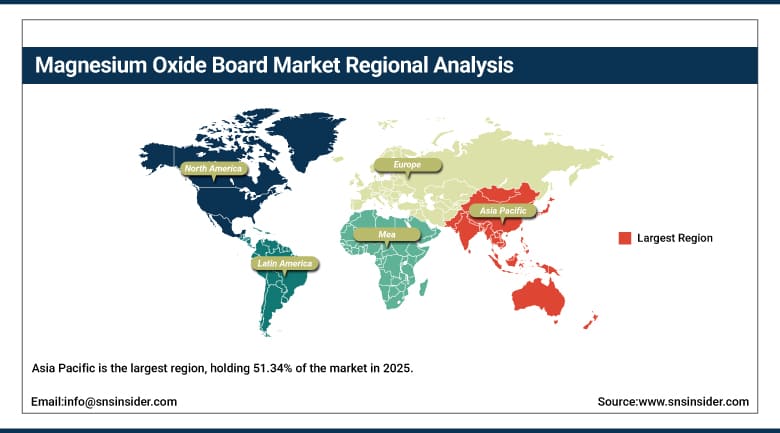
Asia Pacific accounted for the largest share of the market, at 51.34% in 2025, because China hosts most of the magnesite reserves worldwide and board lines, and because construction activity across the region remains high. North America is the second largest region, followed by Europe, Middle East and Africa and Latin America. Europe is the fastest growing region, as stricter fire safety rules and energy efficiency targets steer designers toward mineral boards. Government housing programs and a rising pool of certified installers support the expansion in most regions, while import dependence limits adoption in smaller markets.
To Get More Information On Magnesium Oxide Board Market - Request Free Sample Report
Key Report Takeaways
-
By product type, thin boards lead the market in 2025, while medium boards are the fastest growing.
-
By application, residential construction leads the market in 2025, while commercial buildings are the fastest growing.
-
By region, Asia Pacific held a 51.34% share in 2025, while Europe is the fastest growing.
Market Trends and Insights
Fire performance is becoming the main selling point. Building codes in several countries now require non-combustible linings in high-rise, healthcare and school projects, and fire-rated wall and ceiling assemblies that use a single layer of mineral board save labor on site. Manufacturers are publishing tested assemblies and obtaining third-party evaluations so that designers and inspectors can approve the product without extra review.
Product quality is also improving. Early boards that used chloride binders drew complaints about surface moisture and corrosion of metal fasteners, and many producers have moved to sulfate formulations, tighter curing control and sealed surfaces. Factory-applied weather barriers and pre-cut sizes are appearing, which shortens installation time and widens the use of the board in exterior sheathing.
Supply is spreading beyond China. Startups and established building product groups are opening board lines in North America and Europe, driven by tariff exposure, shipping costs and buyer interest in local sourcing. Prefabricated and modular builders are adopting mineral boards for panelized walls, and green building programs increasingly credit materials that last longer and avoid organic content that can burn or rot.
Drivers Impact Analysis
|
Driver |
(~) Percentage Point Impact on Market CAGR |
Geographic Relevance |
Impact Timeline |
|---|---|---|---|
|
Stricter fire safety and building code requirements |
+2.31% |
Europe, North America and Asia Pacific |
Long term (4 years or more) |
|
Moisture, mold and pest resistance in humid climates |
+1.74% |
Asia Pacific, Middle East and Africa and Latin America |
Medium term (2 to 4 years) |
|
Growth in residential and commercial construction |
+1.32% |
Asia Pacific and North America |
Short term (2 years or less) |
|
Prefabrication and modular building |
+0.68% |
North America and Europe |
Medium term (2 to 4 years) |
|
Green building programs and energy efficiency goals |
+0.47% |
Europe and North America |
Long term (4 years or more) |
Stricter Fire Safety and Building Code Requirements
Fires in tall residential blocks and public buildings have led regulators in many countries to tighten rules on combustible linings and cladding. Magnesium oxide board is classified as non-combustible in many test systems and does not release harmful fumes at normal fire temperatures, which makes it an easy choice for stairwells, corridors, shafts and partitions that need rated protection. Insurers also favor buildings that use fire-resistant materials, and that preference supports specifications even where codes do not strictly demand the product. Lower repair costs add to the case.
Moisture, Mold and Pest Resistance in Humid Climates
Gypsum board with a paper facing absorbs water and supports mold, so builders in tropical and coastal regions look for alternatives for bathrooms, kitchens, basements and exterior sheathing. Magnesium oxide board stays dimensionally stable when wet, resists termites and rot, and can be finished with tiles, paint or plaster. Storm and flood damage in recent years has increased interest in materials that dry out and can be reused after wetting, which benefits both new construction and repair work. Repair crews also appreciate quick drying.
Growth in Residential and Commercial Construction
Urban population growth, housing shortages and office, retail and hospitality projects keep demand for wall and ceiling boards strong, especially across Asia Pacific. Governments are funding affordable housing and infrastructure, and renovation of older buildings requires large volumes of lining and flooring panels. Mineral boards compete with gypsum, cement board and plywood in these projects, and their combination of fire, water and impact resistance lets them win specifications in demanding rooms and exposed locations. Fast, clean installation also appeals to landlords refitting occupied buildings.
Prefabrication and Modular Building
Factory-built wall panels, modular rooms and structural insulated panels need boards that are stable, strong and quick to fix. Magnesium oxide board can be cut, bonded and laminated to insulation cores, and it provides fire protection without extra layers. Developers use off-site building to cut schedules and labor costs, and the share of prefabricated housing is rising in North America, Europe and parts of Asia. Board makers are working with panel fabricators on tailored sizes and surfaces. Training programs from board makers help fabricators adopt it.
Green Building Programs and Energy Efficiency Goals
Green building rating systems reward durable, low-maintenance and recyclable materials, and magnesium oxide board can be made with lower process emissions than cement-based panels when magnesium compounds are produced at moderate temperatures. Long service life reduces replacement waste, and the absence of formaldehyde binders helps indoor air quality. Energy codes that call for airtight, well-insulated envelopes also increase demand for sheathing that holds coatings and sealants over decades without swelling. Product declarations from manufacturers make such claims easier to document for project teams.
Restraints Impact Analysis
|
Restraint |
(~) Percentage Point Impact on Market CAGR |
Geographic Relevance |
Impact Timeline |
|---|---|---|---|
|
Binder chemistry issues and quality inconsistency |
-0.62% |
Global |
Short term (2 years or less) |
|
Competition from gypsum, cement and fiber cement boards |
-0.41% |
Global |
Long term (4 years or more) |
|
Limited awareness, codes and installer experience |
-0.22% |
North America and Europe |
Medium term (2 to 4 years) |
|
Raw material and logistics cost swings |
-0.15% |
Asia Pacific and Europe |
Medium term (2 to 4 years) |
Binder Chemistry Issues and Quality Inconsistency
Boards made with magnesium chloride can attract moisture from the air, form surface droplets and corrode nails, screws and metal studs if the formula or curing is poor. Producers that have not controlled raw material purity and mixing ratios have shipped panels with weak strength or warping, and some buyers still associate the product with those failures. Sulfate and improved chloride boards address the problem, yet the history makes architects and builders cautious and leads them to demand test reports and warranties before approving a supplier.
Competition from Gypsum, Cement and Fiber Cement Boards
Gypsum board is cheap, familiar and made in nearly every region, and fiber cement and cement board hold strong positions in exterior and wet area applications. Contractors prefer products they already know how to cut, fasten and finish, and distributors stock the established brands first. Magnesium oxide board usually costs more per square foot than gypsum, so it tends to be chosen only where its extra performance is required, which limits volume in standard residential walls. Price gaps narrow only at larger volumes.
Limited Awareness, Codes and Installer Experience
In several Western markets the product lacks a long record of use, and building officials may ask for extra evaluation reports before accepting it. Installers need guidance on fasteners, joint treatment, storage and coating systems that differ from gypsum practice. Where training is missing, installation errors can create callbacks that damage the reputation of the whole category. Industry groups are publishing guides and testing standards, but progress is gradual and uneven across states and countries. Pilot projects are often needed first.
Raw Material and Logistics Cost Swings
The product depends on magnesite or magnesium compounds, magnesium salts, wood fibers or perlite, and glass fiber mesh, and the cost of each can move with mining policy, energy prices and freight rates. Environmental inspections in major producing areas can interrupt mine and kiln output. Boards are heavy and bulky, so long-distance shipping adds a large share of delivered cost. Buyers outside Asia therefore face price swings and delivery delays that can push them back to local alternatives. Brokers add margins on small orders.
Magnesium Oxide Board Segment Analysis
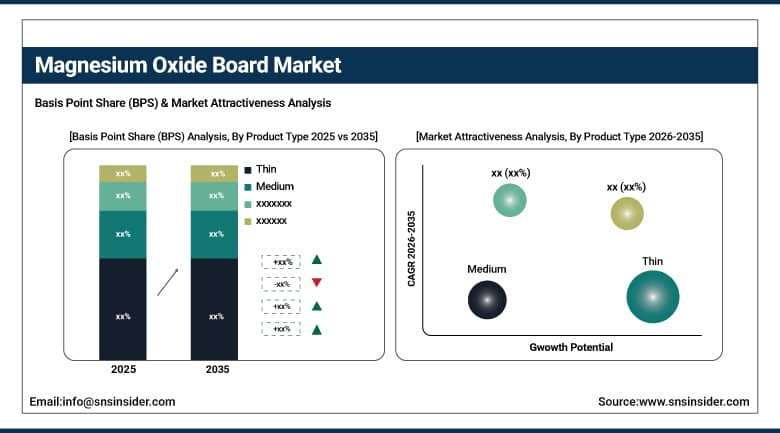
By Product Type, Thin Boards Dominate Magnesium Oxide Board Market; Medium Boards to Register Fastest Growth.
Thin boards, below 8 mm, lead the product type axis in 2025. They serve as ceiling panels, wall linings, partitions and decorative surfaces, where light weight, easy handling and quick finishing matter most. Their lower material use keeps price per sheet attractive, and they can be cut on site with simple tools. High volumes in interior fit-out and renovation across Asia Pacific keep this class the largest. Distributors keep stocks, so contractors can collect sheets quickly for fast moving jobs.
Medium boards, between 8 and 15 mm, are expected to register the fastest growth, at a CAGR of 5.91% during 2026–2035. This thickness suits wall sheathing, subflooring, fire-rated partitions and structural insulated panel facings, where load capacity and fastener holding are needed. Rising use in prefabricated and fire-rated assemblies in North America and Europe supports demand, and manufacturers are broadening certified product lines in this range. Fabricators of modular wall systems also place bulk orders for this class regularly.
By Application, Residential Dominates Magnesium Oxide Board Market; Commercial to Register Fastest Growth.
Residential construction leads the application axis in 2025. Houses, apartments and townhomes use the board for interior walls, ceilings, bathrooms, flooring underlayment and exterior sheathing, and demand is large because dwelling counts keep rising in urban areas. Families and builders value moisture resistance and fire safety, while developers in Asia Pacific and the Middle East use the board in mid-rise housing blocks and affordable housing schemes. Their strength and fire protection justify the price premium over plain gypsum board.
Commercial buildings are projected to register the fastest growth, at a CAGR of 5.68% over 2026–2035. Offices, hotels, hospitals, schools and retail centers require rated partitions, shafts and ceilings, and owners care about durability and low maintenance. Stricter egress and fire rules for public buildings make non-combustible boards more attractive, and renovation of older commercial stock adds a steady stream of fit-out orders. Leading hotel and hospital operators often write mineral board into their design standards, giving suppliers repeat orders.
Geography Analysis
|
Region |
Major Country |
Share within Region, 2025 (%) |
|---|---|---|
|
Asia Pacific |
China |
52.60% |
|
Europe |
Germany |
21.35% |
|
North America |
United States |
86.40% |
|
Middle East and Africa |
Saudi Arabia |
31.20% |
|
Latin America |
Brazil |
47.80% |
Asia Pacific Magnesium Oxide Board Market
Asia Pacific is the largest region, holding 51.34% of the market in 2025. China dominates supply because it holds large magnesite deposits in Liaoning and has built a dense network of board factories that serve both local builders and export buyers. Japan, South Korea, India and Southeast Asian countries add demand through housing, commercial projects and fire safety upgrades, and humid conditions favor moisture-resistant boards. Public infrastructure spending and private investment in commercial towers keep order books full for board makers across the region.
India is a growing user as smart city, affordable housing and metro station projects specify fire-rated lining materials. Australia is a smaller but demanding market with strict bushfire and wet area standards. Producers in the region compete on price and shipping reach, while the better firms invest in quality control, third-party testing and branded distribution to win projects outside China. Exporters ship boards to Europe, the Middle East and North America, and several have obtained international certificates to meet foreign buyer requirements. Consolidation among smaller plants is also underway.
Get Customized Report as Per Your Business Requirement - Enquiry Now
Europe Magnesium Oxide Board Market
Europe held 20.67% of the market in 2025 and is the fastest growing region, with a projected CAGR of 5.88% during 2026–2035. Fire safety reforms after tall building fires, strict energy performance rules and a strong culture of dry construction are steering specifiers toward mineral boards. Germany leads regional demand, supported by timber frame, prefabrication and renovation activity, while France, Italy and the Nordic countries also adopt the product. Prefabricated timber systems in the Nordic region and Germany are also important buyers.
The United Kingdom has tightened rules on external wall materials, which helps non-combustible sheathing. Eastern Europe supplies raw magnesite and some finished boards, and Turkey acts as a link between producers and buyers. Environmental product declarations and recycled content are becoming common selection criteria, which rewards producers that can document low emissions. Distributors in France and Italy increasingly stock fire-rated panels for retrofit contractors, and architects favor boards that offer long service life, low maintenance and straightforward recycling at the end of building life.
North America Magnesium Oxide Board Market
North America accounted for 21.82% of the market in 2025. The United States market was valued at USD 0.37 Billion in 2025 and is projected to register a CAGR of 4.97% during 2026–2035. Demand comes from hurricane and wildfire prone states, where builders want boards that resist wind-driven water and embers, and from multifamily projects that need fire-rated walls with fewer layers. Dealers in Texas, Florida and the Carolinas stock mineral sheathing for coastal projects, and insurers in storm exposed areas increasingly reward resilient wall systems.
Canada adds demand through cold climate housing and modular construction, where panelized walls are built in factories. Imports from Asia still supply a large part of the volume, but new local board lines are being set up to cut tariff and freight exposure. Builders and code officials are growing more familiar with tested assemblies, which is expected to widen use beyond specialty projects. Public agencies and school districts are also writing non-combustible lining requirements into project specifications, which gives tested products an advantage in bid evaluations.
Middle East and Africa Magnesium Oxide Board Market
Middle East and Africa accounted for 4.28% of the market in 2025. Gulf countries lead demand through large hotel, residential tower, airport and mixed-use developments, where fire regulations are strict and heat and humidity favor durable boards. Saudi Arabia and the United Arab Emirates import most of their boards from Asian suppliers. Airports, stadiums, hospitals and tourism complexes under development in the region require rated linings, and project owners commonly insist on internationally tested products supplied with full technical documentation.
South Africa has local building material makers and a growing interest in fire-resistant systems, while East and West Africa are early markets driven by urban housing. Limited installer training, import dependence and currency swings restrain adoption, but mega projects and new building codes are expected to raise volumes over the forecast period. Government housing programs in Egypt, Morocco and Nigeria also create an opening for lightweight boards that can be installed quickly by trained crews, though price remains a deciding factor for many buyers.
Latin America Magnesium Oxide Board Market
Latin America held 1.89% of the market in 2025. Brazil leads the region on the back of a large housing sector, commercial development and an established dry construction industry that is moving away from masonry in some segments. Chile, Colombia and Argentina add smaller volumes, with seismic design requirements favoring light, strong panels. Merchants in São Paulo and Rio de Janeiro have started to carry mineral boards next to gypsum, and developers value their performance in damp coastal districts and on exposed balconies.
Mexico and Central America use boards in tourism developments, where humidity and salt air damage conventional materials. Import duties, currency changes and limited local production keep prices high, so the market remains small, yet interest from developers of resorts, hospitals and industrial buildings is expected to support gradual expansion. Mining and industrial facilities in Chile and Peru also need rated and moisture tolerant linings for control rooms and accommodation blocks, which adds specialty orders for suppliers with technical support teams in the region.
Competitive Landscape
The Magnesium Oxide Board Market is fragmented, with many Chinese factories supplying low-cost boards in large volumes and a smaller group of branded firms in North America, Europe and Asia competing on certified quality, fire-rating documentation and technical support. Large building products groups sell select mineral boards alongside gypsum and cement lines, while startups focus on local production and tested assemblies.
Competition depends on binder chemistry, consistency, price, code approvals and distribution reach. Firms are investing in sulfate formulations, factory-applied coatings and pre-cut sizes, and several are building plants closer to end users to avoid freight and tariffs. Over the forecast period, certification, local supply and installer training are expected to separate leading suppliers from the rest.
Magnesium Oxide Board Industry Leaders
1. DuPont
3. US MGO
4. DragonBoard USA
Companies Covered in this Report
-
DuPont
-
Jiashan Jiafeng Decorative Materials Co., Ltd.
-
Jiangsu Jinpeng Fireproof Board Co., Ltd.
-
Jiangsu Yunxi Decoration Material Co., Ltd.
-
Shandong Weiran Building Materials Co., Ltd.
-
Shandong Oushibao New Materials Co., Ltd.
-
Sulfycor New Materials Co., Limited
-
Oriental Construction Material Industry Co., Ltd. (OCM)
-
Dart MGO Panel
-
Huber Engineered Woods LLC
-
US MGO Company
-
Dragonboard USA
Recent Industry Developments
-
January 2025: US MGO announced its first magnesium oxide sheathing panel plant in Wilmington, North Carolina, with a larger campus planned in Brunswick County.
-
February 2026: DuPont returned its ArmorBoard Plus fire-rated structural sheathing, a magnesium oxide board with a factory-applied air and water barrier, to its product range.
Scope and Research Methodology
This study sizes the Magnesium Oxide Board Market for 2025 and forecasts it to 2035. The scope covers rigid boards made from magnesium oxide, a magnesium chloride or sulfate binder and reinforcing fibers or mesh, sold for wall, ceiling, floor, roof and sheathing uses, measured as manufacturer sales value in USD. Gypsum board, cement board, fiber cement board, calcium silicate board and raw magnesium compounds are excluded. Values are reported on a calendar year basis, and trade is allocated to the country of production. The historical period covers 2021 to 2024 and the forecast period covers 2026 to 2035.
Research began with a review of construction statistics, magnesite production and trade data, building code documents, product certifications, company announcements and industry association reports. Demand was built from the bottom up using board output, installed capacity and price by thickness, and it was cross-checked from the top down using floor area completed and the share of mineral boards in wall and ceiling systems. Segment and regional shares were set from construction mix, fire regulation and trade flows in each geography. Board prices were reviewed by thickness and binder type to convert output volume into revenue, and constant exchange rates were used to remove currency effects from the series. Assumptions were documented for each major country.
Findings were validated through discussions with board makers, distributors, builders, architects and fire engineers, and the forecast was tested under scenarios for construction activity, code changes, raw material cost and tariff policy. Growth rates reflect expected adoption in fire-rated and prefabricated assemblies. Values are expressed in USD, rounded to two decimals, and the analysis is refreshed when major market or policy changes occur. Estimates for each region were checked against national production and trade statistics where available, and adjustments were made for imported and exported boards. Results are reviewed periodically.
Magnesium Oxide Board Market Report Scope:
| Report Attributes | Details |
|---|---|
| Market Size in 2025 | USD 1.94 Billion |
| Market Size by 2035 | USD 3.19 Billion |
| CAGR | CAGR of 5.12% From 2026 to 2035 |
| Base Year | 2025 |
| Forecast Period | 2026-2035 |
| Historical Data | 2022-2024 |
| Report Scope & Coverage | Market Size, Segments Analysis, Competitive Landscape, Regional Analysis, DROC & SWOT Analysis, Forecast Outlook |
| Key Segments | • By Product Type (Thin, Medium, and Thick) • By Application (Residential, Commercial, and Industrial) |
| Regional Analysis/Coverage | North America (US, Canada), Europe (Germany, UK, France, Italy, Spain, Russia, Poland, Rest of Europe), Asia Pacific (China, India, Japan, South Korea, Australia, ASEAN Countries, Rest of Asia Pacific), Middle East & Africa (UAE, Saudi Arabia, Qatar, South Africa, Rest of Middle East & Africa), Latin America (Brazil, Argentina, Mexico, Colombia, Rest of Latin America). |
| Company Profiles | DuPont, Jiashan Jiafeng Decorative Materials Co., Ltd., Jiangsu Jinpeng Fireproof Board Co., Ltd., Jiangsu Yunxi Decoration Material Co., Ltd., Shandong Weiran Building Materials Co., Ltd., Shandong Oushibao New Materials Co., Ltd., Sulfycor New Materials Co., Limited, Oriental Construction Material Industry Co., Ltd. (OCM), Dart MGO Panel, Huber Engineered Woods LLC, US MGO Company, Dragonboard USA. |

Frequently Asked Questions
The market was valued at USD 1.94 Billion in 2025 and is expected to reach USD 2.04 Billion in 2026 and USD 3.19 Billion by 2035.
The market is projected to grow at a CAGR of 5.12% during 2026–2035.
Asia Pacific holds the largest share, at 51.34% in 2025, led by China.
Europe is the fastest growing region, with a projected CAGR of 5.88% during 2026–2035.
Thin boards and residential construction lead, while medium boards and commercial buildings grow fastest.
