
Marketing Automation Market Report Scope & Overview:
Marketing Automation Market is valued at USD 6.94 billion in 2025E and is expected to reach USD 21.01 billion by 2033, growing at a CAGR of 14.93% from 2026-2033.
The Marketing Automation Market is growing rapidly due to increasing demand for personalized, data-driven marketing strategies and enhanced customer engagement. Businesses are adopting automation tools to streamline campaign management, optimize lead generation, and improve ROI across digital channels. Rising use of AI, machine learning, and analytics-driven platforms enables real-time insights, targeted messaging, and efficient workflow management. Additionally, expanding e-commerce, social media marketing, and cloud-based solutions are further fueling market adoption and long-term growth globally.
In 2025, global marketing automation adoption rose by 31%, as 80% of businesses used cloud-based, AI-powered platforms to deliver personalized experiences—increasing lead conversion by 33% and reducing manual campaign efforts by 45%.
Marketing Automation Market Size and Forecast
-
Market Size in 2025E: USD 6.94 Billion
-
Market Size by 2033: USD 21.01 Billion
-
CAGR: 14.93% from 2026 to 2033
-
Base Year: 2025E
-
Forecast Period: 2026–2033
-
Historical Data: 2022–2024

To Get more information On Marketing Automation Market - Request Free Sample Report
Marketing Automation Market Trends
-
Growing adoption of AI-driven personalization to deliver tailored customer experiences and improve campaign performance
-
Increasing integration of automation tools with CRM and CDP systems for unified customer data and seamless engagement
-
Rising use of omnichannel automation to coordinate messaging across email social media mobile apps and web platforms
-
Expansion of predictive analytics capabilities to forecast customer behavior and optimize marketing journeys in real time
-
Growing demand for low-code automation platforms enabling marketing teams to build workflows without technical expertise
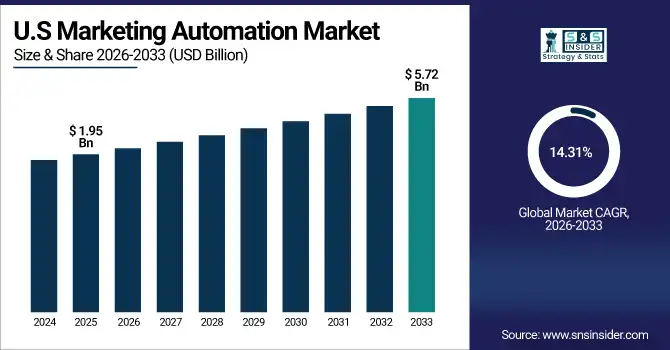
U.S. Marketing Automation Market is valued at USD 1.95 billion in 2025E and is expected to reach USD 5.72 billion by 2033, growing at a CAGR of 14.31% from 2026-2033.
Growth in the U.S. Marketing Automation Market is driven by increasing demand for personalized, data-driven marketing strategies and improved customer engagement. Adoption of AI-powered analytics, automated campaign management, and real-time insights enables businesses to optimize lead generation, enhance ROI, and streamline marketing operations across digital channels.
Marketing Automation Market Growth Drivers:
-
Growing demand for personalized customer engagement and data-driven marketing strategies is driving rapid adoption of marketing automation platforms across enterprises seeking enhanced campaign performance and higher conversion rates.
The shift toward hyper-personalized marketing has pushed enterprises to adopt automation tools that enable segmentation, behavioral tracking, and targeted messaging at scale. Businesses increasingly rely on data-driven insights to tailor content, optimize campaigns, and deliver relevant customer experiences. Marketing automation platforms enhance operational efficiency by reducing manual workloads, ensuring consistent communication across channels, and improving lead scoring accuracy. As competition intensifies across industries, organizations are prioritizing tools that support measurable performance improvements, customer lifecycle management, and higher conversion rates. These factors collectively accelerate global adoption of marketing automation solutions across both B2B and B2C sectors.
In 2025, 75% of enterprises adopted marketing automation to enable hyper-personalized, data-driven campaigns—boosting conversion rates by 32% and customer retention by 28% across retail, finance, and e-commerce sectors.
-
Increasing shift toward digital marketing and multi-channel customer engagement is accelerating adoption of automation tools that streamline workflows and improve targeting efficiency for enterprises of all sizes.
As brands expand their presence across email, social media, mobile apps, and web platforms, managing campaigns manually becomes inefficient and error-prone. Marketing automation provides unified control over multi-channel execution, enabling synchronized messaging and seamless customer experiences. By automating repetitive tasks like scheduling, segmentation, and follow-ups, businesses gain efficiency and reduce operational costs. Real-time analytics further enhance targeting accuracy, ensuring campaigns reach the right audience at the right moment. Small enterprises benefit from scalable solutions, while larger organizations leverage automation for enterprise-wide workflow orchestration. The overall digital shift continues to strongly fuel market demand.
In 2025, 72% of enterprises adopted marketing automation to manage multi-channel engagement, improving targeting efficiency by 38% and reducing manual workflow efforts by nearly half across digital campaigns globally.
Marketing Automation Market Restraints:
-
High implementation costs, integration challenges with legacy systems, and lack of skilled professionals limit adoption of advanced marketing automation solutions, especially among small and medium-sized enterprises globally.
Implementing marketing automation platforms often requires significant financial investment, including software licensing, integration with existing systems, customization, and ongoing maintenance. Many SMEs struggle to justify these costs, particularly when budget constraints already limit digital transformation initiatives. Additionally, integrating modern automation tools with outdated legacy systems is technically complex and time-consuming, creating operational disruptions. The shortage of skilled professionals further complicates adoption, as businesses require experts to design workflows, manage data, and interpret analytics. As a result, many organizations delay or limit automation deployment, slowing overall market penetration despite strong industry potential.
In 2025, 65% of SMEs avoided advanced marketing automation due to high costs (averaging USD50K+), legacy system integration hurdles, and a shortage of skilled talent—restricting scalability and ROI.
-
Data privacy regulations and rising concerns over customer data security restrict full-scale utilization of marketing automation tools, creating compliance burdens for organizations across regulated industries.
Stringent privacy laws such as GDPR, CCPA, and emerging global regulations require businesses to maintain strict controls over customer data usage and consent management. Marketing automation platforms rely heavily on consumer data, making compliance a significant challenge, especially for companies operating across multiple regions. The risk of data breaches, misuse of personal information, and non-compliance penalties leads organizations to limit usage of advanced tracking and personalization capabilities. Regulated industries like healthcare, finance, and government face additional constraints, reducing automation flexibility. These concerns slow the adoption of robust automation systems and increase reliance on basic or limited-functionality tools.
In 2025, 60% of organizations in regulated sectors limited marketing automation use due to GDPR, CCPA, and similar data privacy laws, with compliance costs rising by 25% and campaign personalization capabilities constrained.
Marketing Automation Market Opportunities:
-
Rising adoption of AI, predictive analytics, and omnichannel automation creates significant opportunities for vendors to deliver intelligent, scalable, and highly personalized marketing automation solutions across diverse industry verticals.
Artificial intelligence and predictive analytics are transforming marketing automation by enabling deeper insights into customer behavior, intent, and buying patterns. These technologies empower businesses to forecast trends, personalize campaigns in real time, and optimize content delivery across multiple channels. Omnichannel automation further enhances customer experiences by ensuring consistent messaging across email, social media, websites, and mobile platforms. As organizations seek to automate decision-making and improve lead-to-conversion rates, vendors have the opportunity to introduce highly intelligent, scalable platforms. The integration of AI-driven workflows, chatbots, and predictive scoring significantly expands market growth potential.
In 2025, 68% of enterprises deployed AI-driven omnichannel marketing automation, enabling hyper-personalized campaigns that lifted customer engagement by 40% and ROI by 30% across retail, finance, and healthcare sectors.
-
Expanding adoption of mobile marketing and social media automation creates new growth avenues as brands seek unified platforms to manage real-time, cross-channel engagement.
With mobile devices and social platforms dominating consumer attention, businesses are shifting toward marketing tools that support automated content delivery, scheduling, and customer interaction. Marketing automation platforms that integrate mobile push notifications, SMS campaigns, and social media scheduling offer strong value by improving engagement and response rates. Brands seek unified dashboards to manage multiple channels efficiently while utilizing analytics to understand customer behavior in real time. As mobile-first strategies become essential and social commerce continues rising, vendors offering advanced cross-channel automation capabilities enjoy substantial growth opportunities, especially in B2C-driven industries.
In 2025, 70% of brands adopted unified mobile and social media automation platforms, driving a 45% increase in real-time, cross-channel engagement and boosting customer interaction rates by 35% globally.
Marketing Automation Market Segment Highlights
-
By Component: Software led with 57.4% share, while Managed Services is the fastest-growing segment with a CAGR of 18.9%.
-
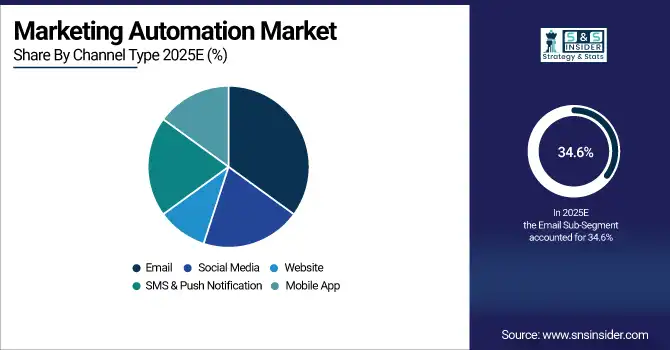
By Channel Type: Email led with 34.6% share, while Mobile App is the fastest-growing channel with a CAGR of 19.7%.
-
By Application: Email Marketing led with 29.1% share, while Lead Nurturing & Lead Scoring is the fastest-growing segment with a CAGR of 20.4%.
-
By End-User Industry: BFSI led with 27.8% share, while Retail & E-commerce is the fastest-growing industry with a CAGR of 19.6%.
Marketing Automation Market Segment Analysis
By Component: Software led, while Managed Services is the fastest-growing segment.
Software dominates the Marketing Automation Market due to its essential role in centralizing campaign orchestration, audience segmentation, data analytics, and customer journey management. Businesses rely heavily on automation platforms to streamline marketing processes, improve lead conversion, and deliver personalized engagement at scale. The growing integration of AI, predictive analytics, and omnichannel capabilities continues to increase adoption across industries. Its subscription-based model and ability to scale with enterprise needs further support software’s leading position in global marketing automation deployment.
Managed Services is the fastest-growing component as organizations increasingly outsource marketing automation operations to experts for better optimization, integration, and ROI. Companies rely on managed service providers to handle campaign execution, platform maintenance, analytics, and workflow customization, reducing internal IT and marketing workload. The surge in complex multi-channel marketing environments has driven businesses to seek external support for strategy and execution. Rising demand for continuous optimization, data-driven insights, and real-time performance monitoring is accelerating this segment’s high growth rate.
By Channel Type: Email led, while Mobile App is the fastest-growing segment.
Email remains the dominant channel as it provides high ROI, strong personalization capabilities, and measurable engagement across industries. Automated email workflows enable brands to nurture leads, re-engage customers, and deliver targeted content based on user behavior. Its widespread adoption, low cost, and compatibility with CRM and analytics tools further strengthen its leadership. With automation enabling segmentation, A/B testing, and lifecycle marketing, email continues to be the backbone of digital marketing strategies, sustaining its dominance in the market.
Mobile App is the fastest-growing channel driven by increasing smartphone usage, mobile commerce expansion, and demand for real-time customer engagement. Companies leverage automation to deliver personalized push notifications, in-app messages, and mobile-triggered campaigns based on user behavior. The rise of mobile-first consumers and app-driven ecosystems accelerates adoption across industries. Advanced analytics, location-based marketing, and AI-enabled personalization are further propelling mobile app automation as brands prioritize mobile engagement as a primary communication channel.
By Application: Email Marketing led, while Lead Nurturing & Lead Scoring is the fastest-growing segment.
Email Marketing leads the application segment due to its proven effectiveness in lead nurturing, customer retention, and revenue generation. Marketing automation platforms enhance email strategy through automated workflows, dynamic content, and detailed analytics. Businesses prioritize email for personalized communication at scale, lifecycle engagement, and triggered responses. Its unmatched ROI, broad accessibility, and continuous innovation in personalization and AI-driven optimization maintain the segment’s dominance within the marketing automation landscape across all major industries.
Lead Nurturing & Lead Scoring is the fastest-growing application as businesses seek to improve conversion rates through predictive insights and behavior-based automation. Companies adopt advanced scoring models to qualify leads efficiently, prioritize prospects, and streamline sales alignment. Automated nurturing sequences enable personalized communication throughout the customer journey. Growing demand for data-driven decision-making, reduced acquisition costs, and enhanced sales efficiency fuels rapid adoption, particularly in B2B sectors and high-value service industries requiring deeper customer lifecycle management.
By End-User Industry: BFSI led, while Retail & E-commerce is the fastest-growing segment.
BFSI dominates the end-user segment due to its reliance on automation for customer onboarding, retention, compliance-driven communication, and personalized financial offers. Banks and financial institutions use automation to streamline outreach, improve customer experience, and manage large-scale campaigns across multiple digital channels. High competition and digital transformation initiatives drive adoption of sophisticated tools for segmentation, behavioral analytics, and predictive marketing. This sector’s strong emphasis on customer lifecycle management and targeted engagement secures BFSI’s leading position in the market.
Retail & E-commerce is the fastest-growing segment as brands increasingly adopt automation for personalized promotions, abandoned-cart recovery, product recommendations, and omnichannel customer engagement. Rapid digitalization, rising online shopping, and demand for real-time marketing drive adoption. Automation enables retailers to optimize campaigns, analyze buying behavior, and tailor offers at scale. Integration with CRM, loyalty programs, and AI engines enhances precision targeting, propelling strong growth as retail businesses prioritize automated, data-driven marketing strategies for conversions.
Marketing Automation Market Regional Analysis
North America Marketing Automation Market Insights:
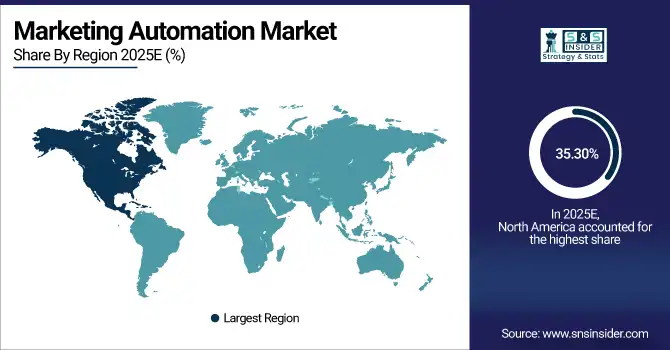
North America dominated the Marketing Automation Market with a 35.30% share in 2025 due to the presence of leading technology providers, advanced digital marketing infrastructure, and high adoption of AI-driven marketing solutions. Strong enterprise investment, widespread integration of CRM systems, and a mature e-commerce ecosystem further strengthened the region’s market leadership.
Get Customized Report as per Your Business Requirement - Enquiry Now
Asia Pacific Marketing Automation Market Insights
Asia Pacific is expected to grow at the fastest CAGR of about 16.87% from 2026–2033, driven by rapid digitalization, increasing adoption of cloud-based marketing platforms, and rising internet penetration. Expanding e-commerce, growing SME participation, and government initiatives supporting technology adoption accelerate the implementation of marketing automation solutions across the regio
Europe Marketing Automation Market Insights
Europe held a significant share in the Marketing Automation Market in 2025, supported by advanced digital marketing infrastructure, high enterprise adoption of AI and CRM-integrated solutions, and the presence of leading technology providers. Growing focus on personalized marketing, regulatory compliance, and data-driven campaign optimization further strengthened Europe’s market position.
Middle East & Africa and Latin America Marketing Automation Market Insights
The Middle East & Africa and Latin America together showed steady growth in the Marketing Automation Market in 2025, driven by increasing digital adoption, expanding e-commerce sectors, and rising SME awareness of automated marketing solutions. Investments in cloud technologies, growing internet penetration, and supportive government initiatives further enhanced the regions’ adoption of marketing automation platforms.
Marketing Automation Market Competitive Landscape:
HubSpot
HubSpot is a leading marketing, sales, and customer service platform that specializes in inbound marketing and automation solutions. It provides tools for email marketing, lead management, CRM integration, social media scheduling, and analytics, enabling businesses to attract, engage, and nurture customers efficiently. HubSpot is widely recognized for its user-friendly interface, scalability, and comprehensive ecosystem, making it suitable for small businesses and large enterprises alike. Its automation capabilities improve productivity, personalize customer experiences, and drive measurable marketing results.
-
2024, HubSpot launched its AI Marketing Automation Suite, embedding generative AI across email, ads, landing pages, and workflows.
Salesforce Marketing Cloud
Salesforce Marketing Cloud is a comprehensive marketing automation platform that allows businesses to deliver personalized, data-driven marketing campaigns across email, social media, mobile, and web channels. It integrates with Salesforce CRM, enabling seamless customer journey management, analytics, and engagement tracking. Known for its scalability and enterprise-level capabilities, Marketing Cloud helps organizations automate campaigns, segment audiences, and optimize marketing performance. Its robust tools support targeted messaging, workflow automation, and predictive insights, enhancing customer experience and ROI.
-
2025, Salesforce enhanced Marketing Cloud with Einstein Copilot for Campaigns, a generative AI assistant that plans, executes, and optimizes cross-channel B2C campaigns.
Adobe Marketo Engage
Adobe Marketo Engage is a powerful marketing automation solution designed for lead management, account-based marketing, email campaigns, and customer engagement. It provides advanced tools for segmentation, personalization, analytics, and nurturing workflows, helping businesses deliver relevant content across multiple channels. Marketo Engage integrates with CRM platforms to streamline marketing operations and measure campaign effectiveness. Trusted by enterprises globally, it enhances lead conversion, customer retention, and revenue growth, offering a scalable platform for complex marketing strategies and data-driven decision-making.
-
2023, Adobe launched the AI Orchestrator within Marketo Engage, designed specifically for B2B account-based marketing (ABM) at scale.
Marketing Automation Market Key Players
Some of the Marketing Automation Market Companies are:
-
HubSpot
-
Salesforce Marketing Cloud
-
Adobe Marketo Engage
-
Oracle Eloqua
-
ActiveCampaign
-
Mailchimp
-
Klaviyo
-
SAP Emarsys
-
Zoho Marketing Automation
-
Keap (Infusionsoft)
-
Act-On Software
-
Brevo (Sendinblue)
-
SharpSpring
-
Braze
-
Iterable
-
MoEngage
-
Insider
-
SAS Customer Intelligence
-
Acoustic
-
Constant Contact
| Report Attributes | Details |
|---|---|
| Market Size in 2025E | USD 6.94 Billion |
| Market Size by 2033 | USD 21.01 Billion |
| CAGR | CAGR of 14.93% From 2026 to 2033 |
| Base Year | 2025 |
| Forecast Period | 2026-2033 |
| Historical Data | 2022-2024 |
| Report Scope & Coverage | Market Size, Segments Analysis, Competitive Landscape, Regional Analysis, DROC & SWOT Analysis, Forecast Outlook |
| Key Segments | • By Component (Software, Services, Professional Services, Managed Services, Consulting Services, Integration & Implementation Services) • By Application (Email Marketing, Lead Nurturing & Lead Scoring, Campaign Management, Social Media Marketing, Mobile Marketing, Search Engine Marketing) • By Channel Type (Website, Email, Mobile App, Social Media, SMS & Push Notifications) • By End-User Industry (BFSI, Retail & E-commerce, IT & Telecom, Healthcare, Manufacturing, Media & Entertainment) |
| Regional Analysis/Coverage | North America (US, Canada), Europe (Germany, UK, France, Italy, Spain, Russia, Poland, Rest of Europe), Asia Pacific (China, India, Japan, South Korea, Australia, ASEAN Countries, Rest of Asia Pacific), Middle East & Africa (UAE, Saudi Arabia, Qatar, South Africa, Rest of Middle East & Africa), Latin America (Brazil, Argentina, Mexico, Colombia, Rest of Latin America). |
| Company Profiles | HubSpot, Salesforce Marketing Cloud, Adobe Marketo Engage, Oracle Eloqua, ActiveCampaign, Mailchimp, Klaviyo, SAP Emarsys, Zoho Marketing Automation, Keap (Infusionsoft), Act-On Software, Brevo (Sendinblue), SharpSpring, Braze, Iterable, MoEngage, Insider, SAS Customer Intelligence, Acoustic, Constant Contact |
Frequently Asked Questions
North America dominated with 35.3% share in 2025, supported by advanced digital infrastructure, high AI adoption, and extensive enterprise investment in marketing automation.
Software dominated the Marketing Automation Market due to centralized campaign orchestration, analytics, CRM integration, and scalability across diverse enterprise marketing operations.
Growth is driven by increasing demand for personalized, data-driven marketing strategies, multi-channel engagement, and AI-enabled automation to optimize campaigns and improve ROI.
The Marketing Automation Market was valued at USD 6.94 billion in 2025, fueled by rising digital campaigns and AI-driven personalization adoption globally.
The Marketing Automation Market is projected to grow at a CAGR of 14.93% from 2026–2033, driven by AI-powered multi-channel automation adoption.
