
North America Healthcare Market Report Scope & Overview:
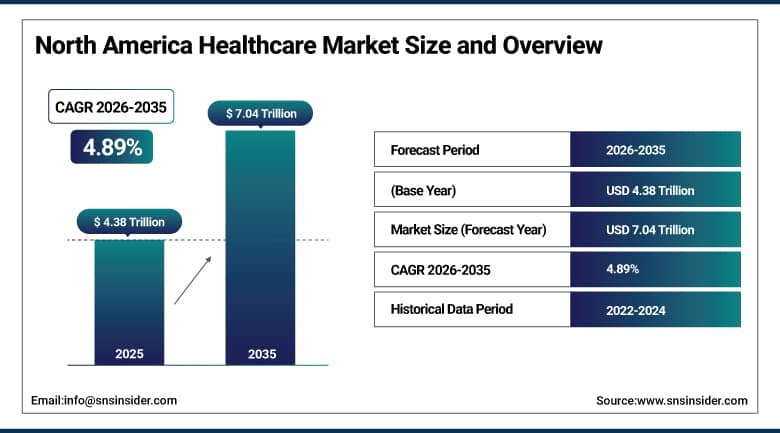
The North America Healthcare Market was valued at USD 4.38 trillion in 2025 and is expected to reach USD 7.04 trillion by 2035, growing at a CAGR of 4.89% from 2026-2035.
The North America Healthcare Market is witnessing steady growth As a result of increased demand for high-end healthcare services, technologies, drugs, diagnostic techniques, and solutions within the region. Increasing incidences of chronic ailments, increasing aged population, and high healthcare consumption is motivating healthcare service providers to increase their capacities and use innovative solutions. Healthcare spending along with the construction of hospitals, advanced health technologies, telemedicine, and diagnostics is further driving market growth. Moreover, increasing usage of telemedicine, artificial intelligence, remote diagnostics, and personalized medicine is also boosting healthcare accessibility, efficiency, and patient outcomes. Advanced healthcare technologies, growing healthcare infrastructure, and increased research and development investments are further driving market growth in North America.
⮞ In the U.S., 2024 hospital expenditure reached USD 1.63 trillion, while physician and clinical services reached USD 1.11 trillion. In Canada, hospitals represented 26% of total health spending in 2025.
To Get More Information On North America Healthcare Market - Request Free Sample Report
North America Healthcare Market Trends:
-
Growing adoption of AI and digital healthcare technologies is improving clinical decision-making, operational efficiency, and patient engagement across North America.
-
Rising demand for virtual and remote care is expanding convenient healthcare delivery across hospitals, clinics, and homecare settings.
-
Increasing use of predictive analytics and connected monitoring is supporting personalized care and earlier intervention for chronic conditions.
-
Adoption of generative AI and agentic AI is improving administrative workflows, clinical support, and healthcare service efficiency.
-
Growing demand for outpatient and home healthcare services is shifting care delivery toward lower-cost and patient-centric settings.
U.S. Healthcare Market Outlook:
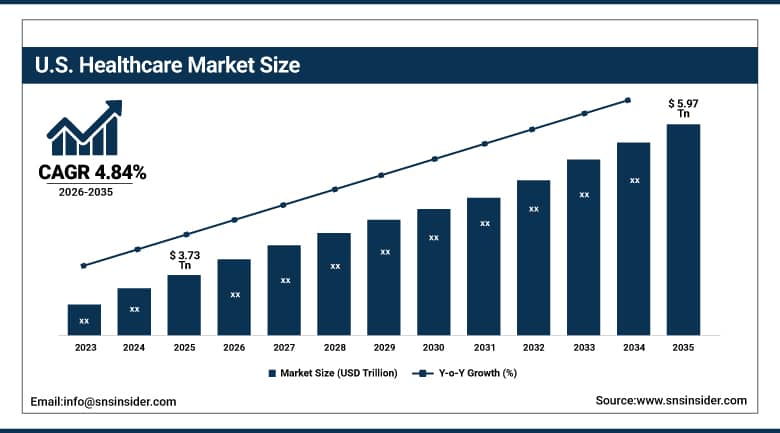
The U.S. Healthcare Market was valued at USD 3.73 trillion in 2025 and is expected to reach USD 5.97 trillion by 2035, growing at a CAGR of 4.84% from 2026-2035.
The U.S. Healthcare Market is witnessing steady growth due to increasing need for advanced healthcare services, medicines, medical devices, diagnostics, and treatment solutions in the United States. The increasing incidence of chronic illnesses, aging demographics, and increased use of healthcare services have driven healthcare providers to increase their capacity and innovate. Increased spending on healthcare and hospitals, digitization of healthcare, infrastructure in the medical field, and advanced diagnostics are further contributing to the growth of the market. Telehealth, artificial intelligence, remote monitoring of patients, and personalized medicine have been gaining popularity, making healthcare more accessible and efficient. Medical technology innovations, developments in healthcare infrastructure, and investments in research and development are further driving the growth of the market.
⮞ CMS projects U.S. national health expenditure through 2034, covering hospital, physician, prescription-drug and other healthcare spending categories.
North America Healthcare Market Segment Analysis:
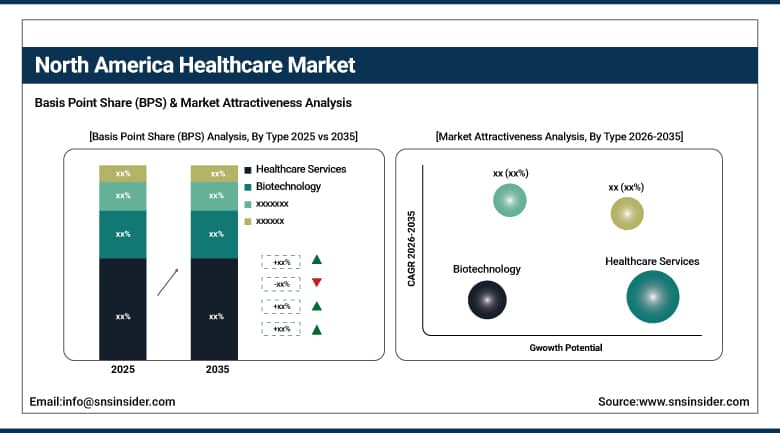
- By Type, Healthcare Services dominate the North America Healthcare Market with 38% share in 2025; Biotechnology is expected to grow at the fastest CAGR of 8.99% from 2026–2035.
By Type, Healthcare Services dominate the North America Healthcare Market, Biotechnology grows fastest.
Healthcare Services dominated the North America Healthcare Market with the highest revenue share of about 38% in 2025, backed by robust healthcare infrastructure, extensive hospital utilization, rising outpatient services, and high healthcare expenditure in the U.S. and Canada. Growing cases of chronic diseases, an aging population, increasing demand for specialized treatments, and improved healthcare facilities continue to support service utilization. In addition, technological advancements, expanding diagnostic capabilities, and greater access to preventive and personalized care are strengthening the demand for healthcare services across North America, contributing significantly to market revenue generation.
Biotechnology is expected to grow at the fastest CAGR of 8.99% from 2026–2035, driven by rapid developments in biologics, cellular and gene therapy, precision medicine, and molecular diagnostics. Rising research and development expenditure, an expanding clinical development pipeline, increased funding support, and growing demand for targeted and personalized therapies are accelerating biotechnology adoption across North America. Advancements in biomanufacturing, genomic technologies, and innovative therapeutic platforms are further creating new opportunities for market expansion. In addition, effective collaboration between pharmaceutical companies, biotechnology firms, research institutions, and healthcare organizations is strengthening innovation, accelerating product development, and supporting the segment’s long-term growth prospects.
Regional Analysis:
|
Region |
Major Country |
Share within Region, 2025 (%) |
|---|---|---|
|
North America |
United States |
85.20% |
|
Canada |
14.80% |
U.S. Healthcare Market Insights
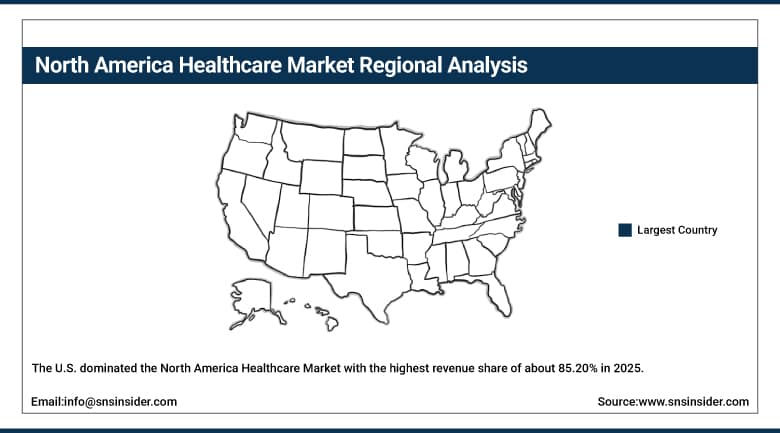
The U.S. dominated the North America Healthcare Market with the highest revenue share of about 85.20% in 2025, backed by high healthcare spending, well-developed healthcare infrastructure, large patient base, robust pharmaceuticals and biotechnology sector, and fast adoption of innovative healthcare technologies. High demand for healthcare services, growing incidence rate of chronic conditions, aging population, and increasing use of advanced healthcare solutions will continue fueling market growth. The country is home to a large number of hospitals, clinics, physicians, and healthcare providers, which ensures wide availability of various medical services in different healthcare categories.
The existence of advanced treatment centers, sophisticated diagnostic centers, world-renowned research institutes, and significant spending on healthcare R&D enhances market position of the country. Innovations in areas like digital healthcare, artificial intelligence, telemedicine, precision medicine, medical devices, and biotechnology continue to enhance quality of healthcare and expand healthcare treatment options. Robust pipeline of pharmaceutical drugs, significant spending on healthcare, and innovations in the healthcare space will help the country maintain its market dominance over the forecast period.
Get Customized Report as Per Your Business Requirement - Enquiry Now
Canada Healthcare Market Insights
The Canada segment is expected to grow at the fastest CAGR of about 5.14% from 2026–2035, facilitated by increasing healthcare expenditure, an aging population, increasing occurrence of chronic conditions, and growing need for quality and accessible healthcare services. Growth in the provision of healthcare services in the hospitals, outpatient clinics, diagnostic centers, and specialty care centers is increasing healthcare utilization in the country. Increasing need for preventive care, chronic care management, and advanced treatments is also fueling growth in the Canadian healthcare market.
Moreover, development of healthcare infrastructure, adoption of digital healthcare technology, improvements in diagnostic procedures, and government initiatives focused on improving healthcare access are propelling market growth. Adoption of telemedicine, electronic healthcare technology, remote patient monitoring, and digitally driven models of care is increasing accessibility of services and improving efficiency of operations. Investments in healthcare facilities, medical technologies, and research along with focus on addressing evolving needs of the population are anticipated to drive growth in Canada during the forecast period.
Market Dynamics:
Growth Drivers: Aging populations are increasing demand for healthcare services across the United States and Canada.
The problem of population aging has led to an increase in demands for treatments of chronic diseases, hospitalizations, prescription drugs, long-term care, diagnostics, and healthcare specialization in North America. Elderly people usually have a higher need for intensive medical attention due to the fact that they have several chronic illnesses at the same time. In Canada, the trend towards increasing the number of aged population is resulting in an ongoing increase in health care expenses and rising demand for long-term, home-based and specialized care, while in the U.S., the country is facing the same challenges caused by the growth of its aged population and chronic illnesses. The necessity to address such diseases as diabetes, cardiovascular diseases, cancer, neurological disorders, and other age-related diseases results in a growing need to provide more opportunities for treatment, which in turn stimulates health care providers to expand their capabilities and make healthcare accessible.
Restraints: Rising healthcare costs are increasing financial pressure across North American healthcare systems.
Growing healthcare expenditure is having a major impact on the North America Healthcare Market as a result of factors such as medical inflation, escalating labor costs, adoption of modern technology, increasing expenditure on medications and increased use of healthcare services. In Canada, rising expenditure on healthcare is putting greater pressure on budgets for healthcare as a result of increasing costs in relation to hospital payments and the delivery of healthcare services. In the United States, healthcare expenditure is being subjected to increasing pressure in terms of hospitals, physician services, prescription drugs, health insurance and advanced medical technology. Growing costs as far as staffing, infrastructure, specialized care, diagnostics and digital healthcare are concerned is making healthcare providers concentrate increasingly on cost control.
Opportunities: Rapid healthcare digitalization creates opportunities for AI-enabled and connected healthcare solutions.
The increasing application of electronic health records, telemedicine, remote patient monitoring, artificial intelligence, digital diagnostics, and connected medical devices is presenting many opportunities within the North America Healthcare Market. Healthcare organizations have started requiring more advanced tools which can help in making decisions based on clinical information, streamline operations, facilitate monitoring of patients, and increase efficiency of resources. Good healthcare spending, advanced infrastructure, high adoption of technology, and presence of favorable ecosystem for digital healthcare is making it easy for hospitals and other healthcare organizations to adopt digital healthcare solutions. Companies with products such as AI enabled healthcare platforms, remote healthcare solutions, predictive analytics, digital diagnostics, and connected medical devices will be able to cater to the growing demands of efficient and personalized healthcare services through technology.
⮞ Merck expanded its Digital Sciences Studio in Montreal, Canada, launching a second innovation cohort focused on AI, digital health, preventive care, and biopharmaceutical R&D technologies, reinforcing digital healthcare investment across North America.
Recent Developments:
-
2026 : UnitedHealth Group expanded access to healthcare services through new behavioral-health coaching, health hubs, and initiatives aimed at simplifying healthcare navigation and improving affordability for members.
-
2026 : Johnson & Johnson advanced its healthcare portfolio through new treatment approvals and medical-technology innovations, while reporting strong second-quarter growth and raising its 2026 financial outlook.
-
2026 : GE HealthCare reported record organic orders growth of 11.1% and a $23.9 billion backlog, supported by adoption of new products and continued investment in precision healthcare technologies.
-
2025 : Mayo Clinic expanded digital healthcare and research capabilities, integrating 22 Mayo Clinic Platform solutions into clinical practice and increasing outpatient digital visits by 17% to 1.2 million.
North America Healthcare Market key players are:
-
UnitedHealth Group Incorporated
-
CVS Health Corporation
-
Cigna Group
-
Elevance Health, Inc.
-
Humana Inc.
-
McKesson Corporation
-
Cencora, Inc.
-
Cardinal Health, Inc.
-
Johnson & Johnson
-
Pfizer Inc.
-
Merck & Co., Inc.
-
Abbott Laboratories
-
Medtronic plc
-
HCA Healthcare, Inc.
-
Kaiser Permanente
-
Mayo Clinic
-
Siemens Healthineers AG
-
GE HealthCare Technologies Inc.
-
Becton, Dickinson and Company (BD)
-
Philips Healthcare
North America Healthcare Market Report Scope:
| Report Attributes | Details |
|---|---|
| Market Size in 2025 | USD 4.38 Trillion |
| Market Size by 2035 | USD 7.04 Trillion |
| CAGR | CAGR of 4.89% From 2026 to 2035 |
| Base Year | 2025 |
| Forecast Period | 2026-2035 |
| Historical Data | 2022-2024 |
| Report Scope & Coverage | Market Size, Segments Analysis, Competitive Landscape, Regional Analysis, DROC & SWOT Analysis, Forecast Outlook |
| Key Segments | • By Type (Pharmaceuticals, Healthcare Services, Medical Devices, Biotechnology, Pharmacy and Retail, Home Healthcare, Diagnostics) |
| Regional Analysis/Coverage | North America (US, Canada) |
| Company Profiles | UnitedHealth Group Incorporated, CVS Health Corporation, Cigna Group, Elevance Health, Inc., Humana Inc., McKesson Corporation, Cencora, Inc., Cardinal Health, Inc., Johnson & Johnson, Pfizer Inc., Merck & Co., Inc., Abbott Laboratories, Medtronic plc, HCA Healthcare, Inc., Kaiser Permanente, Mayo Clinic, Siemens Healthineers AG, GE HealthCare Technologies Inc., Becton, Dickinson and Company (BD), and Philips Healthcare. |
Frequently Asked Questions
Key players in the North America Healthcare Market include UnitedHealth Group Incorporated, CVS Health Corporation, The Cigna Group, Elevance Health, Inc., and Humana Inc., among others.
Key opportunities in the North America Healthcare Market include expansion of digital healthcare, adoption of AI and virtual care, growth of personalized medicine, and increasing investment in advanced healthcare technologies.
The market is driven by rising healthcare expenditure, an aging population, increasing chronic disease prevalence, growing healthcare utilization, and rapid adoption of digital and advanced medical technologies.
The Healthcare Services segment dominated the North America Healthcare Market, accounting for approximately 38.00% market share.
The U. S. region dominated the North America Healthcare Market in 2025 with a 85.20% share, riven by high healthcare spending, advanced medical infrastructure, and strong demand for healthcare services.
