
APAC Healthcare Market Report Scope & Overview:
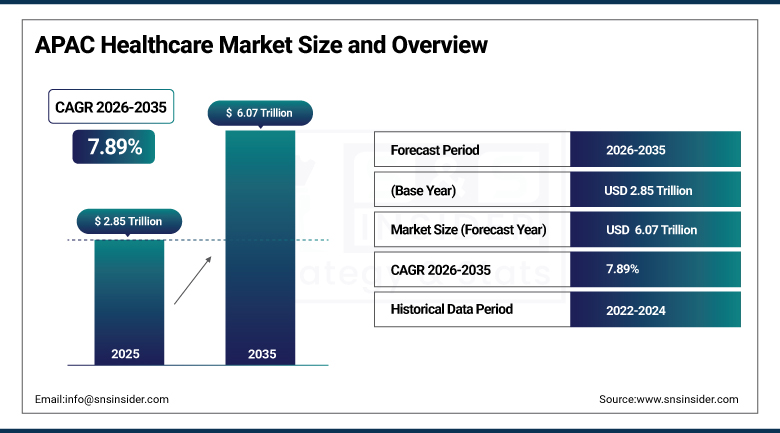
APAC Healthcare Market was valued at USD 2.85 Trillion in 2025 and is expected to reach USD 6.07 Trillion by 2035, growing at a CAGR of 7.89% from 2026-2035.
The APAC Healthcare Market is witnessing strong growth due to high costs of healthcare provision, growth in population, aging population, and high demand for advanced healthcare services in the region. Increasing prevalence of chronic diseases such as heart diseases, diabetes, cancer, and lung diseases is increasing the demand for drugs, medical devices, and healthcare services. Moreover, fast-growing healthcare infrastructure, especially in developing countries, has helped in accessing medical care. The use of digital healthcare solutions, telehealth, AI (artificial intelligence), personalized medicines, and advanced diagnostics has brought further transformation in the delivery of healthcare services. Increased investment in hospital facilities, drug manufacturing, biotech, and medical technology, along with growing awareness about healthcare provision, has helped in the growth of the market.
WHO South-East Asia and Western Pacific regional health reports identify population ageing, NCDs, health-system strengthening, and universal health coverage as major priorities across Asia-Pacific.
To Get more information On APAC Healthcare Market - Request Free Sample Report
APAC Healthcare Market Trends
-
Rising healthcare expenditure and increasing demand for quality medical services are driving expansion of healthcare infrastructure and capacity across APAC countries.
-
Increasing prevalence of chronic diseases, including cardiovascular disorders, diabetes, and cancer, is strengthening demand for diagnostics, pharmaceuticals, and specialized healthcare services.
-
Growing aging populations are accelerating demand for long-term care, preventive healthcare, chronic disease management, and geriatric healthcare services across the region.
-
Rapid adoption of artificial intelligence, telemedicine, wearables, and digital health platforms is improving healthcare accessibility, efficiency, diagnosis, and patient management.
China APAC Healthcare Market Outlook
China Healthcare Market was valued at USD 1.10 Trillion in 2025 and is expected to reach USD 2.30 Trillion by 2035, growing at a CAGR of 7.73% from 2026-2035.
The China APAC Healthcare Market is witnessing steady growth owing to growing healthcare spending, an expanding and aging population, and rising demands for higher-quality medical care. The rise in the prevalence of chronic diseases such as heart disease, diabetes, cancer, and lung disease has increased the demand for medicines, medical equipment, diagnostics, and other health care products and services. Moreover, continuous expansion and upgrading of healthcare infrastructure have improved access to healthcare in urban and rural regions. The adoption of digital health care, telemedicine, artificial intelligence, and advanced diagnostics will further help in transforming the healthcare industry. Increased investments in biotechnology, medicine manufacturing, and healthcare infrastructure, among others, and the focus of governments on providing better healthcare facilities will help in the growth of the market in China.
China's health authorities have established policy measures to promote and regulate AI + healthcare, including applications across prevention, diagnosis, treatment, rehabilitation, health management, and resource optimization.
APAC Healthcare Market Segment Analysis
-
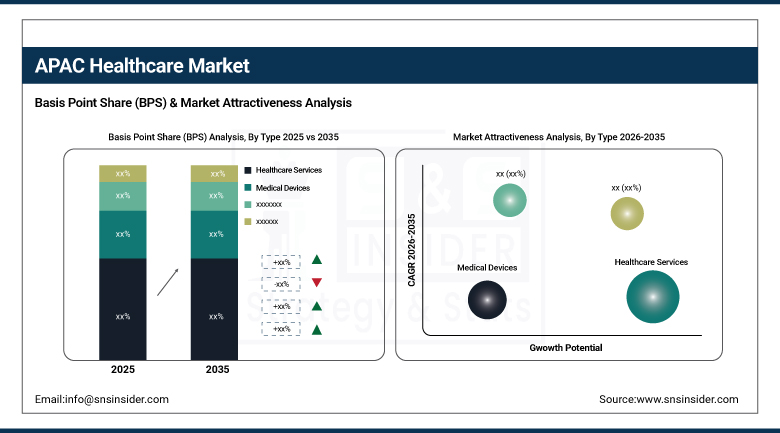
By Type, Healthcare Services dominate the APAC Healthcare Market with 45% share in 2025; Biotechnology is expected to grow at the fastest CAGR of 11.04% from 2026–2035.
By Type, Healthcare Services dominate the APAC Healthcare Market, Biotechnology grows fastest.
Healthcare Services segment dominated the APAC Healthcare Market with the highest revenue share of about 45% in 2025 as a result of the large and expanding population, high utilization of health services, and prevalence of chronic illnesses in the area. The development of hospitals, clinics, laboratories, and out-patient clinics is contributing to improved access to health services. Increased expenditure on health care and urbanization increase demand for health services.
Biotechnology segment is expected to grow at the fastest CAGR of 11.04% from 2026-2035 Because of increased investment in biologics, biosimilars, genomics, cell and gene therapies, and drug discovery technologies. The growing incidence of complex diseases has led to increased demand for new treatments. Increased biotechnology research, improved healthcare systems, government initiatives, and collaboration between pharmaceutical companies are contributing to rapid development of biotechnology in APAC.
Country Analysis
|
Region |
Major Country |
Share within Region, 2025 (%) |
|---|---|---|
|
Asia Pacific |
China |
38.50% |
|
Japan |
21.05% |
|
|
India |
14.53% |
|
|
South Korea |
6.32% |
|
|
Australia |
6.00% |
China APAC Healthcare Market Insights
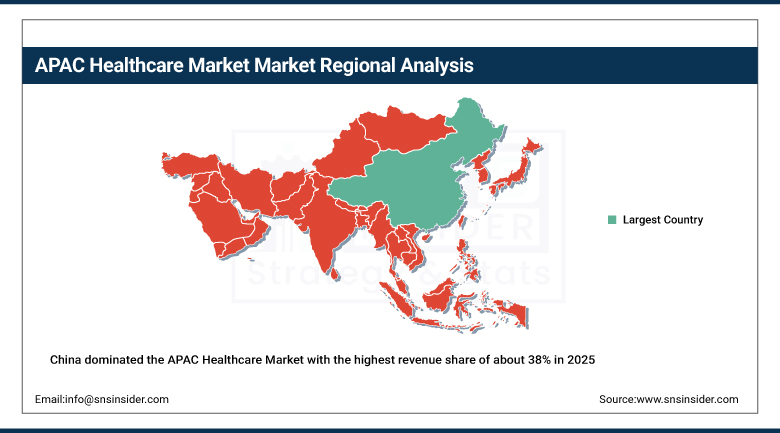
China dominated the APAC Healthcare Market with the highest revenue share of about 38.50% in 2025, backed by its huge population base, improving healthcare facilities, and increasing healthcare spending. Increase in prevalence of chronic illnesses, high demand for healthcare services, robust production of medicines, and government initiatives in healthcare sector are fuelling the growth of the market. Health care modernization and advancements in medical technology will increase the dominance of China even further.
Get Customized Report as per Your Business Requirement - Enquiry Now
Japan APAC Healthcare Market Insights
The Japan APAC Healthcare Market was a major contributor in 2025, driven by the country’s aging population, sophisticated healthcare infrastructure, and high healthcare expenditure. The prevalence of age-related and chronic diseases is fueling demand for medical services, drugs, and advanced medical technology. Adoption of digital healthcare, a strong pharmaceutical sector, and government initiatives focused on healthcare innovation are additional factors driving the Japanese market.
India APAC Healthcare Market Insights
India is expected to grow at the fastest CAGR of about 10.74% from 2026–2035, As a result of developments in the healthcare infrastructure, increase in healthcare spending, and an ever-growing demand for quality health services. The growth in chronic diseases, healthcare digitization, drug manufacturing, and government policies is driving this development. The growth in investments in healthcare, health insurance, adoption of medical technology, and healthcare access in India is facilitating this growth.
South Korea APAC Healthcare Market Insights
The South Korea APAC Healthcare Market was driven by the country’s highly developed healthcare infrastructure, well-developed pharmaceutical and biotechnology industries, and increased use of medical technology. The growing need for healthcare services, higher prevalence of chronic diseases, and aging population are fueling market growth. Healthcare innovations, digital health, biotechnology, and advanced medical devices are further contributing to South Korea’s regional position.
Market Dynamics
Growth Drivers: Growing population, rapid aging, and rising prevalence of chronic diseases are accelerating healthcare demand across APAC
The large and increasingly aging population across Asia-Pacific is creating sustained demand for healthcare services, pharmaceuticals, medical devices, diagnostics, and long-term care. The APAC region consists of a relatively high proportion of the world’s aging population, while the declining fertility rate and rising longevity are rapidly driving demographic change. According to APEC projections, the proportion of individuals over 65 years old in the region's economies is expected to almost double to 22 percent in 2050. In parallel with this demographic shift, the problem of non-communicable diseases becomes more pressing for the region's health care systems. The World Bank stresses the increase in the number of patients suffering from chronic diseases and growing health care demands of aging populations in East Asia and the Pacific.
Restraints: Uneven healthcare infrastructure, expenditure, and access across countries can constrain regional market expansion
Significant disparities in healthcare infrastructure and spending remain across APAC, creating challenges for uniform market development. Affluent countries like Australia, Japan, Singapore, and New Zealand typically have better healthcare infrastructure and higher healthcare spending, whereas many developing countries are still suffering from lack of healthcare facilities, healthcare workers, diagnostic machines, and funding. Data provided by the OECD reveals that there is a considerable difference in terms of health care spending in Asia-Pacific economies, where some countries allocate less than 3% of their GDP to healthcare, while others spend more than 10%. Such a difference may lead to disparities in terms of medicine, treatment, diagnostics, and healthcare service availability. This could make the healthcare business environment vary between individual APAC economies.
Opportunities: Rapid adoption of digital health, AI, telemedicine, and advanced healthcare technologies is creating significant growth opportunities
The accelerating adoption of digital healthcare technologies represents a major opportunity across APAC. Electronic health systems, telemedicine, remote monitoring, artificial intelligence, digital diagnostics, and data-enabled healthcare systems are being adopted by governments and healthcare organizations. The WHO has stated that digital technology and artificial intelligence is changing healthcare delivery in Southeast Asia, especially due to shortage of skilled workers, geographic isolation, and increasing burden of non-communicable diseases. The APAC healthcare providers are also considering the use of agentic AI and advanced analytics for clinical decision support and population health management. This provides an opportunity for technology companies, hospitals, pharmaceutical companies, medical device manufacturers, and digital health companies to design solutions in areas like early diagnosis, personalized treatments, remote treatments, chronic disease management, and workflow optimization in healthcare.
Recent Developments:
-
2026 : Takeda expanded its healthcare presence in Asia through a landmark collaboration with the Indonesian Government to establish a plasma ecosystem, with an initial investment of up to USD 30 million to improve access to plasma-derived medicines.
-
2026 : Daiichi Sankyo strengthened its APAC healthcare portfolio with multiple product approvals, including Enhertu in China for neoadjuvant HER2-positive breast cancer and Vanflyta in China for newly diagnosed FLT3-ITD-positive AML.
-
2026 : Sun Pharmaceutical Industries Limited expanded its international healthcare portfolio by receiving approval to manufacture and market semaglutide in Brazil and launching generic semaglutide in South Africa, strengthening its presence in emerging healthcare markets.
-
2025 : Apollo Hospitals expanded technology-enabled healthcare delivery through AI-powered preventive care initiatives, including its partnership with OneBanc and the use of AI-enabled health assistance and machine-learning-driven patient engagement across its healthcare ecosystem.
APAC Healthcare Market key players are:
-
Astellas
-
Sun Pharma
-
Cipla
-
Hengrui
-
BeiGene
-
Celltrion
-
CSL
-
WuXi
-
Terumo
-
Olympus
-
Nipro
-
Mindray
-
Sysmex
-
Shimadzu
-
Sonic Healthcare
-
IHH Healthcare
-
Apollo Hospitals
APAC Healthcare Market Report Scope:
| Report Attributes | Details |
|---|---|
| Market Size in 2025 | USD 2.85 Trillion |
| Market Size by 2035 | USD 6.07 Trillion |
| CAGR | CAGR of 7.89% From 2026 to 2035 |
| Base Year | 2025 |
| Forecast Period | 2026-2035 |
| Historical Data | 2022-2024 |
| Report Scope & Coverage | Market Size, Segments Analysis, Competitive Landscape, Regional Analysis, DROC & SWOT Analysis, Forecast Outlook |
| Key Segments | • By Type (Pharmaceuticals, Healthcare Services, Medical Devices, Biotechnology, Pharmacy and Retail, Home Healthcare, Diagnostics) |
| Regional Analysis/Coverage | Asia Pacific (China, India, Japan, South Korea, Australia, ASEAN Countries, Rest of Asia Pacific), |
| Company Profiles | Takeda, Chugai, Daiichi Sankyo, Astellas, Sun Pharma, Cipla, Hengrui, BeiGene, Celltrion, CSL, WuXi, Terumo, Olympus, Nipro, Mindray, Sysmex, Shimadzu, Sonic Healthcare, IHH Healthcare, and Apollo Hospitals. |

Frequently Asked Questions
Key players in the APAC Healthcare Market include Takeda, Chugai Pharmaceutical, Daiichi Sankyo, Astellas Pharma, and Sun Pharma, among others.
Key opportunities in the APAC Healthcare Market include expansion of digital healthcare, increasing adoption of personalized medicine, and growing investment in biotechnology, medical devices, and healthcare infrastructure.
The market is driven by rising healthcare expenditure and increasing chronic disease prevalence, along with expanding healthcare infrastructure, growing medical tourism, and rapid adoption of advanced healthcare technologies.
The Healthcare Services segment dominated the APAC Healthcare Market, accounting for approximately 45.00% market share.
The China region dominated the APAC Healthcare Market in 2025 with a 38.50% share, driven by high firearm sales and strong defense procurement.
