
U.S. Healthcare Market Report Scope & Overview:
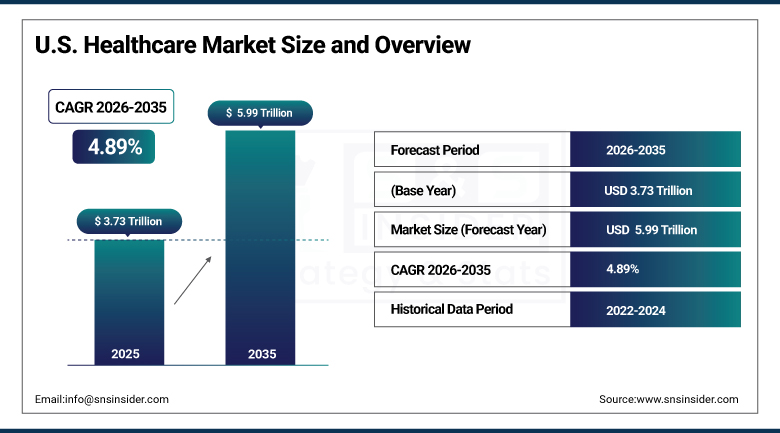
U.S. Healthcare Market was valued at USD 3.73 trillion in 2025 and is expected to reach USD 5.99 trillion by 2035, growing at a CAGR of 4.89% from 2026-2035.
The U.S. Healthcare Market is witnessing steady growth because of increasing health care costs, aging populations, and high demand for advanced medical treatment facilities. The increase in cases of chronic diseases like cardiovascular diseases, diabetes, cancer, and respiratory illnesses is causing the demand for medicines, medical instruments, diagnostics, and specialized health care services. Furthermore, the implementation of digital health care, telemedicine, artificial intelligence, remote patient monitoring, and diagnostics technologies is enhancing the quality of health care and helping in market growth. Investment in the development of hospitals, biotechnology, pharmaceutical research, and medical technologies is further assisting in market growth.
U.S. national health expenditures reached $5.3 trillion in 2024, accounting for 18.0% of GDP, reflecting the very large and expanding U.S. healthcare spending base.
To Get more information On U.S. Healthcare Market - Request Free Sample Report
U.S. Healthcare Market Trends
-
Rising healthcare expenditure and an aging population are driving demand for advanced medical services, chronic disease management, and specialized treatments across the United States.
-
Increasing adoption of artificial intelligence and generative AI is transforming clinical workflows, diagnostics, administrative operations, and healthcare decision-making processes.
-
Growing utilization of telehealth, remote monitoring, and virtual care is expanding healthcare accessibility while supporting convenient and technology-enabled patient management.
-
Rising demand for personalized and preventive healthcare is encouraging adoption of precision medicine, digital monitoring, and data-driven treatment strategies across healthcare organizations.
U.S. Healthcare Market Segment Analysis
-
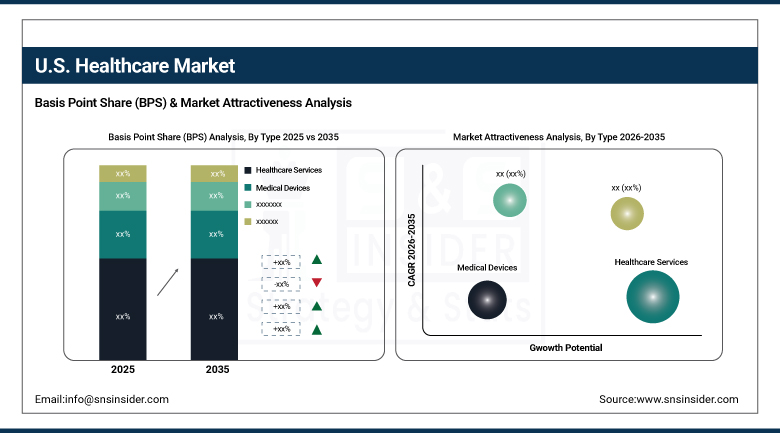
By Type, Healthcare Services dominate the U.S. Healthcare Market with 63% share in 2025; Home Healthcare is expected to grow at the fastest CAGR of 7.01% from 2026–2035.
By Type, Healthcare Services dominate the U.S. Healthcare Market, Home Healthcare grows fastest.
Healthcare Services segment dominated the U.S. Healthcare Market with the highest revenue share of about 63% in 2025 because of high usage of health care, high expenditure on health care, and wide demands for health care services and preventive care. Aging population, increase in chronic disease prevalence, well-established hospitals and clinics, and increasing demand for specialized health care services are the factors that further boost health care services consumption in the United States.
Home Healthcare segment is expected to grow at the fastest CAGR of 7.01% from 2026-2035 due to the rising inclination towards convenient and patient-focused care in non-hospital settings. The increase in the elderly population, along with the high prevalence of chronic diseases, is leading to a rising demand for nursing, monitoring, and rehabilitation services provided at home. The escalating cost of healthcare, among other factors, is further fueling the growth.
Regional Analysis
South U.S. Healthcare Market Insights
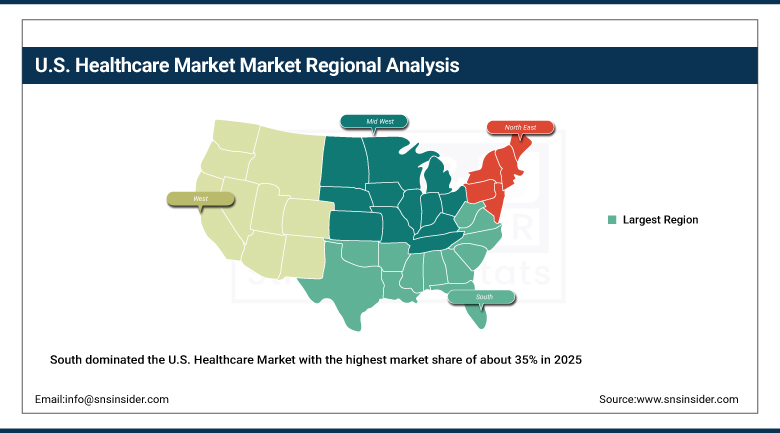
South dominated the U.S. Healthcare Market with the highest market share of about 35% in 2025, supported by its large population base, extensive healthcare infrastructure, and strong healthcare spending. Texas and Florida contribute significantly through large healthcare ecosystems, while growing Medicare Advantage enrollment, Medicaid activity, hospital networks, and increasing demand for medical services further strengthen the South’s market position.
Get Customized Report as per Your Business Requirement - Enquiry Now
West U.S. Healthcare Market Insights
West is expected to grow at the fastest rate from 2026–2035, driven by increasing healthcare innovation, digital health adoption, expanding outpatient services, and rising demand for advanced medical technologies. Strong technology ecosystems, healthcare investments, population growth, and increasing adoption of AI-enabled healthcare solutions are supporting regional expansion, while continued development of healthcare facilities further accelerates market growth.
Northeast U.S. Healthcare Market Insights
The Northeast U.S. Healthcare Market is supported by a well-established healthcare system, strong concentration of hospitals, research institutions, and specialty care providers. The region benefits from high healthcare access, advanced medical infrastructure, and significant adoption of innovative healthcare technologies. An aging population and rising prevalence of chronic diseases are increasing demand for healthcare services, diagnostics, pharmaceuticals, and advanced treatment options. Continued investments in healthcare facilities, digital health solutions, and medical research are also supporting market development across the Northeast.
Midwest U.S. Healthcare Market Insights
The Midwest U.S. Healthcare Market is driven by a broad network of hospitals, healthcare providers, pharmaceutical companies, and medical research institutions. The region is experiencing increasing demand for healthcare services due to its aging population and growing burden of chronic diseases. Expansion of healthcare infrastructure, adoption of digital healthcare technologies, and improvements in diagnostic and treatment capabilities are supporting market growth. Rising healthcare spending and investments in modern medical facilities are further strengthening access to advanced healthcare services across the Midwest.
Market Dynamics
Growth Drivers: Aging population and growing burden of chronic diseases are increasing demand for healthcare services and treatments
The aging U.S. population is generating increasing demand for chronic disease management, specialized medical services, pharmaceuticals, long-term care, and home healthcare. Older people have substantially greater use of healthcare and costs compared to their younger counterparts. According to the CMS, there were about 69.3 million Medicare beneficiaries and over $1.2 trillion Medicare spending in 2025. Additionally, chronic diseases such as cancer, heart diseases, diabetes, and respiratory diseases are characterized by frequent diagnosis, treatment, monitoring, and drug prescription. There is also increased focus on the management of chronic diseases and prevention as well as the reimbursement models in healthcare. All these factors will drive the demand for medical products and services.
Restraints: Healthcare workforce shortages and administrative complexity can limit healthcare delivery capacity
Workforce shortages and operational complexity remain important challenges for the U.S. healthcare system. With increased demands due to an aging population and chronic conditions, more pressure will be put on doctors, nurses, allied health professionals, caregivers, and other health professionals. In addition to that, health organizations have to handle complex issues including financing systems, regulations, paperwork, etc. which may lead to the problems associated with providers' burnout, capacity problems, and access to care issues. National Center for Health Workforce Analysis of the federal government analyzes U.S. health workforce needs and capacity continually because of the necessity of health workforce planning. Shortages and efficiency problems will continue to be important when there is increased demand for healthcare services.
Opportunities: Rapid adoption of artificial intelligence, digital health, and healthcare automation is creating significant growth opportunities
The increasing adoption of artificial intelligence and digital technologies is creating substantial opportunities across the U.S. healthcare market. The applications of AI include clinical decision-making, medical imaging, drug discovery, administrative processes, patient monitoring, and population health management. The U.S. Department of Health & Human Services sees AI implementation in clinical practice as one of the key ways of boosting the effectiveness of healthcare and decreasing costs in healthcare, while its AI strategy covers the use of AI technology in all aspects of healthcare delivery, research, and public health. Regulatory initiatives are increasingly backing AI-powered interoperability and data exchange in healthcare. All these trends open up many opportunities for AI software vendors, digital healthcare vendors, healthcare organizations, pharmaceutical companies, medical device companies, and health data platforms.
Recent Developments:
-
2026 : UnitedHealth Group strengthened its U.S. healthcare operations through continued investment in healthcare services, technology, data analytics, and value-based care, supporting more integrated and cost-efficient healthcare delivery.
-
2026 : Eli Lilly and Company expanded its U.S. healthcare presence through continued growth of its obesity and diabetes portfolio, particularly GLP-1 therapies, while advancing new indications and next-generation medicines.
-
2026 : Johnson & Johnson continued strengthening its U.S. healthcare portfolio through innovations in pharmaceuticals and medical technology, with continued investment in oncology, immunology, cardiovascular care, surgery, and digital health.
-
2025 : CVS Health expanded its U.S. healthcare ecosystem through integrated pharmacy, insurance, primary-care, and healthcare-services operations, with continued focus on improving affordability, access, and coordinated patient care.
U.S. Healthcare Market key players are:
-
UnitedHealth
-
Merck
-
Eli Lilly
-
AbbVie
-
Bristol Myers Squibb
-
Abbott
-
Medtronic
-
Amgen
-
Gilead
-
HCA Healthcare
-
Cigna
-
Elevance Health
-
Humana
-
McKesson
-
Cencora
-
Cardinal Health
-
Danaher
U.S. Healthcare Market Report Scope:
| Report Attributes | Details |
|---|---|
| Market Size in 2025 | USD 3.73 Trillion |
| Market Size by 2035 | USD 5.99 Trillion |
| CAGR | CAGR of 4.89% From 2026 to 2035 |
| Base Year | 2025 |
| Forecast Period | 2026-2035 |
| Historical Data | 2022-2024 |
| Report Scope & Coverage | Market Size, Segments Analysis, Competitive Landscape, Regional Analysis, DROC & SWOT Analysis, Forecast Outlook |
| Key Segments | • By Type (Pharmaceuticals, Healthcare Services, Medical Devices, Biotechnology, Pharmacy and Retail, Home Healthcare, Diagnostics) |
| Regional Analysis/Coverage | US (Northeast, Midwest, South, West) |
| Company Profiles | UnitedHealth, CVS Health, Johnson & Johnson, Pfizer, Merck, Eli Lilly, AbbVie, Bristol Myers Squibb, Abbott, Medtronic, Amgen, Gilead, HCA Healthcare, Cigna, Elevance Health, Humana, McKesson, Cencora, Cardinal Health, and Danaher. |

Frequently Asked Questions
Key players in the U.S. Healthcare Market include UnitedHealth Group, CVS Health, Johnson & Johnson, Pfizer Inc., and Eli Lilly and Company, among others.
Key opportunities in the U.S. Healthcare Market include expansion of digital healthcare, increasing adoption of personalized medicine, and growing investment in healthcare technology, biotechnology, and advanced medical devices.
The market is driven by increasing healthcare expenditure and chronic disease prevalence, along with technological advancements, aging population, and growing demand for advanced healthcare services.
The Healthcare Services segment dominated the U.S. Healthcare Market, accounting for approximately 63.00% market share.
The South region dominated the U.S. Healthcare Market in 2025 with a 35.00% share, driven by high firearm sales and strong defense procurement.
