
Oil & Gas Storage Terminal Market Report Scope & Overview:
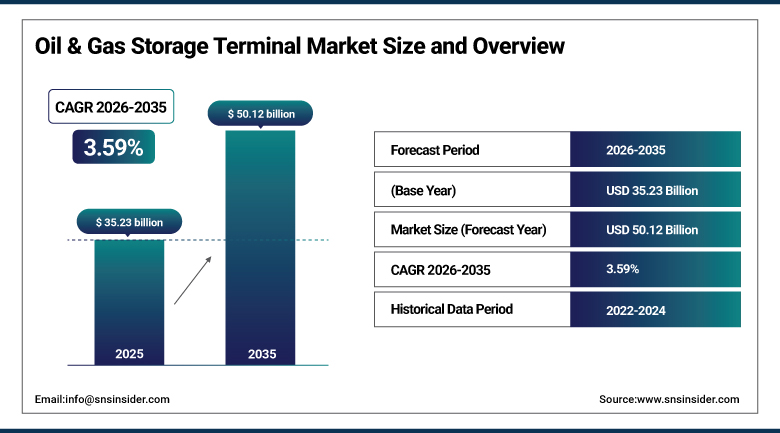
The Global Oil & Gas Storage Terminal Market was valued at USD 35.23 Billion in 2025 and is expected to reach USD 50.12 Billion by 2035, growing at a CAGR of 3.59% from 2026 to 2035.
Oil and gas storage terminals represent a vital component of the world’s energy infrastructure, acting as the backbone for the storage, transfer, and distribution of both crude oil and petroleum products through the entire value chain – from exploration to distribution. Oil and gas storage terminals usually consist of above- or underground storage facilities, systems for transferring between storage tanks, pumps, loading arms, and pipeline connections.
Royal Vopak, the world's largest independent tank terminal operator, continues to run more than 69 terminals around 20 or more countries, offering a total storage capacity of about 37 million cbm, covering petroleum products, chemicals, LNG, and an increasing range of energy transition products such as ammonia, hydrogen, and sustainable aviation fuel.
Market Size and Forecast:
-
Market Size in 2026E: USD 37.86 Billion
-
Market Size by 2035: USD 50.12 Billion
-
CAGR: 3.59% from 2026 to 2035
-
Fastest Growing Region: Middle East & Africa
-
Largest Region: Asia Pacific
To Get more information Oil & Gas Storage Terminal Market - Request Free Sample Report
Oil & Gas Storage Terminal Market Trends:
-
Growing digitally integrated monitoring systems are enhancing tank inspection, diagnosis, and safety compliance across terminal operations worldwide.
-
Rising strategic petroleum reserve expansion continues as nations bolster energy security in response to persistent geopolitical instability.
-
Expanding selective divestment of lower-margin oil storage assets is enabling leading operators to accelerate investment in LNG and energy transition infrastructure.
-
Increasing wide-scale utilization of crude oil distillation products and by-products as raw materials across manufacturing applications continues to drive terminal expansion.
-
Growing investment in ammonia, hydrogen, and sustainable aviation fuel storage capability is reshaping traditional oil terminal operator business models.
U.S. Oil & Gas Storage Terminal Market Outlook:
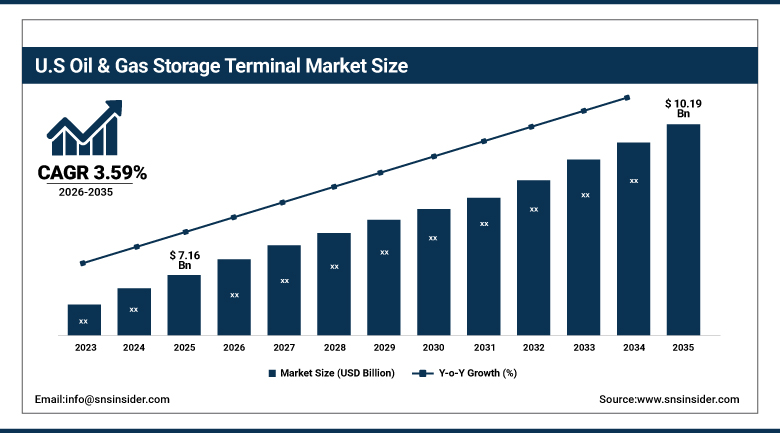
The U.S. Oil & Gas Storage Terminal Market was valued at USD 7.16 Billion in 2025 and is projected to reach USD 10.19 Billion by 2035, growing at a CAGR of 3.59% during 2026-2035.
Extensive Gulf Coast commercial storage infrastructure, combined with sustained Strategic Petroleum Reserve investment, continues to support robust market growth across the United States. Leading midstream operators including Kinder Morgan, Enterprise Products, and Buckeye Partners continue to expand pipeline-integrated storage capacity addressing the country's position as a leading global crude oil and refined product exporter. Growing terminal automation and technological improvements continue to reinforce sustained infrastructure investment nationwide.
The Port of Houston, home to one of the largest concentrations of oil storage terminal capacity in the United States, hosts 52 terminals with a combined capacity of approximately 29 million cbm operated primarily by Kinder Morgan, Enterprise Products, and Magellan Midstream, reflecting the sheer scale of Gulf Coast terminal infrastructure underpinning American crude oil and refined product export capability.
Oil & Gas Storage Terminal Market Segment Analysis:
-
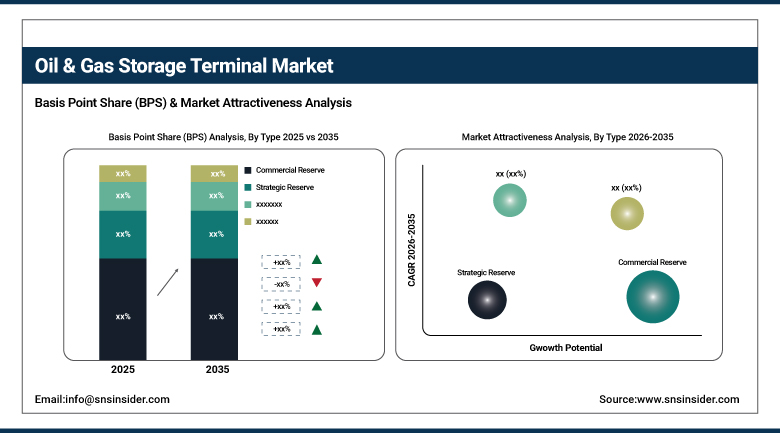
By Type, Commercial Reserve led the Oil & Gas Storage Terminal Market with a 62.60% share in 2025, while Strategic Reserve is the fastest-growing type segment with a CAGR of 5.60% from 2026-2035.
-
By Tank Type, Floating Roof led the Oil & Gas Storage Terminal Market with a 44.60% share in 2025, while Spherical Tank is the fastest-growing tank type segment with a CAGR of 6.20% from 2026-2035.
-
By Product, Crude Oil led the Oil & Gas Storage Terminal Market with a 48.60% share in 2025, while LPG is the fastest-growing product segment with a CAGR of 6.60% from 2026-2035.
By Type, Commercial Reserve Dominated the Market While Strategic Reserve Is the Fastest-Growing Segment
Commercial Reserve held the maximum revenue share of 62.60% in 2025 in the Oil & Gas Storage Terminal Market. The requirement of large-scale storage capacities by private terminal operators, refineries, and trading firms for supporting the oil trade and its distribution on a commercial basis is responsible for the Commercial Reserve's leading market position. Commercial Reserve terminals will continue to hold their leading market position because of the large amount of oil and refined oil products handled by the terminals every day.
Strategic Reserve is anticipated to register the fastest CAGR of 5.60% during 2026-2035 owing to the increasing energy security among the nations due to continued geopolitical instability through reserve filling efforts. National reserves build up initiatives will continue to fuel the above-average growth performance of this segment compared to that of commercial storage.
By Tank Type, Floating Roof Dominated the Market While Spherical Tank Is the Fastest-Growing Segment
The Floating Roof segment led the Oil & Gas Storage Terminal Market with a revenue share of 44.60% in 2025, reflecting this tank design's superior ability to reduce vapor emissions and evaporation losses when storing volatile crude oil and refined petroleum products. Tightening environmental regulations around methane and volatile organic compound emissions continue to reinforce floating roof adoption across major terminal operators, sustaining this tank type's dominant position across the broader oil and gas storage terminal market worldwide.
The Spherical Tank segment is expected to register the fastest CAGR of 6.20% during the forecast period 2026-2035, driven by growing demand for pressurized storage suited to LPG, LNG, and other liquefied gas products requiring specialized containment. Rising liquefied gas trade volumes continue to reinforce this segment's above-average growth trajectory relative to conventional atmospheric-pressure tank designs used for crude oil and refined products.
By Product, Crude Oil Dominated the Market While LPG Is the Fastest-Growing Segment
Crude Oil occupied the dominant share of 48.60% in the Oil & Gas Storage Terminal Market on account of the dependence of refineries, NOCs, and commercial traders on huge storage tanks owing to the inherent supply variability, price volatility, and logistical issues associated with global oil trade. The infrastructure of crude oil storage is also the underlying layer in the global oil supply chain and helps to maintain the dominant position of this product in the global storage terminal market.
LPG is expected to witness the highest CAGR of 6.60% in the coming years from 2026 to 2035 because of the growing global trade in liquefied petroleum gas that necessitates pressurized storage infrastructure. Increasing usage of liquefied petroleum gas in residential, commercial, and petrochemical applications is the key factor driving the growth of the segment at an above-average rate compared to crude oil and refined products.
Regional Analysis:
|
Region |
Country |
Share (2025) |
|---|---|---|
|
Asia Pacific |
China |
38.60% |
|
North America |
United States |
84.60% |
|
Europe |
Netherlands |
26.40% |
|
Middle East & Africa |
Saudi Arabia |
34.60% |
|
Latin America |
Brazil |
24.60% |
Asia Pacific Oil & Gas Storage Terminal Market Insights
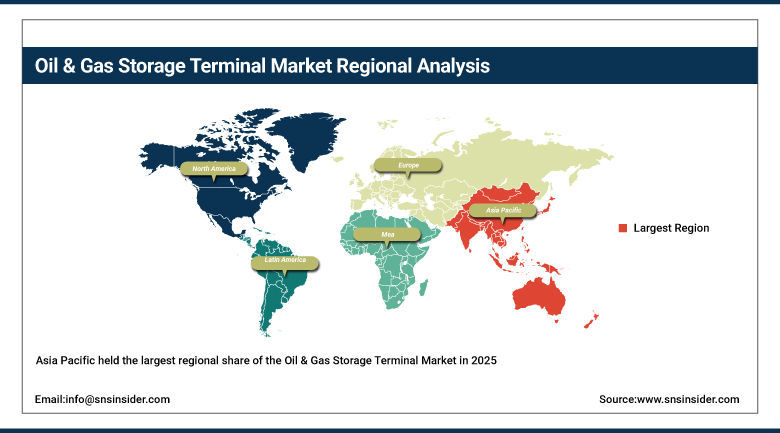
Asia Pacific held the largest regional share of the Oil & Gas Storage Terminal Market in 2025, driven by rapid urbanization and industrialization increasing energy demand across the region. Developing countries continue trying to store as much crude oil and petroleum products as possible to tackle supply chain disruption risk, with expanding strategic and commercial storage investment reinforcing the region's leadership position across the broader oil and gas storage terminal landscape.
China accounted for approximately 38.60% of the Asia Pacific market in 2025, supported by its massive industrial base and rapidly expanding domestic refining and storage infrastructure. India, Japan, and South Korea are also contributing meaningfully to regional growth, with India's strategic petroleum reserve expansion and private refinery buildouts accelerating storage construction to meet growing import dependency.
Get Customized Report as per Your Business Requirement - Enquiry Now
North America Oil & Gas Storage Terminal Market Insights
The North American region holds considerable market share in terms of the global Oil & Gas Storage Terminal Market in 2025, backed by well-developed commercial terminals on the Gulf Coast along with the presence of the nation as one of the largest exporters of crude oil and refined products in the world.
The market share of the United States was recorded to be around 84.60% in the North American region in 2025, owing to the extensive presence of Strategic Petroleum Reserve in the nation along with well-developed Gulf Coast commercial terminals.
Europe Oil & Gas Storage Terminal Market Insights
Europe represented a meaningful share of the global Oil & Gas Storage Terminal Market in 2025, anchored by Rotterdam's position as a major global oil trading and storage hub alongside strong regulatory frameworks governing terminal safety and environmental compliance. Growing selective divestment of lower-margin oil storage assets and accelerating LNG infrastructure investment continue to reshape the region's terminal operator landscape.
The Netherlands led the European market with a 26.40% regional share in 2025, supported by Rotterdam's status as Europe's largest oil trading and storage hub and the headquarters location of leading independent tank terminal operators. Germany, the United Kingdom, and Belgium are also contributing meaningfully to regional growth, supported by established terminal infrastructure and strong industrial oil demand.
Middle East & Africa and Latin America Oil & Gas Storage Terminal Market Insights
Middle East & Africa is expected to account for the highest CAGR during the forecast period, 2026-2035 due to investments made by large national oil companies in crude oil production and exports in the countries of the Gulf region. Latin America is also witnessing growth due to increasing investments in refining and storage facilities, and this is because of Brazil's offshore production capacity in oil.
Saudi Arabia accounted for the largest regional share of 34.60% of the Middle East & Africa market in 2025, owing to being one of the top crude oil producers and exporters in the world, which require large storage capacity. Brazil accounted for 24.60% of the Latin American market in 2025, because of Brazil's large offshore oil production capacity, while Mexico too contributes to regional growth in oil storage.
Market Dynamics:
Growth Drivers: Energy Demand Growth and Strategic Reserve Expansion Driving Market Growth
The Oil & Gas Storage Terminal Market is being driven primarily by increasing global energy demand and industrialization in emerging economies, geopolitical factors and fluctuating oil prices, and rising investments in strategic petroleum reserves. Wide-scale utilization of products and by-products of crude oil distillation as raw materials to manufacture goods across many application sectors continues to drive market growth, while expanding trade activities and the shift toward cleaner fuels further boost sector investment worldwide.
Growing digitally integrated monitoring systems continue to enhance tank inspection, diagnosis, and safety compliance across terminal operations. Rising strategic petroleum reserve expansion continues as nations bolster energy security in response to persistent geopolitical instability. Expanding selective divestment of lower-margin oil storage assets is further enabling leading operators to accelerate investment in LNG and energy transition infrastructure, reshaping the competitive landscape.
Restraints: High Capital Investment and Environmental Regulation Limiting Market Expansion
Despite favorable underlying demand, the market faces meaningful restraints related to high initial investment requirements for terminal construction and expansion, which can be difficult for smaller operators to justify given the scale of capital required for compliant, modern storage infrastructure. Environmental regulations governing emissions and safety compliance continue to add cost and complexity for terminal operators, particularly those managing legacy fixed roof infrastructure requiring retrofit investment.
The global less-competitive nature of the market, given the presence of relatively few large-scale terminal operators, continues to concentrate infrastructure investment risk among a limited number of major players. Transition to renewable energy sources also continues to introduce long-term demand uncertainty for conventional crude oil and refined product storage infrastructure, requiring operators to diversify toward energy transition products including ammonia, hydrogen, and sustainable aviation fuel.
Opportunities: Energy Transition Product Diversification and Digital Monitoring Creating New Growth Avenues
There is great opportunity for additional diversification into energy transition products, such as ammonia, hydrogen, and sustainable aviation fuels, with top players positioning their assets for future relevance. Terminal companies that effectively utilize and develop their ability to handle multiple products will be able to capitalize on the growth of the industry, with the whole energy sector moving towards more sustainable fuels.
Another important area of growth is the increased use of digital integrated monitoring and diagnostic technologies in order to optimize efficiency and compliance with regulations in older terminal infrastructure. Finally, expanding the construction of strategic petroleum reserves in emerging markets of Asia Pacific and the Middle East offers great potential for growth.
Recent Developments:
-
2026: Vopak reported record financial results for 2025 and announced a multi-year share buyback program of up to EUR 500 million.
-
2024: Gulf Navigation announced plans to acquire Brooge Energy, aiming to double the Fujairah-based operator's storage capacity outside the Strait of Hormuz.
-
2025-2026: Vopak continued selectively divesting lower-margin oil storage assets while accelerating investment in LNG infrastructure and new energy hubs including ammonia and hydrogen.
-
2025-2026: Oiltanking, a subsidiary of Marquard & Bahls, continued operating 79 terminals across 24 countries with approximately 21 million cbm of storage capacity.
Oil & Gas Storage Terminal Market key players are:
-
Royal Vopak N.V.
-
Kinder Morgan, Inc.
-
Oiltanking GmbH (Marquard & Bahls AG)
-
Vitol Group
-
Shell plc
-
NuStar Energy L.P.
-
Buckeye Partners, L.P.
-
Brooge Energy Limited
-
Koole Terminals B.V.
-
Oman Tank Terminal Company (OTTCO)
-
GPS Group
-
Ceylon Petroleum Storage Terminal Limited
-
Eilat Ashkelon Pipeline Co. Ltd.
-
VTTI B.V.
-
Belco Manufacturing Co., Inc.
-
PetroChina Company Limited
-
Saudi Aramco
-
Sinopec (China Petroleum & Chemical Corporation)
-
Enterprise Products Partners L.P.
-
Odfjell SE
Oil & Gas Storage Terminal Market Report Scope:
| Report Attributes | Details |
|---|---|
| Market Size in 2025 | USD 35.23 Billion |
| Market Size by 2035 | USD 50.12 Billion |
| CAGR | CAGR of 3.59% From 2026 to 2035 |
| Base Year | 2025 |
| Forecast Period | 2026-2035 |
| Historical Data | 2022-2024 |
| Report Scope & Coverage | Market Size, Segments Analysis, Competitive Landscape, Regional Analysis, DROC & SWOT Analysis, Forecast Outlook |
| Key Segments | • By Type (Strategic Reserve, Commercial Reserve) • By Tank Type (Fixed Roof, Floating Roof, Bullet Tank, Spherical Tank) • By Product (Crude Oil, Diesel, Petrol/Gasoline, Aviation Fuel, Kerosene, LPG, Others) |
| Regional Analysis/Coverage | North America (US, Canada), Europe (Germany, UK, France, Italy, Spain, Russia, Poland, Rest of Europe), Asia Pacific (China, India, Japan, South Korea, Australia, ASEAN Countries, Rest of Asia Pacific), Middle East & Africa (UAE, Saudi Arabia, Qatar, South Africa, Rest of Middle East & Africa), Latin America (Brazil, Argentina, Mexico, Colombia, Rest of Latin America). |
| Company Profiles | Royal Vopak N.V., Kinder Morgan, Inc., Oiltanking GmbH (Marquard & Bahls AG), Vitol Group, Shell plc, NuStar Energy L.P., Buckeye Partners, L.P., Brooge Energy Limited, Koole Terminals B.V., Oman Tank Terminal Company (OTTCO), GPS Group, Ceylon Petroleum Storage Terminal Limited, Eilat Ashkelon Pipeline Co. Ltd., VTTI B.V., Belco Manufacturing Co., Inc., PetroChina Company Limited, Saudi Aramco, Sinopec (China Petroleum & Chemical Corporation), Enterprise Products Partners L.P., Odfjell SE |
Frequently Asked Questions
The Oil & Gas Storage Terminal Market is expected to grow at a CAGR of 3.59% from 2026 to 2035.
The Oil & Gas Storage Terminal Market was valued at USD 35.23 Billion in 2025.
The market is driven by increasing global energy demand and industrialization in emerging economies, geopolitical factors, and rising investments in strategic petroleum reserves.
The Commercial Reserve segment dominated the Oil & Gas Storage Terminal Market in 2025, accounting for approximately 62.60% market share.
The Asia Pacific region dominated the Oil & Gas Storage Terminal Market in 2025.
