
Oil Shale Market Report Scope & Overview:
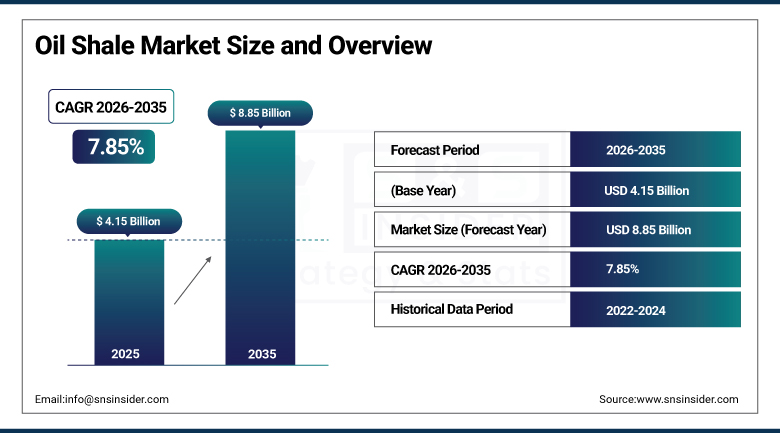
The Oil Shale Market was valued at USD 4.15 Billion in 2025 and is expected to reach USD 8.85 Billion by 2035, growing at a CAGR of 7.85% from 2026 to 2035.
The Oil Shale Market is experiencing stable growth owing to the increase in demand for energy sources, emphasis on energy security, supply diversification, and governmental incentives for unconventional hydrocarbon production. Oil shale refers to a sedimentary rock rich in kerogen and capable of generating liquids and combustible gases during retorting process. The importance of oil shale as an additional energy source is increasing, since the demand for domestic energy sources to cut dependence from foreign oil and natural gas is growing in many countries. There are more than 600 known oil shale deposits, estimated at 2.6 trillion barrels of resources spread over 33 countries in the world. In addition, innovations in the sphere of in-situ conversion technologies are making this energy source more economically feasible and environmentally friendly.
In 2025, Eesti Energia commissioned an upgraded Enefit280 shale oil retorting unit at its Narva operations in Estonia, engineered to improve hydrocarbon yield efficiency and reduce processing emissions across its commercial oil shale operations.
To Get more information On Oil Shale Market - Request Free Sample Report
Oil Shale Market Trends:
-
Rising adoption of in-situ conversion technologies is reducing surface disturbance and improving extraction economics across major oil shale reserves.
-
Growing government-backed energy security initiatives are accelerating oil shale project development across resource-rich nations.
-
Expanding integration of carbon capture and water recycling systems is addressing environmental compliance challenges in oil shale processing.
-
Increasing investment in retorting technology upgrades is improving hydrocarbon yield efficiency across commercial oil shale operations.
-
Strategic partnerships between national oil companies and technology providers are advancing next-generation oil shale extraction methods.
U.S. Oil Shale Market Outlook:
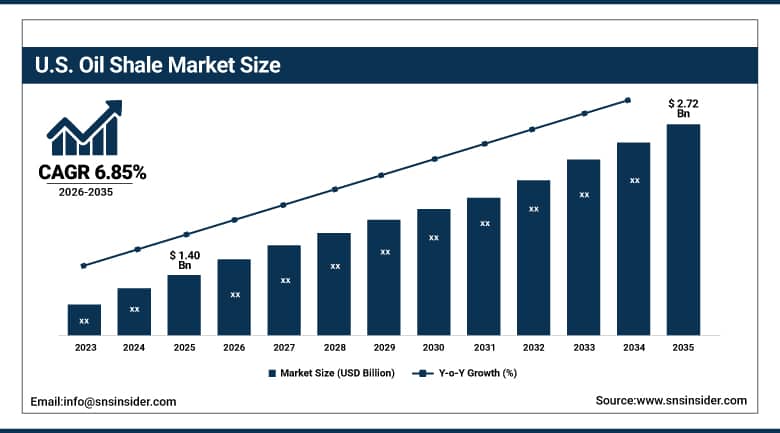
The U.S. Oil Shale Market was valued at USD 1.40 Billion in 2025 and is projected to reach USD 2.72 Billion by 2035, growing at a CAGR of 6.85% during 2026–2035.
The United States holds among the largest identified oil shale reserves globally, concentrated primarily within the Green River Formation spanning Colorado, Utah and Wyoming, positioning the country as a central focus of long-term commercial development activity. Continued pilot-scale investment by major integrated energy companies in in-situ conversion technologies, combined with sustained federal and state-level interest in domestic energy security and resource diversification, continues to support incremental project development across the region. While commercial-scale extraction remains constrained by production economics relative to conventional crude oil, ongoing technological refinement aimed at reducing water consumption, land disturbance, and processing costs continues to improve the long-term viability outlook for U.S. oil shale resources, particularly as energy security considerations gain renewed policy emphasis across federal and state government agendas.
In 2025, ExxonMobil advanced its in-situ conversion pilot program within the Green River Formation, targeting improved hydrocarbon recovery rates from deep oil shale deposits in Colorado.
Oil Shale Market Segment Analysis:
-
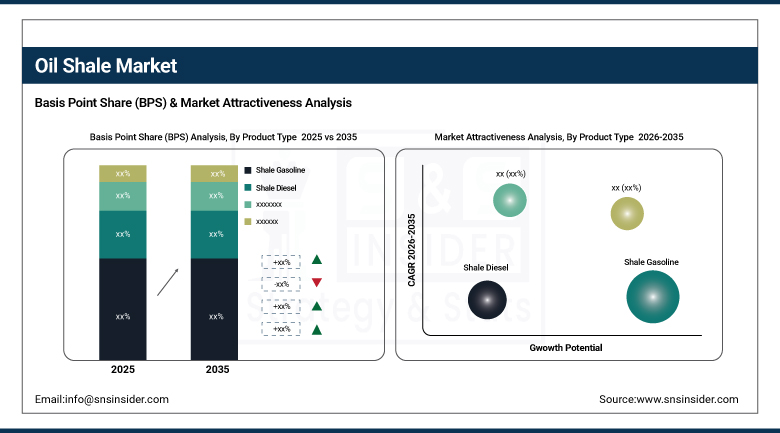
By Product Type, Shale Gasoline dominated the Oil Shale Market with a 35.60% share in 2025, while Shale Diesel is the fastest-growing product type segment with a CAGR of 8.90% from 2026–2035.
-
By Technology, Ex-Situ Technology dominated the Oil Shale Market with a 58.20% share in 2025, while In-Situ Technology is the fastest-growing technology segment with a CAGR of 9.40% from 2026–2035.
-
By Application, Fuel dominated the Oil Shale Market with a 52.30% share in 2025, while Electricity Generation is the fastest-growing application segment with a CAGR of 8.70% from 2026–2035.
-
By End Use Industry, Energy & Utilities dominated the Oil Shale Market with a 46.40% share in 2025, while Industrial is the fastest-growing end use industry segment with a CAGR of 8.50% from 2026–2035.
By Product Type, Shale Gasoline led the market Shale Diesel is the fastest-growing segment.
The Shale Gasoline segment was the leading contributor in the Oil Shale Market in 2025. This superiority is attributable to the wide applicability of shale gasoline within existing fuel distribution networks and refinery systems which enable it to be mixed with traditionally-refined products without extensive changes in the distribution system, a factor which has ensured that it has become the output stream of choice for large scale retorting operations in areas such as Estonia, China, and the United States where production is underway. Further optimization of the retorting process has also seen improvements in the yields of shale gasoline as opposed to other output streams.
The Shale Diesel segment is expected to witness the highest CAGR during the forecast period 2026-2035. Growing demands of diesel usage in heavy duty transportation, industrial machines, and back-up power generation, along with the efforts to improve the technologies of increasing the ratio of diesel production from kerogen-based hydrocarbons, stimulate rapid growth of this market segment. Growing government interest in domestic diesel supply diversification, particularly across import-dependent economies, is further supporting above-average growth for shale diesel relative to the broader oil shale product portfolio.
By Technology, Ex-Situ Technology led the market In-Situ Technology is the fastest-growing segment.
The Ex-Situ Technology category held major share in the Oil Shale Market in 2025. Ex-situ processes, including established methods such as the Kiviter, Galoter, Fushun, and Petrosix technologies, remain the dominant commercial extraction pathway owing to their decades-long operational track record, proven scalability, and established supply chains across major producing regions, particularly Estonia and China where surface mining and retorting infrastructure has been continuously operated and upgraded for extended periods, providing operators with a lower-risk, technically mature pathway to commercial-scale hydrocarbon production from oil shale deposits.
The In-Situ Technology segment is anticipated to grow at the fastest rate during the forecast period 2026-2035. The rising popularity of in-situ processes for conversion, whereby hydrocarbons are recovered directly from deposits under the ground with much less disruption to the land surface, usage of water, and production of waste rock, than that seen in traditional surface mining operations, is spurring adoption rates as more emphasis is placed on less disruptive ways of extracting oil, especially in deposits such as the Green River Formation of the U.S.
By Application, Fuel led the market Electricity Generation is the fastest-growing segment.
The Fuel segment dominated the Oil Shale Market. Fuel production remains the leading application category as shale oil-derived gasoline, diesel, and kerosene continue to serve as the primary commercial output of oil shale processing operations, supplying domestic transportation and industrial fuel markets across producing regions with limited access to conventional crude oil imports, reinforcing fuel production as the anchor demand driver underpinning continued investment in oil shale extraction and processing infrastructure globally.
The Electricity Generation segment is expected to register the fastest CAGR. Rising utilization of oil shale as a direct combustion fuel for power generation, particularly across Estonia where shale-fired power plants continue to supply a substantial share of domestic electricity, combined with growing interest in circulating fluidized bed combustion technology that improves combustion efficiency and reduces emissions, is driving accelerated growth for this application segment relative to the broader oil shale market.
By End Use Industry, Energy & Utilities led the market Industrial is the fastest-growing segment.
The Energy & Utilities segment dominated the Oil Shale Market with a revenue share. Energy and utility companies remain the dominant end-use category as they operate the overwhelming majority of commercial-scale oil shale mining, retorting, and power generation infrastructure worldwide, driving consistent, high-volume demand for extraction technology, processing equipment, and downstream refining capacity across established producing regions, reinforcing their position as the primary channel through which oil shale resources are converted into usable fuel and electricity outputs.
The Industrial segment is expected to witness the fastest CAGR during the forecast period 2026-2035. As more oil shale by-products such as shale ash and feedstocks for specialty chemicals become used in processes like cement manufacture, chemical production, and heating of industrial processes, the rising demand in the industrial sector continues, due to manufacturers exploring oil shale as a cheaper option than regular materials and energy in view of unpredictable global commodities prices.
Regional Analysis:
|
Region |
Major Country |
Share within Region, 2025 (%) |
|---|---|---|
|
North America |
United States |
78.60% |
|
Europe |
Estonia |
42.30% |
|
Asia Pacific |
China |
44.80% |
|
Middle East & Africa |
Jordan |
33.50% |
|
Latin America |
Brazil |
39.20% |
North America Oil Shale Market Insights
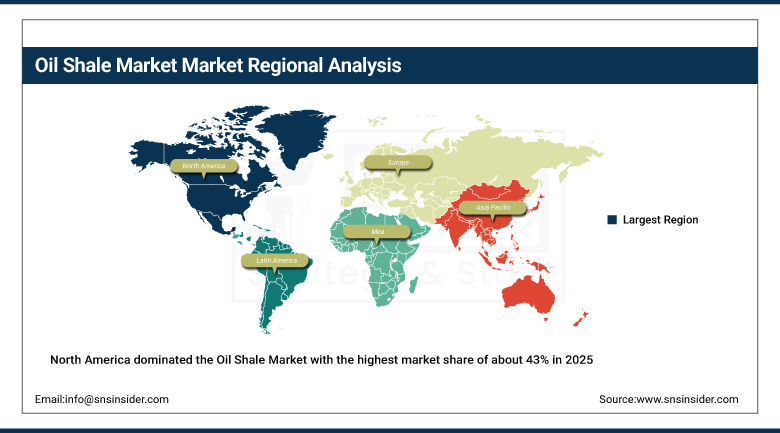
North America dominated the Oil Shale Market with the highest market share of about 43% in 2025, owing to the region's vast identified reserves, particularly within the Green River Formation, combined with advanced extraction technology capabilities and substantial capital investment from integrated energy majors pursuing long-term resource development. The region's mature regulatory framework governing unconventional resource development, alongside continued federal and state-level interest in domestic energy security, continues to reinforce North America's position as the largest oil shale market globally, spanning both pilot-scale in-situ conversion projects and established commercial operations.
The US was the leading country within the North America Oil Shale Market in 2025 with a market share of the regional market, Motivated by the huge reserves of the Green River Formation, along with pilot in-situ conversion efforts of major energy firms. The contribution of Canada to the region’s growth can be seen in terms of continued exploration work and increased government interest in energy diversity other than oil sands.
Get Customized Report as per Your Business Requirement - Enquiry Now
Europe Oil Shale Market Insights
The Europe region was a major contributor to the Oil Shale Market in 2025, anchored by Estonia's decades-long commercial oil shale mining and power generation industry, which remains among the most technologically mature and continuously operated oil shale sectors globally. The region's established retorting and shale-fired power generation infrastructure, combined with ongoing government support for domestic energy security amid broader European supply diversification efforts, continues to support steady market activity despite growing environmental regulatory pressure across the European Union.
Estonia is one of the major markets in Europe owing to its long-standing state-supported oil shale mining, retorting, and power generation industry supplying a substantial share of the country's domestic electricity needs. Russia, holding among the largest oil shale reserves in the region, is also contributing to regional market activity through continued exploration and resource development interest, despite comparatively limited commercial-scale extraction relative to Estonia's established operations.
Asia Pacific Oil Shale Market Insights
The Asia Pacific Oil Shale Market is expected to witness the fastest growth rate during the forecast period 2026-2035, registering a CAGR of 9.60%. The market growth is driven by rapidly rising regional energy demand, continued government-backed investment in domestic energy security, and expanding commercial-scale retorting capacity across the region's major producing economies seeking to reduce dependence on imported crude oil and natural gas.
China is one of the main growth drivers in the Asia Pacific Oil Shale Market, due to its sizable amount of reserves and state-sponsored investments in expanding retort capacity in plants within Fushun and Jilin province that provide fuel and chemical processing needs for their domestic market. Australia and Japan, countries which are also undertaking projects on exploiting domestic oil shale reserves due to increasing concerns on regional energy security issues, are also playing their role in expanding regional markets.
Middle East & Africa and Latin America Oil Shale Market Insights
Middle East & Africa and Latin American regions are gradually expanding oil shale resource development activity, supported by substantial identified reserves, growing government interest in domestic energy diversification, and increasing pilot-scale project investment by national oil companies and international technology partners across the regions' major reserve-holding countries.
Brazil is set to be a prominent Latin American market fueled by Petrobras' long-standing Petrosix oil shale processing operations and continued government support for domestic energy resource diversification. The Middle East & Africa region has Jordan investing heavily in oil shale-fired power generation and pilot-scale in-situ conversion projects, gradually increasing regional market activity as the country seeks to reduce its historical dependence on imported energy resources.
Market Dynamics:
Growth Drivers: Rising energy security focus and technological advancement driving market growth
The growing global emphasis on energy security and supply diversification, combined with continued advancement of extraction and processing technologies, is among the primary drivers of the Oil Shale Market. Oil shale offers resource-rich nations a strategic pathway to reduce dependence on imported crude oil and natural gas, particularly amid ongoing geopolitical volatility affecting conventional energy supply chains, a strategic value proposition that continues to attract sustained government and national oil company investment across major reserve-holding countries including the United States, China, Estonia, and Jordan.
The continuous improvements being made in in-situ conversion and retorting technologies have been responsible for boosting efficiency in hydrocarbon production as well as lowering the usage of water, surface disturbance, and emissions compared to the previous generation of extraction technologies. The increasing need for energy on the global front, along with the development of carbon capture and recycling techniques that have tried to address past environmental problems, are some of the factors aiding the growth of the market during the forecast period.
Restraints: High production costs and environmental regulation limiting market expansion
One of the most critical obstacles to market growth is the comparatively high production cost of oil shale extraction and processing relative to conventional crude oil, which requires substantial capital investment in retorting infrastructure, water management systems, and land reclamation programs that constrain commercial viability, particularly during periods of low conventional crude oil pricing that reduce the relative economic attractiveness of oil shale-derived hydrocarbons.
Moreover, stringent environmental regulation governing land disturbance, water consumption, and greenhouse gas emissions associated with oil shale mining and retorting operations continues to constrain project development timelines and raise compliance costs across major producing regions, particularly within the European Union and United States where regulatory scrutiny of unconventional resource development has intensified. Besides, the highly capital-intensive nature of commercial-scale oil shale project development creates a significant barrier to entry for smaller operators, concentrating market activity among a limited number of integrated energy majors and state-backed national oil companies.
Opportunities: In-situ technology advancement and emerging reserve development creating new growth avenues
The continued advancement of in-situ conversion technologies, combined with growing government interest in developing previously untapped oil shale reserves across emerging producing regions, presents substantial growth opportunities across the Oil Shale Market. Nations holding significant identified reserves but limited current commercial-scale development, including Jordan, Morocco, and several Southeast Asian countries, represent meaningful long-term expansion potential as extraction economics continue improving alongside technological maturation.
There is substantial potential for development in the areas of carbon capture and water recycling technologies that could help resolve some of the environmental issues associated with oil shale production, making it more likely that new projects can gain approval from governments within regions where the environment is highly valued. The increasing use of oil shale products as specialty chemicals and feedstocks, along with increasing investments by governments to ensure energy security within countries rich in resources, will fuel the need for improved technology.
Recent Developments:
-
2026: PetroChina expanded shale oil retorting capacity at its Fushun-process facility in Jilin province to support rising domestic fuel and chemical feedstock demand.
-
2026: Genie Energy's Israel Energy Initiatives subsidiary advanced its in-situ conversion process pilot in the Shfela Basin, targeting lower-emission oil shale extraction technology validation.
Oil Shale Market key players are:
-
ExxonMobil Corporation
-
Chevron Corporation
-
Shell plc
-
TotalEnergies SE
-
ConocoPhillips Company
-
BHP Group Limited
-
EOG Resources, Inc.
-
Suncor Energy Inc.
-
Eesti Energia AS (Enefit)
-
PetroChina Company Limited
-
China Petroleum & Chemical Corporation (Sinopec)
-
Occidental Petroleum Corporation
-
Equinor ASA
-
Repsol S.A.
-
SM Energy Company
-
EQT Corporation
-
Expand Energy Corporation
-
Genie Energy Ltd.
-
Japan Oil, Gas and Metals National Corporation (JOGMEC)
-
Queensland Energy Resources Ltd
Oil Shale Market Report Scope:
| Report Attributes | Details |
|---|---|
| Market Size in 2025 | USD 4.15 Billion |
| Market Size by 2035 | USD 8.85 Billion |
| CAGR | CAGR of 7.85% From 2026 to 2035 |
| Base Year | 2025 |
| Forecast Period | 2026-2035 |
| Historical Data | 2022-2024 |
| Report Scope & Coverage | Market Size, Segments Analysis, Competitive Landscape, Regional Analysis, DROC & SWOT Analysis, Forecast Outlook |
| Key Segments | • By Product Type (Shale Gasoline, Shale Diesel, Kerosene & Others) • By Technology (In-Situ Technology, Ex-Situ Technology) • By Application (Fuel, Electricity Generation, Cement & Chemicals & Others) • By End Use Industry (Energy & Utilities, Industrial, Construction & Others) |
| Regional Analysis/Coverage | North America (US, Canada), Europe (Germany, UK, France, Italy, Spain, Russia, Poland, Rest of Europe), Asia Pacific (China, India, Japan, South Korea, Australia, ASEAN Countries, Rest of Asia Pacific), Middle East & Africa (UAE, Saudi Arabia, Qatar, South Africa, Rest of Middle East & Africa), Latin America (Brazil, Argentina, Mexico, Colombia, Rest of Latin America). |
| Company Profiles | ExxonMobil Corporation, Chevron Corporation, Shell plc, TotalEnergies SE, ConocoPhillips Company, BHP Group Limited, EOG Resources, Inc., Suncor Energy Inc., Eesti Energia AS (Enefit), PetroChina Company Limited, China Petroleum & Chemical Corporation (Sinopec), Occidental Petroleum Corporation, Equinor ASA, Repsol S.A., SM Energy Company, EQT Corporation, Expand Energy Corporation, Genie Energy Ltd., Japan Oil, Gas and Metals National Corporation (JOGMEC), Queensland Energy Resources Ltd. |

Frequently Asked Questions
The market is driven by rising global energy demand, growing emphasis on energy security and supply diversification, and continued advancement of in-situ conversion and retorting technologies.
The Fuel segment dominated the Oil Shale Market in 2025, accounting for approximately 52.30% market share.
The North America region dominated the Oil Shale Market in 2025 with a 41.50% market share, driven by its vast Green River Formation reserves and advanced extraction technology capabilities.
