
Oil and Gas Upstream Equipment Market Report Scope & Overview:
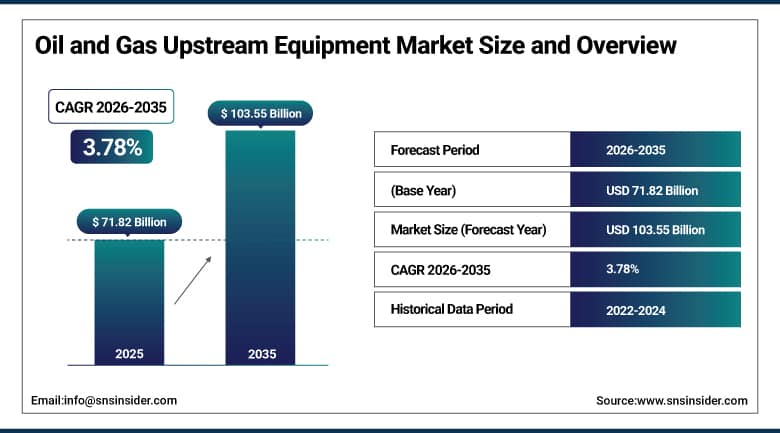
The Oil and Gas Upstream Equipment Market was valued at USD 71.82 billion in 2025 and is expected to reach USD 103.55 billion by 2035, growing at a CAGR of 3.78% from 2026-2035.
Rising energy consumption all over the world, especially in developing countries, in addition to huge investments in offshore and unconventional resources, is expected to play an important role in the expansion of the oil and gas upstream equipment market. Industrialization and transport demands have motivated oil and gas companies to increase their exploration and production operations. At the same time, huge investments in deepwater, ultra-deepwater, and shale projects are leading to the rise in demand for sophisticated drilling, production, wellhead, and subsea equipment.
According to the International Energy Agency (IEA), global oil demand increased by 0.65 million barrels per day (mb/d) in 2025, demonstrating continued dependence on hydrocarbons despite the energy transition. The IEA also reported that global oil demand is expected to remain above 104 million barrels per day in the medium term, sustaining the need for upstream investments and equipment deployment.
To Get More Information On Oil and Gas Upstream Equipment Market - Request Free Sample Report
Oil and Gas Upstream Equipment Market Trends
-
Increasing adoption of digital oilfield technologies and real-time equipment monitoring solutions.
-
Growing investments in offshore and ultra-deepwater exploration and production projects globally.
-
Rising deployment of automated drilling systems to improve operational efficiency and safety.
-
Expanding use of artificial intelligence for predictive maintenance and equipment optimization.
-
Increasing demand for subsea production systems in complex offshore hydrocarbon developments.
U.S. Oil and Gas Upstream Equipment Market Outlook
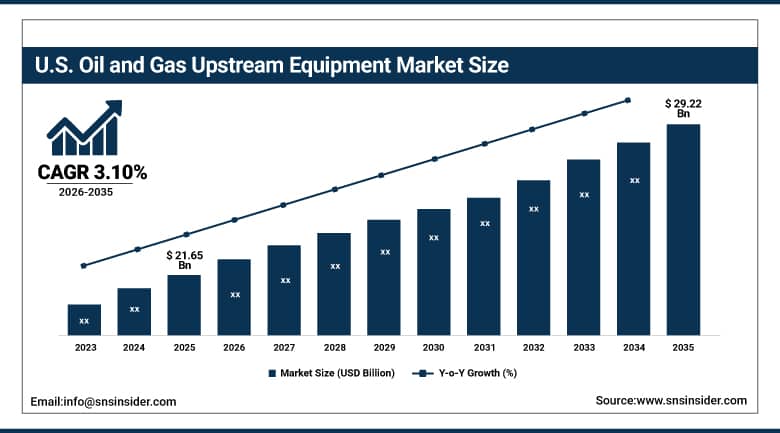
U.S. Oil and Gas Upstream Equipment Market was valued at USD 21.65 billion in 2025 and is expected to reach USD 29.22 billion by 2035, growing at a CAGR of 3.10% from 2026-2035.
The oil and gas upstream equipment market in the United States is largely influenced by high crude oil production and shale developments. The nation continues to be the biggest producer of oil in the world owing to large-scale drilling in the Permian, Eagle Ford, and Bakken formations. Increased investment in unconventional oil and gas development and the need to ensure that the production rates are sustained are expected to fuel demand for drilling rig equipment, artificial lift equipment, wellhead equipment, and production equipment. Furthermore, advances in horizontal drilling and hydraulic fracturing techniques are spurring use of upstream oil and gas equipment.
The U.S. Energy Information Administration (EIA) stated that the United States produced a record 13.6 million barrels of crude oil per day in 2025, making it the world's largest crude oil producer and highlighting the growing requirement for drilling, production, and wellhead equipment. The EIA also noted that total U.S. energy production reached a record 107 quadrillion British thermal units (quads) in 2025.
Oil and Gas Upstream Equipment Market Segment Analysis
-
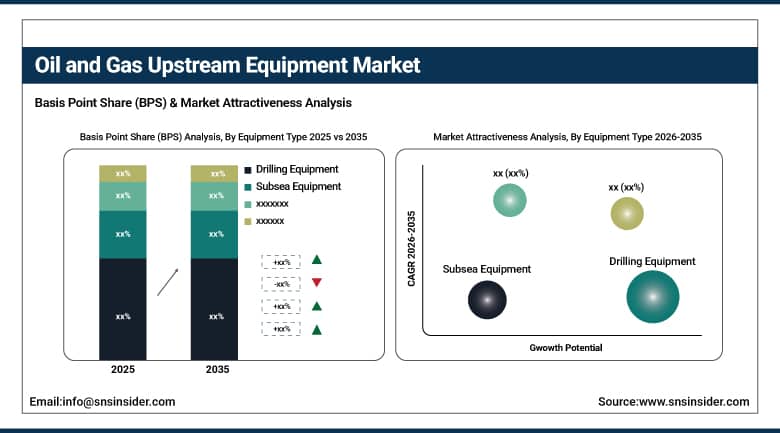
By equipment, drilling equipment dominated the oil and gas upstream equipment market in 2025 with 31.26% share; subsea equipment is the fastest-growing segment with a 7.71% CAGR.
-
By operation, drilling dominated the market in 2025 with 35.48% share; well completion and intervention is the fastest-growing segment with a 6.32% CAGR.
-
By application, onshore dominated the market in 2025 with 68.34% share; offshore are the fastest-growing segment with a 4.56% CAGR.
-
By end user, national oil companies (NOCs) dominated the market in 2025 with 43.83% share; oilfield service companies are the fastest-growing segment with a 5.78% CAGR
By equipment, drilling equipment segment dominates the Oil and Gas Upstream Equipment Market, subsea equipment segment expected to grow fastest
Drilling equipment dominates the Oil and Gas Upstream Equipment Market because drilling activities account for a significant share of upstream capital expenditure and are essential for developing both conventional and unconventional reserves. Rising investments in shale oil, deepwater exploration, and enhanced recovery projects have increased demand for drilling rigs, drill pipes, and related machinery. Continuous exploration activities across North America, the Middle East, and Asia-Pacific further support the segment's leading market position.
The subsea equipment category is projected to experience the highest rate of growth because of the growing spending on the development of offshore and ultra-deepwater oil and gas projects. In addition, oil and gas companies are focusing on offshore oil reserves because of the increasing need for energy and diversification of hydrocarbons sources. The development of the deepwater reservoirs in Brazil, Guyana, West Africa, and the Gulf of Mexico is fueling the growth in this category.
By operation, drilling segment dominates the Oil and Gas Upstream Equipment Market, well completion and intervention segment expected to grow fastest
The drilling segment dominates the market because drilling activities represent the foundation of upstream oil and gas development and require substantial investments in equipment and services. The growing need to replace declining production from mature fields and increasing exploration activities in emerging basins continue to support drilling operations. Rising shale development and horizontal drilling projects, particularly in North America, have further strengthened demand for drilling equipment and associated technologies.
The well completion and intervention segment is expected to grow at the fastest pace owing to increasing efforts to maximize production efficiency and extend the life of existing wells. Operators are investing in advanced completion technologies and intervention services to improve recovery rates and reduce operational costs. Growing numbers of mature oilfields and the rising adoption of enhanced oil recovery techniques are creating significant opportunities for this segment over the forecast period.
By application, onshore segment dominates the Oil and Gas Upstream Equipment Market, offshore segment expected to grow fastest
The onshore segment dominates the Oil and Gas Upstream Equipment Market due to the large concentration of oil and gas reserves and extensive drilling activities on land. Onshore projects generally require lower capital investments and have shorter development cycles compared to offshore operations, making them economically attractive. Significant shale developments in the United States and expanding exploration activities in the Middle East and Asia continue to sustain the segment's market leadership.
The offshore segment is projected to be the fastest-growing due to rising investments in deepwater and ultra-deepwater exploration projects. Increasing depletion of easily accessible onshore reserves is compelling operators to explore offshore resources with substantial hydrocarbon potential. Technological advancements in subsea production systems and floating production units have improved project feasibility and operational efficiency, thereby accelerating equipment demand across offshore developments worldwide.
By end user, national oil companies (NOCs) segment dominates the Oil and Gas Upstream Equipment Market, oilfield service companies segment expected to grow fastest
The National Oil Companies are the dominant players due to their possession of a huge share of the world’s oil and natural gas reserves and a big part of the capital invested in exploration and production operations. The governments of the Middle East, Asia, and Latin American regions will keep on investing money into exploration and production efforts in order to secure the supply of energy and produce more hydrocarbons. Their strategic plans and projects require a lot of equipment for drilling, producing, and maintaining wells.
The fastest growth is forecasted in the segment of the oilfield services because of the increasing amount of outsourcing of such activities as exploration and production of oil and natural gas. More and more energy companies resort to the specialized services in order to make their operations more efficient and cost-effective and gain access to new technologies.
Regional Analysis
|
Region |
Major Country |
Share within Region, 2025 (%) |
|---|---|---|
|
North America |
United States |
86.59% |
|
Europe |
Germany |
22.83% |
|
Asia Pacific |
China |
36.47% |
|
Middle East & Africa |
UAE |
24.65% |
|
Latin America |
Brazil |
48.34% |
North America Oil and Gas Upstream Equipment Market Insights
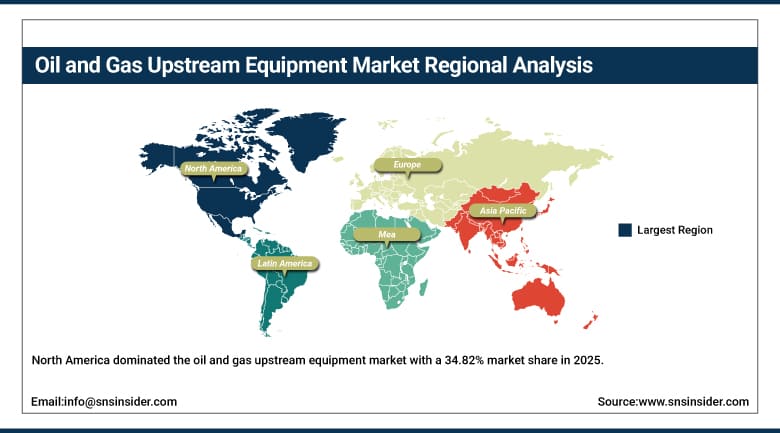
North America dominated the oil and gas upstream equipment market with a 34.82% market share in 2025. This market is mainly fueled by the growing exploitation of shale reserves, especially in the United States and Canada. There has been substantial investment in drilling and production of shale reserves in the Permian, Bakken, and Montney basins. Increased production from unconventional reserves has increased the need for drilling rig equipment, wellhead equipment, artificial lift equipment, and completion equipment, thus resulting in substantial investment in upstream equipment.
Growing investment in offshore activities in the Gulf of Mexico region and the uptake of digital oilfield technologies is contributing to increased demand for equipment in North America. Drilling automation systems, IoT-driven monitoring solutions, and predictive maintenance solutions have been adopted by companies in order to optimize their processes and minimize cost of operation. Adoption of technologies in upstream operations has been driving modernization of equipment.
Get Customized Report as Per Your Business Requirement - Enquiry Now
Europe Oil and Gas Upstream Equipment Market Insights
The oil and gas upstream equipment market in Europe is being fueled by growing investments in the revival of mature fields in the North Sea region and projects focused on enhancing energy security of the region. It involves efforts of government authorities and oil companies in prolonging the life of existing facilities and extracting maximum hydrocarbons from the ground. This trend stimulates the need for drilling equipment, well intervention services and production equipment that presents great opportunities for equipment suppliers.
There have been growing investments in the exploration and extraction of natural gas from offshore deposits in order to cut down dependence on imported sources of energy. Countries like Norway and UK are stepping up their gas developments and building offshore infrastructure. Investments in subsea production systems, well heads and offshore drilling equipment boost the upstream equipment market in the region.
Asia Pacific Oil and Gas Upstream Equipment Market Insights
The Asia Pacific Oil and Gas Upstream Equipment Market shows fastest growth with a CAGR of 5.45% in 2025. Industrialization, urbanization, and increase in population in Asia Pacific region has led to the rise in demand for energy. Countries like China, India, Indonesia, and Malaysia have increased their efforts to explore and produce oil and gas reserves. Investments in the new oil and gas reserves are leading to the high demand for drilling equipment and other equipment used in the production and completion of wells. Thus, Asia Pacific has become the fastest growing market for upstream equipment.
There is a lot of encouragement by the governments of Asia Pacific for domestic production of hydrocarbons via policies and investments in offshore exploration. There have been some major developments in South China Sea, Bay of Bengal, and offshore basins in Southeast Asia. These developments have fueled the demand for advanced subsea and drilling equipment.
Middle East & Africa and Latin America Oil and Gas Upstream Equipment Market Insights
The Middle East, Africa, and Latin America have abundant oil and gas resources that ensure a steady inflow of capital into the upstream operations. Countries like Saudi Arabia, the UAE, Brazil, and Guyana continue their efforts to enhance the production potential to satisfy growing worldwide energy needs. Numerous initiatives for developing new large fields and expanding the existing ones are raising the demand for drilling equipment, production systems, and other wellhead equipment, thus contributing to strong growth of the upstream equipment market.
Growing investment activity in offshore and deepwater projects leads to a strong increase in the demand for advanced upstream equipment in MEA and Latin America. New offshore initiatives in pre-salt formations of Brazil, offshore assets of Guyana, and deepwater projects in West Africa and the Middle East are raising the demand for subsea production systems and drilling technologies. Growth in exploration efforts and development of the related infrastructure will provide numerous opportunities for the manufacturers and suppliers of equipment over the forecast period.
Market Dynamics
Growth Drivers: Rising Global Energy Demand and Increasing Investments in Offshore and Unconventional Resource Development
Increased energy demand, especially in the developing countries, will result in increased demand for crude oil and natural gas, making the producers invest more in exploration and production operations. The governments and energy firms are making huge investments in oilfields and production infrastructure in order to guarantee energy security. This has resulted in an increase in the utilization of drilling rigs, production equipment, and wellhead equipment, which in turn will help drive the growth of the oil and gas upstream equipment market globally.
Exploration of offshore hydrocarbons and unconventional sources like shale oil and tight gas is contributing a lot towards the demand for advanced upstream equipment. Offshore projects including deepwater and ultra-deepwater will require drilling and subsea production equipment whereas shale oil developments will require drilling and completion operations. Increased capital expenditures in these projects will increase the demand for drilling equipment and artificial lift systems and other advanced production equipment worldwide.
Restraints: Volatility in Crude Oil Prices and Stringent Environmental Regulations Impacting Upstream Investments
High volatility in oil prices in the global markets plays a key role in upstream investments. Low oil prices make operators delay their projects in exploration and extraction of oil and limit the investments in equipment. Oil and gas industry operates in cycles, which leads to uncertainty among manufacturers and providers of services, making it hard for them to plan their investments and impacting the demand for upstream equipment in various regions.
Environmental restrictions and the need to move towards decarbonization is posing a threat to the oil and gas upstream industry. There are strict policies from governments aimed at cutting down on greenhouse gas emissions and increasing the use of renewable energy, causing high costs for operators. This trend towards the use of clean energy sources might affect investments into new oil and gas projects and limit market development.
Opportunities: Growing Deepwater Developments and Rising Adoption of Digital Technologies in Upstream Operations
Growing discoveries and developments of reserves in the deep and ultra-deep waters are providing many opportunities for upstream equipment manufacturers. Projects carried out offshore require very specialized drilling rigs, subsea production systems, and well intervention technologies. The rising investments being made by oil and gas companies into offshore developments in Brazil, Guyana, West Africa, and the Gulf of Mexico will result in rising demands for technologically advanced upstream equipment during the forecast period.
The use of digital technologies such as artificial intelligence, Internet of Things, and predictive analytics is revolutionizing upstream operations. Many oil and gas companies have started using automated drilling systems, digital twins, and remote monitoring to increase efficiency and decrease downtime. Digital transformation is offering many opportunities to the manufacturers of upstream equipment.
Recent Developments:
-
2026: Halliburton and ExxonMobil deployed the industry's first fully closed-loop automated geological well placement system in offshore Guyana. The technology integrates rig automation, real-time subsurface interpretation, and advanced drilling analytics to improve well placement accuracy and reservoir contact. The development highlights the increasing adoption of automation technologies in upstream operations and is expected to drive demand for advanced drilling equipment and digital oilfield solutions.
-
2026: ExxonMobil and its partners announced a USD 1 billion investment in Nigeria's Usan offshore oilfield development project. The investment is expected to increase production by approximately 40,000 barrels per day and stimulate demand for offshore drilling, subsea production systems, and related equipment. The project underscores growing investments in offshore developments and their importance in driving the global upstream equipment market.
-
2025: Halliburton launched LOGIX Unit Vitality, an artificial intelligence-powered platform that monitors cementing equipment in real time and enables predictive maintenance. The system helps operators improve equipment reliability, reduce unplanned downtime, and enhance operational efficiency. The introduction of AI-enabled monitoring technologies highlights the increasing integration of digital solutions and smart equipment across upstream oil and gas operations.
Oil and Gas Upstream Equipment Market key players are:
-
Aker Solutions ASA
-
Archer Ltd.
-
ATB Holding Spa
-
Atlas Copco AB
-
AXON Pressure Products Inc.
-
Dril Quip Inc.
-
Evolution Oil Tools Inc.
-
Flowserve Corp.
-
Forum Energy Technologies Inc.
-
General Electric Co.
-
Geometrics Inc.
-
Halliburton Co.
-
Helmerich and Payne Inc.
-
NOV Inc.
-
Schlumberger Ltd.
-
Seadrill Ltd.
-
Siemens AG
-
SPX FLOW Inc.
-
Sumitomo Corp.
-
Weatherford International Plc
Oil and Gas Upstream Equipment Market Report Scope:
| Report Attributes | Details |
|---|---|
| Market Size in 2025 | USD 71.82 Billion |
| Market Size by 2035 | USD 103.55 Billion |
| CAGR | CAGR of 3.78% From 2026 to 2035 |
| Base Year | 2025 |
| Forecast Period | 2026-2035 |
| Historical Data | 2022-2024 |
| Report Scope & Coverage | Market Size, Segments Analysis, Competitive Landscape, Regional Analysis, DROC & SWOT Analysis, Forecast Outlook |
| Key Segments | • By Equipment Type (Drilling Equipment, Production Equipment, Artificial Lift Systems, Wellhead Equipment, Subsea Equipment, Others) • By Operation (Exploration, Drilling, Production, Well Completion and Intervention, Others) • By Application (Onshore, Offshore) • By End User (National Oil Companies (NOCs), International Oil Companies (IOCs), Oilfield Service Companies, Others) |
| Regional Analysis/Coverage | North America (US, Canada), Europe (Germany, UK, France, Italy, Spain, Russia, Poland, Rest of Europe), Asia Pacific (China, India, Japan, South Korea, Australia, ASEAN Countries, Rest of Asia Pacific), Middle East & Africa (UAE, Saudi Arabia, Qatar, South Africa, Rest of Middle East & Africa), Latin America (Brazil, Argentina, Mexico, Colombia, Rest of Latin America). |
| Company Profiles | Aker Solutions ASA, Archer Ltd., ATB Holding SpA, Atlas Copco AB, AXON Pressure Products Inc., Dril-Quip Inc., Evolution Oil Tools Inc., Flowserve Corp., Forum Energy Technologies Inc., General Electric Co., Geometrics Inc., Halliburton Co., Helmerich & Payne Inc., NOV Inc., Schlumberger Ltd., Seadrill Ltd., Siemens AG, SPX FLOW Inc., Sumitomo Corp., Weatherford International Plc. |

Frequently Asked Questions
The drilling segment dominated the Oil and Gas Upstream Equipment Market in 2025.
The Oil and Gas Upstream Equipment Market is expected to grow at a CAGR of 3.78% from 2026 to 2035.
The Oil and Gas Upstream Equipment Market was valued at USD 71.82 billion in 2025.
The major growth factor driving the Oil and Gas Upstream Equipment Market is increasing global energy demand and rising investments in offshore and unconventional oil and gas exploration activities.
North America dominated the Oil and Gas Upstream Equipment Market in 2025.
