
Vacuum Gas Oil Market Report Scope & Overview:
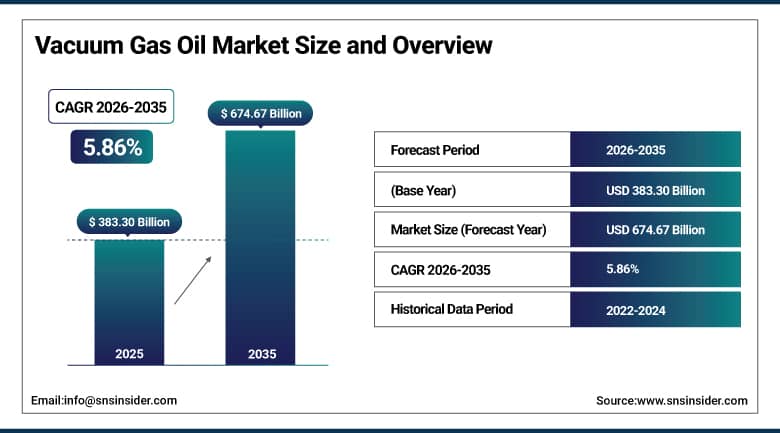
The Vacuum Gas Oil Market was valued at USD 383.30 Billion in 2025 and is projected to reach USD 674.67 Billion by 2035, expanding at a CAGR of 5.86% during the forecast period 2026–2035.
Vacuum Gas Oil Market is propelled by the rising demand for environment-friendly transportation fuel, expanding capacities of refining units, and adoption of improved hydrocracking and hydrotreating process technologies. Growing global energy consumption, tightening sulfur emissions norms, and shift towards Euro-VI (BS-VI) fuel norms have led to investments in vacuum gas oil processing units among the refiners. Rising need for premium-grade gasoline, low-sulfur diesel, and petrochemical feeds is adding impetus to the market growth. Besides, refinery modernization projects, capacity expansions, and innovations in hydro processing are set to provide future growth opportunities to Vacuum Gas Oil market.
Between 2025-2026, Hindustan Petroleum Corporation Limited (HPCL) undertook several major expansions in Indian refineries for achieving energy independence and complying with Euro-VI (BS-VI) fuel norms. Expansion at Visakhapatnam refinery included 3.0 MMTPA vacuum gas oil (VGO) hydrocracker. On the other hand, HPCL Rajasthan Refinery Limited (HRRL) installed its Pachpadra refinery complex equipped with 3.5 MMTPA VGO hydrotreater for refining heavy vacuum gas oils into premium-grade gasoline and low sulfur diesel.
Market Size and Forecast:
-
Market Size in 2026E: USD 404.15 Billion
-
Market Size by 2035: 674.67 Billion
-
CAGR: 5.86% from 2026 to 2035
-
Fastest Growing Region: Asia Pacific
-
Largest Region: Asia Pacific
To Get More Information On Vacuum Gas Oil Market - Request Free Sample Report
Vacuum Gas Oil Market Trends:
-
Increasing demand for cleaner transportation fuels and ultra-low sulfur diesel is driving Vacuum Gas Oil market growth as refiners are expanding hydro processing capabilities to meet stringent emission regulations and fuel quality standards.
-
Growing refinery modernization and capacity expansion projects are accelerating Vacuum Gas Oil adoption through investments in hydrocrackers, hydrotreaters, and advanced upgrading technologies to improve fuel production efficiency.
-
Rising global energy consumption and increasing demand for gasoline, diesel, and petrochemical feedstocks are supporting market expansion as refineries utilize Vacuum Gas Oil as a key intermediate feedstock for high-value fuel production.
-
Expansion of Euro-VI (BS-VI) fuel standards and sulfur reduction initiatives is creating new opportunities for Vacuum Gas Oil processing by encouraging refiners to upgrade heavy feedstocks into cleaner and higher-quality fuels.
-
Increasing investments in refinery infrastructure, particularly in emerging economies, are strengthening Vacuum Gas Oil supply chains through the development of large-scale refining complexes and advanced conversion facilities.
U.S. Vacuum Gas Oil Market Outlook:
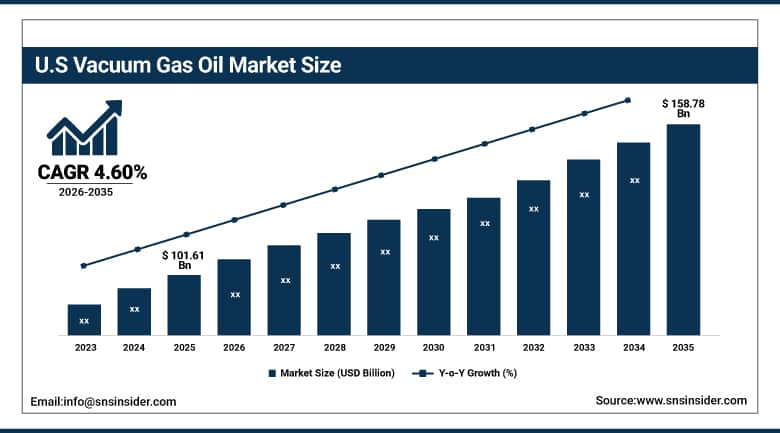
The U.S. Vacuum Gas Oil Market was valued at USD 101.61 Billion in 2025 and is projected to reach USD 158.78 Billion by 2035, expanding at a CAGR of 4.60% during the forecast period 2026–2035.
U.S. Vacuum Gas Oil Market growth is attributed to the growing modernization in refineries, increasing demand for clean transportation fuel, and investments in new hydro processing technology. Growth of this market is facilitated by the strict fuel quality regulations such as ultralow sulfur fuel regulations, which promote adoption of hydrocracking and hydrotreating in order to upgrade vacuum gas oil efficiently. Increased demand for gasoline, diesel, and high-grade base oils coupled with capacity expansion in the refineries and conversion technologies is helping in driving the growth of the market. The investments in domestic refining infrastructure and energy supply chain development will increase the use of vacuum gas oil in the U.S. energy industry.
In 2026, Vertex Energy announced an increase of 6,000 bpd in the production of Group III base oil from Mobile, Alabama, through hydrocracker facility for the processing of vacuum gas oil into base oils.
Vacuum Gas Oil Market Segment Analysis:
-
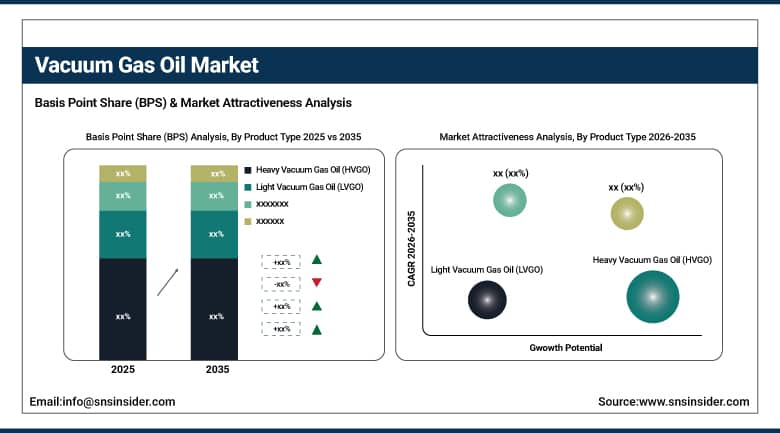
By Product Type, Heavy Vacuum Gas Oil (HVGO)dominated the Vacuum Gas Oil Market with a 53.20% share in 2025, while Light Vacuum Gas Oil (LVGO) is the fastest-growing product type segment with a CAGR of 6.39% from 2026–2035.
-
By Sulfur Content, High Sulfur Vacuum Gas Oildominated the Vacuum Gas Oil Market with a 57.40% share in 2025, while Low Sulfur Vacuum Gas Oil is the fastest-growing sulfur content segment with a CAGR of 8.05% from 2026–2035.
-
By Application, Diesel Oil Productiondominated the Vacuum Gas Oil Market with a 55.70% share in 2025, while Diesel Oil Production is the fastest-growing application segment with a CAGR of 6.32% from 2026–2035.
-
By Type, High Sulfur Content dominated the Vacuum Gas Oil Market with a 57.40% share in 2025, while Low Sulfur Content is the fastest-growing type segment with a CAGR of 8.05% from 2026–2035.
By Product Type, Heavy Vacuum Gas Oil (HVGO) dominated the Market, while Light Vacuum Gas Oil (LVGO) is expected to register the fastest CAGR
Heavy Vacuum Gas Oil (HVGO) dominated the Vacuum Gas Oil Market with a revenue share of 53.20% in 2025. High use as feedstock for hydrocracking, catalytic cracking and other refinery conversion processes results in segment dominance. HVGO contains heavier hydrocarbon fractions which are readily upgraded to value-added transportation fuels such as diesel and gasoline components. Increasing investment in refineries and growing demand for fuel production and expansion of advanced upgrading facilities are fuelling sustained adoption of HVGO across refining operations globally.
The Light Vacuum Gas Oil (LVGO) is projected to grow at the fastest CAGR of 6.39% during the forecast period of 2026-2035. The segment is growing due to rising demand for cleaner fuel production and greater flexibility for refineries. LVGO has better processing properties and is increasingly used in fluid catalytic cracking units to produce higher value fuel products. LVGO is likely to benefit from increasing penetration of advanced refining technologies, fuel quality regulations and refinery optimisation investments during the forecast period.
By Sulfur Content, High Sulfur Vacuum Gas Oil dominated the Market, while Low Sulfur Vacuum Gas Oil is expected to register the fastest CAGR
High Sulfur Vacuum Gas Oil dominated the Vacuum Gas Oil Market with a revenue share of 57.40% in 2025. Due to its ease of availability and widespread use in refineries with desulfurization and upgrading capabilities, the segment continues to hold the largest market share. High sulphur VGO is an important feedstock for production of transportation fuels and petrochemical intermediates The segment’s market is supported by growing refinery capacity, rising global fuel demand, and investments in sulphur removal technologies.
The Low Sulphur Vacuum Gas Oil segment is expected to grow at the fastest CAGR of 8.05% during the forecast period. Growth is driven by increasingly stringent environmental regulations, tough sulphur emission standards and a surge in demand for cleaner fuels. Refineries are increasingly using low sulphur VGO to produce ultra-low sulphur diesel to comply with global fuel quality requirements. This segment is expected to witness rapid growth with expansion of hydro processing facilities and increasing investments on cleaner refining technologies.
By Application, Diesel Oil Production dominated the Market, while Diesel Oil Production is expected to register the fastest CAGR
Diesel Oil Production dominated the Vacuum Gas Oil Market with a revenue share of 55.70% in 2025. The segment’s growth is boosted by increasing global demand for diesel fuel in transportation, logistics, industrial operations and heavy-duty vehicles. Vacuum Gas Oil is heavily processed by hydrocracking and hydrotreating technologies to produce high quality diesel with low sulphur content. The growing demand for cleaner diesel fuels, the modernisation projects of refineries and the stringent emission regulations are further aiding the growth of this application segment.
Diesel Oil Production is projected to grow at the fastest CAGR of 6.32% during 2026-2035. Growth is driven by higher demand for ultra-low sulphur diesel, expansion of commercial transportation and increasing investments in refinery upgrading infrastructure. With the latest hydro processing technologies, refiners can maximise diesel production while meeting environmental requirements. The demand for diesel production is projected to increase during the forecast period owing to the increasing fuel efficiency requirements and rising energy consumption.
By Type, High Sulfur Content dominated the Market, while Low Sulfur Content is expected to register the fastest CAGR
High Sulfur Content dominated the Vacuum Gas Oil Market with a revenue share of 57.40% in 2025. The segment continues to benefit from the availability of heavy crude processing streams and existing refinery infrastructure that can process high sulphur feedstocks. High-sulfur VGO is an important feedstock for fuel production, especially where desulfurization capability is more advanced. The rising demand for fuel and the continuous refinery operations are supporting the segment’s dominance.
The Low Sulphur Content is expected to register the fastest CAGR of 8.05% during 2026-2035. The growth of the segment is fuelled by increasing adoption of cleaner fuel standards, environmental regulations and growing demand for low emission transportation fuels. Refineries are putting money into hydro processing and upgrading technologies so they can process low-sulfur VGO efficiently; Low Sulphur Vacuum Gas Oil has a good growth prospect due to growing preference towards cleaner energy solutions along with rising focus on reducing sulphur emissions.
Regional Insights:
|
Region |
Major Country |
Share within Region, 2025 (%) |
|---|---|---|
|
North America |
United States |
80.75% |
|
Europe |
Germany |
28.50% |
|
Asia Pacific |
China |
36.20% |
|
Latin America |
Brazil |
46.80% |
|
Middle East & Africa |
UAE |
25.60% |
Asia Pacific Vacuum Gas Oil Market Insights
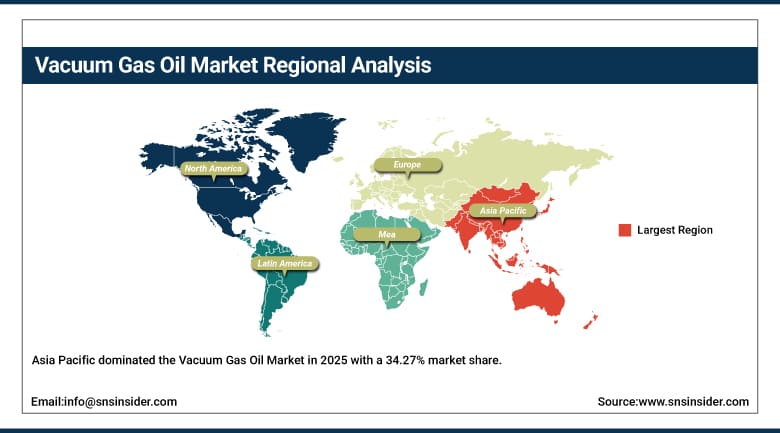
Asia Pacific dominated the Vacuum Gas Oil Market in 2025 with a 34.27% market share and is expected to register the fastest CAGR of 7.20% during 2026–2035. Regional growth is driven by rising energy consumption, transportation fuels demand, and investment in innovative refining technologies, along with refinery capacity expansion. Countries such as China, India, Japan, South Korea and South-east Asian countries are increasing refinery operations and infrastructure to meet rising demand for fuel and to improve processing efficiency.
China has a large refining capacity, a growing petrochemical industry and a rising demand for the production of gasoline and diesel, all of which make it a major contributor to the Asia Pacific Vacuum Gas Oil market. Refinery expansion projects, fuel consumption and modernisation of petroleum processing facilities are all seeing strong growth in India too. The growth of the market is fuelled by rising investments in hydrocracking units, sulphur reduction technologies and advanced fuel production systems in Asia Pacific.
Get Customized Report as Per Your Business Requirement - Enquiry Now
North America Vacuum Gas Oil Market Insights
The North America region held a significant share in the Vacuum Gas Oil Market in 2025 due to the availability of an advanced refining structure, refinery modernisation, and high demand for quality transport fuels. The advanced processes used in crude oil refining, large scale refining operations and the use of hydrocracking/hydrotreating techniques have assisted in the manufacture of clean fuels and value-added petroleum products. Most of the revenue contribution from North America came from the United States, where the country has extensive refining operations and requires a wide range of refined petroleum products such as gasoline and diesel.
The U.S. Vacuum Gas Oil Market is seeing continued growth on the back of rising investments in refinery modifications and advanced refining process and demand for ultra-low sulphur fuels. In the country, refining efficiency and production of value-added products through hydrocracking process is getting focus. Canada is experiencing steady growth due to increasing refining activities, abundance of heavy crudes and investment in upgrading activities.
Europe Vacuum Gas Oil Market Insights
The Vacuum Gas Oil Market of Europe has captured a significant market share in 2025 because of the rising demand for clean fuel for transportation applications, stringent sulfur emissions norms, and refinery upgrade programs. The regional market will be emphasizing improving the quality of fuel and refinery efficiency with the help of upgrading processes. Many nations such as Germany, United Kingdom, France, Italy, and Netherlands are contributing significantly owing to the presence of well-established refining facilities and advanced petroleum processing solutions.
Germany continues to be one of the key contributors to the Vacuum Gas Oil Market of Europe because of the presence of established refining sector, improving fuel quality, and advanced hydro processing process. The region will see significant investment in the upgrading of refineries that will help produce low-sulfur fuels. Increasing demand for diesel production, clean fuels, and crude oil processing solutions will contribute towards future market growth in Europe.
Middle East & Africa and Latin America Vacuum Gas Oil Market Insights
Latin America and Middle East & Africa are the rising regions in the Vacuum Gas Oil Market, thanks to increased refinery developments, high fuel demands, and infrastructural investments made in the process of petroleum refining. Brazil is one of the prominent contributors in Latin America because of growing refining capacity, increased consumption of transportation fuel, and upgrading of refinery facilities.
Middle East & Africa Vacuum Gas Oil Market will be driven by the availability of abundant oil reserves, rising capacity of refineries, and increasing investments in downstream petroleum refining projects. Countries like UAE and Saudi Arabia are upgrading their refining capabilities through refining capacity expansion projects. Despite facing issues such as infrastructure constraints and volatility of the market, demand for fuel and petrochemical products is expected to drive the growth of the market in Latin America and Middle East & Africa.
Growth Drivers: Increasing refinery modernization and rising demand for cleaner transportation fuels driving market growth
Rising demand for transport fuels globally, energy consumption, and investments made towards expanding refinery capacity projects have been pushing the demand for VGO. VGO is an important raw material used in the production of gasoline and diesel among other petroleum products through hydrocracking and catalytic cracking. Increasing demand for low sulfur fuel and stringent environmental regulations have compelled refineries to adopt better upgrading technology. Expansion in the refinery capacity as well as refinery modernization in emerging nations has led to enhanced availability and use of Vacuum Gas Oil.
Refineries have been making use of advances in hydrocracking, hydrotreating and desulfurization technologies for improved efficiency of their refineries and better transformation of heavy oil fractions into fuels and petrochemicals. Refiners have been making use of efficient solutions for improving production, efficiency and fuel specifications. Rising demand for diesel production, petrochemical activity and downstream infrastructure development in developed and emerging nations is expected to boost Vacuum Gas Oil Market.
Restraints: Fluctuating crude oil prices and environmental concerns affecting market growth
The Vacuum Gas Oil market is plagued by certain risks, which include volatility in the prices of crude oil, changes in refinery economics, and rising calls for reducing reliance on fossil fuels. Changes in the availability and cost of crude oil influence the functioning of refineries and the profitability of producers of Vacuum Gas Oil. Also, the growing use of renewable energy sources and vehicles will have an effect on the growth of demand for the product.
The necessity for meeting the requirements of the law that is concerned with reducing sulfur emissions and lowering carbon footprints involves considerable expenses on the modernization of refineries. This may become a problem for small refineries to implement the necessary equipment owing to its costly nature and complexity of implementation. Other possible risks are the supply chain disruptions and geopolitical uncertainties.
Opportunities: Expansion of advanced refining technologies and growing demand for high-quality petroleum products
Growth opportunities for the Vacuum Gas Oil Market are being fuelled by higher investment in modernisation of refineries, increased hydrocracking capacity, and growing demand for cleaner fuels. Refiners are now concentrating on upgrading heavy feeds to higher value products such as ULSD, gasoline and petrochemicals. The VGO industry is growing because of the increasing technological advancement in refining process with improvements in hydro processing and catalytic conversion technology.
Emerging economies from Asia Pacific, Middle East & Africa and Latin America are expected to provide growth opportunities for the petroleum downstream facilities market due to increased refining capabilities, fuel demands and investment. Energy companies, refiners and technologists work together to develop solutions for efficient processing and fuel production. Some of the Vacuum Gas Oil market growth opportunities are growing demand for clean fuels, refineries optimisation and higher value-added petroleum product.
Recent Developments:
-
2025: Sinopec commissioned upgraded VGO hydrocracking and mild hydrocracking reactor systems across its integrated refining-petrochemical complexes in China. The advanced units improve sulfur and nitrogen removal efficiency while enhancing conversion of VGO into chemical-grade naphtha and Group III base oil feedstocks to meet China-VI fuel standards.
-
2025: Petrobras launched refinery modernization programs across its REPLAN and REDUC complexes in Brazil to improve Vacuum Gas Oil processing efficiency and hydrotreating capabilities. The upgrades enable conversion of heavier crude fractions into ultra-low sulfur diesel and petrochemical feedstocks.
-
2026: Indian Oil Corporation Limited (IOCL) advanced the expansion of its Panipat Refinery & Petrochemical Complex in Haryana, incorporating high-capacity VGO hydrocracking and secondary conversion units. The project aims to produce ultra-low sulfur diesel and high-purity chemical feedstocks for downstream petrochemical applications.
-
2026: CNPC and Sinopec initiated new secondary hydrocracking unit installations in China to support China-VI emission standards and strengthen domestic fuel supply. The advanced systems enhance deep desulfurization of heavy VGO streams and increase production of clean middle distillates and petrochemical feedstocks.
Vacuum Gas Oil Market Key Players:
-
Exxon Mobil Corporation
-
Shell plc
-
BP plc
-
Saudi Arabian Oil Company (Saudi Aramco)
-
TotalEnergies SE
-
China Petroleum & Chemical Corporation (Sinopec)
-
PetroChina Company Limited (CNPC)
-
Indian Oil Corporation Limited (IOCL)
-
Reliance Industries Limited
-
Bharat Petroleum Corporation Limited (BPCL)
-
Hindustan Petroleum Corporation Limited (HPCL)
-
Petrobras
-
Marathon Petroleum Corporation
-
Phillips 66
-
LyondellBasell Industries N.V.
-
Eni S.p.A.
-
Repsol S.A.
-
PBF Energy Inc.
Vacuum Gas Oil Market Report Scope:
| Report Attributes | Details |
|---|---|
| Market Size in 2025 | USD 383.30 Billion |
| Market Size by 2035 | USD 674.67 Billion |
| CAGR | CAGR of 5.86% From 2026 to 2035 |
| Base Year | 2025 |
| Forecast Period | 2026-2035 |
| Historical Data | 2022-2024 |
| Report Scope & Coverage | Market Size, Segments Analysis, Competitive Landscape, Regional Analysis, DROC & SWOT Analysis, Forecast Outlook |
| Key Segments | • By Product Type (Light Vacuum Gas Oil (LVGO), Heavy Vacuum Gas Oil (HVGO)) • By Sulfur Content (Low Sulfur Vacuum Gas Oil, High Sulfur Vacuum Gas Oil) • By Application (Gasoline Production, Diesel Oil Production) • By Type (Low Sulfur Content, High Sulfur Content) |
| Regional Analysis/Coverage | North America (US, Canada), Europe (Germany, UK, France, Italy, Spain, Russia, Poland, Rest of Europe), Asia Pacific (China, India, Japan, South Korea, Australia, ASEAN Countries, Rest of Asia Pacific), Middle East & Africa (UAE, Saudi Arabia, Qatar, South Africa, Rest of Middle East & Africa), Latin America (Brazil, Argentina, Mexico, Colombia, Rest of Latin America). |
| Company Profiles | Exxon Mobil Corporation, Shell plc, BP plc, Chevron Corporation, Saudi Arabian Oil Company (Saudi Aramco), TotalEnergies SE, China Petroleum & Chemical Corporation (Sinopec), PetroChina Company Limited (CNPC), Indian Oil Corporation Limited (IOCL), Reliance Industries Limited, Bharat Petroleum Corporation Limited (BPCL), Hindustan Petroleum Corporation Limited (HPCL), Petrobras, Valero Energy Corporation, Marathon Petroleum Corporation, Phillips 66, LyondellBasell Industries N.V., Eni S.p.A., Repsol S.A., PBF Energy Inc. |
Frequently Asked Questions
The Vacuum Gas Oil Market was valued at USD 383.30 Billion in 2025.
The Vacuum Gas Oil Market is expected to grow at a CAGR of 5.86% from 2026 to 2035.
The major growth factor driving the Vacuum Gas Oil Market is rising refinery modernization, increasing demand for cleaner fuels, and expansion of hydrocracking technologies.
The Heavy Vacuum Gas Oil (HVGO) segment dominated the Vacuum Gas Oil Market in 2025, accounting for approximately 53.20% market share.
The Asia Pacific region dominated the Vacuum Gas Oil Market in 2025, accounting for approximately 34.27% market share.
