
SCADA Oil and Gas Market Report Scope & Overview:
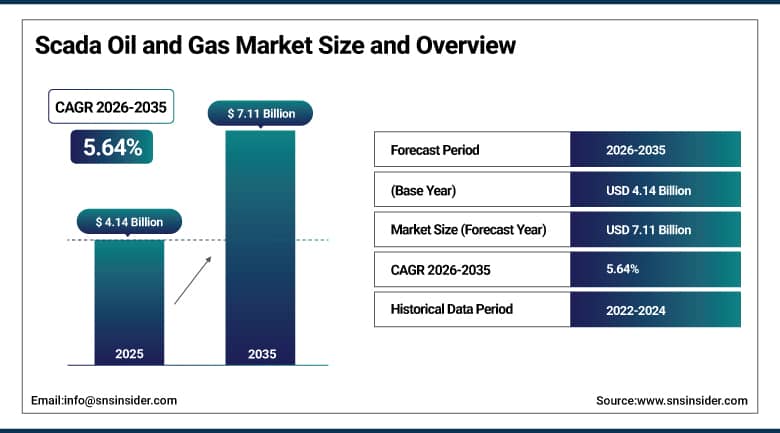
The SCADA Oil and Gas Market was valued at USD 4.14 billion in 2025 and is expected to reach USD 7.11 billion by 2035, growing at a CAGR of 5.64% from 2026–2035.
There are very strong dynamics in the market as far as growing demand for real-time monitoring, automation, and operational efficiency in both upstream, midstream, and downstream oil & gas operations. Investments into pipelines, refineries upgrades, offshore exploration, and digital oilfields are leading to increased use of sophisticated Scada platforms across the globe. Moreover, increasing security threats, leak detection requirements, cybersecurity issues, and uninterrupted energy transport are driving cloud-based AI-powered SCADA solutions.
In January 2026, multiple refinery operators across Asia-Pacific initiated large-scale modernization programs integrating centralized SCADA control rooms with advanced industrial cybersecurity frameworks and digital twin-based operational monitoring systems to improve refinery process visibility and reduce unplanned downtime.
Market Size and Forecast
-
Market Size 2026E: USD 4.34 Billion
-
Market Size 2035: USD 7.11 Billion
-
CAGR (2026 - 2035): 5.64%
-
Fastest Growing Region: Asia Pacific
-
Largest Region: North America
To Get More Information On SCADA Oil and Gas Market - Request Free Sample Report
SCADA Oil and Gas Market Trends
-
Rising adoption of AI-based predictive maintenance is improving oil & gas operational efficiency.
-
Increasing IIoT integration is accelerating deployment of smart SCADA systems.
-
Rising cybersecurity investments are strengthening protection of industrial SCADA networks.
-
Increasing refinery modernization and pipeline expansion projects are driving SCADA demand globally.
-
Growing adoption of 4G/5G industrial communication systems is improving remote monitoring performance.
The US Oil and Gas SCADA Market Size Outlook
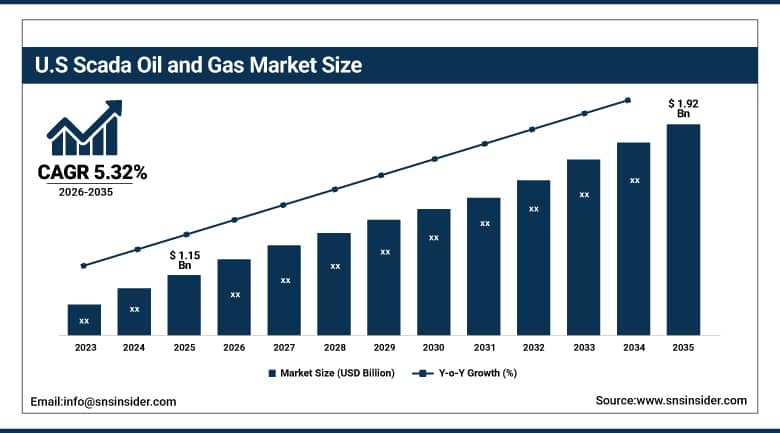
The U.S. Oil and Gas SCADA Market was valued at USD 1.15 billion in 2025 and is expected to reach around USD 1.92 billion by 2035, growing at a CAGR of 5.32% from 2026–2035.
The dominance of the United States in the SCADA Oil and Gas sector is owing to its rich pipeline networks, large number of activities involving shale oil & gas, as well as substantial investments being made in industrial automation solutions by companies involved in various sectors such as upstream, midstream and downstream oil & gas operations. The availability of top automation solution vendors such as Schneider Electric, Honeywell International Inc., Emerson Electric Co. and Rockwell Automation Inc. is driving the implementation of new SCADA technology solutions.
In April 2026, several U.S. pipeline operators expanded deployment of AI-enabled SCADA monitoring platforms featuring real-time leak detection and predictive maintenance capabilities across interstate transmission networks. Additionally, refinery operators accelerated upgrades toward cloud-connected SCADA control systems to improve operational visibility and cybersecurity resilience.
SCADA Oil and Gas Market Segment Analysis
-
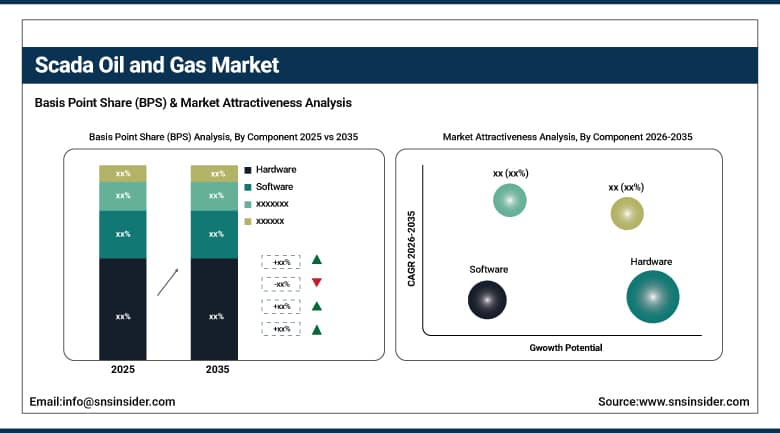
By Component, hardware dominated the SCADA Oil and Gas market with 48.64% share in 2025; software is the fastest-growing segment with the highest CAGR.
-
By Architecture, distributed SCADA dominated the SCADA Oil and Gas market with 34.45% share in 2025; IoT-based / cloud SCADA systems are the fastest-growing segment with the highest CAGR.
-
By Deployment Mode, on-premise SCADA systems dominated the SCADA Oil and Gas market with 62.42% share in 2025; Cloud-Based SCADA Solutions systems is the fastest-growing segment with the highest CAGR.
-
By Communication Technology, wired SCADA systems dominated the SCADA Oil and Gas market with 46.45% share in 2025; cellular (4G/5G) SCADA is the fastest-growing segment with the highest CAGR.
By Component, hardware dominates the SCADA Oil and Gas market, while software is the fastest-growing segment.
Hardware segment dominated the SCADA Oil and Gas market with the highest revenue share of about 48.64% in 2025 because of wide adoption of PLCs, RTUs, industrial sensors, communication devices, and HMI systems in upstream, midstream, and downstream processes in the oil and gas industry. Wide adoption of pipelines, refinery automation, and offshore monitoring systems depends on industrial hardware components, owing to their importance in real-time operation controls. The fact that hardware systems have an extended operating life and are crucial infrastructures contributes to dominance in the segment globally.
Software segment is projected to register the fastest CAGR during 2026–2035 driven by increasing popularity of applications such as AI-powered analytics tools, cloud-based SCADA software, predictive maintenance applications, and integrated operational monitoring systems. Rising awareness and emphasis on automation in industrial processes, security, and asset management is leading to rapid software deployment in oil and gas industry.
By Architecture, distributed SCADA dominates the SCADA Oil and Gas market, while IoT-based / cloud SCADA systems are the fastest-growing segment.
Distributed SCADA segment dominated the SCADA Oil and Gas market with the highest share of about 34.45% in 2025 due to its extensive applicability in complex oil and gas installations where decentralized monitoring of operations, reliability of the systems and process control are important. The reason being, its ability to manage field equipment, pipeline systems and refining processes from a networked control environment is the most preferred architectural approach for industrial sites.
IoT-based / cloud SCADA systems segment is expected to register the fastest CAGR during 2026–2035 owing to increased use of remote monitoring tools, edge computing solutions, and cloud-connected industrial automation systems. Rising spending on digital oilfields, intelligent pipeline monitoring, and analytics powered by artificial intelligence is leading to rapid adoption of cloud-based SCADA systems.
By Deployment Mode, on-premise SCADA systems dominate the SCADA Oil and Gas market, while cloud-based SCADA solutions are the fastest-growing segment.
On-premise SCADA systems segment held the dominant share of about 62.42% in 2025 as there is a high preference by oil & gas companies for industrial automation setups that offer high security, low latency, and total control within the network itself. Operations such as refineries, off-shore rigs, and pipelines are still choosing on-premise installation due to critical operational, cybersecurity, and compliance reasons.
Cloud-based SCADA solutions segment is projected to grow at the fastest CAGR during 2026–2035 motivated by escalating requirements for scalable remote monitoring, access to centrally located data, and efficient industrial automation management. Escalating trends of hybrid cloud computing, remote equipment diagnostics, and artificial intelligence-based analytics are driving fast growth in the industry.
By Communication Technology, wired SCADA systems dominate the SCADA Oil and Gas market, while cellular (4G/5G) SCADA is the fastest-growing segment.
Wired SCADA systems segment dominated the SCADA Oil and Gas market with the highest share of about 46.45% in 2025 due to its reliable communication and effective data transfer, and also being highly suited to critical industrial applications such as those in refineries, processing units, and pipeline management centers. The existing industrial infrastructure and reduced disruption risks associated with these wired communication systems ensure their wide use.
Cellular (4G/5G) SCADA segment is expected to record the fastest CAGR during 2026–2035 due to rising demand for real-time remote monitoring across offshore facilities, remote oilfields, and cross-country pipeline systems. Expansion of industrial 5G networks, low-latency connectivity, and growing adoption of wireless industrial automation technologies are significantly accelerating segment growth globally.
Regional Analysis:
|
Region |
Major Country |
Share within Region, 2025(%) |
|---|---|---|
|
North America |
United States |
81.54% |
|
Europe |
Germany |
29.31% |
|
Asia Pacific |
China |
47.14% |
|
Middle East & Africa |
UAE |
26.41% |
|
Latin America |
Brazil |
38.76% |
North America SCADA Oil and Gas Market Insights
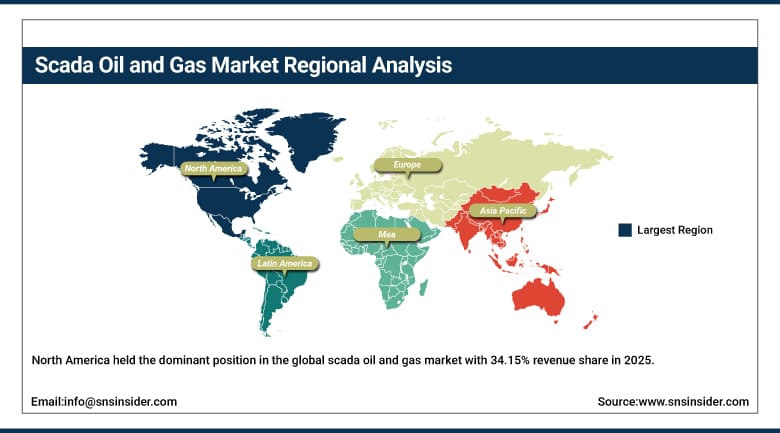
North America held the dominant position in the global SCADA Oil and Gas market with 34.15% revenue share in 2025, backed by shale oil and gas extraction, significant interstate pipeline infrastructure development, automation improvements within refineries, as well as the widespread implementation of digitalization solutions in the industrial environment of the U.S. and Canada. The region has seen significant adoption of sophisticated SCADA solutions for real-time monitoring of pipelines, leakage detection, compressor stations automation, and offshore facilities operation management. Growing investments in cybersecurity measures and artificial intelligence-powered predictive maintenance have only been boosting demand for modern SCADA solutions.
Industrial automation investments exceeding USD 1.2 billion were directed toward modernization of U.S. pipeline monitoring and refinery control infrastructure during 2025, while multiple Gulf Coast energy operators expanded deployment of AI-assisted SCADA systems across transmission networks covering more than 45,000 km of operational pipelines to improve leak detection accuracy and operational reliability.
Get Customized Report as Per Your Business Requirement - Enquiry Now
Europe SCADA Oil and Gas Market Insights
Europe constitutes a lucrative system for SCADA Oil and Gas market due to their excellent capabilities in terms of automation in industries, tough security regulations relating to energy infrastructure and modernization of refineries and pipelines. Industrial nations such as Germany, UK, Norway, France, and Netherlands have adopted highly sophisticated SCADA systems that incorporate elements of cybersecurity, IIOT, and predictive analytics. The shift towards energy-efficient operations and smart industrial infrastructures has further propelled the adoption of these intelligent monitoring systems in oil & gas operations.
More than EUR 3 billion was allocated toward industrial digitalization and energy infrastructure modernization projects across European oil & gas facilities during 2025, while North Sea offshore operators expanded deployment of satellite-enabled SCADA systems across remote production assets to strengthen operational visibility and reduce manual inspection frequency by nearly 20%.
Asia Pacific SCADA Oil and Gas Market Insights
Asia Pacific is projected to register the highest CAGR of 6.13% from 2026–2035 in SCADA Oil and Gas market. This is driven by the fast-growing capabilities in terms of refinery capacity, cross-border pipelines, construction of LNG terminals, and adoption of industrial automation technology in China, India, Southeast Asia, and Australia. Rising energy demand, offshore exploration activities, and investments in digital oilfields are majorly driving the installation of SCADA systems through cloud computing and remote monitoring solutions in the region.
China and India together accounted for more than 18,000 km of newly monitored oil & gas transmission pipelines integrated with digital SCADA platforms during 2025, while several LNG and refinery expansion projects across Southeast Asia implemented centralized remote monitoring systems supporting 24/7 operational control and automated process optimization.
Latin America, Middle East & Africa (LAMEA) SCADA Oil and Gas Market Insights
There have been consistent growth trends in the LAMEA SCADA Oil and Gas market owing to increased upstream exploration operations, massive cross-country pipeline projects, refinery automation projects, and industrial remote monitoring technology investments in Saudi Arabia, UAE, Brazil, Mexico, Nigeria, and South Africa. Increasing reliance on oil & gas transmission pipelines and offshore installations has greatly boosted the demand for sophisticated SCADA technology solutions that can facilitate remote central management and prediction capabilities in harsh operating environments.
Middle East energy operators expanded digital monitoring coverage across more than 30,000 km of oil & gas transmission infrastructure during 2025 through integration of cloud-connected SCADA and industrial cybersecurity systems, while Brazilian offshore projects accelerated deployment of remote automation platforms supporting real-time operational monitoring across deepwater production zones exceeding 2,000 meters in depth.
Market Dynamics:
Growth Drivers: Increasing investment in industrial automation and real-time pipeline monitoring is accelerating adoption of advanced SCADA systems across oil & gas operations
The growing need for operational efficiency, asset visibility, and industrial control from afar is playing an important role in the deployment of SCADA systems for oil & gas applications. Companies are making greater investments in automation technology that will aid in pipeline monitoring, process optimization in refineries, leak detection, and predictive maintenance. The rapid growth in the use of cross-border pipelines, offshore drilling operations, and LNG plants is encouraging companies to opt for cloud-based SCADA systems integrated with artificial intelligence. Besides, the growing importance of industrial cybersecurity, safety, and reduced downtime is also helping fuel the modernization of legacy systems in oil & gas operations.
Restraints: Rising cybersecurity risks and high modernization costs are limiting adoption of advanced SCADA infrastructure across aging oil & gas facilities
Increasing vulnerability of industrial control systems to cyber-attacks, ransomware attacks, and network security breaches constitutes another key constraint facing the growth trajectory of SCADA Oil and Gas industry. Several players within the sector still use outdated automation systems that would need substantial investments for integration with advanced technology platforms. The prohibitive nature of investments in terms of setting up industrial communication systems, adopting cloud computing, and ensuring cybersecurity compliance is posing a hurdle to the growth potential of the sector. Moreover, system integration issues and scarcity of trained industrial automation professionals have also hindered large-scale deployment in various emerging energy regions.
Opportunities: Expanding deployment of AI-enabled industrial automation and cloud-based remote monitoring platforms is creating new growth opportunities in digital oilfield operations
The fast-paced developments of analytics through AI, edge computing, IIoT, and cloud-based automation technologies create a number of promising prospects for the next-gen SCADA implementation within the field of oil and gas exploration activities. More energy companies tend to implement intelligent monitoring systems that will be able to deliver predictive maintenance services, autonomous process control, and real-time diagnostics in remote production assets. The expansion of investment into smart pipelines, unmanned offshore plants, and digital refining facilities drives the increasing demand for SCADA environments. Besides, the adoption of 5G communication technology and digital twins creates additional benefits in managing remote assets.
Recent Developments
-
2026: Schneider Electric expanded deployment of AI-enabled pipeline SCADA platforms integrated with predictive maintenance analytics and industrial cybersecurity systems to strengthen real-time monitoring capabilities across North American oil & gas transmission networks.
-
2026: Honeywell International Inc. introduced upgraded cloud-native SCADA solutions featuring edge computing integration and low-latency operational control for offshore oilfield and LNG infrastructure applications across the Middle East and Asia-Pacific.
-
2025: Emerson Electric Co. enhanced its industrial automation portfolio with next-generation remote asset monitoring systems supporting centralized refinery control, intelligent alarm management, and AI-assisted operational diagnostics for large-scale energy facilities.
-
2025: Siemens AG expanded deployment of digital oilfield automation solutions incorporating industrial IoT connectivity and secure SCADA communication architectures to improve pipeline efficiency and remote infrastructure visibility across European energy operations.
SCADA Oil and Gas Companies are:
-
Schneider Electric
-
ABB Ltd.
-
Honeywell International Inc.
-
Emerson Electric Co.
-
Rockwell Automation Inc.
-
Mitsubishi Electric Corporation
-
General Electric (GE Vernova)
-
Hitachi Energy Ltd.
-
AVEVA Group plc
-
Inductive Automation
-
Bentley Systems Incorporated
-
Cisco Systems Inc.
-
Huawei Technologies Co., Ltd.
-
Omron Corporation
-
Phoenix Contact GmbH & Co. KG
-
Larsen & Toubro Limited (L&T Technology Services)
-
WAGO GmbH & Co. KG
-
TechnipFMC plc
SCADA Oil and Gas Market Report Scope:
| Report Attributes | Details |
|---|---|
| Market Size in 2025 | USD 4.14 Billion |
| Market Size by 2035 | USD 7.11 Billion |
| CAGR | CAGR of 5.64% From 2026 to 2035 |
| Base Year | 2025 |
| Forecast Period | 2026-2035 |
| Historical Data | 2022-2024 |
| Report Scope & Coverage | Market Size, Segments Analysis, Competitive Landscape, Regional Analysis, DROC & SWOT Analysis, Forecast Outlook |
| Key Segments | • By Component (Hardware, Software, Services) • By Architecture (Monolithic SCADA, Distributed SCADA, IoT-based / Cloud SCADA Systems, Networked SCADA) • By Deployment Mode (On-Premise SCADA Systems, Cloud-Based SCADA Solutions, Hybrid SCADA Systems) • By Communication Technology (Wired SCADA Systems, Wireless SCADA Systems, Cellular (4G/5G) SCADA, Satellite-based SCADA) |
| Regional Analysis/Coverage | North America (US, Canada), Europe (Germany, UK, France, Italy, Spain, Russia, Poland, Rest of Europe), Asia Pacific (China, India, Japan, South Korea, Australia, ASEAN Countries, Rest of Asia Pacific), Middle East & Africa (UAE, Saudi Arabia, Qatar, South Africa, Rest of Middle East & Africa), Latin America (Brazil, Argentina, Mexico, Colombia, Rest of Latin America). |
| Company Profiles | Schneider Electric, Siemens AG, ABB Ltd., Honeywell International Inc., Emerson Electric Co., Rockwell Automation Inc., Yokogawa Electric Corporation, Mitsubishi Electric Corporation, General Electric (GE Vernova), Hitachi Energy Ltd., AVEVA Group plc, Inductive Automation, Bentley Systems Incorporated, Cisco Systems Inc., Huawei Technologies Co., Ltd., Omron Corporation, Phoenix Contact GmbH & Co. KG, Larsen & Toubro Limited (L&T Technology Services), WAGO GmbH & Co. KG, TechnipFMC plc |
Frequently Asked Questions
The SCADA Oil and Gas Market is expected to grow at a CAGR of 5.64% from 2026 to 2035.
The SCADA Oil and Gas Market was valued at USD 4.14 billion in 2025.
Rising investments in pipeline automation, refinery modernization, offshore exploration activities, industrial cybersecurity infrastructure, and real-time remote monitoring systems are driving adoption of SCADA Oil and Gas solutions globally.
The hardware segment dominated the SCADA Oil and Gas Market in 2025.
North America dominated the SCADA Oil and Gas Market in 2025.
Get in Touch
