
Ophthalmic Surgical Robotics Market Report Scope and Overview:
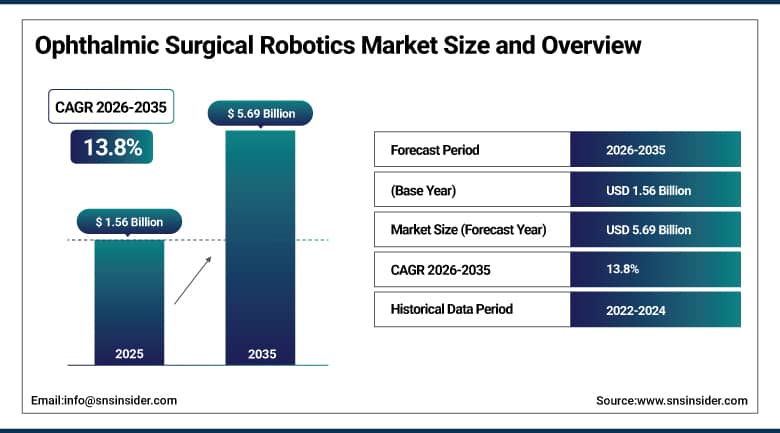
The Ophthalmic Surgical Robotics Market was valued at USD 1.56 Billion in 2025 and is projected to reach USD 5.69 Billion by 2035, registering a CAGR of 13.8% from 2026 to 2035.
The ophthalmic surgical robotics Market is changing the field of cataract, retinal and corneal surgeries through the development of AI-supported robotic systems, image-guided visualization and femtosecond laser technology to attain levels of precision that cannot be attained by humans without assistance in performing microsurgeries on delicate eye tissues. The industry is characterized by rapid deployment of specialized autonomous cataract surgery systems, growing body of scientific support for robotic-assisted retinal microsurgery with high levels of precision and further use of computer vision/AI in guiding software systems. Growth drivers in the industry include wearable digital visualization headsets, teleoperated systems and advanced femtosecond lasers as medical institutions invest more money in the wake of high demand globally for cataracts, glaucoma and retinal diseases.
In 2025, ForSight Robotics, an Israel-based medical robotics company, raised USD 135 million in Series B funding to advance its Oryom robotic system, an AI-guided autonomous platform designed specifically for cataract surgery, the world's most commonly performed surgical procedure, toward clinical trials and eventual commercialization.
To Get More Information On Ophthalmic Surgical Robotics Market - Request Free Sample Report
Ophthalmic Surgical Robotics Market Trends
-
Rapid emergence of dedicated autonomous cataract robotics platforms continues reshaping the world's most common eye surgery.
-
Growing clinical validation of robotic-assisted retinal microsurgery continues enabling procedures too precise for manual manipulation.
-
Expanding integration of computer vision and AI into surgical guidance continues improving procedural accuracy and outcomes.
-
Rising adoption of wearable digital visualization platforms continues replacing traditional optical surgical microscopes.
-
Increasing femtosecond laser integration with robotic guidance systems continues advancing image-guided cataract surgery precision.
U.S. Ophthalmic Surgical Robotics Market Outlook
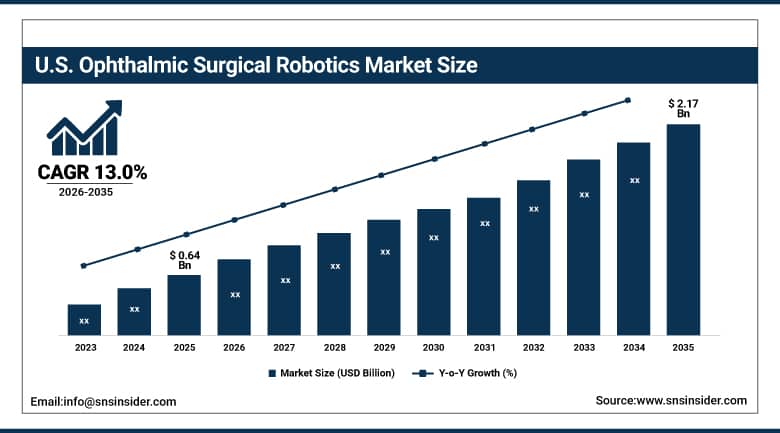
The U.S. Ophthalmic Surgical Robotics Market was valued at approximately USD 0.64 Billion in 2025 and is projected to reach approximately USD 2.17 Billion by 2035, registering a CAGR of approximately 13.0% from 2026 to 2035.
Demand across the United States continued to be shaped by a dense concentration of high-volume cataract and retinal surgery centers, favorable FDA regulatory pathways for novel surgical robotics, and substantial private investment funding emerging ophthalmic robotics startups. Rising deployment of AI-guided cataract and femtosecond laser platforms by leading academic and community ophthalmology practices continued reinforcing the country's position as both the largest and most innovation-driven ophthalmic surgical robotics market. Growing adoption across ambulatory surgical centers and specialty ophthalmology clinics added further layers of sustained domestic demand well beyond the technology's traditional hospital-based use case, with expanding same-day cataract surgery volumes increasingly relying on precision-enhancing robotic and image-guided technology.
In 2025, Alcon Inc. continued investing in next-generation phacoemulsification and robotic-assisted surgical platform research, building on its established LenSx femtosecond laser system for image-guided cataract surgery to reinforce its position among American ophthalmology practices adopting advanced surgical technology.
Ophthalmic Surgical Robotics Market Segment Analysis
-
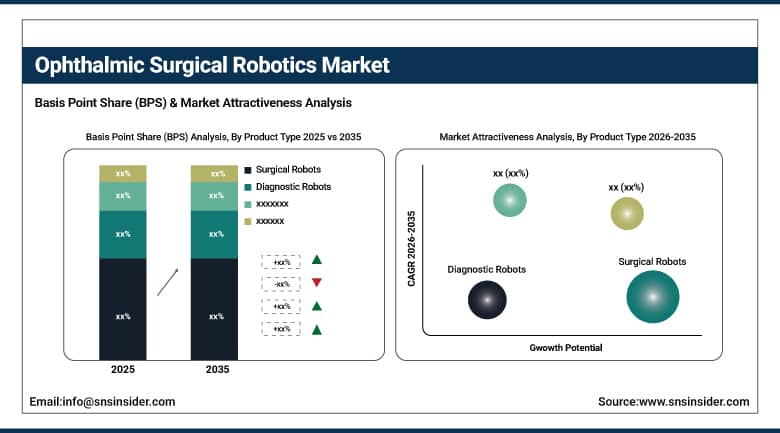
By Product Type, Surgical Robots segment dominated the Ophthalmic Surgical Robotics Market in 2025 with 74% share; Diagnostic Robots segment is the fastest growing segment, registering a CAGR of 15.2% from 2026 to 2035.
-
By Application, Cataract Surgery segment dominated the market in 2025 with 56% share; Retinal Surgery segment is the fastest growing segment, registering a CAGR of 15.0% from 2026 to 2035.
-
By Technology, Robotic-Assisted Surgery segment dominated the market in 2025 with 68% share; Computer Vision-Based Surgery segment is the fastest growing segment, registering a CAGR of 15.4% from 2026 to 2035.
-
By End-User, Hospitals segment dominated the market in 2025 with 54% share; Ambulatory Surgical Centers segment is the fastest growing segment, registering a CAGR of 14.7% from 2026 to 2035.
By Product Type: Surgical Robots Lead, Diagnostic Robots Emerge as Fastest-Growing Segment
The Surgical Robots segment dominated the Ophthalmic Surgical Robotics Market in 2025, driven by their role as the core revenue-generating platform across every robotic-assisted cataract and retinal procedure performed in hospitals and ophthalmology clinics. Established clinical validation for femtosecond laser-integrated and image-guided surgical platforms sustained steady adoption across high-volume cataract surgery centers seeking precision improvements over manual technique. Growing use of autonomous and semi-autonomous surgical robots, combined with expanding indications across retinal and corneal procedures, reinforced surgical robots revenue as the single largest contributor to total market spending throughout the base year.
The Diagnostic Robots segment is the fastest growing in the Ophthalmic Surgical Robotics Market owing to rising integration of AI-powered diagnostic imaging directly into surgical planning and intraoperative guidance workflows. Growing demand for real-time optical coherence tomography and automated biometry integrated with robotic surgical platforms is driving ophthalmology practices to invest in combined diagnostic-surgical systems rather than standalone diagnostic equipment. Rising vendor investment in AI-enabled preoperative planning tools continues extending diagnostic robotics capability well beyond traditional standalone imaging equipment.
By Application: Cataract Surgery Dominates, Retinal Surgery Gains Fastest Momentum
The Cataract Surgery segment dominated the Ophthalmic Surgical Robotics Market because cataract surgery remains the world's most commonly performed surgical procedure, creating the largest addressable procedure volume for any robotic or laser-assisted ophthalmic technology. Rising global prevalence of age-related cataracts among an aging population, combined with growing patient and surgeon preference for femtosecond laser-assisted precision, has sustained high procedure volumes across established and emerging robotic cataract platforms. Increased use of image-guided robotic systems to improve capsulorhexis consistency and reduce complication rates contributed to sustained segment dominance throughout the base year.
The Retinal Surgery segment is the fastest growing as robotic platforms like the Preceyes Surgical System increasingly address vitreoretinal procedures requiring a level of precision and tremor elimination that exceeds unassisted human surgical capability. Rising clinical evidence supporting robotic assistance in retinal vein cannulation and membrane peeling procedures continues expanding adoption among specialized vitreoretinal surgery centers. Growing physician confidence in robotic-assisted retinal microsurgery is driving faster adoption across leading academic ophthalmology programs treating complex retinal disease worldwide.
By Technology: Robotic-Assisted Surgery Dominates, Computer Vision Grows Fastest
The Robotic-Assisted Surgery segment was the leading subsegment in the Ophthalmic Surgical Robotics Market due to being the most mature technology type in terms of clinical acceptance, encompassing both femtosecond laser-assisted cataract surgery platforms and autonomous surgical platforms which are still under development. Maturity in the regulatory pathway and robust training programs for surgeons using the technology helped maintain the dominance of this particular technology subsegment in the overall market in the base year period.
The Computer Vision-Based Surgery segment is the fastest growing due to rising integration of AI-powered image recognition and real-time anatomical tracking into surgical guidance systems, enabling more autonomous and adaptive robotic behavior during delicate ocular procedures. Growing clinical evidence supporting computer vision-enhanced precision in capsulorhexis sizing and instrument positioning continues expanding adoption among next-generation robotic platform developers. Rising vendor investment in AI-driven surgical guidance is accelerating this technology's transition from research-stage innovation toward mainstream commercial deployment across leading ophthalmic surgical centers worldwide.
By End-User: Hospitals Dominate, Ambulatory Surgical Centers Grow Fastest
Hospitals was the leading segment within the Ophthalmic Surgical Robotics Market owing to the presence of well-established facilities for performing ophthalmic surgical procedures using robotic technology as well as the capacity to perform complicated robotic-assisted retinal and corneal surgeries that involve multidisciplinary teams of healthcare professionals. The largest procedure volumes continue to be performed at academic and tertiary hospitals within robotic-assisted cataract surgery and retinal surgery programs, ensuring continuous platform and consumables usage.
The Ambulatory Surgical Centers segment is expected to witness the fastest growth in the Ophthalmic Surgical Robotics Market as the vast majority of cataract procedures continue migrating toward lower-cost, high-throughput outpatient settings supported by favorable reimbursement structures. Growing numbers of ophthalmologists performing same-day discharge robotic-assisted cataract procedures increasingly rely on ambulatory surgical centers equipped with compact robotic platforms to deliver hospital-comparable precision in a more cost-efficient, higher-volume setting. Expanding ambulatory surgical center adoption of femtosecond laser and robotic platforms continues attracting a broadening base of cost-conscious health systems.
Regional Analysis
|
Region |
Major Country |
Share within Region, 2025 (%) |
|---|---|---|
|
North America |
United States |
85.00% |
|
Europe |
Germany |
21.60% |
|
Asia Pacific |
China |
27.80% |
|
Middle East and Africa |
Saudi Arabia |
23.40% |
|
Latin America |
Brazil |
33.00% |
North America Ophthalmic Surgical Robotics Market Insights
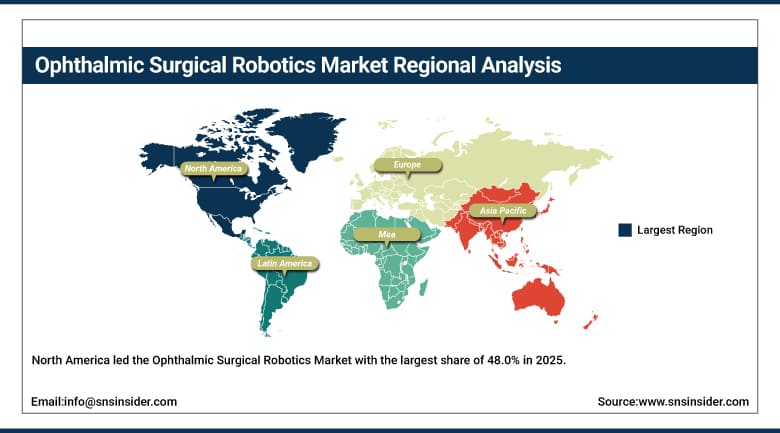
North America led the Ophthalmic Surgical Robotics Market with the largest share of 48.0% in 2025. A dense concentration of high-volume cataract and retinal surgery centers, favorable FDA regulatory pathways for novel surgical robotics, and substantial private investment funding emerging ophthalmic robotics startups continued reinforcing this dominant regional position. A deep concentration of leading device manufacturers, academic ophthalmology programs, and venture-backed robotics startups headquartered across the continent gave regional surgeons early access to next-generation autonomous and AI-guided surgical platforms well ahead of most other regions.
The United States accounted for larger share of regional revenue, anchored by a dense cluster of high-volume ophthalmology practices, rapid venture capital investment in ophthalmic robotics startups, and expanding same-day discharge protocols across ambulatory surgical centers. Canada added further regional demand through its own growing cataract surgery volumes and expanding public health system investment in advanced ophthalmic technology, and that combined strength kept the continent the largest addressable market for ophthalmic surgical robotics vendors through the forecast period.
Get Customized Report as Per Your Business Requirement - Enquiry Now
Europe Ophthalmic Surgical Robotics Market Insights
Europe held a meaningful share of global revenue, supported by rising prevalence of age-related eye disease, expanding national reimbursement coverage for femtosecond laser-assisted procedures, and continued growth of specialized ophthalmic robotics research programs across the region's major economies. Regulatory harmonization under the EU Medical Device Regulation and continued expansion of high-volume ophthalmic surgical training centers continued lowering historically significant barriers to advanced surgical robotics technology adoption across the continent.
Germany led demand of the European revenue, supported by its substantial ophthalmic device manufacturing base, including Carl Zeiss Meditec and Ziemer, and high per-capita cataract surgery procedure volumes among the region's largest economies. The UK and France contributed substantial additional demand through their own expanding robotic-assisted ophthalmic surgery programs, and continued European investment in surgical robotics infrastructure should keep regional demand for ophthalmic surgical robotics technology climbing through the forecast period.
Asia Pacific Ophthalmic Surgical Robotics Market Insights
Asia Pacific is expected to grow at the fastest CAGR of about 17.5% from 2026 to 2035, driven by the region's massive and rapidly aging cataract and retinal disease patient population, expanding healthcare expenditure, and growing government-backed investment in advanced ophthalmic surgical infrastructure across the region's largest economies. That combination of enormous procedure volumes and expanding domestic device manufacturing capacity kept the region's growth trajectory well ahead of every other region tracked in this report.
China led the pack, supported by its massive cataract surgery procedure volumes and rapidly expanding domestic ophthalmic device manufacturing capability. Japan and South Korea contributed meaningful additional demand, with South Korea's Meere Company advancing domestic robotic-assisted cataract platforms and Japan's advanced ophthalmic device manufacturing base, both reinforcing the region's position as the fastest-growing market tracked in this report.
MEA and Latin America Ophthalmic Surgical Robotics Market Insights
The Middle East and Africa and Latin America both showed steady growth, driven by expanding ophthalmic surgical infrastructure, rising government investment in tertiary eye care, and growing surgeon training in robotic-assisted cataract and retinal procedures across both areas. As these markets continued building out modern ophthalmic surgical infrastructure, robotic and image-guided technology proved a genuinely efficient way to expand advanced procedural capability without the decades-long buildout wealthier nations required.
Saudi Arabia led Middle East and Africa demand, supported by the country's substantial healthcare investment under its national healthcare transformation programs targeting rising cataract and diabetic retinopathy prevalence. The UAE contributed further demand through its own expanding private hospital network and ophthalmic surgical capability. In Latin America, Brazil accounted for the largest share of regional revenue, with growing cataract surgery adoption and academic ophthalmology training continuing to anchor regional demand for ophthalmic surgical robotics technology.
Market Dynamics
Growth Drivers: Rising Global Cataract Burden and Growing AI-Guided Surgical Adoption
The industry is driven by rising global prevalence of age-related cataracts, glaucoma, and retinal disease among aging populations, growing surgeon and patient preference for AI-guided and femtosecond laser-assisted precision over manual technique, increasing venture capital investment in dedicated ophthalmic robotics startups, and expanding indications spanning cataract, retinal, and corneal surgery. As global cataract surgery volumes continue rising with population aging, the need for scalable, precision-enhancing surgical technology continues driving adoption of ophthalmic surgical robotics.
Rising clinical evidence supporting robotic assistance in traditionally manual-only procedures, such as retinal vein cannulation, continues reinforcing this driver, as more surgeons adopt robotic-first protocols for procedures previously considered too delicate for any mechanical assistance. Growing competitive investment from both established ophthalmic device incumbents and venture-backed robotics startups continues expanding platform availability and clinical indications, and that combination of clinical validation and intensifying competition is exactly what keeps demand climbing at such a steady, sustained pace.
Restraints: High Platform Costs and Limited Trained Surgeon Availability
The substantial capital cost of dedicated ophthalmic surgical robotics platforms continues posing a genuine restraint on faster market-wide expansion, particularly across emerging healthcare systems and smaller ophthalmology practices without the procedure volumes needed to justify premium robotic technology adoption. That cost profile has kept large-scale ophthalmic surgical robotics capability concentrated among a comparatively small number of well-resourced academic and high-volume surgical centers.
Limited availability of surgeons trained on emerging robotic-assisted ophthalmic platforms continues posing a further restraint, as newer autonomous and semi-autonomous systems require dedicated training programs that many ophthalmology residency programs have not yet fully integrated. That training gap keeps some smaller ophthalmic practices reliant on conventional manual and femtosecond laser-only techniques rather than adopting fully robotic-assisted surgical technology of their own.
Opportunities: Autonomous Cataract Platforms and Emerging Market Eye Care Infrastructure
Rising investment in autonomous and semi-autonomous cataract robotics platforms represents a genuinely significant opportunity, as venture-backed startups increasingly seek to address the world's single largest surgical procedure volume with technology designed to reduce dependency on scarce, highly trained ophthalmic surgeons. Companies positioned early in AI-guided autonomous surgical technology stand to capture meaningful share as this capability continues expanding from specialized academic centers into mainstream high-volume cataract surgery practice.
Closing eye care infrastructure gaps across emerging markets offers a second substantial opportunity, as government initiatives aimed at expanding tertiary ophthalmic care capacity continue creating fresh demand for accessible, scalable robotic surgical infrastructure capable of addressing enormous underserved cataract and retinal disease patient populations. Vendors with proven, cost-effective robotic and image-guided platforms stand to capture meaningful share as developing economies increasingly view in-house ophthalmic surgical capability as a genuinely practical way to reduce preventable vision loss at scale.
Recent Developments:
-
2025: Preceyes B.V. received continued clinical validation for its Preceyes Surgical System, the world's first CE-marked robotic platform specifically designed for retinal microsurgery, used in ongoing vitreoretinal surgical trials.
-
2025: Acu-Surgical SAS advanced clinical development of its ACUSURGE robotic-assisted cataract surgery system, designed to improve precision during capsulorhexis and lens extraction procedures.
-
2025: Carl Zeiss Meditec AG expanded its image-guided surgical ecosystem with continued integration between its CALLISTO eye guidance system and ARTEVO surgical microscopes for robotic-assisted ophthalmic procedures.
Ophthalmic Surgical Robotics Market key players are:
-
ForSight Robotics Ltd.
-
Preceyes B.V.
-
Acu-Surgical SAS
-
Carl Zeiss Meditec AG
-
Alcon Inc.
-
Johnson & Johnson Vision (J&J MedTech)
-
Bausch + Lomb Corporation
-
Intuitive Surgical, Inc.
-
Medtronic plc
-
Stryker Corporation
-
Meere Company Inc.
-
Karl Storz SE & Co. KG
-
Haag-Streit Group
-
Topcon Corporation
-
NIDEK Co., Ltd.
-
Ziemer Ophthalmic Systems AG
-
Leica Microsystems (Danaher)
-
Beyeonics Surgical Ltd.
-
Ellex Medical Lasers Limited
-
Vitreq B.V.
Ophthalmic Surgical Robotics Market:
| Report Attributes | Details |
|---|---|
| Market Size in 2025 | USD 1.56 Billion |
| Market Size by 2035 | USD 5.69 Billion |
| CAGR | CAGR of 13.8% From 2026 to 2035 |
| Base Year | 2025 |
| Forecast Period | 2026-2035 |
| Historical Data | 2022-2024 |
| Report Scope & Coverage | Market Size, Segments Analysis, Competitive Landscape, Regional Analysis, DROC & SWOT Analysis, Forecast Outlook |
| Key Segments | • By Product Type (Surgical Robots, Diagnostic Robots, Rehabilitation Robots) • By Application (Cataract Surgery, Retinal Surgery, Glaucoma Surgery, Corneal Surgery, Others) • By Technology (Robotic-Assisted Surgery, Teleoperated Surgery, Computer Vision-Based Surgery) • By End-User (Hospitals, Ambulatory Surgical Centers, Ophthalmology Clinics) |
| Regional Analysis/Coverage | North America (US, Canada), Europe (Germany, UK, France, Italy, Spain, Russia, Poland, Rest of Europe), Asia Pacific (China, India, Japan, South Korea, Australia, ASEAN Countries, Rest of Asia Pacific), Middle East & Africa (UAE, Saudi Arabia, Qatar, South Africa, Rest of Middle East & Africa), Latin America (Brazil, Argentina, Mexico, Colombia, Rest of Latin America). |
| Company Profiles | ForSight Robotics Ltd., Preceyes B.V., Acu-Surgical SAS, Carl Zeiss Meditec AG, Alcon Inc., Johnson & Johnson Vision (J&J MedTech), Bausch + Lomb Corporation, Intuitive Surgical, Inc., Medtronic plc, Stryker Corporation, Meere Company Inc., Karl Storz SE & Co. KG, Haag-Streit Group, Topcon Corporation, NIDEK Co., Ltd., Ziemer Ophthalmic Systems AG, Leica Microsystems (Danaher), Beyeonics Surgical Ltd., Ellex Medical Lasers Limited, Vitreq B.V. |

Frequently Asked Questions
Key players include ForSight Robotics Ltd., Preceyes B.V., Acu-Surgical SAS, Carl Zeiss Meditec AG, and Alcon Inc., among others.
Key opportunities include increasing adoption of robotic-assisted ophthalmic procedures, technological advancements in surgical precision, rising demand for minimally invasive techniques, and expanding applications in complex eye surgeries.
The major growth factor is rising global prevalence of cataracts and retinal disease, growing preference for AI-guided precision surgery, and increasing venture capital investment in dedicated ophthalmic robotics platforms.
The Surgical Robots segment dominated the Ophthalmic Surgical Robotics Market by product type, representing the largest share of revenue in 2025.
