
Uterine Fibroids Non-Surgical Treatment Market Report Scope & Overview:
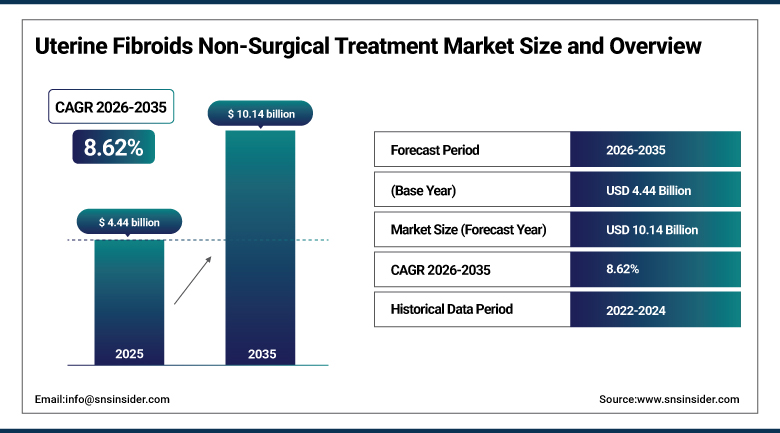
The Uterine Fibroids Non-Surgical Treatment Market was valued at USD 4.44 Billion in 2025 and is projected to reach USD 10.14 Billion by 2035, expanding at a CAGR of 8.62% during the forecast period 2026–2035.
The global market for non-surgical uterine fibroids treatment is exhibiting steady growth due to increasing prevalence of uterine fibroids in women of reproductive age, growing inclination towards uterine preservation techniques and ongoing development in minimally invasive treatment methods. Increased awareness of early diagnosis, advancements in gynecological imaging techniques and widespread adoption of advanced hormonal treatments have greatly helped in increasing acceptance of non-surgical treatments.
There is an increasing trend among medical practitioners of developing personalized treatment approaches for reducing hospital stays, preservation of fertility, reduction in recovery time and better quality of life. In addition to this, increasing investments in women's health sector, reimbursement support in developed nations for minimally invasive procedures and better accessibility to advanced gynecological treatments in developing nations are contributing to strong future growth in the market. In 2025, there has been an increase in the indications and marketing strategy for oral GnRH antagonist medications, while there has been higher investment made by healthcare providers in image guided minimally invasive uterine fibroids treatment programs.
To Get more information Uterine Fibroids Non-Surgical Treatment Market - Request Free Sample Report
Uterine Fibroids Non-Surgical Treatment Market Trends
-
Growing adoption of oral GnRH antagonist therapies for long-term symptom management.
-
Increasing utilization of MRI-guided focused ultrasound as a uterus-preserving treatment option.
-
Rising demand for minimally invasive outpatient uterine fibroid procedures worldwide.
-
Expansion of advanced diagnostic imaging technologies supporting earlier fibroid detection.
-
Increasing investment in women's health innovation and fertility-preserving treatment strategies.
The U.S. Uterine Fibroids Non-Surgical Treatment Market Size Outlook
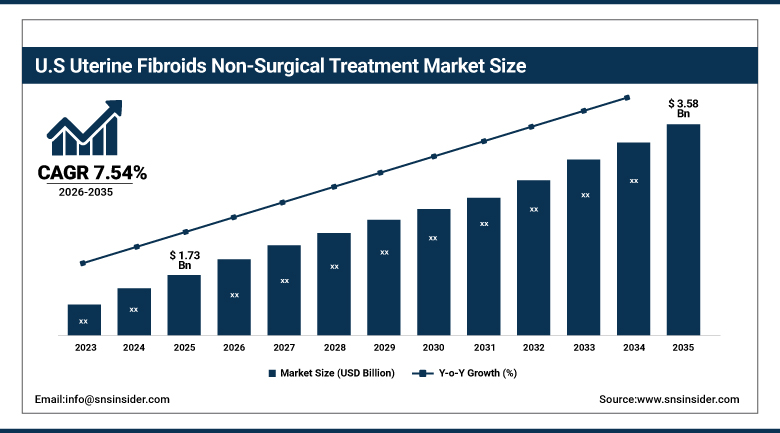
The U.S. Uterine Fibroids Non-Surgical Treatment Market was valued at USD 1.73 billion in 2025 and is expected to reach approximately USD 3.58 billion by 2035, expanding at a CAGR of 7.54% during 2026–2035.
The United States is likely to remain the market leader in the global uterine fibroids non-surgical treatment market owing to the state-of-the-art healthcare system for women, high levels of awareness on minimally invasive gynecologic procedures, favorable reimbursement scenario, and adoption of innovative drug-based solutions. Higher rates of diagnosis aided by routine gynecologic screening, easy availability of FDA-approved oral GnRH antagonist drugs, and greater access to imaging guided uterine conservative procedures are likely to drive market demand. In addition, healthcare facilities are focusing on fertility preserving solutions that minimize hospitalizations and lower the cost of healthcare.
The increasing investments in research pertaining to women's health care, establishment of outpatient gynecology centers, and greater use of technologically advanced procedures such as MRI guided treatment are likely to aid the leadership of the country in the coming years. In 2025, the leading players in the pharmaceutical industry intensified their commercialization activities of next-generation oral GnRH antagonist drugs in the country, while key healthcare facilities witnessed higher adoption of MRI guided focused ultrasound and minimally invasive uterine artery embolization procedures.
Uterine Fibroids Non-Surgical Treatment Market Segment Analysis
-
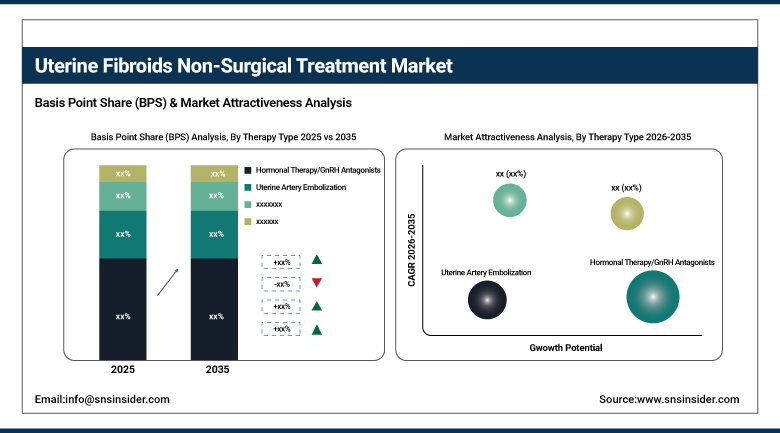
By Therapy Type, hormonal therapy/GnRH antagonists dominated the market with 37.00% share in 2025, while MRI-guided focused ultrasound is projected to witness the fastest growth with a CAGR of 14.32% during the forecast period.
-
By End User, hospitals dominated the market with 39.00% share in 2025, while diagnostic & imaging centers are projected to register the fastest CAGR of 10.21% during the forecast period.
By Therapy Type, hormonal therapy/GnRH antagonists dominated, while MRI-guided focused ultrasound fastest-growing segment.
The hormonal therapy/GnRH antagonists segment dominated the market and generated the maximum revenue share of 37.00% in 2025. This can be attributed to increased usage of oral GnRH antagonists in managing heavy menstrual bleeding along with the reduction in fibroid size without compromising on the fertility rate. Increasing commercial acceptance across regions has been fueled by availability of oral medication for managing fibroids, rising patient compliance, and physicians' preference for a non-invasive treatment approach as the first choice.U.S. FDA has extended indications of Myfembree (relugolix combination therapy) for extending the period of treatment in case of moderate to severe symptoms of uterine fibroids, which has resulted in building up confidence in the long-term efficacy of oral GnRH antagonist.
MRI-guided focused ultrasound (MRgFUS) segment is anticipated to record the highest CAGR of 14.32% during 2026-2035 due to increasing preference for non-invasive and fertility-saving alternative treatments. Improvement in effectiveness of the procedure due to advancements in MRI imaging technology, precision of thermal ablation technique, and monitoring during the course of the procedure has fueled the adoption of MRgFUS in treating fibroids. Healthcare providers are increasingly adopting MRgFUS with advanced image-guided therapy systems launched by major players in the medical imaging industry.
By End User, hospitals dominated, while diagnostic & imaging centers fastest-growing segment.
The hospitals segment accounted for the highest market share of 39.00% in 2025, driven by the presence of complete gynecology department, multi-specialty treatment, advanced imaging infrastructure, and presence of specialists. Hospitals will continue to remain the preferred choice for treatment modalities such as uterine artery embolization, radiofrequency ablation, and complicated image guided treatment of fibroids. Several academic medical centers introduced complete women's health care programs featuring minimally invasive treatments and image guided treatments for uterine fibroids. Increasing investments in women's health centers, expansion of minimally invasive gynecologic surgery programs, and adoption of advanced MRI and ultrasound technologies continue strengthening hospital-based treatment volumes. Furthermore, favorable reimbursement policies and higher patient confidence in tertiary healthcare institutions continue reinforcing the segment's leadership globally.
The diagnostic & imaging centers segment is expected to witness the highest growth rate at a CAGR of 10.21% during the forecast period owing to increased use of advanced imaging modalities like MRI and high resolution ultrasound for diagnosis, treatment planning, and performing image guided procedures for fibroids. Increased investment in imaging infrastructure, increasing referrals from gynecologists, and increasing number of outpatient diagnostic procedures are driving the rapid growth of the market. Increasing accuracy, reduced procedure time, and increasing demand for minimally invasive outpatient procedures are prompting healthcare providers to work with diagnostic centers, especially within the urban healthcare delivery system and developing countries. Advanced imaging technology providers continue launching new MRI and ultrasound devices specific to women's health applications.
Regional Analysis
|
Region |
Major Country |
Share within Region, 2025 (%) |
|---|---|---|
|
North America |
United States |
93.50% |
|
Europe |
Germany |
27.00% |
|
Asia Pacific |
China |
22.00% |
|
Middle East & Africa |
UAE |
5.00% |
|
Latin America |
Brazil |
4.00% |
North America Uterine Fibroids Non-Surgical Treatment Market Insights
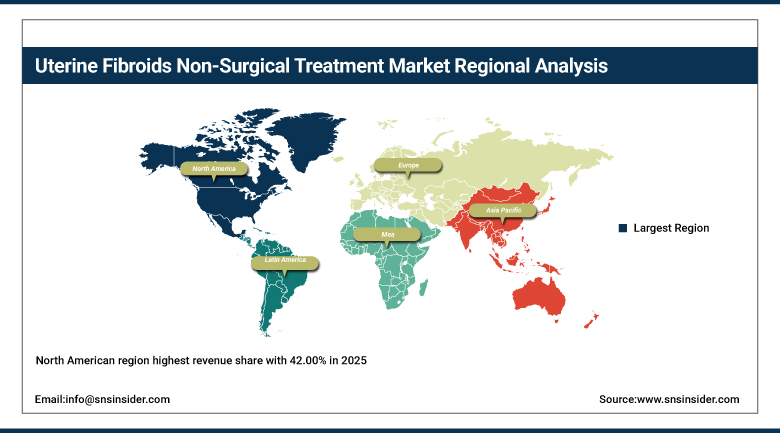
The North American region has taken lead in the worldwide uterine fibroids non-surgical treatments market in terms of the highest revenue share with 42.00% in 2025 because of well-developed women healthcare facilities, high rate of diagnosis, favorable reimbursement policies and fast commercialization of minimally invasive techniques used to treat fibroids. This region has a higher rate of availability of FDA-approved oral GnRH antagonists, widespread use of uterine artery embolization and radiofrequency ablation and greater awareness among physicians of fertility-preserving methods of treatment.
In addition, investment in ambulatory gynecological centers, advanced technologies of MRI-guided treatment and women healthcare research helps to expand the uterine fibroids non-surgical treatments market. High spending on healthcare, active pharmaceutical innovations and patient inclination towards preserving uterus are likely to make North America remain as the leader in the forecast period. The American College of Obstetricians and Gynecologists (ACOG) keeps stressing the importance of evidence-based management of fibroids and encourages individualized minimally invasive treatment.
Get Customized Report as per Your Business Requirement - Enquiry Now
Europe Uterine Fibroids Non-Surgical Treatment Market Insights
Europe was driven by increasing accessibility of minimally invasive gynecological procedures, improving awareness about reproductive health of women and positive healthcare reimbursement in several key countries such as Germany, France, Italy, Spain, and the United Kingdom. Health care practitioners in the region were increasingly adopting advanced imaging technologies, oral hormone therapy and image-guided treatments for managing uterine fibroids. Robust investments in hospital infrastructure, clinical research and preference for fertility preserving treatment methods were fuelling adoption of the market. Growing incidences of symptomatic uterine fibroids and positive regulatory environment would aid growth of the market in the region in the coming years. Gynecological societies of Europe were continuously working on clinical guidelines for minimally invasive treatment of uterine fibroids.
Asia Pacific Uterine Fibroids Non-Surgical Treatment Market Insights
The Asia Pacific is expected to see the highest CAGR of 11.66%, driven by increasing healthcare infrastructure, increasing healthcare expenditures, growing awareness about women’s reproductive health, and increasing adoption of minimally invasive gynecology procedures in countries such as China, Japan, India, South Korea, and Southeast Asian nations. The increasing urbanization rate, easy access to diagnostic facilities, and increased availability of modern MRI and ultrasound technology help in making early diagnosis and better treatment plans.
Initiatives taken by the government for women’s healthcare, increasing disposable income levels, and increased investment from pharmaceutical and medical devices companies will aid significantly in the growth of non-surgical fibroid treatment products in this region. Various leading hospitals within Asia have developed programs related to advanced women’s imaging and minimally invasive gynecology treatments, offering easier access to fertility preserving uterine fibroids treatments at various metropolitan hospital centers.
Middle East & Africa and Latin America Uterine Fibroids Non-Surgical Treatment Market Insights
The Middle East & Africa region was witnessing because of the rising investment in women's health care, advancement in hospital infrastructure, and improvement in access to minimally invasive procedures for gynecology. Many nations like the UAE, Saudi Arabia, and South Africa are improving their diagnostic facilities via advancements in imaging technology along with developing special women's health care centers. Diversification strategies of government in the healthcare sector, rise in awareness about reproductive health, and usage of outpatient procedures continue to provide favorable business environment to the manufacturers of medicines and medical devices.
Latin America region was growing under the influence of improved accessibility in health care, rising diagnoses of uterine fibroids, and increasing demand for treatment procedures that preserve the uterus in Brazil, Mexico, Argentina, and Chile. Growth in the availability of hormonal treatments, increasing number of minimally invasive procedures, and constant investment in diagnostic imaging equipment were driving the market. Healthcare organizations in the Middle East, Africa, and Latin America regions continued to develop their women's health care offerings by adding diagnostic imaging technology and minimally invasive gynecological procedures.
Market Dynamics
Growth Drivers: Growing number of minimally invasive and fertility sparing treatments for uterine fibroid.
One of the key reasons behind the growing demand in the uterine fibroids non-surgical treatment market is the rising trend of opting for uterus sparing treatment methods as compared to traditional hysterectomy. The rising knowledge among women about reproductive health and the importance of preserving their fertility as well as faster recovery has resulted in a high demand for oral hormone therapies, uterine artery embolization, radiofrequency ablation, and magnetic resonance imaging-guided focused ultrasound procedures.
The physicians are increasingly adopting personalized approaches according to fibroid characteristics, age, and reproductive plans of patients. Advances in pharmaceutical therapies, image guided interventions, and outpatient procedures are increasing clinical success rates and decreasing hospitalization costs. The American College of Obstetricians and Gynecologists (ACOG) has continuously stressed on the adoption of personalized treatment plans that are minimally invasive and fertility preserving in nature.
Restraints: Higher treatment costs and poor accessibility to advanced procedures guided by images.
Although there are numerous innovations being introduced into the area, the use of advanced non-surgical fibroid treatments is still limited due to expensive procedures, non-uniform coverage and poor accessibility to specialized centers providing this type of treatment. The introduction of advanced technology such as MRI-guided focused ultrasound requires significant investment and highly qualified medical staff, which makes it less accessible especially in underdeveloped countries.
What is more, late diagnosis, low awareness of patients, and inequalities in access to healthcare services of women are additional factors contributing to poor implementation of these techniques. Non-uniform coverage of new hormonal treatments and minimally invasive methods poses further obstacles to their implementation and commercialization. Women's health organizations around the globe drew attention to the problem of inequality in access to advanced gynecology care and the importance of implementing early diagnosis and minimally invasive treatments for women of different backgrounds.
Opportunities: Adoption of oral GnRH antagonist treatments through image guidance technology.
The significant opportunities that have arisen from the quick emergence of the next generation of oral GnRH antagonist treatments, advancements in image guidance technology in outpatient intervention procedures, and outpatient gynecological services have increased rapidly. Various pharmaceutical manufacturers keep coming up with new and innovative hormonal treatments that have enhanced safety and are for prolonged use, while healthcare service providers continue offering outpatient gynecology services that come with advanced imaging technologies like MRI and ultrasounds. Significant investment in emerging economies along with increased awareness regarding the importance of fertility preservation and treatment plans is expected to present huge commercial opportunities.
Additionally, the incorporation of artificial intelligence technology in medical diagnosis, treatment planning, and decision support in the process of medical intervention will help enhance accuracy of the procedure, improve patient selection, and increase the adoption of the market long term. Myovant Sciences and Pfizer kept working on their clinical and commercial ventures promoting long-term adoption of oral GnRH antagonist treatment for women with symptomatic uterine fibroids.
Recent Developments
-
2026: Gedeon Richter continued expanding commercialization activities for Ryeqo (relugolix combination therapy) across additional international markets, strengthening access to long-term oral treatment for women with symptomatic uterine fibroids.
-
2025: Pfizer Inc. continued supporting broader commercialization and physician education initiatives for Myfembree, reinforcing adoption of oral GnRH antagonist therapy for heavy menstrual bleeding associated with uterine fibroids.
-
2025: INSIGHTEC expanded global collaborations with healthcare institutions to increase access to MRI-guided Focused Ultrasound (MRgFUS) platforms for incision-free uterine fibroid treatment, supporting wider adoption of non-invasive therapy.
-
2025: Boston Scientific Corporation continued expanding physician training and clinical adoption programs supporting Uterine Artery Embolization (UAE) technologies for minimally invasive management of symptomatic uterine fibroids.
Uterine Fibroids Non-Surgical Treatment Market Key Players are:
-
Pfizer Inc.
-
Gedeon Richter Plc.
-
AbbVie Inc.
-
Bayer AG
-
Sumitomo Pharma Co., Ltd.
-
INSIGHTEC Ltd.
-
Boston Scientific Corporation
-
Hologic, Inc.
-
CooperSurgical, Inc.
-
GE HealthCare Technologies Inc.
-
Siemens Healthineers AG
-
Koninklijke Philips N.V.
-
Canon Medical Systems Corporation
-
Samsung Medison Co., Ltd.
-
Merit Medical Systems, Inc.
-
Terumo Corporation
-
Cook Medical LLC
-
Medtronic plc
-
Fujifilm Holdings Corporation
-
Olympus Corporation
Uterine Fibroids Non-Surgical Treatment Market Report Scope:
| Report Attributes | Details |
|---|---|
| Market Size in 2025 | USD 4.44 Billion |
| Market Size by 2035 | USD 10.14 Billion |
| CAGR | CAGR of 8.62% From 2026 to 2035 |
| Base Year | 2025 |
| Forecast Period | 2026-2035 |
| Historical Data | 2022-2024 |
| Report Scope & Coverage | Market Size, Segments Analysis, Competitive Landscape, Regional Analysis, DROC & SWOT Analysis, Forecast Outlook |
| Key Segments | • By Therapy Type (Hormonal Therapy/GnRH Antagonists, Uterine Artery Embolization, Radiofrequency Ablation, MRI-Guided Focused Ultrasound, Others) • By End User (Hospitals, Gynecology Clinics, Ambulatory Surgical Centers, Diagnostic & Imaging Centers, Others) |
| Regional Analysis/Coverage | North America (US, Canada), Europe (Germany, UK, France, Italy, Spain, Russia, Poland, Rest of Europe), Asia Pacific (China, India, Japan, South Korea, Australia, ASEAN Countries, Rest of Asia Pacific), Middle East & Africa (UAE, Saudi Arabia, Qatar, South Africa, Rest of Middle East & Africa), Latin America (Brazil, Argentina, Mexico, Colombia, Rest of Latin America). |
| Company Profiles | Pfizer Inc., Gedeon Richter Plc., AbbVie Inc., Bayer AG, Sumitomo Pharma Co., Ltd., INSIGHTEC Ltd., Boston Scientific Corporation, Hologic, Inc., CooperSurgical, Inc., GE HealthCare Technologies Inc., Siemens Healthineers AG, Koninklijke Philips N.V., Canon Medical Systems Corporation, Samsung Medison Co., Ltd., Merit Medical Systems, Inc., Terumo Corporation, Cook Medical LLC, Medtronic plc, Fujifilm Holdings Corporation, Olympus Corporation |

Frequently Asked Questions
The global Uterine Fibroids Non-Surgical Treatment Market was valued at USD 4.44 Billion in 2025.
The market is projected to reach USD 10.14 Billion by 2035.
The market is anticipated to expand at a CAGR of 8.62% during the forecast period.
Hormonal Therapy/GnRH Antagonists accounted for the largest market share of 37.00% in 2025.
North America dominated the global market in 2025.
