
Peripheral Nerve Stimulators Market Report Scope and Overview:
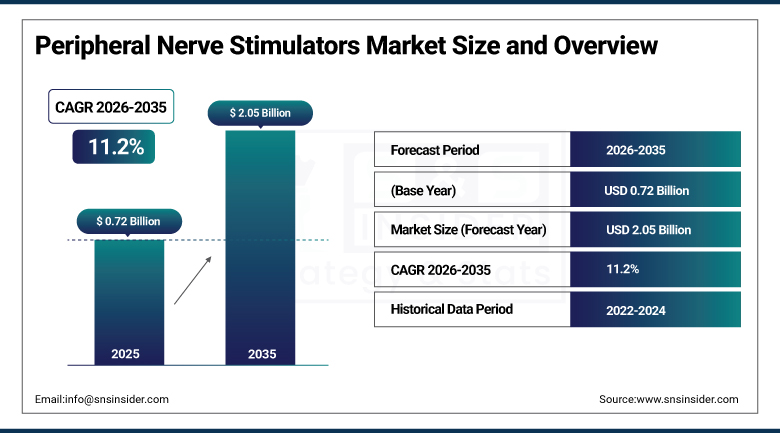
The Peripheral Nerve Stimulators Market was valued at USD 0.72 Billion in 2025 and is projected to reach USD 2.05 Billion by 2035, registering a CAGR of 11.2% from 2026 to 2035.
Peripheral Nerve Stimulators Market has revolutionized chronic and acute pain management by providing patients with the treatment of direct electrical stimulation on the peripheral nerves, serving as a viable and non-opioid substitute for oral pain drugs and spinal cord stimulators. The market is characterized by rapid growth of temporary, percutaneous PNS systems that require no permanent implant, rising adoption of wireless and app-controlled devices, and expanding indications spanning chronic pain, diabetic peripheral neuropathy, and post-surgical acute pain relief. Significant growth is being witnessed in the deployment of miniaturized, battery-free implantable pulse generators, wearable non-invasive accessories, and closed-loop stimulation technology, considering that pain management clinics, hospitals, and ambulatory surgical centers continue investing heavily in minimally invasive neuromodulation therapy that reduces dependence on narcotic-based pain management protocols.
In 2026, Medtronic plc announced its intent to acquire SPR Therapeutics, Inc. for USD 650 million, adding the FDA-cleared SPRINT PNS System, a temporary 60-day percutaneous peripheral nerve stimulation therapy, to its Neuromodulation portfolio and expanding earlier-intervention treatment options for chronic pain sufferers.
To Get more information On Peripheral Nerve Stimulators Market - Request Free Sample Report
Peripheral Nerve Stimulators Market Trends
-
Rapid growth of temporary, percutaneous PNS systems continues offering patients pain relief without a permanent implant.
-
Rising M&A consolidation continues as major neuromodulation companies acquire specialized PNS developers.
-
Growing adoption of wireless, app-controlled stimulation devices continues improving patient-directed therapy management.
-
Expanding diabetic peripheral neuropathy indications continue broadening PNS adoption beyond core chronic pain applications.
-
Increasing use of miniaturized, battery-free implantable generators continues reducing surgical burden and device replacement needs.
U.S. Peripheral Nerve Stimulators Market Outlook
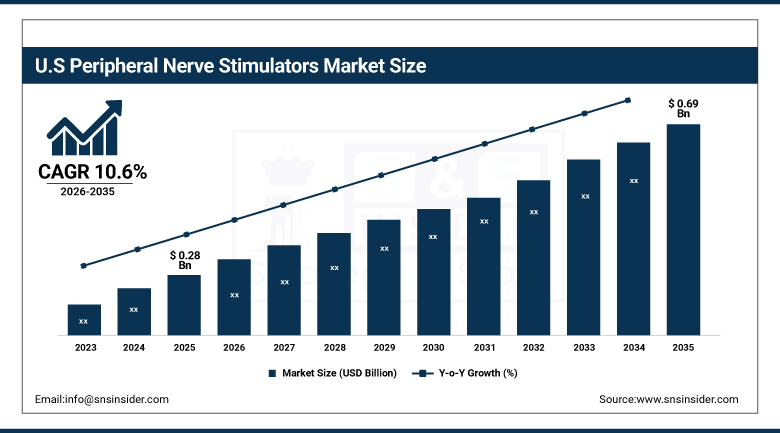
The U.S. Peripheral Nerve Stimulators Market was valued at approximately USD 0.28 Billion in 2025 and is projected to reach approximately USD 0.69 Billion by 2035, registering a CAGR of approximately 10.6% from 2026 to 2035.
In the United States, the demand continued to be shaped by the country's position as the commercial and regulatory epicenter for PNS innovation, favorable FDA clearance pathways for temporary percutaneous systems, and growing physician and patient preference for non-opioid pain management alternatives. Rising deployment of temporary PNS systems by pain management clinics and ambulatory surgical centers continued reinforcing the country's position as both the largest and most technologically advanced PNS market. Growing adoption across hospitals, physiotherapy centers, and specialty pain clinics added further layers of sustained domestic demand well beyond the technology's traditional chronic-pain use case, with expanding post-surgical and diabetic neuropathy indications increasingly relying on targeted peripheral nerve stimulation therapy.
In 2026, Boston Scientific Corporation completed its acquisition of the remaining equity in Nalu Medical for approximately USD 533 million, gaining the Nalu Neurostimulation System, a miniaturized, battery-free implantable peripheral nerve stimulation platform for adults with chronic pain of peripheral nerve origin.
Peripheral Nerve Stimulators Market Segment Analysis
-
By Product, Systems (Implantable Pulse Generators & Leads) segment dominated the Peripheral Nerve Stimulators Market in 2025 with 66.11% share; Wearables & Non-Invasive Accessories segment is the fastest growing segment, registering a CAGR of 13.1% during the forecast period.
-
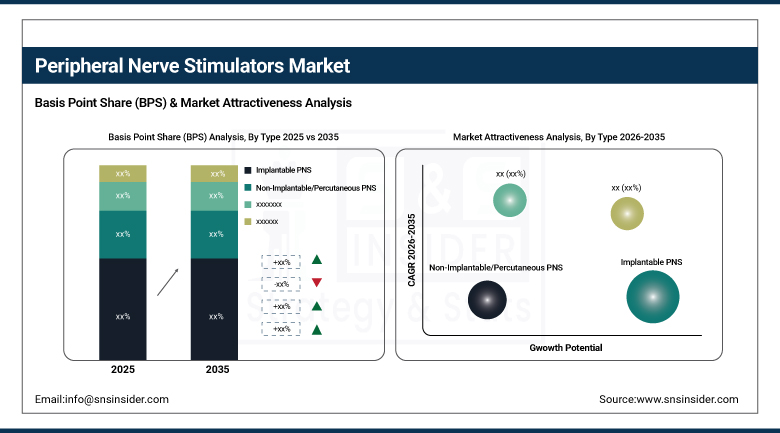
By Type, Implantable PNS segment dominated the market in 2025 with 64.36% share; Non-Implantable/Percutaneous PNS segment is the fastest growing segment, registering a CAGR of 12.8% during the forecast period.
-
By Application, Chronic Pain Management segment dominated the market in 2025 with 58.09% share; Diabetic Peripheral Neuropathy Pain segment is the fastest growing segment, registering a CAGR of 13.4% during the forecast period.
-
By End-User, Hospitals segment dominated the market in 2025 with 52.30% share; Pain Management Clinics segment is the fastest growing segment, registering a CAGR of 12.5% during the forecast period.
By Product, Systems (Implantable Pulse Generators & Leads) Lead, Wearables & Accessories Grows Fastest
The Systems (Implantable Pulse Generators & Leads) emerged as the leading Peripheral Nerve Stimulators Market segment in 2025. This is because they play a key part in serving as the major revenue generator for all PNS implant procedures, starting from the placement of the leads up to the implantation of the pulse generator. The availability of established reimbursement procedures along with decades worth of clinical data endorsing the use of implantable pulse generators played a pivotal role in keeping a consistent volume of procedures. Growing use of miniaturized, battery-free pulse generator designs, combined with expanding indications across chronic and post-surgical pain, reinforced systems revenue as the single largest contributor to total market spending throughout the base year.
The Wearables & Non-Invasive Accessories segment is the fastest growing in the Peripheral Nerve Stimulators Market owing to rising consumer and clinical demand for implant-free, externally worn stimulation devices that avoid surgical risk entirely. Growing direct-to-consumer marketing of wearable nerve stimulation products, combined with expanding insurance coverage for non-invasive pain management alternatives, is driving adoption among patients seeking lower-risk treatment options before considering implantable therapy. Rising vendor investment in smartphone-app-connected wearable platforms continues extending the addressable patient population well beyond those eligible for surgical implantation.
By Type, Implantable PNS Dominates, Non-Implantable/Percutaneous PNS Grows Fastest
The Implantable PNS segment dominated the Peripheral Nerve Stimulators Market because of its established long-term efficacy record, durable pain relief profile, and broad physician familiarity built over more than a decade of commercial use across specialty pain clinics and hospitals. Strong reimbursement coverage for implantable systems treating severe intractable chronic peripheral nerve pain, combined with growing physician confidence in outpatient minimally invasive implantation procedures, sustained implantable PNS as the default choice for patients requiring durable, long-term pain relief throughout the base year.
The Non-Implantable/Percutaneous PNS segment is the fastest growing due to rising adoption of temporary, 60-day systems that require no permanent implant and carry substantially lower procedural risk and cost than fully implantable alternatives. Growing clinical evidence supporting temporary PNS as an effective earlier-intervention option, positioned before patients progress to permanent implantable therapy, continues expanding adoption among pain management clinics and ambulatory surgical centers. Rising vendor M&A investment in percutaneous platforms is accelerating clinician transition toward temporary-first treatment protocols across leading pain management practices worldwide.
By Application: Chronic Pain Management Leads, Diabetic Neuropathy Grows Fastest
The Chronic Pain Management segment dominated the Peripheral Nerve Stimulators Market due to the central role PNS plays in treating severe intractable chronic pain of peripheral nerve origin, including complex regional pain syndrome, neuroma, and post-stroke shoulder pain. Rising global prevalence of chronic pain conditions among an aging population, combined with growing physician and patient preference for non-opioid treatment alternatives, has sustained high procedure volumes across established and emerging pain management programs. Increased use of PNS to reduce reliance on narcotic-based pain medication contributed to sustained segment dominance throughout the base year.
The Diabetic Peripheral Neuropathy Pain segment is the fastest growing as PNS increasingly addresses the painful nerve damage associated with poorly controlled diabetes, a condition affecting a rapidly expanding global patient population. Rising global diabetes prevalence, combined with growing clinical evidence supporting PNS as an effective alternative to pharmacological neuropathy management, continues expanding procedure volumes across endocrinology-adjacent pain management programs. Growing physician awareness of PNS as a targeted, non-systemic treatment option is driving faster adoption across specialty diabetic care and pain management centers worldwide.
By End-User: Hospitals Dominate, Pain Management Clinics Grow Fastest
The Hospitals segment was the leading player in the Peripheral Nerve Stimulators Market on account of its comprehensive pain management and neurosurgery infrastructure along with its ability to cater to implantation procedures needing multi-disciplinary teams. Academic and tertiary hospitals have continued to remain the topmost centers performing implantable and non-implantable PNS procedures in terms of volume of procedures. Investment in specialized pain management departments having the facility for implantable and percutaneous PNS systems further strengthened the position of hospitals as the leading segment during the base year period.
The Pain Management Clinics segment is expected to witness the fastest growth in the Peripheral Nerve Stimulators Market as more temporary and percutaneous PNS procedures migrate toward specialized outpatient settings supported by favorable reimbursement changes. Growing numbers of interventional pain physicians performing office-based temporary PNS placements increasingly rely on dedicated pain management clinics equipped with PNS-compatible programming systems to deliver hospital-comparable procedural safety in a more cost-efficient setting. Expanding pain management clinic adoption of temporary PNS continues attracting a broadening base of cost-conscious health systems.
Regional Analysis
|
Region |
Major Country |
Share within Region, 2025 (%) |
|---|---|---|
|
North America |
United States |
87.00% |
|
Europe |
Germany |
22.60% |
|
Asia Pacific |
China |
28.90% |
|
Middle East and Africa |
Saudi Arabia |
23.20% |
|
Latin America |
Brazil |
33.60% |
North America Peripheral Nerve Stimulators Market Insights
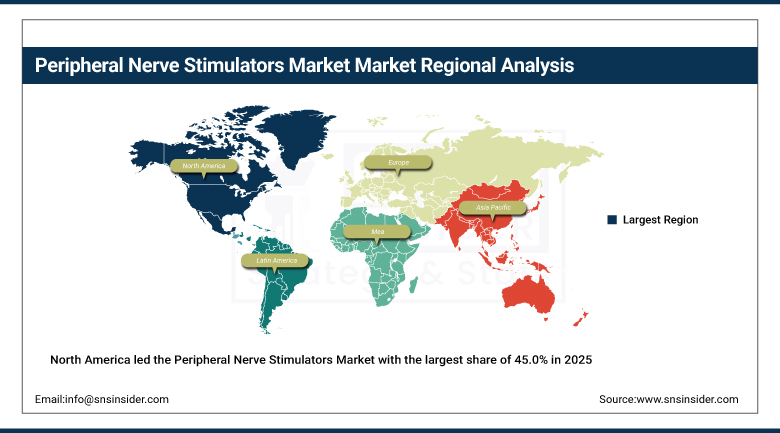
North America led the Peripheral Nerve Stimulators Market with the largest share of 45.0% in 2025. The region's position as the commercial and regulatory epicenter for PNS innovation, favorable FDA clearance pathways for temporary percutaneous systems, and growing physician and patient preference for non-opioid pain management alternatives continued reinforcing this dominant regional position. A deep concentration of leading device manufacturers, pain management clinics, and academic medical centers headquartered across the continent gave regional clinicians early access to next-generation implantable and temporary PNS platforms well ahead of most other regions.
The United States accounted for highest share of regional revenue, anchored by a dense cluster of pain management clinics, rapid M&A consolidation among major neuromodulation companies, and expanding physician adoption of temporary percutaneous PNS systems. Canada added further regional demand through its own growing chronic pain treatment infrastructure and expanding public health system investment in non-opioid pain management, and that combined strength kept the continent the largest addressable market for PNS vendors through the forecast period.
Get Customized Report as per Your Business Requirement - Enquiry Now
Europe Peripheral Nerve Stimulators Market Insights
Europe held a meaningful share of global revenue, supported by rising prevalence of chronic pain conditions, expanding national reimbursement coverage for neuromodulation procedures, and continued growth of specialized pain management programs across the region's major economies. Regulatory harmonization under the EU Medical Device Regulation and continued expansion of pain management training centers continued lowering historically significant barriers to advanced PNS technology adoption across the continent.
Germany led demand of European revenue, supported by its substantial hospital infrastructure and high per-capita pain management procedure volumes among the region's largest economies. The UK and France contributed substantial additional demand through their own expanding neuromodulation and pain management programs, and continued European investment in chronic pain treatment infrastructure should keep regional demand for peripheral nerve stimulator technology climbing through the forecast period.
Asia Pacific Peripheral Nerve Stimulators Market Insights
Asia Pacific is advancing at the fastest pace among all regions tracked in this report, growing at a CAGR of approximately 15.0% from 2026 to 2035, driven by rising chronic pain and diabetic neuropathy prevalence, expanding pain management training infrastructure, and growing government-backed investment in advanced neuromodulation care across the region's largest economies. That combination of rising patient volumes and expanding domestic device manufacturing capacity kept the region's growth trajectory well ahead of every other region tracked in this report.
China led the pack, supported by rapid expansion of pain management infrastructure and growing domestic neurostimulation device manufacturing capability. Japan and India contributed meaningful additional demand, with India's fast-growing diabetic patient population and Japan's advanced pain management programs both reinforcing the region's position as the fastest-growing market tracked in this report.
MEA and Latin America Peripheral Nerve Stimulators Market Insights
The Middle East and Africa and Latin America both showed steady growth, driven by expanding pain management clinic infrastructure, rising government investment in tertiary neurological care, and growing clinician training in PNS-guided chronic pain treatment across both areas. As these markets continued building out modern pain management infrastructure, peripheral nerve stimulation proved a genuinely efficient way to expand advanced procedural capability without the decades-long buildout wealthier nations required.
Saudi Arabia led Middle East and Africa demand, supported by the country's substantial healthcare investment under its national healthcare transformation programs. The UAE contributed further demand through its own expanding private hospital network and pain management capability. In Latin America, Brazil accounted for the largest share of regional revenue, with growing chronic pain treatment adoption and academic pain management training continuing to anchor regional demand for peripheral nerve stimulator technology.
Market Dynamics
Growth Drivers: Rising Chronic Pain Prevalence and Growing Non-Opioid Treatment Preference
The industry is driven by rising global prevalence of chronic pain conditions and diabetic peripheral neuropathy among aging populations, growing physician and patient preference for non-opioid pain management alternatives, rapid growth of temporary percutaneous PNS systems, and expanding indications spanning chronic pain, post-surgical pain, and neuropathy management. As awareness of opioid-related risks continues rising, the need for effective, minimally invasive, non-pharmacological pain relief continues driving adoption of peripheral nerve stimulator technology.
Rising M&A consolidation among major neuromodulation companies continues reinforcing this driver, as acquiring companies channel substantial resources into expanding clinical evidence, physician training, and commercial reach for newly acquired PNS platforms. Growing integration of wireless, app-controlled programming into both implantable and temporary systems continues improving patient-directed therapy management, and that combination of clinical validation and improved usability is exactly what keeps demand climbing at such a steady, sustained pace.
Restraints: High Device Costs and Reimbursement Gaps in Emerging Markets
The substantial cost of implantable pulse generators and associated surgical implantation procedures continues posing a genuine restraint on faster market-wide expansion, particularly across emerging healthcare systems and smaller pain management practices without the patient volumes needed to justify premium neuromodulation technology adoption. That cost profile has kept large-scale, implantable PNS procedural capability concentrated among a comparatively small number of well-resourced pain management centers.
Limited or inconsistent reimbursement coverage for PNS procedures across several emerging markets continues posing a further restraint, as healthcare systems in cost-constrained regions often default to lower-cost pharmacological pain management rather than investing in dedicated neurostimulation infrastructure. That reimbursement gap keeps some smaller healthcare systems reliant on conventional pain medication protocols rather than adopting catheter-based peripheral nerve stimulation of their own.
Opportunities: Temporary PNS Expansion and Emerging Market Pain Care Infrastructure
Rising investment in temporary, percutaneous PNS platforms represents a genuinely significant opportunity, as pain management clinics increasingly seek lower-risk, earlier-intervention treatment options positioned before patients progress to permanent implantable therapy. Vendors positioned early in temporary system technology optimized for broad chronic and acute pain indications stand to capture meaningful share as this capability continues expanding from specialized pain centers into mainstream outpatient practice.
Closing pain-care infrastructure gaps across emerging healthcare markets offers a second substantial opportunity, as government initiatives aimed at expanding non-opioid pain management capacity continue creating fresh demand for accessible, cost-effective neurostimulation infrastructure. Vendors with proven, affordable implantable and temporary platforms stand to capture meaningful share as developing economies increasingly view in-house pain management capability as a genuinely practical way to reduce dependency on pharmacological and opioid-based treatment protocols.
Recent Developments:
-
2025: Saluda’s Evoke System received recognition at the 2025 NANS Annual Meeting, highlighting its closed-loop sensing technology for personalized neuromodulation.
-
2025: Bioventus Inc. received FDA 510(k) clearances for its TalisMann and StimTrial peripheral nerve stimulation products, expanding its PNS portfolio alongside its existing StimRouter Neuromodulation System.
-
2026: The FDA cleared SPR Therapeutics' Sprint endura and Sprint extensa peripheral nerve stimulation systems for both chronic and acute pain, including post-operative and post-traumatic pain indications.
Peripheral Nerve Stimulators Market key players are:
-
Medtronic plc
-
Boston Scientific Corporation
-
Abbott Laboratories
-
Becton, Dickinson and Company (BD)
-
Teleflex Incorporated
-
Bioventus Inc.
-
Nevro Corp.
-
Saluda Medical Pty Ltd
-
Neuros Medical, Inc.
-
Micron Medical Corporation
-
Cala Health, Inc.
-
NeuroMetrix, Inc.
-
Nalu Medical, Inc.
-
SPR Therapeutics, Inc.
-
Mainstay Medical International plc
-
Cirtec Medical, LLC
-
NeuroOne Medical Technologies Corporation
-
LivaNova PLC
-
Integra LifeSciences Holdings Corporation
-
Axonics, Inc.
Peripheral Nerve Stimulators Market Report Scope:
| Report Attributes | Details |
|---|---|
| Market Size in 2025 | USD 0.72 Billion |
| Market Size by 2035 | USD 2.05 Billion |
| CAGR | CAGR of 11.2% From 2026 to 2035 |
| Base Year | 2025 |
| Forecast Period | 2026-2035 |
| Historical Data | 2022-2024 |
| Report Scope & Coverage | Market Size, Segments Analysis, Competitive Landscape, Regional Analysis, DROC & SWOT Analysis, Forecast Outlook |
| Key Segments | • By Product (Systems (Implantable Pulse Generators & Leads), Wearables & Non-Invasive Accessories) • By Type (Implantable PNS, Non-Implantable/Percutaneous PNS) • By Application (Chronic Pain Management, Diabetic Peripheral Neuropathy Pain, Post-Surgical & Acute Pain Management, Migraine & Headache Disorders, Others) • By End User (Hospitals, Pain Management Clinics, Ambulatory Surgical Centers, Others) |
| Regional Analysis/Coverage | North America (US, Canada), Europe (Germany, UK, France, Italy, Spain, Russia, Poland, Rest of Europe), Asia Pacific (China, India, Japan, South Korea, Australia, ASEAN Countries, Rest of Asia Pacific), Middle East & Africa (UAE, Saudi Arabia, Qatar, South Africa, Rest of Middle East & Africa), Latin America (Brazil, Argentina, Mexico, Colombia, Rest of Latin America). |
| Company Profiles | Medtronic plc, Boston Scientific Corporation, Abbott Laboratories, Becton, Dickinson and Company (BD), Teleflex Incorporated, Bioventus Inc., Nevro Corp., Saluda Medical Pty Ltd, Neuros Medical, Inc., Micron Medical Corporation, Cala Health, Inc., NeuroMetrix, Inc., Nalu Medical, Inc., SPR Therapeutics, Inc., Mainstay Medical International plc, Cirtec Medical, LLC, NeuroOne Medical Technologies Corporation, LivaNova PLC, Integra LifeSciences Holdings Corporation, Axonics, Inc. |

Frequently Asked Questions
Key Palyers include Medtronic plc, Boston Scientific Corporation, Abbott Laboratories, Becton, and Dickinson and Company (BD), among others.
Key opportunities include rising demand for chronic pain management, increasing adoption of neuromodulation therapies, technological advancements, expanding indications, and growing preference for minimally invasive treatment options.
The major growth factor is rising prevalence of chronic pain and diabetic peripheral neuropathy, growing preference for non-opioid pain management alternatives, and rapid growth of temporary percutaneous PNS systems.
The Systems (Implantable Pulse Generators & Leads) segment dominated the Peripheral Nerve Stimulators Market by product, representing the largest share of revenue in 2025.
North America dominated the Peripheral Nerve Stimulators Market in 2025, holding an estimated 45.0% share of total global market revenue.
