
Power Flow Controller Market Report Scope and Overview:
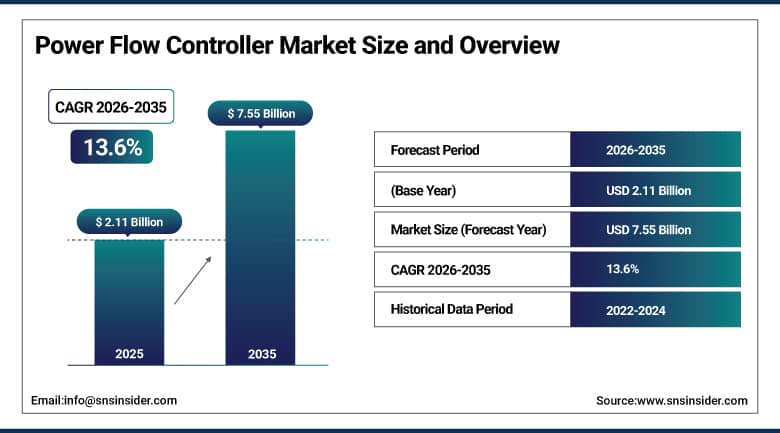
The Power Flow Controller Market was valued at USD 2.11 Billion in 2025 and is projected to reach USD 7.55 Billion by 2035, registering a CAGR of 13.6% from 2026 to 2035.
The Power Flow Controller Market has revolutionized the management of transmission networks through the use of static VAR compensators, thyristor-controlled series capacitor, unified power flow controllers and modular advanced power flow controllers, which help to direct and control power flow without any need for building new transmission lines. Key features that define the market include the increasing grid congestion caused by renewable energy sources, rising investments in FACTS technology by utilities, increasing use of solid state and modular grid enhancement devices and the expanding use of the technology in loop flow control, voltage stabilization and alleviating congestion caused by data centers.
In June 2026, GE Vernova increased its grid solutions capabilities through investments in innovative FACTS and power electronics technologies to assist in voltage regulation, reactive power management, and improved transmission capacities with an increase in renewable energy sources on utility grids.
To Get More Information On Power Flow Controller Market - Request Free Sample Report
Power Flow Controller Market Trends
-
Expanding deployment of modular advanced power flow controllers continues improving substation transfer capacity for data center-driven demand growth.
-
Growing integration of HVDC-based bi-directional power flow control continues accelerating cross-regional renewable interconnection projects.
-
Rising utility investment in grid-enhancing technologies continues expanding the addressable base for congestion relief without new transmission lines.
-
Increasing wind and solar penetration continues strengthening demand for voltage stability and loop flow mitigation solutions.
-
Growing adoption of solid-state FACTS platforms continues reducing deployment timelines compared to conventional transmission infrastructure upgrades.
U.S. Power Flow Controller Market Outlook
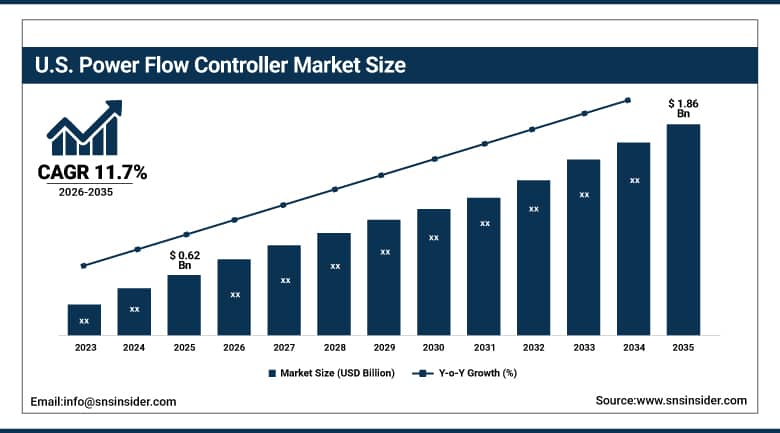
The U.S. Power Flow Controller Market was valued at approximately USD 0.62 Billion in 2025 and is projected to reach approximately USD 1.86 Billion by 2035, registering a CAGR of approximately 11.7% from 2026 to 2035.
The demand in the U.S. was driven by the heavy investments made for the purpose of mitigating transmission congestion, increasing the demand for electricity by data centers that was stressing the capacity of existing substations, and high demand for quick-deploying grid enhancement solutions among the utilities that wanted to bypass long multi-year transmission line build time schedules. The deployment of modular power flow controllers along with FACTS-based congestion mitigation solutions on major utility transmission grids played a crucial part in making the position of the United States the largest market for power flow controllers. Besides, power flow control applications in renewables, voltage stability, and EV charging support infrastructure were aiding the domestic demand for the product.
In April 2026, S&C Electric showcased their grid resilience technology at the IEEE PES T&D Conference held in Chicago, concentrating on distribution automation and grid modernization. This development is important for U.S. utilities that need better management of voltages and power flows as generation and demand for electricity increase.
Power Flow Controller Market Segment Analysis
-
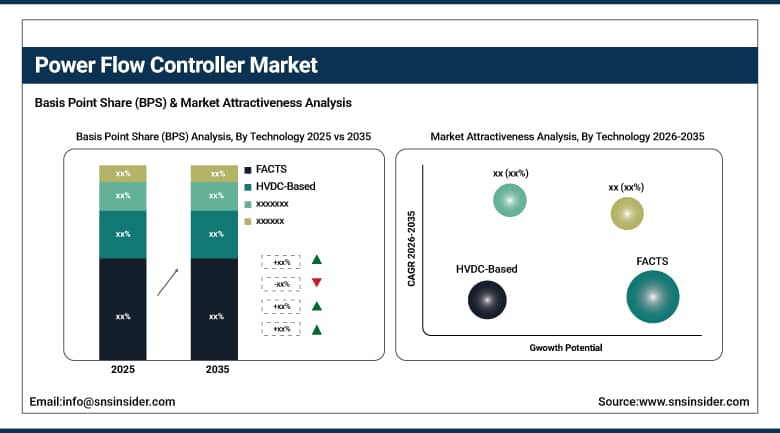
By Technology, FACTS segment dominated the market in 2025 with 61% share; HVDC-Based segment is the fastest growing segment, registering a CAGR of 15.8% from 2026 to 2035.
-
By Type, Static VAR Compensators segment dominated the Power Flow Controller Market in 2025 with 34% share; Advanced Power Flow Controllers segment is the fastest growing segment, registering a CAGR of 16.1% from 2026 to 2035.
-
By Application, Grid Congestion Management segment dominated the market in 2025 with 37% share; Renewable Energy Integration segment is the fastest growing segment, registering a CAGR of 16.3% from 2026 to 2035.
-
By Installation, New Grid Infrastructure segment dominated the market in 2025 with 58% share; Retrofit segment is the fastest growing segment, registering a CAGR of 15.5% from 2026 to 2035.
-
By End User, Utilities segment dominated the market in 2025 with 44% share; Renewable Energy Developers segment is the fastest growing segment, registering a CAGR of 16.0% from 2026 to 2035.
By Technology, FACTS Dominates, HVDC-Based Solutions Post Fastest Growth
FACTS accounted for the highest share in the Power Flow Controller Market in 2025 as Flexible Alternating Current Transmission System is the leading means used by utilities for managing the voltage level, reactive power, and local congestion in existing AC transmission networks. The product line of FACTS by ABB Ltd. and Hitachi Energy, consisting of SVCs, STATCOMs, and series compensation, is an indicator that this type of technologies is still used by utilities for stabilizing their power network.
HVDC-based solutions are expected to post the fastest growth rate over the forecast period as bi-directional power flow control is being implemented by utilities for long distance transmission of renewable energy sources. Hitachi Energy's contract for 6 GW HVDC system in India that allows controlling the power flow in bi-directional mode to support renewables integration and network stability is an example of how important role HVDC-based power flow control plays in regional power transmission planning.
By Type, Static VAR Compensators Lead, While Advanced Power Flow Controllers Grow Fastest
Static VAR Compensators were the leading technology in the Power Flow Controller Market owing to the established history of their involvement in providing voltage support and reactive power compensation for transmission substations across the world. The SVC Classic and SVC PLUS technology categories offered by Siemens AG have been a part of utility voltage stabilization efforts for decades and are the largest of all power flow control technology categories in terms of installed base. Further improvements in the design of thyristors and voltage-source converters have ensured that SVC remains the go-to choice for utilities dealing with voltage problems.
Advanced Power Flow Controllers are expected to exhibit the highest growth rate in the Power Flow Controller Market driven by the need for modular and fast power flow controllers by utilities as a substitute to FACTS for solving congestion problems. The deployment of SmartValves developed by Smart Wires to help PG&E increase the transfer capability of substations by 100 MW+ is an example of modular power flow control technology being used to deal with increased demand caused by data centers without requiring years of transmission line construction.
By Application, Grid Congestion Management Leads, Renewable Energy Integration Grows Fastest
The Grid Congestion Management application segment dominated the Power Flow Controller Market in 2025 due to the utility companies' focus on addressing the transmission network congestion issues without having to incur the cost of building additional lines. The application has a proven business case with regard to the avoidance of capital expenditure and timely implementation, which has made it one of the most well-funded power flow control applications in the utility transmission plan.
The Renewable Energy Integration application segment is the fastest growing due to increasing problems of loop flow and voltage stability as a result of the rise in wind and solar power. This is illustrated by the memorandum of understanding between GE Vernova and Smart Wires to improve the performance of the grid through the application of advanced power flow control and digital grid optimization solutions.
By Installation, New Grid Infrastructure Dominates, Retrofit Deployment Grows Fastest
New Grid Infrastructure installations dominated with a share of the Power Flow Controller Market in 2025 as utilities will be demanding power flow control components as part of their new substation and grid extension projects. An example of how new infrastructure developments remain at the core of the biggest market revenue share is the EUR 2 billion investment by Siemens Energy into the production of transformers and other components used in power flow control.
Retrofit deployment are expected to show the highest growth rate due to utilities' increasing need to use modular power flow controllers to make the most of their existing transfer capacity without having to build anything new. Given how fast and easy the installation of devices like SmartValves from Smart Wires is, this market segment is especially promising amid utilities' need to increase capacity amidst data centers and EV chargers.
By End User, Utilities Dominate, Renewable Energy Developers Gain Fastest Traction
The Utilities segment was the largest end-user in the Power Flow Controller Market in 2025 since utilities are responsible for ensuring the reliability of transmission systems, managing congestion, and interconnection processes. The deployment of power flow controllers in large volumes at the transmission utilities in North America and Asia-Pacific regions, involving FACTS technologies to solve congestion problems and HVDC interconnection processes, confirms that utilities implement their investments in power flow control as a part of their long-term plans for grid improvement and capacity planning.
Renewable energy developers segment is expected to be the fastest growing end-user segment because wind and solar developers will use power flow control technologies to ensure faster interconnection processes and prevent expensive network upgrades required for the integration of new generation resources. The increasing cooperation between renewable developers and suppliers of grid technology in conducting interconnection studies shows that power flow control becomes an integral part of renewable project planning, ensuring its faster growth compared to traditional utilities' investments.
Regional Analysis:
|
Region |
Major Country |
Share within Region, 2025 (%) |
|---|---|---|
|
North America |
United States |
80.00% |
|
Europe |
Germany |
24.10% |
|
Asia Pacific |
China |
38.60% |
|
Middle East and Africa |
Saudi Arabia |
27.50% |
|
Latin America |
Brazil |
32.40% |
North America Power Flow Controller Market Insights
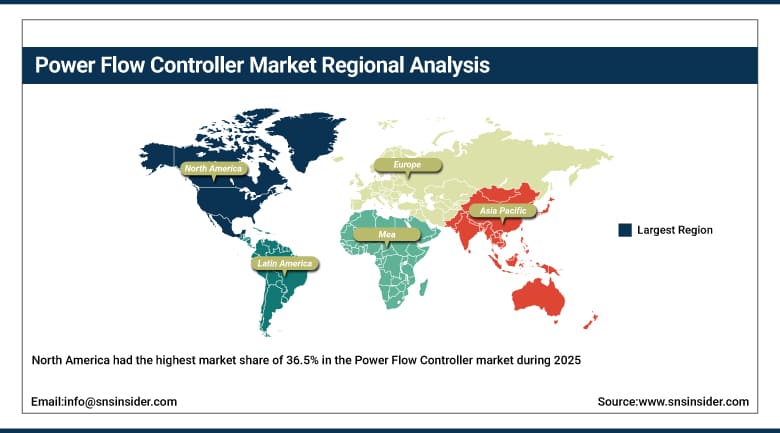
North America had the highest market share of 36.5% in the Power Flow Controller market during 2025 due to factors like acute transmission congestion problems, increasing demands for electricity arising from the rise in data centers, robust renewable energy integration policies, and having prominent FACTS and grid improvement technology vendors based out of this region. Transmission companies in North America along with the domestic manufacturers of power flow controllers also contributed to its dominance in this market.
The U.S. captured majority of the overall revenue share of North America mainly owing to high domestic adoption of SmartWires' SmartValve power flow controller technology, grid optimization solutions by GE Vernova, and rising utility need for rapidly deployable solutions for congestion management linked to EV charging and data center loads. Increased spending on grid modernization projects in Canada also helped the region contribute to North America's overall market dominance.
Get Customized Report as Per Your Business Requirement - Enquiry Now
Europe Power Flow Controller Market Insights
Europe held a sustainable share of Power Flow Controller revenue in the global market as a result of aggressive decarbonization agenda, major investments in electricity connections between countries, and deployment of flexible transmission systems across Europe's transmission network. More adoption of FACTS and HVDC interconnection standards and frameworks has also encouraged European utility companies to invest in vendor-neutral power flow control solutions to ensure Europe's role in the global grid flexibility investment.
Germany demonstrated the largest demand on the market in the region because of major FACTS and grid infrastructure investments by transmission system operators associated with offshore wind energy interconnection growth in the country along with Siemens Energy manufacturing facilities located in the nation. United Kingdom made considerable contribution to regional demand through increasing deployment of grid enhancing technologies for renewable interconnection in the country.
Asia Pacific Power Flow Controller Market Insights
The Asia Pacific region is witnessing the highest rate of growth among all regions covered in the market at a CAGR of 16.8% due to heavy investments in transmission infrastructure in China and India, industrial development, and addition of large capacities of renewables in the region that need sophisticated congestion management and voltage management solutions. The combination of growing grid interconnection activities and increased interest in flexible transmission solutions from utilities has guaranteed that this region is growing the fastest amongst all markets covered in the report in terms of power flow controllers.
China was the dominating nation due to heavy investments in grid modernization as well as increasing local manufacturing of FACTS and HVDC systems. Some other prominent countries driving the market in this region are India, which benefits from Hitachi Energy's 6 GW and 950 km HVDC system that facilitates two-way power flow control, and Japan, which continues growing Mitsubishi Electric's FACTS installations in the domestic transmission grid.
MEA and Latin America Power Flow Controller Market Insights
The Middle East and Africa and Latin America both showed steady growth in the Power Flow Controller Market owing to high investments in the transmission infrastructure development, government initiatives to modernize the grids, and increased cooperation between regional utility companies and global suppliers of FACTS and HVDC technologies. The need for real-time congestion and voltage control has been increasing in these geographies owing to higher renewable capacities additions as compared to transmission line additions.
In ME&A, the leading country market was Saudi Arabia owing to its massive investments in solar power and grid infrastructure projects associated with energy diversification plans. In ME&A, there were grid modernization efforts undertaken in the UAE that also contributed to the growth in the region. In LATAM, the leader in terms of revenues was Brazil owing to its vast transmission grid network and need for congestion control without line construction.
Market Dynamics:
Growth Drivers: Rising Grid Congestion and Expanding Renewable Integration Demand
The market will see a lot of traction owing to increased transmission congestion due to variable renewables, increased adoption of modular grid augmentation technologies, increased electricity demand from data centers and EV charging that is putting pressure on substations' capacities, and increased use cases, such as loop flow reduction, voltage stability management, and transmission augmentation. As more and more utilities plan grid modernization strategies based on timelines of connecting renewable energy sources to the grid, the demand for power flow controllers will stay robust throughout the value chain.
Increased cooperation between power electronics suppliers and transmission utilities, along with increased commitment to flexible AC transmission systems before changes to the interconnection queues become necessary, are additional proofs supporting this trend. Increased government support for cross-border interconnections and grid modernization projects is also contributing to an increased baseline deployment capacity, and all of these are making up for increased demand going forward.
Restraints: High Capital Costs and Grid Integration Complexity
High initial cost associated with FACTS installations remains a real limitation on the speed of market penetration since UPFCs and SVCs represent expensive equipment requiring careful engineering designs, which in turn takes considerable time for completion. It has led to the most sophisticated power flow control installations being implemented predominantly by large transmission utilities with adequate funding resources.
Grid complexity remains an ongoing problem as power flow control systems have to be compatible with the current protection and control systems of a transmission grid, and thus should not interact with them in an unwanted way in a meshed grid structure. Solution of this problem entails system studies and development of communication protocols, which is a resource-intensive process.
Opportunities: Modular Device Deployment and Data Center Demand Growth
The development of modular and speedy power flow control devices is a notable business opportunity as utilities begin to prefer quick-to-deploy options to tackle their urgent transmission problems. Those manufacturers who will be able to gain early customers for their modular platforms, including the partnership of Smart Wires with PG&E via SmartValves, are likely to capture large market share as utilities move away from their traditional multi-year projects of FACTS towards much quicker installations of congestions relief devices.
Another business opportunity is tied to the rapid growth of electricity consumption for data centers and EV chargers, leading to the overload of substations in developed countries and the emergence of the necessity to upgrade the transmission lines without building new ones. Vendors of fast and standardized power flow control solutions, including the cooperation of GE Vernova with Smart Wires on grid performance improvement, will get a significant share of demand-driven investments in the forecast period.
Recent Developments:
-
2025: Smart Wires Inc. partnered with PG&E to deploy its SmartValve advanced power flow controller devices, increasing substation transfer capacity by more than 100 MW to support data center-driven electricity demand growth.
-
2026: Siemens Energy expanded its FACTS and advanced power flow control systems portfolio in the United States, targeting improved grid stability for rising data center and EV charging infrastructure loads.
-
2026: ABB shipped out the first locally assembled wind power converter from its expanded plant in India, after acquiring Gamesa Electric. This improves ABB’s power electronics capacity regarding renewable energy generation, grid stabilization, and regulated power flow.
Power Flow Controller Market key players are:
-
Siemens AG
-
ABB Ltd
-
GE Vernova Inc.
-
Hitachi Energy Ltd.
-
Mitsubishi Electric Corporation
-
Toshiba Energy Systems & Solutions Corporation
-
NR Electric Co., Ltd.
-
Hyosung Heavy Industries Corporation
-
Rongxin Power Electronic Co., Ltd.
-
Smart Wires Inc.
-
NARI Technology Co., Ltd.
-
Zhejiang Chint Electrics Co., Ltd.
-
Eaton Corporation plc
-
S&C Electric Company
-
American Superconductor Corporation
-
Quanta Services, Inc.
-
GridBeyond Limited
-
Schneider Electric SE
-
LS ELECTRIC Co., Ltd.
-
Nexans S.A.
Power Flow Controller Market Report Scope:
| Report Attributes | Details |
|---|---|
| Market Size in 2025 | USD 2.11 Billion |
| Market Size by 2035 | USD 7.55 Billion |
| CAGR | 13.6% from 2026 to 2035 |
| Base Year | 2025 |
| Forecast Period | 2026-2035 |
| Historical Data | 2022-2024 |
| Report Scope & Coverage | Market Size, Segments Analysis, Competitive Landscape, Regional Analysis, DROC & SWOT Analysis, Forecast Outlook |
| Key Segments |
• By Type (Static VAR Compensators, Advanced Power Flow Controllers, Thyristor Controlled Series Capacitors, Unified Power Flow Controllers, Others) • By Technology (FACTS, HVDC-Based, Others) • By Application (Grid Congestion Management, Renewable Energy Integration, Transmission Capacity Enhancement, Voltage Stability Management) • By Installation (New Grid Infrastructure, Retrofit) • By End User (Utilities, Renewable Energy Developers, industrial) |
| Regional Analysis/Coverage | North America (US, Canada), Europe (Germany, UK, France, Italy, Spain, Russia, Poland, Rest of Europe), Asia Pacific (China, India, Japan, South Korea, Australia, ASEAN Countries, Rest of Asia Pacific), Middle East & Africa (UAE, Saudi Arabia, Qatar, South Africa, Rest of Middle East & Africa), Latin America (Brazil, Argentina, Mexico, Colombia, Rest of Latin America). |
| Company Profiles | Siemens AG, ABB Ltd, GE Vernova Inc., Hitachi Energy Ltd., Mitsubishi Electric Corporation, Toshiba Energy, Systems & Solutions Corporation, NR Electric Co., Ltd., Hyosung Heavy Industries Corporation, Rongxin Power, Electronic Co., Ltd., Smart Wires Inc., NARI Technology Co., Ltd., Zhejiang Chint Electrics Co., Ltd., Eaton, Corporation plc, S&C Electric Company, American, Superconductor Corporation, Quanta Services, Inc., GridBeyond Limited, Schneider Electric SE, LS ELECTRIC Co., Ltd., and Nexans S.A. |

Frequently Asked Questions
Key players include Siemens AG, ABB Ltd, GE Vernova Inc., Hitachi Energy Ltd., and Mitsubishi Electric Corporation, among others.
Key opportunities include grid modernization, increasing renewable energy integration, transmission congestion management, growing cross-border power flows, and rising demand for flexible and efficient power transmission systems.
The major growth factor is rising transmission congestion driven by intermittent renewable generation, expanding deployment of modular grid-enhancing technologies, and growing data center and EV charging-driven electricity demand straining substation capacity.
The Static VAR Compensators segment dominated the Power Flow Controller Market by type, representing the largest share of revenue in 2025.
North America had the highest market share of 36.5% in the Power Flow Controller market in 2025.
