
Shore to Ship Power Supply Market Report Scope & Overview:
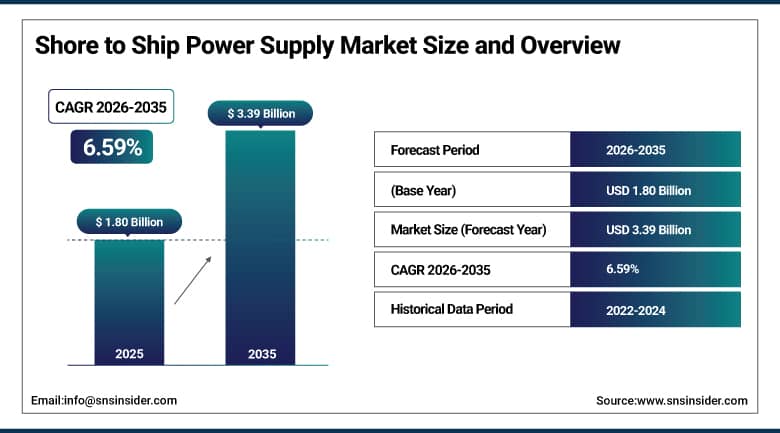
The Shore to Ship Power Supply Market was valued at USD 1.80 billion in 2025 and is expected to reach USD 3.39 billion by 2035, growing at a CAGR of 6.59% from 2026-2035.
The shore to ship power supply market is primarily driven by increasingly stringent environmental regulations aimed at reducing greenhouse gas emissions and air pollution from berthed vessels, encouraging ports to adopt shore power infrastructure. Another major growth factor is the rising investment in port electrification and sustainable maritime transportation initiatives, supported by government funding and decarbonization programs. The growing number of cruise ships and commercial vessels requiring clean energy solutions further accelerates market expansion globally.
A study commissioned by Transport & Environment reported that European ports are accelerating investments in onshore power supply systems to meet the European Union's 2030 shore power mandate, although only around 20% of required OPS connections had been installed or contracted as of mid-2025. This highlights the substantial infrastructure investment opportunity in the market.
To Get More Information On Shore to Ship Power Supply Market - Request Free Sample Report
Shore to Ship Power Supply Market Trends:
-
Rapid deployment of shore power infrastructure across major commercial and cruise ports globally.
-
Growing integration of renewable energy sources with shore-to-ship power supply systems.
-
Increasing adoption of high-voltage shore connection systems for large container and cruise vessels.
-
Rising investments in smart port electrification and digital energy management technologies worldwide.
-
Increasing government funding for green port initiatives and maritime decarbonization projects globally.
U.S. Shore to Ship Power Supply Market Outlook:
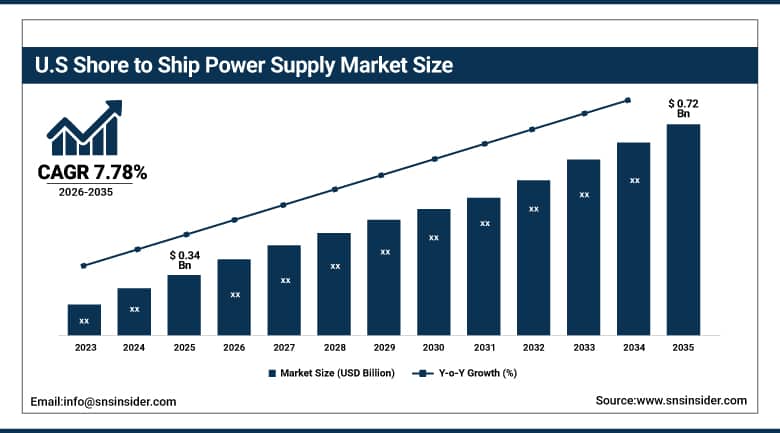
The U.S. Shore to Ship Power Supply Market was valued at USD 0.34 billion in 2025 and is expected to reach USD 0.72 billion by 2035, growing at a CAGR of 7.78% from 2026-2035.
The U.S. shore to ship power supply market is primarily driven by stringent federal and state emissions regulations, particularly in California, requiring vessels to reduce emissions while at berth through shore power connections. Another major driver is the substantial investment in port modernization and electrification projects supported by federal funding programs and clean energy initiatives. The increasing cargo throughput and cruise activities at major U.S. ports are further accelerating the deployment of shore power infrastructure nationwide.
The U.S. Environmental Protection Agency (EPA) states that shore power can reduce overall pollutant emissions from docked ships by up to 98%, depending on the electricity generation mix. This is one of the primary reasons ports are investing in shore-to-ship power infrastructure. The U.S. government has allocated USD 3 billion toward port decarbonization projects, including electrification and shore power initiatives, to reduce emissions from port operations.
Shore to Ship Power Supply Market Segment Analysis:
-
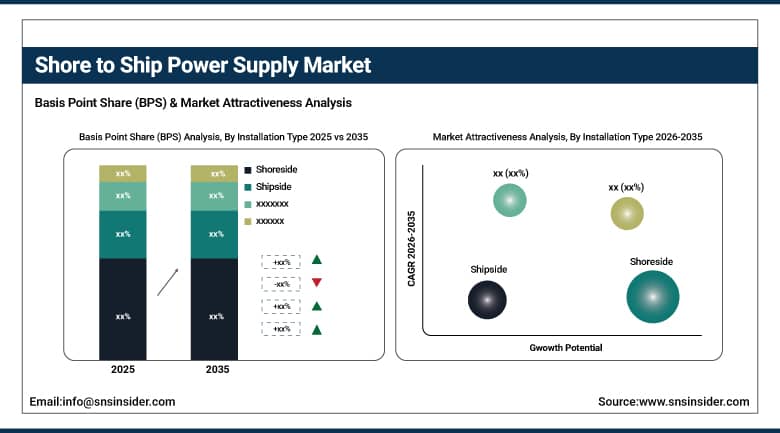
By Installation Type, shoreside dominated the shore to ship power supply market in 2025 with 67.93% share; shipside is the fastest-growing segment with a 7.04% CAGR.
-
By Connection Type, new installation dominated the market in 2025 with 62.76% share; retrofit is the fastest-growing segment with a 7.68% CAGR.
-
By Component, frequency converters dominated the market in 2025 with 34.67% share; switchgear devices are the fastest-growing segment with a 8.86% CAGR.
-
By Power Rating, up to 30 MVA dominated the market in 2025 with 48.37% share; above 60 MVA is the fastest-growing segment with a 7.52% CAGR
-
By Application, commercial shipping dominated the market in 2025 with 39.44% share; passenger transportation is the fastest-growing segment with a 8.32% CAGR
By Installation Type, shoreside segment dominates the shore to ship power supply market, shipside segment expected to grow fastest
The shoreside segment dominates the shore to ship power supply market because ports and terminal operators are making substantial investments in electrical infrastructure to comply with increasingly stringent emission regulations. Shoreside installations, including substations, transformers, and cable management systems, account for a significant portion of project costs, resulting in higher revenue generation. Additionally, the expansion of green port initiatives and government funding programs for port electrification across Europe, North America, and Asia has accelerated the deployment of shoreside systems, reinforcing the segment's leading market position.
The shipside segment is expected to witness the fastest growth as an increasing number of existing vessels undergo retrofitting to become compatible with shore power systems. Shipping companies are investing in onboard electrical modifications to comply with emission reduction regulations and gain access to ports that mandate shore power connections. Furthermore, rising demand for sustainable maritime operations and the growing number of newly built vessels equipped with shore power capabilities are significantly accelerating the adoption of shipside infrastructure worldwide.
By Connection Type, new installation segment dominates the shore to ship power supply market, retrofit segment expected to grow fastest
The new installation segment dominates the market due to the large-scale development of shore power infrastructure at newly modernized ports and terminals. Governments and port authorities are increasingly integrating shore-to-ship power systems into greenfield and expansion projects to meet long-term decarbonization objectives. Since establishing a complete shore power system requires significant investments in electrical infrastructure and grid connections, new installations generate the largest share of market revenues and continue to lead the industry.
The retrofit segment is anticipated to grow at the fastest pace because many existing ports and vessels were originally designed without shore power capabilities. As environmental regulations become stricter, operators are increasingly upgrading existing infrastructure instead of replacing assets entirely. Retrofitting offers a cost-effective approach to reducing emissions and extending asset life while meeting regulatory requirements. The growing number of ports introducing mandatory shore power policies is further driving demand for retrofit projects globally.
By Component, frequency converters segment dominates the shore to ship power supply market, switchgear devices segment experiences fastest growth
The frequency converters market share dominates the shore to ship power supply market since it plays a crucial role in matching the frequencies of electricity from the shore power supplies with those of the vessel. Each country operates at various frequencies; therefore, there will be no shore power supply without frequency converters. Moreover, the frequency converter is among the most expensive components in shore power, which makes them add considerably to the revenues of the market.
The switchgear devices market share records fastest growth since there are growing investments in the field of power distribution and protection in the port electrification projects. The modern shore power installation demands highly efficient switchgear devices to ensure safety and smooth power delivery. In addition, the increased use of digital substations and smart grids increases the demand for advanced switchgears.
By Power Rating, up to 30 MVA segment dominates the shore to ship power supply market, above 60 MVA segment expected to grow fastest
The up to 30 MVA capacity segment dominates the market owing to the fact that the majority of shore power installation systems are built with an intention to cater to medium-size vessels, ferries, and smaller cruise ships that have medium power demands. This system requires a comparatively low capital investment and can thus be implemented in a variety of ports, making it economically viable. The extensive use of medium-capacity shore power systems in regional ports and inland waterways makes this segment highly dominant in the market.
The above 60 MVA capacity segment is projected to have the fastest rate of growth owing to the rising requirement of electrification among larger container ships, mega cruise ships, and higher capacity maritime terminals. There are several major international ports that are planning on investing in advanced high-capacity shore power systems to provide adequate power for such energy-hungry vessels. Also, growing world trade and increasing capacities of ports are driving the demand for high-capacity systems.
By Application, commercial shipping segment dominates the shore to ship power supply market, passenger transportation segment shows fastest growth
The commercial shipping segment dominated the market since container ships, bulk carriers, and tankers make up the largest percentage of the world’s sea traffic. This is because the ships remain docked for long periods, thus making the use of shore power to be highly effective in curbing emission levels and saving fuel costs. Also, there is an increased focus by governments on the reduction of carbon emission from the commercial ships through the use of shore power technology.
The passenger transportation market is expected to witness fastest growth owing to the rising demand for cruise and ferry services and increased regulations concerning the emissions from passenger ships in urban areas. The cruise ships use a lot of energy when docked, hence making it necessary to adopt the shore power system for reducing emissions. Also, there are some major cruise ports that have made it mandatory for cruise ships to use shore power connections.
Regional Analysis:
|
Region |
Major Country |
Share within Region, 2025 (%) |
|---|---|---|
|
North America |
United States |
76.82% |
|
Europe |
Germany |
24.58% |
|
Asia Pacific |
China |
41.72% |
|
Middle East & Africa |
UAE |
33.63% |
Asia Pacific Shore to Ship Power Supply Market Insights
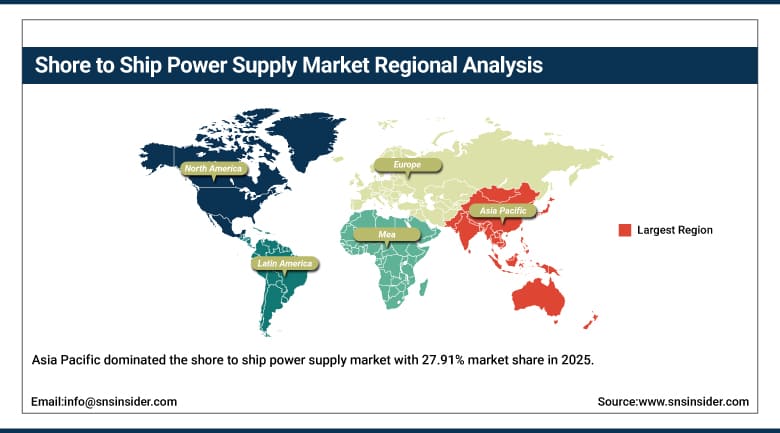
Asia Pacific dominated the shore to ship power supply market with 27.91% market share in 2025. It is driven by the rapid expansion of port infrastructure and increasing maritime trade activities. Countries such as China, Japan, South Korea, and Singapore are investing heavily in port modernization to accommodate rising cargo volumes and larger vessels. The expansion of commercial shipping operations has significantly increased the demand for shore power systems that can reduce emissions and improve port efficiency, thereby supporting the region's strong market growth.
Government initiatives aimed at creating a sustainable maritime transportation system in terms of carbon reduction are another factor that is driving the market growth in the area. There are many government initiatives being taken in Asia Pacific in order to create green ports that adopt technologies which ensure minimal carbon emissions. Such initiatives include investments in shore power systems.
Get Customized Report as Per Your Business Requirement - Enquiry Now
North America Shore to Ship Power Supply Market Insights
North America shore to ship power supply market experienced fastest growth with a CAGR of 8.01% in 2025 driven by stringent environmental regulations aimed at reducing emissions from berthed vessels. In the United States and Canada, there are some policies that promote shore power usage by ports and vessels, which is aimed at reducing greenhouse gas emissions and improving air quality. Decarbonization initiatives such as the At-Berth regulation of California and other initiatives at the federal level will increase the development of the shore power infrastructure. This will boost the market due to compliance with environmental issues.
Furthermore, the investments in modernization and electrification of ports represent another factor that contributes to market growth. There are some federal funding initiatives and programs that are promoting the development of shore power infrastructure within cargo ports and cruise ports. Growing trade activities and growing vessel traffic make the need for energy-efficient ports even greater.
Europe Shore to Ship Power Supply Market Insights
The factors contributing to the demand for shore to ship power supply in the Europe market include environmental regulation and decarbonization goals set by the European Union. Regulations such as Alternative Fuels Infrastructure Regulation and FuelEU Maritime encourage ports to install shore power installations to help reduce emission by ships when berthed. The regulatory push has helped accelerate investments in port electrification, which has ensured that the region maintains its dominance in the global shore power industry.
Other factors influencing the growth of the Europe shore to ship power supply market include investments in sustainable port infrastructure in European countries. Various governments and port authorities have invested heavily in upgrading their ports and incorporating sustainable energy options in their maritime activities. The focus on attaining zero carbon emission and better air quality within cities has led to the installation of shore power systems in major commercial and passenger ports.
Middle East & Africa and Latin America Shore to Ship Power Supply Market Insights
Investments in port upgrading and port development programs are driving the Middle East & Africa and Latin America shore to ship power supply market. Various countries including UAE, Saudi Arabia, Brazil, and Panama have been making efforts for upgrading their port infrastructure for enhancing operational efficiencies and maritime trade. Adoption of sustainable and efficient technology in ports is boosting the demand for shore power systems across the two regions and thereby creating many market opportunities.
Environmental sustainability and maritime decarbonization are other important factors that are expected to drive the market during the forecast period. Increasing efforts of governments and port authorities towards lowering the emissions of docked ships in coastal regions are propelling the demand for the infrastructure for providing shore power systems in ships. Increased international trade and participation in global climate agreements are encouraging investments in this infrastructure segment.
Market Dynamics:
Growth Drivers: Stringent Environmental Regulations and Rising Investments in Green Port Electrification Infrastructure
Stringent regulations to curb greenhouse gas emissions and pollution by berthed ships are becoming increasingly common, which is playing a pivotal role in propelling the shore to ship power supply market. There are strict regulations around the world that require the installation of shore power facilities in order to minimize the emissions from berthed ships. Regulations like FuelEU Maritime, apart from regional emission standards for ports, are fostering the development of port electrification.
Growing investments in the green port development and sustainability in maritime industry is another key factor that is contributing to market growth. Heavy investment is being made towards the development of port electrification solutions, due to increased cargo handling and rising cruise activities. Moreover, the need to become net-zero in carbon emissions is also generating strong demand for shore power solutions.
Restraints: High Infrastructure Costs and Limited Standardization Restrict Shore Power System Deployment
One of the factors restraining growth in the shore to ship power supply market is the heavy financial burden that comes from the large amount of funds needed to establish shore power supply infrastructures. There are high investments needed to establish substations, frequency converters, transformers, and even improve the grids, which can make it harder to implement the technology for small ports. Moreover, the difficulty in establishing the technology with high capacity of electrical systems with port infrastructures usually causes longer implementation periods and higher costs.
The lack of universal standards for the infrastructures of shore power supply and incompatibility among different ships also hinder the growth of the market. Different frequency and voltage requirements as well as differences in connectors pose problems in operation in different areas. Moreover, many ships already exist which will need to be modified in order for the ships to operate with the new system.
Opportunities: Expansion of High-Voltage Shore Power and Renewable Energy Integration Creates Growth Opportunities
The increasing use of high-voltage shore connection systems for big container ships and cruise liners has opened up many business opportunities for players in the market. Due to the fact that big ships need lots of electricity when docked, ports are increasingly installing high capacity shore connections. The emergence of mega ports and increase in international trading volume has created a lot of demand for modern high voltage technologies and provided market players with good chances for innovations.
The inclusion of renewable energy sources and smart grid technologies in the shore power infrastructure has provided plenty of opportunities for growth in the market. Ports have increasingly started using renewable energy sources such as solar, wind and energy storage systems to produce green electricity for ships. The introduction of intelligent energy management systems and monitoring systems makes shore power connections even more attractive.
Recent Developments:
-
2022: Government ministers, port authorities, and the European Investment Bank signed the Shore Power Declaration during the One Ocean Summit, committing to accelerate the deployment of shore-side electricity infrastructure by 2028, particularly for cruise and container vessels. The initiative marked a major international effort to reduce maritime emissions and promote port electrification globally.
-
2022: Canadian shipping company CSL partnered with the Port Authority of New South Wales to develop shore power infrastructure at Glebe Island, Australia. The project aims to enable vessels to shut down auxiliary engines while berthed, significantly reducing emissions and improving local air quality. CSL also invested more than USD 1 million to prepare vessels for shore power connectivity, highlighting the growing commitment toward maritime decarbonization initiatives.
-
2025: Cavotec secured an approximately €8 million (USD 9.2 million) contract to supply shore power systems for newly built container ships of a major global shipping company. The order includes the company's PowerAMPReel shipboard shore power systems, along with associated equipment and support services. The development highlights the increasing adoption of shore power technologies by shipping companies seeking to reduce emissions and comply with evolving environmental regulations.
Shore to Ship Power Supply Market key players are:
-
ABB Ltd.
-
Siemens AG
-
Schneider Electric SE
-
Wärtsilä Corporation
-
Cavotec SA
-
GE Vernova
-
Hitachi Energy Ltd.
-
Danfoss A/S
-
Eaton Corporation
-
Wabtec Corporation
-
Cochran Marine
-
Blueday Technology AS
-
Nidec ASI S.p.A.
-
Vinci Energies
-
PowerCon A/S
-
Mitsubishi Electric Corporation
-
Fuji Electric Co., Ltd.
-
Toshiba Energy Systems & Solutions Corporation
-
Hyundai Electric & Energy Systems Co., Ltd.
-
Zinus AS.
Shore to Ship Power Supply Market Report Scope:
| Report Attributes | Details |
|---|---|
| Market Size in 2025 | USD 1.80 Billion |
| Market Size by 2035 | USD 3.39 Billion |
| CAGR | CAGR of 6.59% From 2026 to 2035 |
| Base Year | 2025 |
| Forecast Period | 2026-2035 |
| Historical Data | 2022-2024 |
| Report Scope & Coverage | Market Size, Segments Analysis, Competitive Landscape, Regional Analysis, DROC & SWOT Analysis, Forecast Outlook |
| Key Segments | • By Installation Type (Shoreside, Shipside) • By Connection Type (Retrofit, New Installation) • By Component (Frequency Converters, Transformers, Switchgear Devices, Cables & Accessories, Others) • By Power Rating (Up to 30 MVA, 30-60 MVA, Above 60 MVA) • By Application (Commercial Shipping, Passenger Transportation, Defense and Naval Operations, Offshore Oil & Gas Operations, Inland Waterway Transport) |
| Regional Analysis/Coverage | North America (US, Canada), Europe (Germany, UK, France, Italy, Spain, Russia, Poland, Rest of Europe), Asia Pacific (China, India, Japan, South Korea, Australia, ASEAN Countries, Rest of Asia Pacific), Middle East & Africa (UAE, Saudi Arabia, Qatar, South Africa, Rest of Middle East & Africa), Latin America (Brazil, Argentina, Mexico, Colombia, Rest of Latin America). |
| Company Profiles | ABB Ltd., Siemens AG, Schneider Electric SE, Wärtsilä Corporation, Cavotec SA, GE Vernova, Hitachi Energy Ltd., Danfoss A/S, Eaton Corporation, Wabtec Corporation, Cochran Marine, Blueday Technology AS, Nidec ASI S.p.A., Vinci Energies, PowerCon A/S, Mitsubishi Electric Corporation, Fuji Electric Co., Ltd., Toshiba Energy Systems & Solutions Corporation, Hyundai Electric & Energy Systems Co., Ltd., Zinus AS. |

Frequently Asked Questions
The shoreside dominated the Shore to Ship Power Supply Market in 2025.
The Shore to Ship Power Supply Market was valued at USD 1.80 billion in 2025.
The major growth factor driving the shore to ship power supply market is the increasing implementation of stringent emission regulations and investments in green port electrification infrastructure worldwide.
The Shore to Ship Power Supply Market is expected to grow at a CAGR of 6.59% from 2026 to 2035.
Asia Pacific dominated the Shore to Ship Power Supply Market in 2025.
