
RF Power Meter Market Report Scope & Overview:
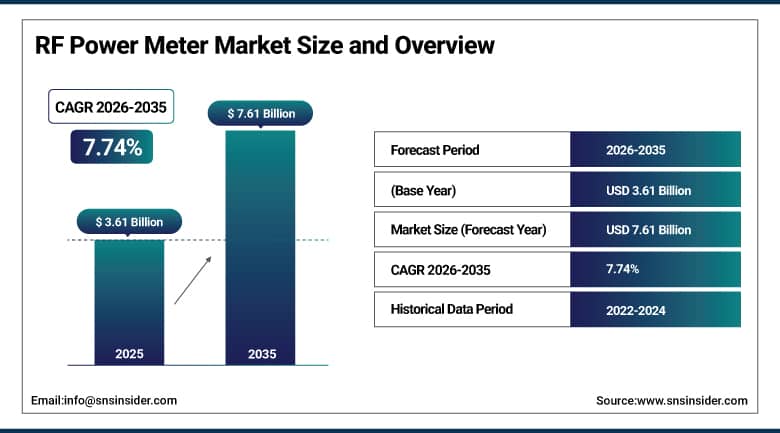
The RF Power Meter Market size was valued at USD 3.61 Billion in 2025 and is expected to reach USD 7.61 Billion by 2035, growing at a CAGR of 7.74% from 2026 to 2035.
The RF Power Meter market experiences continued growth due to increased usage of the 5G wireless technology infrastructure, increased demand for accurate power measurements for telecommunication and aerospace and defense testing purposes, and advancements in digital signal processing that enhance the accuracy and speed of measurement. Radio frequency power meters are vital test and measurement devices that are used to measure radio frequency power in wireless networks, radar systems, satellite communications, and broadcast systems. Moreover, market growth is also supported by increased spending by the military and defense sector on radar and satellite communications testing, incorporation of the Internet of Things connectivity technology into modern power meters, and increased spending in smart cities and wireless infrastructure testing projects.
In 2024, Keysight Technologies collaborated with National Physical Laboratory, UK to introduce the world’s first traceable RF power meter in cryogenic temperature range, which depicts the continuous innovations taking place in the field of RF power meters.
To Get More Information On RF Power Meter Market - Request Free Sample Report
RF Power Meter Market Trends:
-
Rising integration of AI and machine learning algorithms is enabling automated error correction and real-time signal analysis in RF power meters.
-
Growing adoption of cryogenic and wideband peak power sensors is improving measurement precision for quantum computing and 5G mmWave applications.
-
Increasing demand for compact, handheld devices with integrated data logging is expanding field-testing and on-site measurement capability.
-
Expanding use of IoT-connected power meters is enabling remote, real-time monitoring across distributed wireless infrastructure networks.
-
Rising focus on energy-efficient measurement solutions is driving innovation in low-power, high-accuracy RF sensor design.
U.S. RF Power Meter Market Size Outlook:
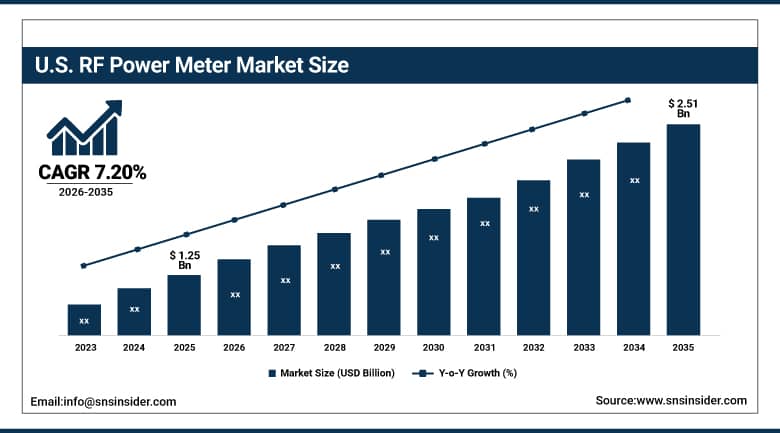
The U.S. RF Power Meter Market was valued at USD 1.25 Billion in 2025 and is projected to reach USD 2.51 Billion by 2035, growing at a CAGR of 7.20% during 2026–2035.
The nation’s leading RF test and measurement instrument makers have continuously increased usage of RF power meters because of steady investments in the deployment of 5G networks, extensive testing activities within defense and aerospace industries, and significant domestic semiconductor and electronics manufacturing which requires high accuracy of RF calibration devices. In addition to consistent FCC funding for deployment of rural 5G networks and increasing budget spending by U.S. Department of Defense on radar and satellite communications, there is increased demand for sophisticated power measuring instruments. Domestic makers are also focusing on AI diagnostics software and cryogenic measurement technology to compete effectively with foreign competitors entering the U.S. RF test and measurement market.
Anritsu introduced a new IQ capture and IQ streaming option for its Field Master MS2080A RF spectrum analyzer in 2024, enhancing real-time data analysis capabilities for 5G, IoT, and aerospace testing applications across U.S. defense and telecommunications customers.
RF Power Meter Market Segment Analysis:
-
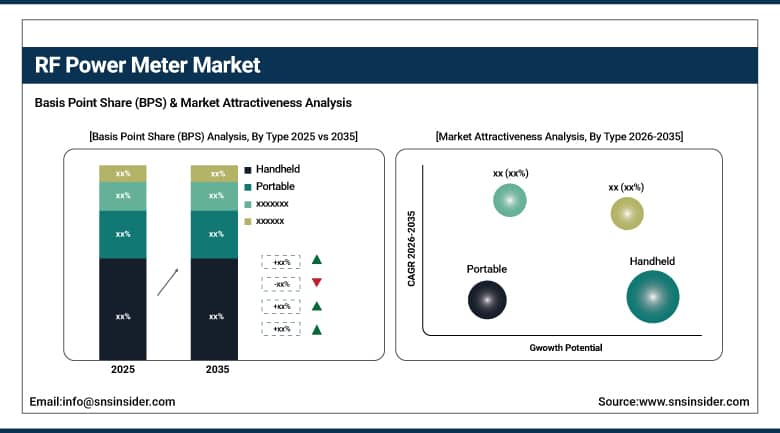
By Type, Handheld dominated the RF Power Meter Market with a 34.00% share in 2025, while Portable is the fastest-growing type segment with a CAGR of 9.60% from 2026–2035.
-
By Application, Telecommunications dominated the RF Power Meter Market with a 42.00% share in 2025, while Automotive is the fastest-growing application segment with a CAGR of 9.80% from 2026–2035.
By Type, Handheld dominated the RF Power Meter Market, while Portable is the fastest-growing segment.
The Handheld segment was the leading contributor with 34.00% revenue share in the RF Power Meter Market. The popularity of handheld devices stems from their flexibility, portability, and cost efficiency in telecommunications, aerospace and defense, and electronics sectors. They are widely used and favored for field-testing and measurement purposes due to these properties. The rising preference for portable power meters by engineers and specialists is due to their simplicity and capability to provide precise and timely measurements in 5G infrastructure, network maintenance, and broadcasting equipment repair processes without the need for setup of benchtop systems. Rapid development and expansion of rugged handheld devices available in various price ranges and offered by different companies, along with the incorporation of such capabilities as data logging and wireless connectivity.
Portable segment will see a high CAGR of 9.60% during the forecast period of 2026-2035. The growing need for efficient, portable power measuring instruments that can be used for field-based work in remote or space-restricted places is driving the above-mentioned average growth of the segment, with portable power meters acting as a compromise between convenience and precision. The increasing use of portable devices for testing IoT structures and dense wireless network expansion projects is enhancing the clinical and industrial applications of the said devices, and the emphasis on improved battery life and wireless communication by manufacturers is further fueling their adoption in such testing programs.
By Application, Telecommunications dominated the RF Power Meter Market, while Automotive is the fastest-growing segment.
Telecommunications was the key segment which accounted for a market share of 42.00% in the RF Power Meter Market in 2025. Telecommunications continues to be the biggest application category due to the worldwide rollout of 5G network infrastructures and an increasing number of devices that need to undergo signal quality and performance checks during network rollouts and maintenance phases. The dominance of this segment is also backed up by heavy investments made by telecoms in their infrastructures along with the installation of small cells and DAS infrastructure needing regular power measurement through highly precise RF power meters.
The Automotive segment is expected to register the fastest CAGR of 9.80% during the forecast period 2026-2035. Growing integration of wireless communication technologies in connected and electric vehicles, including vehicle-to-everything (V2X) communication systems and advanced driver-assistance systems, is driving above-average adoption of RF power meters for automotive radar and communication module testing. Rising global spending on vehicle electronics and the accelerating development of autonomous vehicle technology continue to expand the clinical and industrial utility of RF power measurement in automotive manufacturing and quality assurance processes, positioning this segment as an increasingly important growth driver for instrumentation manufacturers.
Regional Analysis:
|
Region |
Major Country |
Share within Region, 2025 (%) |
|
North America |
United States |
86.00% |
|
Europe |
Germany |
26.00% |
|
Asia Pacific |
China |
40.00% |
|
Middle East & Africa |
UAE |
24.00% |
|
South and Central America |
Brazil |
40.00% |
North America RF Power Meter Market Insights
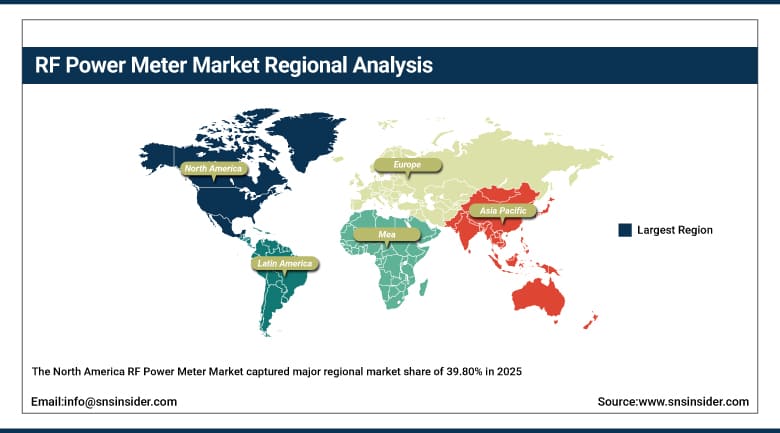
The North America RF Power Meter Market captured major regional market share of 39.80% in 2025 due to the region’s highly advanced telecommunication infrastructure, huge defense and aerospace testing base, and presence of major players manufacturing test & measurement equipment who have engineering excellence. The strict regulatory requirements for quality test equipment, along with consistent investment from governments towards 5G infrastructure development and modernization of wireless networks, will ensure continued engineering assurance of accuracy in RF power measurement equipment in commercial and military communications.
The US was the leading nation in the North America RF Power Meter Market in 2025 having a market share of 86.00% in the regional market, owing to huge investments in 5G infrastructure in the country, large defense budgets of the US Department of Defense in terms of testing of radars and satellite communication, and major presence of domestic companies manufacturing RF instrumentations. Canada is contributing to regional growth through expanding telecommunications infrastructure investment and growing adoption of advanced power measurement systems across major industrial and defense-related testing facilities.
Get Customized Report as Per Your Business Requirement - Enquiry Now
Europe RF Power Meter Market Insights
The Europe region is expected to register steady growth for regulatory-compliant, high-precision testing equipment during the forecast period. It is due to the tough regulations put forth by entities like the European Telecommunications Standards Institute that ensure that high-quality test equipment is used, alongside growing interest in renewable energy and smart grid technologies that demand energy-efficient and effective communication testing facilities.
Germany is one of the significant markets in Europe due to its strong automotive industry and use of RF testing equipment in the manufacturing of electric vehicles. Other countries such as the United Kingdom, home to leading test and measurement equipment manufacturers, are also contributing to market growth through expanding investment in smart transportation and communication technologies across national telecommunications and defense sectors.
Asia Pacific RF Power Meter Market Insights
The Asia Pacific RF Power Meter Market is expected to witness the fastest growth rate during the forecast period 2026-2035, registering a CAGR of 9.80%. The market growth is driven by rapid industrialization, expanding telecommunications infrastructure investment, and rising adoption of 5G technology across countries such as China, Japan, and South Korea, supported by significant government initiatives aimed at enhancing regional technological capabilities and wireless network coverage.
China is one of the main growth drivers in the Asia Pacific RF Power Meter Market, owing to its leading position in 5G infrastructure development and rapid addition of new 5G base stations supporting both domestic telecommunications expansion and export-oriented manufacturing. Japan and India are also contributing to regional growth through accelerating investment in wireless communication infrastructure and rising demand for precision testing equipment across expanding electronics and telecommunications manufacturing sectors.
Middle East & Africa and South and Central America RF Power Meter Market Insights
Middle East & Africa and South and Central American regions are gradually expanding RF power meter adoption as telecommunications and defense sector investment grows across both regions, supported by increasing government initiatives to enhance connectivity and military modernization programs across major metropolitan and industrial centers.
Brazil is set to be a prominent South American market fueled by increased spending on telecommunications and defense sectors supporting demand for precision power measurement equipment. The Middle East & Africa region has the UAE and Saudi Arabia investing heavily in 5G technology and advanced radar systems for defense, creating significant market opportunities for RF power meter manufacturers expanding their regional distribution networks.
Market Dynamics:
Growth Drivers: Rising 5G deployment and defense sector investment driving market growth
Increasing demand for wireless technology and development of 5G networks is positively impacting the market for RF Power Meters. There are more than 1.5 billion users in the world that use 5G networks, thus creating the demand for high-quality power measuring devices that can deal with the complexities of new frequencies and dense network structure. Another important driver of the market demand is aerospace and defense industry, which is actively deploying radar and satellite communication systems. Military spending is growing in the world, creating the demand for testing equipment.
Increasing regulatory compliance demands from the telecommunication and broadcasting industries will continue to drive market growth as organizations impose stringent demands for measuring power accurately to ensure safety and performance. Continuous improvements in digital signal processing, calibration systems, and internet of things connectivity are increasing the efficiency and accuracy of current radio frequency power meters, encouraging more widespread adoption of the devices in telecommunication, aerospace, automotive, and electronic manufacturing sectors.
Restraints: High product costs and component supply volatility limiting market expansion
Market growth is hindered by expensive products and unstable pricing of raw materials such as semiconductors, essential in the development of RF power meters. This is because precise RF test Equipment need to utilize semiconductor technology and calibration procedures, and therefore, constitute a substantial financial investment that might not be easily justified by small laboratories with limited resources.
In addition to this, the previous lack of semiconductors has created delays in delivering testing devices in sufficient quantities, hampering market growth in the process. On the other hand, the need for specialized engineering knowledge needed to operate and analyze data obtained from RF power meters may pose difficulties for small companies with no engineers available.
Opportunities: Automotive electrification and IoT integration creating new growth avenues
There are opportunities in the automotive sector, where RF technology incorporation in EVs and advanced driver assistance systems will create high demand for precise power measuring devices. Increased use of autonomous vehicle technologies, along with increasing global expenditure on automotive electronics, will create additional demands in the market for RF power meters owing to the fact that testing of radar, communication, and sensing systems will be required during the development and manufacturing of vehicles.
There exists huge scope for growth within the domain of IoT-integrated power meters that enable real-time monitoring and analytics from a wireless infrastructure network. This is owing to the increasing need for testing and monitoring of wireless infrastructure owing to the emergence of smart cities and IoT devices. Further advancements in cryogenic and wideband measurements, coupled with increased investments in research and development within the worldwide RF instruments market, are anticipated to provide incremental opportunities during the forecast period within quantum computing and communications.
Recent Developments:
-
2023: Rohde & Schwarz expanded its R&S NRP power sensor family with new wideband peak power sensors designed to support 5G mmWave testing and next-generation wireless network validation.
-
2023: Bird launched an updated Bird 5000-EX RF power meter and wattmeter platform aimed at broadcast and telecommunications customers requiring rugged, field-deployable measurement instrumentation.
-
2022: National Instruments integrated enhanced RF power measurement capability into its PXIe-based modular test systems, supporting aerospace and defense radar testing applications requiring high-throughput, automated validation.
RF Power Meter Companies are:
-
Rohde & Schwarz
-
Anritsu Corporation
-
Bird (Bird Technologies)
-
Emerson Electric Co.
-
Wireless Telecom Group, Inc.
-
Aim-TTi
-
Cobham Limited
-
Fluke Corporation
-
National Instruments Corporation
-
Narda Safety Test Solutions GmbH
-
Advantest Corporation
-
Viavi Solutions Inc.
-
Teledyne LeCroy
-
Siglent Technologies Co., Ltd.
-
B&K Precision Corporation
-
Berkeley Nucleonics Corporation
-
Mini-Circuits
-
Boonton Electronics
RF Power Meter Market Report Scope:
| Report Attributes | Details |
|---|---|
| Market Size in 2025 | USD 3.61 Billion |
| Market Size by 2035 | USD 7.61 Billion |
| CAGR | CAGR of 7.74% From 2026 to 2035 |
| Base Year | 2025 |
| Forecast Period | 2026-2035 |
| Historical Data | 2022-2024 |
| Report Scope & Coverage | Market Size, Segments Analysis, Competitive Landscape, Regional Analysis, DROC & SWOT Analysis, Forecast Outlook |
| Key Segments | • By Type (Handheld, Benchtop, Portable, Other Types) • By Application (Telecommunications, Aerospace & Defense, Automotive, Electronics, Other Applications) |
| Regional Analysis/Coverage | North America (US, Canada), Europe (Germany, UK, France, Italy, Spain, Russia, Poland, Rest of Europe), Asia Pacific (China, India, Japan, South Korea, Australia, ASEAN Countries, Rest of Asia Pacific), Middle East & Africa (UAE, Saudi Arabia, Qatar, South Africa, Rest of Middle East & Africa), Latin America (Brazil, Argentina, Mexico, Colombia, Rest of Latin America). |
| Company Profiles | Keysight Technologies, Rohde & Schwarz, Anritsu Corporation, Bird (Bird Technologies), Emerson Electric Co., Tektronix, Inc., Wireless Telecom Group, Inc., Aim-TTi, Cobham Limited, Fluke Corporation, National Instruments Corporation, Narda Safety Test Solutions GmbH, Advantest Corporation, Viavi Solutions Inc., Teledyne LeCroy, Siglent Technologies Co., Ltd., B&K Precision Corporation, Berkeley Nucleonics Corporation, Mini-Circuits, Boonton Electronics. |

Frequently Asked Questions
Key players in the RF Power Meter Market include Keysight Technologies, Rohde & Schwarz, Anritsu Corporation, Bird Technologies, and Emerson Electric, among others.
Key opportunities in the RF Power Meter Market include automotive electrification, IoT-integrated power meters, cryogenic measurement technology, and advanced RF testing for quantum computing and next-generation wireless applications.
The market is driven by rising 5G infrastructure deployment, increasing aerospace and defense investment, growing demand for precise RF testing, regulatory compliance requirements, and advancements in digital signal processing and connectivity.
The Handheld segment dominated the RF Power Meter Market, accounting for approximately 34.00% market share in 2025.
North America led the RF Power Meter Market in 2025 with a 39.80% share, driven by 5G, aerospace, defense, and advanced telecom infrastructure.
