
Low Power Next Generation Display Market Report Scope and Overview:
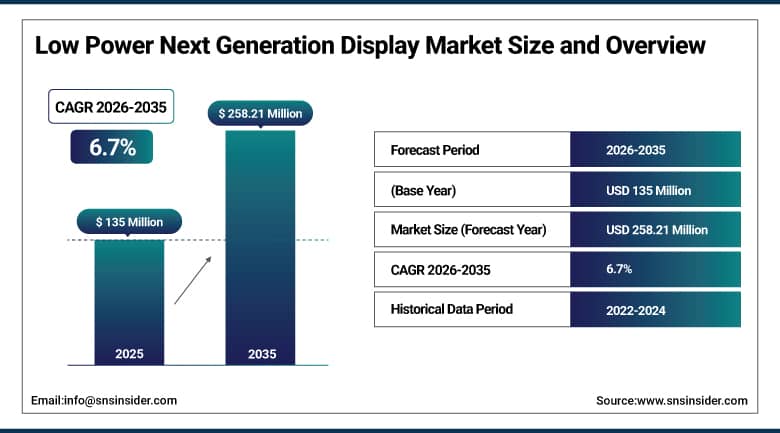
The Low Power Next Generation Display Market size was valued at USD 135 Million in 2025 and is projected to reach USD 258.21 Million by 2035, registering a CAGR of 6.7% from 2026 to 2035.
The Low Power Next Generation Display Market is revolutionizing the energy-efficient computing market through next-generation OLED, microLED, and e-paper displays that help prolong battery lives in smartphones, wearable technology, and digital cockpits in automobiles. Key features of the low power next generation display market include increasing usage of LTPO OLED displays supporting dynamic refresh rates in premium smartphones, rising implementation of energy-efficient microdisplays in AR/VR displays, and increasing use of automotive digital cockpits and display systems in vehicles. There are many instances of growth seen in health monitors in wearable devices, foldable smartphone screens, and IoT edge device displays, owing to the fact that there are large investments being made by display companies and device manufacturers in power-efficient display designs to meet the stringent global energy-efficiency norms.
The Samsung Display company unveiled its QD-OLED Penta Tandem display panels during the fourth quarter of 2025. This technology is characterized by the five-layer organic stack design, which enhances the lifetime and peak brightness of the display panels.
To Get More Information On Low Power Next Generation Display Market - Request Free Sample Report
Low Power Next Generation Display Market Trends
-
Rapid adoption of LTPO OLED panels continues enabling dynamic refresh rates that significantly reduce smartphone power consumption.
-
Growing commercialization of mass transfer and hybrid bonding techniques continues improving microLED yield and cost efficiency.
-
Rising integration of display hardware with power-management ICs continues optimizing system-level energy efficiency in portable electronics.
-
Increasing adoption of tandem and multi-stack OLED architectures continues improving brightness while reducing per-unit power draw.
-
Expanding digital automotive cockpit deployment continues driving demand for energy-efficient, high-resolution in-vehicle display systems.
U.S. Low Power Next Generation Display Market Size Outlook
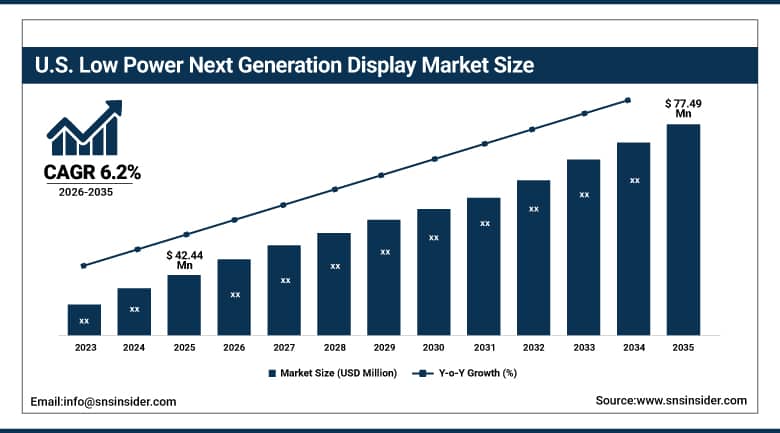
The U.S. Low Power Next Generation Display Market was valued at approximately USD 42.44 Million in 2025 and is projected to reach approximately USD 77.49 Million by 2035, registering a CAGR of approximately 6.2% from 2026 to 2035.
Demand across the United States continued to be shaped by a strong consumer electronics sector, an advanced research and development ecosystem, and rapid adoption of OLED and microLED technologies across smartphones, smart TVs, and automotive displays. Rising deployment of energy-efficient display modules by domestic electric vehicle manufacturers for information systems and heads-up displays continued reinforcing the country's position as both the largest and one of the most innovation-driven markets tracked in this report. Growing adoption across home appliances, industrial equipment, and IoT-enabled devices added further layers of sustained domestic demand well beyond the technology's original smartphone use case.
Planar Systems announced a strategic partnership with Megapixel throughout 2025 to deliver a premium next-generation LED display platform, combining Planar’s visualization technology with advanced processing for ultra-fine pixel pitch video walls.
Low Power Next Generation Display Market Segment Analysis
-
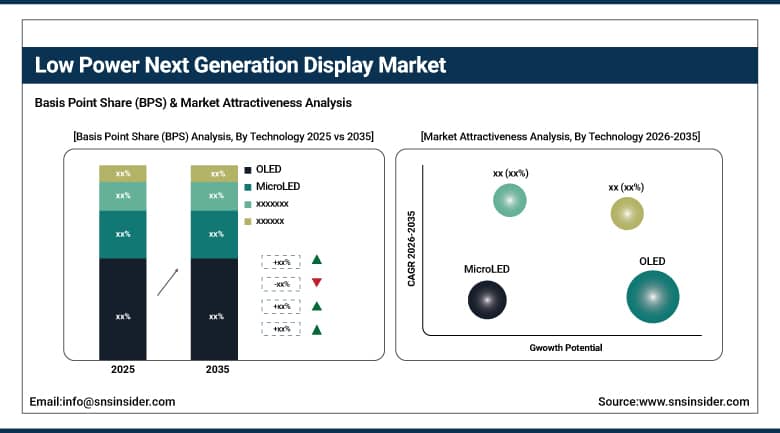
By Technology, OLED segment dominated the Low Power Next Generation Display Market in 2025 with 41% share; MicroLED segment is the fastest growing segment.
-
By Panel Size, Small Panels (2"-7") segment dominated the market in 2025 with 34% share; Microdisplays (<2") segment is the fastest growing segment.
-
By Form Factor, Rigid Displays segment dominated the market in 2025 with 52% share; Foldable Displays segment is the fastest growing segment.
-
By Application, Consumer Electronics segment dominated the market in 2025 with 48% share; AR/VR/XR Devices segment is the fastest growing segment.
By Technology, OLED Leads While MicroLED Grows Fastest
The OLED segment dominated the Low Power Next Generation Display Market in 2025 owing to its self-emissive technology, brightness, and energy efficiency, making it appropriate for smartphones and tablets as well as automotive applications. Its ability to provide adaptive refresh rates and cut energy consumption has made it widely popular in electronic devices and industrial equipment. Continued penetration of tandem OLED architectures into laptops and automotive displays has kept OLED the largest single revenue contributor within the technology landscape tracked in this report.
The MicroLED segment is the fastest growing in the Low Power Next Generation Display Market owing to increasing popularity in the domain of AR/VR, large signage, and ultra-bright displays on account of its brightness, long lifecycle, and power efficiency. Advancements in mass transfer technology and defect management are fueling the adoption of microLED technology to power energy-efficient premium displays. Growing investment in manufacturing yield improvement continues accelerating commercialization of microLED across premium consumer and automotive segments.
By Panel Size, Small Panels Dominate While Microdisplays Record Fastest Growth
The segment of small panels (2" to 7") was the most popular product type in the Low Power Next Generation Display Market 2025, commonly applied in phones, tablet computers, and wearable technology, because of their balance of a small form factor and performance. These panels use LTPO OLED and energy-efficient LCD technology, which provide long battery life and "always on" mode. Sustained global smartphone and wearable device shipment volumes have kept this panel size the largest overall revenue contributor across the market.
The Microdisplays (<2 inches) segment is the fastest growing in the Low Power Next Generation Display Market as it is critical for AR/VR headsets, smart glasses, and other wearable optics requiring compact, high-resolution, and energy-efficient displays. Advancements in microLED and OLED-on-silicon technologies are driving adoption, enabling immersive experiences while minimizing power consumption and device weight. Growing enterprise and consumer AR/VR device adoption continues accelerating demand for this panel size segment.
By Form Factor, Rigid Displays Lead While Foldable Grows Fastest
The Rigid Displays segment ruled over the Low Power Next Generation Display Market in 2025 owing to its mature manufacturing process and wide compatibility with most of the smartphones, tablets, and televisions that are already in mass production. The manufacturers preferred rigid displays because of their reliability, reduced manufacturing costs, and ease of installation in regular device casings. Sustained mainstream consumer electronics production has kept rigid displays the largest overall contributor to market revenue.
The Foldable Displays segment is the fastest growing in the Low Power Next Generation Display Market owing to rising smartphone and tablet manufacturer investment in foldable form factors that combine adaptive refresh rate control with power-optimized panel architectures. Device makers increasingly favor foldable displays to differentiate premium smartphone and tablet offerings while extending battery life through dynamic power management. Growing consumer demand for innovative, space-saving device form factors continues accelerating growth in this form factor segment.
By Application, Consumer Electronics Leads While AR/VR/XR Grows Fastest
The Consumer Electronics segment dominated the Low Power Next Generation Display Market in 2025, as low-power displays are extensively deployed in smartphones, tablets, laptops, and wearable devices, where energy efficiency is critical for battery life and portability. Continuous innovation in OLED and LCD panels with adaptive refresh rates ensures high adoption, keeping consumer electronics as the leading application segment tracked in this report.
The AR/VR/XR Devices segment is the fastest growing in the Low Power Next Generation Display Market owing to increasing demand for energy-efficient microdisplays and high-brightness, compact panels in gaming, training, and enterprise applications. The combination of lightweight form factor, high resolution, and low power consumption drives adoption in immersive devices, positioning AR/VR/XR as a high-growth application through the forecast period.
Regional Analysis
|
Region |
Major Country |
Share within Region, 2025 (%) |
|---|---|---|
|
North America |
United States |
87.00% |
|
Europe |
United Kingdom |
26.00% |
|
Asia Pacific |
China |
40.00% |
|
Middle East and Africa |
Saudi Arabia |
29.00% |
|
Latin America |
Brazil |
28.00% |
North America Low Power Next Generation Display Market Insights
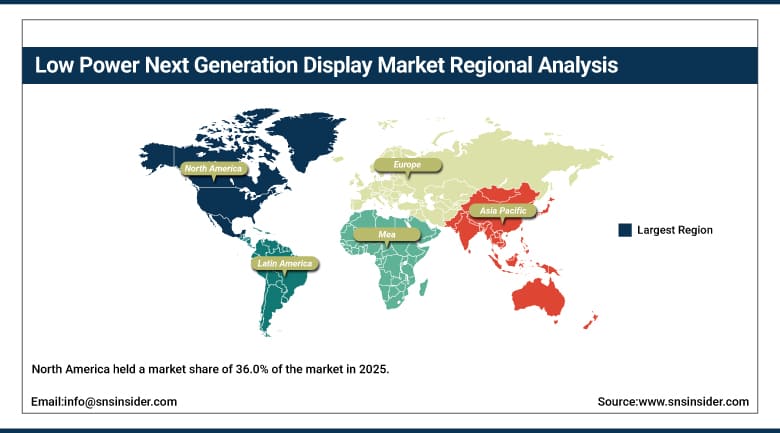
North America held a market share of 36.0% of the market in 2025. The region is experiencing strong expansion driven by growing demand for energy-efficient display technologies in consumer electronics, automotive, industrial, and smart infrastructure applications, supported by rapid uptake of OLED, microLED, and quantum dot displays that deliver lower energy consumption and superior visual performance compared to legacy LCD panels. Demand is strong, especially in automotive displays, digital car instrumentation, infotainment systems, AR/VR devices, wearable displays, and high-end TVs, with adoption fueled by strong R&D capabilities and use of AI/IoT technology for dynamic display panel control.
The United States accounted for roughly 87.00% of regional revenue, anchored by its strong consumer electronics sector coupled with an advanced R&D ecosystem, alongside advanced display technologies like OLED and MicroLED across smartphones, smart TVs, and automotive displays. Canada added further regional demand through its own growing technology and manufacturing sectors, and that combined strength kept the continent the largest addressable market for low power next generation display vendors through the forecast period.
Get Customized Report as Per Your Business Requirement - Enquiry Now
Europe Low Power Next Generation Display Market Insights
Europe held a meaningful share of global revenue, expanding due to a combination of stringent energy efficiency regulations like the EU Ecodesign Directive and strong industry demand from automotive, industrial, and consumer electronics segments. European automotive manufacturers are integrating advanced energy-efficient display modules into digital cockpits and infotainment systems, driving significant regional demand, while industrial automation and public infrastructure projects across Western and Eastern Europe are adopting flexible low power panels for human-machine interfaces and digital signage.
The United Kingdom led demand at roughly 26.00% of European revenue, distinguished by its high adoption of microdisplay and quantum dot technologies, driven by advanced R&D infrastructure and significant commercial use in AR/VR, automotive displays, and industrial applications. Germany and France contributed additional demand, and continued European investment in energy-efficient display materials and manufacturing should keep regional demand climbing steadily through the forecast period.
Asia Pacific Low Power Next Generation Display Market Insights
Asia Pacific is anticipated to grow at the highest CAGR of 8.2% during the forecast period, with the market consistently leading global share due to robust manufacturing ecosystems and high volume production of advanced display technologies. This dominance is driven by China, Japan, South Korea, and Taiwan, which together form the bulk of OLED, microLED, and quantum dot panel output. APAC’s industrial and automotive industries are further accelerating adoption, integrating low power next generation panels into dashboard displays, in-vehicle infotainment systems, and industrial human-machine interfaces that combine high performance with reduced energy use.
China led the pack, characterized by massive scale and rapid structural advancement, holding the largest regional share in Asia Pacific and acting as a central node in global display production. Domestic panel makers such as BOE Technology Group, TCL CSOT, Tianma, and Visionox are scaling up facilities and diversifying technology portfolios, aligning production toward low power, high efficiency panel types for smartphones, tablets, wearables, TVs, and AR/VR devices.
MEA and Latin America Low Power Next Generation Display Market Insights
The Middle East and Africa and Latin America both showed steady growth, driven by strategic national technology initiatives and commercial infrastructure demand. Under Saudi Vision 2030, the country has emphasized digital transformation, which has accelerated the deployment of energy-efficient displays such as OLED, microLED, and advanced LED video walls in public, commercial, and smart city environments. As these markets continued building out modern infrastructure, low power display technology proved a genuinely valuable way to capture value-added retail, entertainment, and smart infrastructure installations.
Saudi Arabia led Middle East and Africa demand, supported by strategic national technology initiatives tied to Vision 2030 and rising adoption of OLED and microLED-based panels in retail, entertainment, and smart infrastructure installations across malls, airports, and smart districts. In Latin America, Brazil accounted for the largest share of regional revenue, with growing consumer electronics and automotive manufacturing investment continuing to anchor regional demand for low power next generation display technology.
Market Dynamics
Growth Drivers: Rapid LTPO OLED Adoption and Sustainability Regulation
The industry is driven by rapid adoption of LTPO OLED in smartphones enabling dynamic refresh rates that significantly reduce power consumption, expanding use in wearable health monitoring devices requiring always-on energy-efficient panels, growing demand for energy-efficient AR/VR microdisplays, and tightening sustainability regulations favoring lower power electronics. As OEMs increasingly prioritize battery life and regulatory compliance, the need for power-optimized display architectures continues driving sustained investment across the industry.
New energy-efficiency and ecodesign regulations for smartphones and tablets, such as those that took effect in the European Union in June 2025, continue reinforcing this driver by mandating energy efficiency ratings and design standards for durability. Growing automotive shift toward digital cockpit displays continues defining a further layer of sustained demand, and that combination of regulatory pressure and automotive digitalization is exactly what keeps overall demand climbing at such a steady, sustained pace.
Restraints: LTPO Fabrication Yield Challenges and MicroLED Production Limitations
LTPO fabrication yield optimization complexities continue posing a genuine restraint on faster market-wide expansion, as LTPO fabrication requires precise oxide-TFT backplane integration and complex switching architectures. Yield optimization challenges during mass production increase manufacturing costs and limit scalability, particularly for mid-tier device manufacturers seeking cost-efficient panel solutions.
Limited large-scale microLED mass production continues posing a further restraint, as large-scale microLED manufacturing remains technically complex due to challenges in chip transfer, uniformity control, and defect management. Low production yields and high capital expenditure for advanced manufacturing equipment delay commercialization across mainstream consumer applications, keeping premium microLED deployment concentrated among a comparatively small number of well-resourced manufacturers.
Opportunities: Foldable OLED Expansion and IoT Edge Device Integration
Adaptive Refresh Foldable OLED Panels offer promising growth prospects through the ability to implement adaptive refresh rate in foldable OLED panels, whereby power is managed optimally depending on usage of content. This improves the efficiency of batteries in foldable mobile phones and tablets, and at the same time allows for thinner designs, giving an opportunity for manufacturers to gain significant market share as foldable devices become more popular.
The next major opportunity that is created by IoT edge devices would be in low-power displays for these devices, which will provide ultra-low power display capabilities for smart meters, industrial sensors, and other medical devices. Such displays will ensure that the lifespan of devices is increased, as well as ensuring that maintenance is decreased and the ability to function in remote locations or those with limited energy is enhanced.
Recent Developments:
-
2025: Samsung Display introduced its QD-OLED Penta Tandem panel technology for monitors and TVs, featuring a five-layer organic structure that delivers higher peak brightness and longer lifespan for premium display segments.
-
2025: Panasonic Projector & Display Corporation launched a new sub-brand aimed at transforming visual media experiences, focusing on innovative display solutions for professional and entertainment markets.
-
2025: Planar Systems announced a strategic partnership with Megapixel to deliver a premium next-generation LED display platform, combining visualization technology with advanced processing for ultra-fine pixel pitch video walls.
Low Power Next Generation Display Companies are:
-
BOE Technology Group
-
LG Display
-
AU Optronics Corporation
-
Panasonic Corporation
-
Sharp Corporation
-
Sony Corporation
-
Tianma
-
Universal Display Corporation (UDC)
-
QUALCOMM Incorporated
-
Nanosys
-
Planar Systems
-
Novaled GmbH
-
Koninklijke Philips N.V.
-
DuPont de Nemours, Inc.
-
Futaba Corporation
-
RiTdisplay Corporation
-
Innolux Corporation
-
E Ink Holdings Inc.
Low Power Next Generation Display Market Report Scope:
| Report Attributes | Details |
|---|---|
| Market Size in 2025 | USD 135 Million |
| Market Size by 2035 | USD 258.21 Million |
| CAGR | CAGR of 6.7% From 2026 to 2035 |
| Base Year | 2025 |
| Forecast Period | 2026-2035 |
| Historical Data | 2022-2024 |
| Report Scope & Coverage | Market Size, Segments Analysis, Competitive Landscape, Regional Analysis, DROC & SWOT Analysis, Forecast Outlook |
| Key Segments | • By Technology (OLED, MicroLED, E-paper, Advanced Low-Power LCD) • By Panel Size (Microdisplays (<2 inches), Small Panels (2"-7"), Medium Panels (7"-17"), Large Panels (17"-43"), Extra Large Panels (>=43")) • By Form Factor (Rigid Displays, Flexible Displays, Foldable Displays, Rollable/Slidable Displays) • By Application (Consumer Electronics, Automotive Displays, Wearable Devices, AR/VR/XR Devices, Industrial & Commercial Applications) |
| Regional Analysis/Coverage | North America (US, Canada), Europe (Germany, UK, France, Italy, Spain, Russia, Poland, Rest of Europe), Asia Pacific (China, India, Japan, South Korea, Australia, ASEAN Countries, Rest of Asia Pacific), Middle East & Africa (UAE, Saudi Arabia, Qatar, South Africa, Rest of Middle East & Africa), Latin America (Brazil, Argentina, Mexico, Colombia, Rest of Latin America). |
| Company Profiles | Samsung Display, BOE Technology Group, LG Display, AU Optronics Corporation, Visionox Technology, Panasonic Corporation, Sharp Corporation, Sony Corporation, Tianma, Universal Display Corporation (UDC), QUALCOMM Incorporated, Nanosys, Planar Systems, Novaled GmbH, Koninklijke Philips N.V., DuPont de Nemours, Inc., Futaba Corporation, RiTdisplay Corporation, Innolux Corporation, E Ink Holdings Inc. |

Frequently Asked Questions
Key players in the Low Power Next Generation Display Market include Samsung Display Co., Ltd., LG Display Co., Ltd., BOE Technology Group Co., Ltd., TCL CSOT, and Panasonic Corporation, among others.
Key opportunities in the Low Power Next Generation Display Market include expansion of foldable OLED panels with adaptive refresh rates and integration of low-power displays into IoT edge devices.
The market is driven by rapid adoption of LTPO OLED displays, increasing demand for energy-efficient AR/VR microdisplays, wearable health-monitoring devices, and tightening energy-efficiency regulations.
The OLED segment dominated the Low Power Next Generation Display Market, accounting for approximately 41% market share.
The North America region dominated the Low Power Next Generation Display Market in 2025 with a 36.0% share, driven by strong consumer electronics demand, advanced display R&D capabilities, and growing automotive and AR/VR applications.
