
Resilient Power Infrastructure Market Report Scope and Overview:
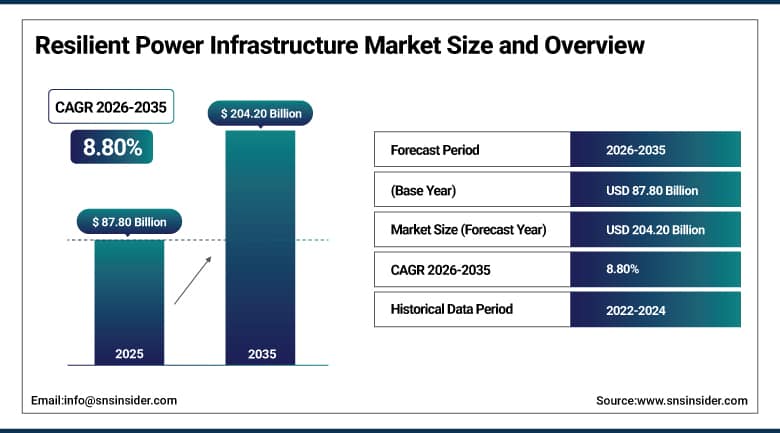
The Resilient Power Infrastructure Market was valued at USD 87.80 Billion in 2025 and is projected to reach USD 204.20 Billion by 2035, registering a CAGR of 8.80% from 2026 to 2035.
Resilient Power Infrastructure Market growth is driven by increasing frequency and impact of climatic events, increasing spending on grid modernization, increased use of renewable energy, and heightened energy security concerns for power infrastructure across generation, transmission, and distribution networks. Advanced distribution automation systems, strategic collaboration between technology providers and electric utilities, as well as growing AI-powered grid orchestration ability has been the outcome of large-scale investment in resilient and disaster-proof power infrastructure by electric utilities, government organizations, and critical infrastructure operators.
To Get More Information On Resilient Power Infrastructure Market - Request Free Sample Report
Resilient Power Infrastructure Market Trends
-
Rising deployment of microgrids and distributed energy resources continues improving disaster-preparedness for critical facilities.
-
Growing grid hardening investment continues expanding underground cabling and storm-resistant infrastructure deployment.
-
Expanding renewable energy integration is broadening demand for advanced grid management and orchestration platforms.
-
Increasing cyber threats targeting power infrastructure continue driving investment in resilient security architectures.
-
Growing digitalization of grid assets continues improving situational awareness and outage recovery speed.
U.S. Resilient Power Infrastructure Market Outlook
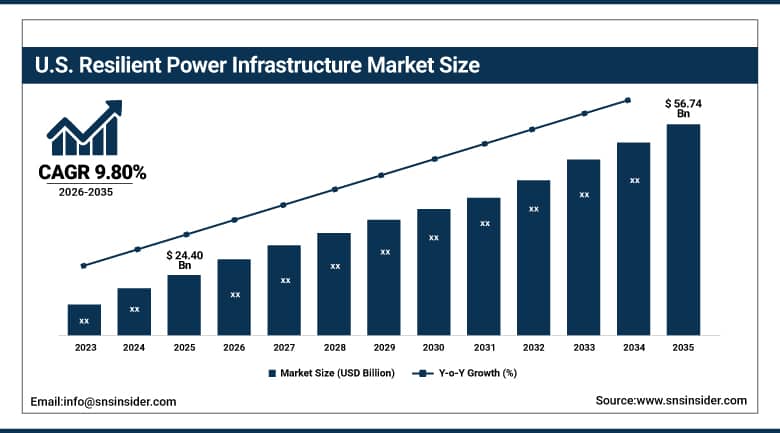
The U.S. Resilient Power Infrastructure Market was valued at approximately USD 24.40 Billion in 2025 and is projected to reach approximately USD 56.74 Billion by 2035, registering a CAGR of approximately 9.80% from 2026 to 2035.
The demand from the U.S. has been propelled by programs related to grid resiliency at federal and state level, investments made to mitigate wildfires, microgrids, and upgrades of existing old transmission and distribution grid infrastructure. American utilities have been making significant investments in automation of the grid, monitoring technologies, undergrounding of distribution grids, and cyber security solutions for resilience against extreme weather events and growing electricity demand.
The adoption of AI-based grid orchestration and distribution automation software played a pivotal role in establishing leadership of the resilient power infrastructure market in the United States. In addition to that, the deployment of battery energy storage systems for protection of critical facilities fueled the demand for the product.
Resilient Power Infrastructure Market Segment Analysis
-
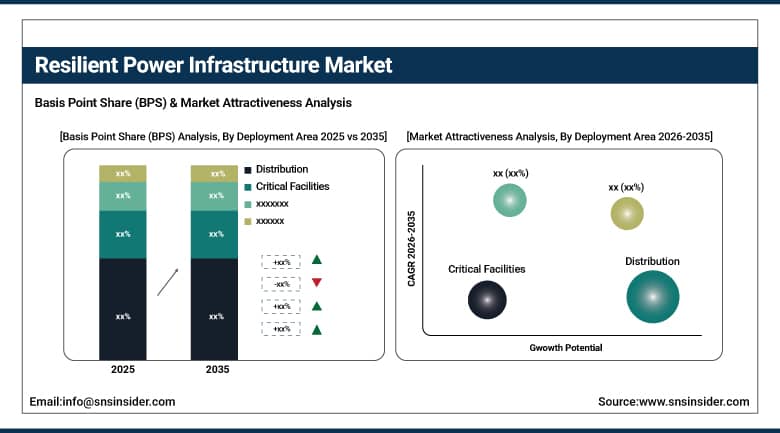
By Deployment Area, Distribution segment dominated the market in 2025 with 32.60% share; Critical Facilities segment is the fastest growing segment, registering a CAGR of approximately 9.60%.
-
By Solution, Grid Hardening Solutions segment dominated the Market in 2025 with 34.50% share; Energy Storage Solutions segment is the fastest growing segment, registering a CAGR of approximately 10.80%.
-
By End-User, Electric Utilities segment dominated the market in 2025 with 37.20% share; Critical Infrastructure Operators segment is the fastest growing segment, registering a CAGR of approximately 9.50%.
By Deployment Area, Distribution Dominates the Resilient Power Infrastructure Market While Critical Facilities Grows Fastest
Distribution held the largest deployment area share in 2025 at approximately 32.60%, due to the significant amount of investments made for the development of distribution network infrastructure, automated distribution management systems, smart switches, fault detections technologies and hardening of the infrastructure. The distribution networks are very susceptible to the power outages due to storms, wildfires, floods and equipment failure which makes the development of this technology very necessary for the utilities which operate such distribution networks.
The critical facilities deployment area will witness the highest growth rate of about 9.60% over the forecast period owing to growing demand for energy resilience from hospitals, data centers, military facilities, airports and water treatment plants. Operators of critical facilities are investing heavily in microgrids, battery energy storage systems, and intelligent energy management systems to ensure uninterrupted operations during grid disruptions.
By Solution, Grid Hardening Solutions Dominates the Resilient Power Infrastructure Market While Energy Storage Solutions Grows Fastest
Grid Hardening Solutions held the largest market share of around 34.50% in the Resilient Power Infrastructure Market in 2025, owing to rising investments in improving the strength of transmission and distribution networks, undergrounding the cables, covered conductors, storm-resilient infrastructure, and wildfire mitigation infrastructure. For example, the ongoing effort on System Hardening by Pacific Gas & Electric Company is evidence of the continued focus of utilities on investing in grid hardening instead of other resilience solutions in order to mitigate wildfires.
Energy Storage Solutions are expected to witness the highest growth rate of about 10.80% during the forecast period, which is the fastest among all Solution segments due to the rising installation of battery energy storage systems that help stabilize the grid, integrate renewable energy sources, provide backup power, and manage peak loads.
By End-User, Electric Utilities Leads the Resilient Power Infrastructure Market While Critical Infrastructure Operators Grows Fastest
The Electric Utilities were estimated to be the largest end-users sector during 2025, having their revenue share in total revenue of about 37.20%, due to considerable spending on grid modernization, grid hardening, advanced grid automation technologies, and improvements in cybersecurity. Utilities are the key entities that guarantee reliable electricity supply and are the leaders in the investments into resilience, which would help to minimize outages and facilitate renewables integration.
The Critical Infrastructure Operators were expected to demonstrate the highest growth rates, reaching a CAGR of about 9.50%, driven by increasing investments from data centers, telecom operators, airports, hospitals, and water utilities. Increasing digitalization and dependency on stable electricity supply are making this sector more relevant and rapidly growing one.
Regional Analysis:
|
Region |
Major Country |
Share within Region, 2025 (%) |
|---|---|---|
|
Asia Pacific |
China |
33.00% |
|
North America |
United States |
85.50% |
|
Europe |
Germany |
25.00% |
|
Middle East and Africa |
GCC |
46.00% |
|
Latin America |
Brazil |
44.00% |
Asia Pacific Resilient Power Infrastructure Market Insights
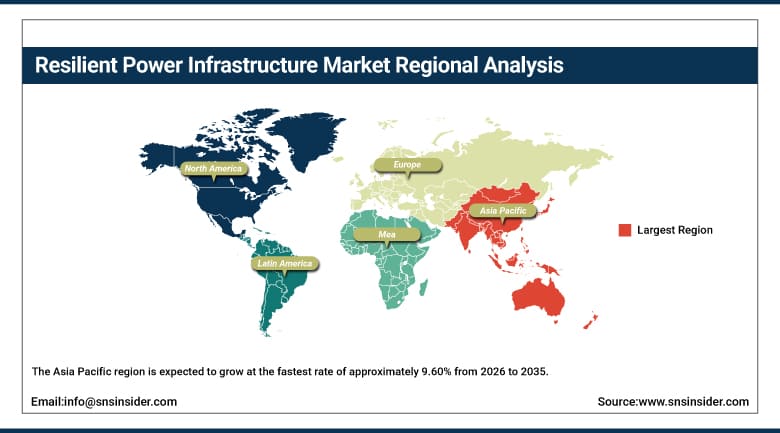
The Asia Pacific region is expected to grow at the fastest rate of approximately 9.60% from 2026 to 2035. This dominance has been primarily supported by investments made in grid modernization, expansion in transmission and distribution networks, integration of renewable energy sources and climate resilient power infrastructure in China, India, Japan, Australia, and Southeast Asia.
The maximum contribution to the Asia Pacific region's revenue came from China with a market share of about 33.00%, due to major investments made in transmission projects and ultra-high-voltage networks in addition to the government initiatives taken to improve energy security in the country. The investments made in the transmission network and smart grid in India also contributed to the rapid growth of the Asia Pacific region during the forecast period.
Get Customized Report as Per Your Business Requirement - Enquiry Now
North America Resilient Power Infrastructure Market Insights
North America dominated the market by holding a share of approximately 32.50% of the Resilient Power Infrastructure Market in 2025, remaining one of the largest markets globally driven by extensive investments in grid hardening, wildfire mitigation programs, storm-resilient infrastructure, and transmission modernization projects. Utilities across the U.S. and Canada continue investing heavily in grid automation, advanced monitoring systems, and cybersecurity technologies to improve resilience against extreme weather events.
The U.S. accounted for approximately 85.50% of the overall North American revenue share, primarily driven by federal and state-level grid resilience programs, wildfire mitigation investments, and modernization of aging transmission and distribution infrastructure across investor-owned and municipal utility networks.
Europe Resilient Power Infrastructure Market Insights
Europe accounted for a significant market share in the Resilient Power Infrastructure Market due to growth opportunities from investments in energy security, grid modernization, renewables, and resilient infrastructure projects. The region's aggressive decarbonization targets and widespread use of distributed energy resources continue pushing power utilities to enhance their transmission and distribution networks.
In Europe, Germany was the leader in terms of revenue generation, holding a share of around 25.00% in the region due to transmission expansion projects and deployment of advanced substation automation systems. In addition, the United Kingdom continued to be a significant contributor to regional demand on account of investments in transmission and offshore wind infrastructure projects.
MEA and Latin America Resilient Power Infrastructure Market Insights
The Middle East & Africa and Latin America experienced consistent growth as government agencies and utilities work on improving electricity networks through the integration of renewable energy sources and energy security in order to diversify economies and develop industries. The rise in infrastructure resilience programs and increased installations of renewable energy sources requiring efficient grid management made both regions become more promising markets for resilient power infrastructure in the coming years.
In the Middle East & Africa region, GCC took the lead among others, contributing to 46.00% of regional share as a result of utility modernization projects and renewable energy integration projects in Saudi Arabia, UAE, Qatar, Kuwait, Bahrain, and Oman. In Latin America, Brazil emerged as the biggest market, taking 44.00% of regional share due to expansion of transmission network and investments in grid resilience and energy security.
Market Dynamics:
Growth Drivers: Rising Investments in Grid Modernization and Electrification
The market progresses as there is an increase in the global shift from the traditional energy systems powered by fossil fuels to energy systems that use clean energy sources, driving investments in energy infrastructure systems. Governments, utility companies, and private sector entities are updating their old electrical grid infrastructure to cope with increased electricity demands and incorporate renewable energy sources in the grid, making the grid more reliable.
Other evidence is increased electrification in transport, industrial processes, buildings, and critical infrastructure, adding more pressure on the existing power grid infrastructure. Modern grid monitoring technologies, smart substations, distributed energy resource management systems, microgrids, and battery energy storage systems represent other factors supporting the demand and growth dynamics of the market throughout the forecast period.
Restraints: High Capital Investment Requirements
The high cost of capital associated with resilience infrastructure projects is still a considerable barrier to quicker market adoption due to the costly nature of grid hardening projects, underground transmission and distribution infrastructures, and grid automation technologies. In small utilities and infrastructures, especially those located in developing areas, financial constraints could result in slow implementation of resilience infrastructure.
Another challenge that could impede big-scale resilience efforts is long permitting processes, complex regulation, and an unclear timeline for the return on investment in such projects. The deployment of utility-scale transmission hardening and energy storage in grids would take many years of investment before reaping the benefits.
Opportunities: Renewable Energy Integration and Distributed Grid Architectures
The increasing use of renewable energy sources and distributed energy resources opens up tremendous opportunities for vendors who are able to provide technology, energy storage, and microgrids that ensure stability in the grid as systems become more decentralized. Platform solutions provided by vendors such as Schneider Electric and GreenYellow, combining distributed energy sources along with battery energy storage and microgrids, are examples of vendors taking advantage of this evolving workflow and setting themselves apart.
Moreover, increased spending on smart grids, distributed generation systems, and community energy resilience initiatives is likely to fuel the growth of the market during the forecast period. Vendors who are able to show improvements in resilience using digital and integrated solutions will find themselves in a good position to receive ongoing funding.
Recent Developments:
-
2025: General Electric Vernova announced enhancements to its GridOS software platform with advanced grid orchestration and resilience management capabilities for utility customers.
-
2025: Eaton Corporation expanded its microgrid and energy storage integration portfolio with advanced intelligent power management technologies for critical infrastructure operations.
-
2025: Hitachi Energy launched new digital substation and grid automation solutions aimed at accelerating outage recovery and supporting resilient power infrastructure investment.
-
2025: Siemens AG expanded its Grid Software portfolio with enhanced Distributed Energy Resource Management System capabilities improving renewable energy integration and network resilience.
-
2025: ABB introduced advanced distribution automation and grid resilience solutions featuring intelligent fault detection and automated restoration capabilities for utility resilience programs.
-
2026: Quanta Services secured a large-scale transmission hardening and resilience infrastructure contract supporting utility storm-preparedness and grid modernization programs.
Resilient Power Infrastructure Market key players are:
-
Siemens AG
-
ABB Ltd.
-
Schneider Electric SE
-
Eaton Corporation plc
-
Hitachi Energy Ltd.
-
GE Vernova Inc.
-
Mitsubishi Electric Corporation
-
Honeywell International Inc.
-
Cisco Systems, Inc.
-
Itron, Inc.
-
S&C Electric Company
-
Schweitzer Engineering Laboratories, Inc.
-
Landis+Gyr Group AG
-
Oracle Corporation
-
IBM Corporation
-
Quanta Services, Inc.
-
AECOM
-
Black & Veatch Holding Company
-
Burns & McDonnell Engineering Company, Inc.
-
Duke Energy Corporation
Resilient Power Infrastructure Market Report Scope:
| Report Attributes | Details |
|---|---|
| Market Size in 2025 | USD 87.80 Billion |
| Market Size by 2035 | USD 204.20 Billion |
| CAGR | 8.80% from 2026 to 2035 |
| Base Year | 2025 |
| Forecast Period | 2026-2035 |
| Historical Data | 2022-2024 |
| Report Scope & Coverage | Market Size, Segments Analysis, Competitive Landscape, Regional Analysis, DROC & SWOT Analysis, Forecast Outlook |
| Key Segments | •Solution (Grid Hardening Solutions, Grid Automation & Monitoring Solutions, Energy Storage Solutions, Microgrid Solutions, Cybersecurity Solutions, Resilience Software & Analytics Solutions, Engineering & Consulting Services, Others) •Deployment Area (Generation, Transmission, Distribution, Critical Facilities, Commercial & Industrial Facilities, Others) •End-User (Electric Utilities, Government & Public Sector, Commercial & Industrial, Critical Infrastructure Operators, Others) |
| Regional Analysis/Coverage | North America (US, Canada), Europe (Germany, UK, France, Italy, Spain, Russia, Poland, Rest of Europe), Asia Pacific (China, India, Japan, South Korea, Australia, ASEAN Countries, Rest of Asia Pacific), Middle East & Africa (UAE, Saudi Arabia, Qatar, South Africa, Rest of Middle East & Africa), Latin America (Brazil, Argentina, Mexico, Colombia, Rest of Latin America). |
| Company Profiles | Siemens AG, ABB Ltd., Schneider Electric SE, Eaton Corporation plc, Hitachi Energy Ltd., GE Vernova Inc., Mitsubishi Electric Corporation, Honeywell International Inc., Cisco Systems, Inc., Itron, Inc., S&C Electric Company, Schweitzer Engineering Laboratories, Inc., Landis+Gyr Group AG, Oracle Corporation, IBM Corporation, Quanta Services, Inc., AECOM, Black & Veatch Holding Company, Burns & McDonnell Engineering Company, Inc., Duke Energy Corporation. |

Frequently Asked Questions
Key players in the Resilient Power Infrastructure Market include Siemens AG, ABB Ltd., Schneider Electric SE, Eaton Corporation plc, and Hitachi Energy Ltd., among others.
Key opportunities in the Resilient Power Infrastructure Market include expansion of renewable energy integration and distributed grid architectures, alongside growing investment in smart grids, distributed generation networks, and community energy resilience programs.
The market is driven by the increasing global transition toward cleaner energy sources, rising grid modernization investments, and growing electrification across transportation, industrial operations, and critical infrastructure.
The Grid Hardening Solutions segment dominated the Resilient Power Infrastructure Market, accounting for approximately 34.50% market share.
The Asia Pacific region dominated the Resilient Power Infrastructure Market in 2025 with a 29.50% share, driven by increasing investments in grid modernization and renewable energy integration across China and India.
