
Power System State Estimator Market Report Scope and Overview:
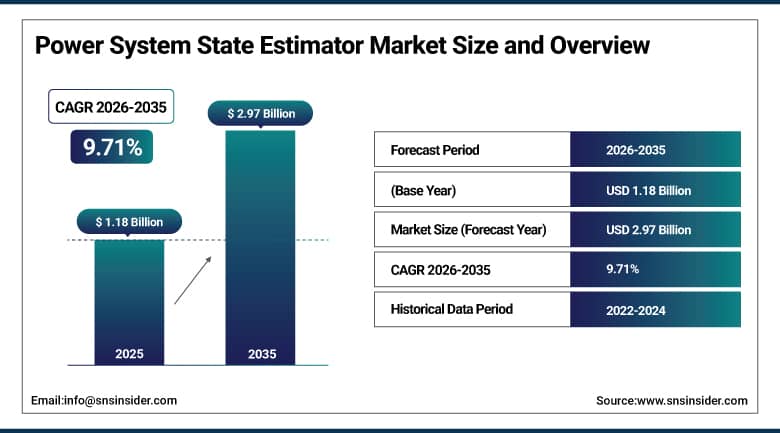
The Power System State Estimator Market was valued at USD 1.18 Billion in 2025 and is projected to reach USD 2.97 Billion by 2035, registering a CAGR of 9.71% from 2026 to 2035.
The Power System State Estimator Market has been creating the future of real-time visibility in the grids by using algorithms like Weighted Least Squares, Kalman Filter and Phasor-Based algorithms that help ascertain the state of operation of the transmission and distribution grid. Key features of the Power System State Estimator Market include increasing deployment of wide area monitoring systems, increasing installation of phasor measurement units, integration of renewable sources and distributed energy resources and application in contingency analysis and outage management.
In 2026, Hitachi Energy developed its Network Manager EMS system by using an advanced state estimator to give real-time visibility of power flows, voltages, phase angles, and losses. This system is also equipped with Optimal Power Flow and Volt VAR control features.
To Get More Information On Power System State Estimator Market - Request Free Sample Report
Power System State Estimator Market Trends
-
Expanding phasor measurement unit deployment continues strengthening wide-area situational awareness across transmission networks.
-
Growing renewable and distributed energy integration continues driving demand for real-time distribution state estimation tools.
-
Rising adoption of AI-powered and agentic grid planning platforms continues enhancing state estimator accuracy and speed.
-
Increasing control center modernization investment continues accelerating replacement of legacy SCADA-based estimation systems.
-
Growing utility focus on cybersecurity-hardened grid software continues shaping next-generation state estimator platform design.
U.S. Power System State Estimator Market Outlook
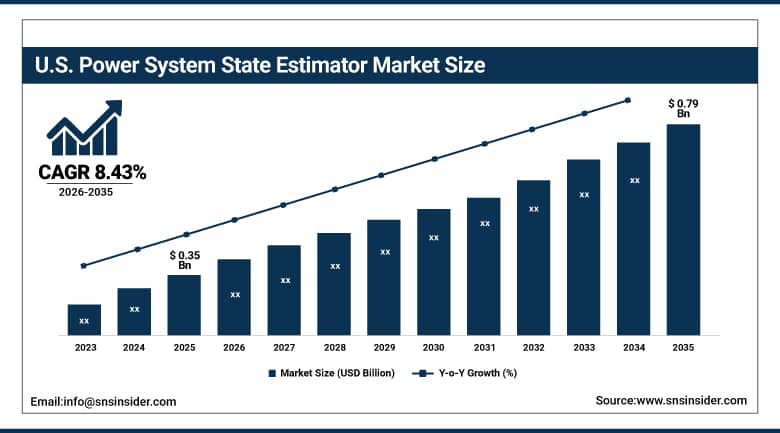
The U.S. Power System State Estimator Market was valued at approximately USD 0.35 Billion in 2025 and is projected to reach approximately USD 0.79 Billion by 2035, registering a CAGR of approximately 8.43% from 2026 to 2035.
Demand in the United States was also created as a result of the massive investments made in terms of wide area monitoring systems upgrade, upgrading of the aging control center facilities, and the increased demand for reliable real-time visibility on the grid from the transmission and distribution utilities. The implementation of transmission planning and PMU networks using artificial intelligence in major utilities was one of the factors that greatly contributed to the position of the United States as the biggest market for power system state estimator software on Earth. Moreover, the usage of state estimators in contingency studies, outage recovery, and power grid resilience planning was also promoting the high domestic demand for the software.
In 2026, ETAP provided State Estimation software to US-based utilities and industrial users. With this software, telemetry data is used for estimating real-time voltage magnitude and angles. ETAP's digital twin technology facilitates more data-driven monitoring and management operations within the US power industry.
Power System State Estimator Market Segment Analysis
-
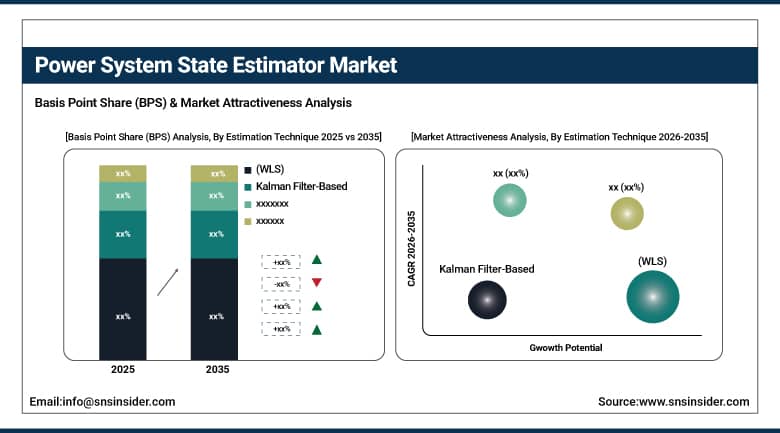
By Estimation Technique, Weighted Least Squares (WLS) segment dominated the market in 2025 with 54% share; Kalman Filter-Based / Phasor-Based segment is the fastest growing segment, registering a CAGR of 11.2% from 2026 to 2035.
-
By Component, Software segment dominated the market in 2025 with 61% share; Software is also the fastest Growing Segment, registering a CAGR of 10.8% from 2026 to 2035.
-
By Network Type, Transmission Network segment dominated the market in 2025 with 63% share; Distribution Network segment is the fastest growing segment, registering a CAGR of 11.0% from 2026 to 2035.
-
By End User, Utilities segment dominated the market in 2025 with 74% share; Industrial (Oil & Gas, Manufacturing) segment is the fastest growing segment, registering a CAGR of 10.7% from 2026 to 2035.
By Estimation Technique, Weighted Least Squares Leads While Kalman Filter and Phasor-Based Methods Grow Fastest
Weighted Least Squares gained widespread acceptance in the Power System State Estimator Market by 2025 due to its well-documented track record as the industry’s de facto algorithm for decades past. Weighted least squares’ capacity for processing redundant measurements from the SCADA system and separating good data from the bad makes it the natural choice for utilities with legacy network monitoring systems in place, having been developed over many years. Siemens AG, ABB Ltd, and Schneider Electric SE, amongst others, kept on including weighted least squares algorithms within their energy management systems products. This guarantees that weighted least squares continues to play a leading role in most state estimator software installations despite newer statistical approaches catching on with more progressive utilities.
Kalman Filter-Based and Phasor-Based estimation methods are expected to experience the highest growth rates among all categories as the number of applications of phasor measurement units for synchronous and high-speed voltage and current readings in wide-area networks increases at utilities. Dynamic estimation methods enable users to monitor rapid changes in network parameters in near-real time. This function becomes very important with the increasing share of renewables and other distributed power sources that add more variability to system performance. Increased spending on wide-area monitoring systems by transmission utilities, along with the attempts of vendors to introduce GPS-synchronized phasor data into the new generation of platforms like Siemens' Gridscale X, will ensure continued outperformance of this segment compared with static estimation techniques.
By Component, Software Dominates While Hardware Gains Fastest Momentum
The Software Product Segment was the dominating factor for the Global Power System State Estimator Market in 2025 owing to the extensive use of the estimation engine, the network modeling platform, the visualization dashboard, and the energy management system. The utilities are focusing on upgrading the software and integrating the platforms to make decisions more efficient. Software solutions provided by organizations such as GE Vernova Inc. and AVEVA Group plc include the state estimator as part of distribution management and outage management systems.
The hardware component which includes PMU, RTU & sensors is anticipated to witness the fastest growth over the forecast period on account of the growing investments in modernizing grid and wide area monitoring systems. Utility companies are increasingly using phasor measurement unit, remote terminal units and sensors to generate synchronized data for dynamic state estimation. Growing number of smart grid programs and investments in grid infrastructure in North America, Europe and Asia Pacific regions are expected to boost the demand for hardware components up to 2035.
By Network Type, Transmission Networks Dominate While Distribution Networks Post Fastest Growth
Power Transmission Networks dominated the Power System State Estimator Market by network type in 2025, as state estimation has traditionally been one of the essential components of the energy management system of transmission level, which is used for maintaining the stability of power transmission networks. State estimation at the transmission level has been used by system operators since the 1970s for contingency analysis, security assessments, and markets; therefore, the significance of these tasks for secure power transmission has ensured constant investments into transmission-level state estimation infrastructure.
The Distribution Networks segment is expected to witness the highest growth rate among all network segments in the Power System State Estimator Market since utilities are increasingly employing real-time state estimation across the entire network, moving beyond just the transmission network due to the need for increased visibility posed by the presence of distributed energy resources, roof-top solar installations, and electric vehicle chargers. Technologies like GE Vernova's GridOS for Distribution are allowing utilities to conduct state estimation on distribution feeders at a scale previously seen only in the case of transmission networks.
By End User, Utilities Dominate While Industrial End Users Gain Fastest Traction
The utilities emerged as the leading category of end-users of the Power System State Estimator Market in 2025, forming a significant share of total deployments owing to the fact that state estimation software and measurement equipment continue to be purchased by system operators who ensure reliability of power grids, adherence to regulation, and market transactions. The importance of state estimation to the reliability of power grids, regulatory compliance, and operations of the electricity market has helped sustain their investments in state estimators.
Industrial end-users, especially those in the oil and gas industry and manufacturing sector, are forecasted to experience the fastest growth among all end-user segments in the Power System State Estimator Market because of energy-intensive sites that run microgrids and captive power grids using the state estimator technology for managing the complexities of generation and load balancing. The rising demand for energy resiliency and renewable energy from the industrial sector has been creating an opportunity for smaller versions of the state estimator technology for private grid owners, a phenomenon that companies like Survalent Technology Corporation and Utilidata, Inc. have already tapped into.
Regional Analysis:
|
Region |
Major Country |
Share within Region, 2025 (%) |
|---|---|---|
|
North America |
United States |
82.10% |
|
Europe |
Germany |
26.40% |
|
Asia Pacific |
China |
38.70% |
|
Middle East and Africa |
Saudi Arabia |
29.60% |
|
Latin America |
Brazil |
64.30% |
North America Power System State Estimator Market Insights
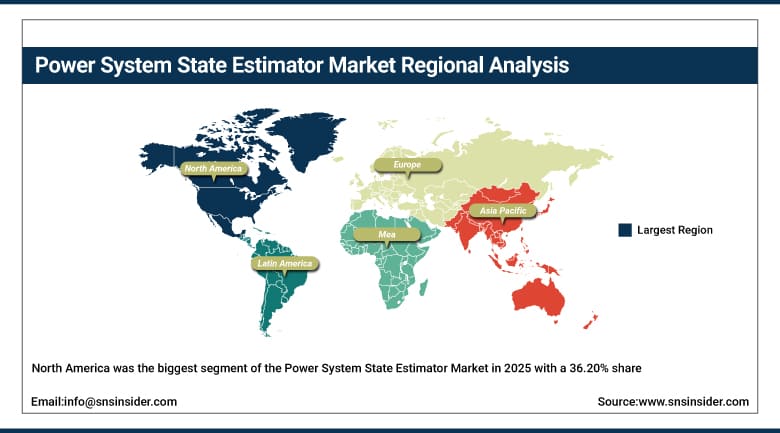
North America was the biggest segment of the Power System State Estimator Market in 2025 with a 36.20% share due to high investments made in control centers modernization by transmission and distribution companies, installation of phasor measurement unit network among major independent system operators, as well as a strong presence of energy management systems vendors located in the region. The cooperation of utilities with grid software companies along with well-established regulatory framework that requires grid reliability standards, allowed the region to remain the dominant one on the world market of Power System State Estimators.
The United States captured a major revenue share in the overall revenue of North America, primarily due to the high presence of GE Vernova Inc. and its GridOS software platform as well as large utility investments in wide area monitoring systems in regional transmission organizations. The addition of AI-powered transmission planning platforms and the increased interest of corporations in grid resilience for data centers and industrial power generation contributed towards Canada and the region’s contribution to North America's dominance in the market.
Get Customized Report as Per Your Business Requirement - Enquiry Now
Europe Power System State Estimator Market Insights
Europe was able to maintain its sustainable market share in the overall revenue generated by the Power System State Estimator Market owing to the fact that the region has been traditionally committed to grid interconnection and cross-border transmission cooperation, has made heavy investments in integrating renewable energy through infrastructures and has seen a rise in the installation of state-of-the-art network monitoring systems as well as state estimators for both the existing and modernized transmission fleets. The growing need for using common grid software solutions has compelled many utility providers in Germany, France and the UK to deploy advanced estimation and orchestration systems.
Germany was the leading market by demand in Europe due to the transmission system coordination needs of the country resulting from its shift to renewable energy and grid software solution providers for the entire Europe. France was yet another key country that contributed to the market demand in the region owing to the investments of its transmission system operator in wide-area monitoring and state estimation improvements. The need for power system state estimators is anticipated to continue in Europe due to increased grid flexibility in Europe.
Asia Pacific Power System State Estimator Market Insights
Asia Pacific has emerged as the fastest-growing region for the Power System State Estimator Market compared to all other regions covered in this market due to heavy investments made in the upgrading of the transmission and distribution grids in China and India, increasing mandates from governments for improving renewable energy penetration, and development of indigenous manufacturing capability of energy management systems and phasor measurement units. The cumulative impact of huge investments in grid infrastructure and increase in urban power demand ensured that this region remained the fastest-growing one in comparison to all others covered in this report.
Leading the way was China, owing to substantial investments in the transmission network infrastructure development, along with the rising capacity of local automation solutions providers such as NARI Group Corporation and Beijing Sifang Automation Co., Ltd. The other nations making contributions to this scenario in the current report include India due to the growth in grid analytics applications of Kalkitech, and Japan due to the development of wide-area monitoring infrastructure by the utilities there.
MEA and Latin America Power System State Estimator Market Insights
Middle East and Africa, as well as Latin America, continued to experience a consistent increase in the market of Power System State Estimator because of the increased investment into the development of transmission systems and governments' efforts in grid modernization projects. At the same time, it became important for the grid modernization projects being implemented in those regions to have stable relationships with the software providers due to the fact that neither of them had any production capacities in the area of energy management system.
ME&A, Saudi Arabia was the biggest country market as a result of continuous upgrading of the capacity of network monitoring by its national utility to aid the diversity of sources of power generation within the country. Additionally, ME&A experienced contributions as a result of grid modernization programs by the United Arab Emirates. Within LATAM, Brazil was the biggest revenue generator as a result of its huge interconnected transmission network.
Market Dynamics:
Growth Drivers: Rising Renewable Integration Complexity and Expanding Wide-Area Monitoring Investment
The market is driven by the rise in demand from utilities for network visibility in real-time, investments made by the government on grid modernization as well as wide-area monitoring, heightened concerns regarding the management of the increasing penetration of renewables and distributed energy, and an increasing number of applications, such as contingency analysis, outage management, and transmission planning. The rise in deployment of phasor measurement units by a growing number of utilities within their networks is bound to drive up demand for state-of-the-art dynamic state estimation software, resulting in procurement being high throughout the forecast period.
The increasing availability of grid software based on AI technologies and agency from reputable vendors, in combination with the greater willingness of utilities to invest in the upgrade of control centers before an increase in renewable energy capacities is expected, offer additional arguments for the mentioned tendency. Business collaboration of grid software providers and utilities, as well as investments in new phasor measurement units network and communication system, are helping in creating additional baseline estimation capabilities, which are creating growing demand consistently during the forecast period.
Restraints: High Implementation Costs and Legacy System Integration Complexity
Implementation cost is a realistic constraint on the speed of the market evolution because deployment of complex state estimation systems together with the phasor measurement units network and communication system requires significant funding and long-term planning. This circumstance has led to the concentration of the best dynamic estimation systems among large and rich companies, while small utilities are not able to catch up with them fast enough due to the high cost of deployment and planning involved.
Legacy integration will continue to remain a problem because several utilities currently use energy management systems based on SCADA technology developed decades ago and require extensive customization for integration with current phasor and artificial intelligence systems. The problem will have to be solved with proper vendor assistance and phased modernization programs and is an ongoing one, taking extensive investment and time for integration.
Opportunities: AI-Powered Grid Orchestration and Distribution-Level State Estimation Expansion
The growing investments in AI grid orchestration platforms become a valuable opportunity due to the fact that there is an increasing tendency among utilities to seek integrated solutions, which include state estimation along with network modeling and DER management and field execution. In this context, vendors capable of incorporating agentic planning into existing estimation platforms, such as Siemens' development of advanced PSS E on the Gridscale X platform, will be capable of securing considerable market shares in the new AI grid software market being formed.
Another key opportunity will come from the growth in state estimation for distribution grids, due to the increased number of distributed energy resources, which is driving the need for greater visibility at the feeder level. Providers that can offer scalable state estimation for distribution grid capabilities, like GridOS for Distribution offered by GE Vernova, will be well-positioned to claim an increasing share of utility budget investments as distribution grids start to require the same visibility that transmission grids have always needed.
Recent Developments:
-
2026: GE Vernova Inc. launched GridOS® for Distribution, a unified grid orchestration platform combining real-time state estimation, DER management, and network modeling to help utilities operate distribution grids as one intelligent system, unveiled at DTECH 2026.
-
2026: Siemens AG introduced the next generation of its PSS®E transmission planning software on its Gridscale X platform, adding AI-powered agentic planning capabilities designed to accelerate transmission studies and support autonomous grid operations.
-
2026: Schneider Electric also pointed out its ADMS EcoStruxure solution and spoke about how it would help grid modernization through having a central database for the network, higher visibility and state estimation.
Power System State Estimator Market key players are:
-
Siemens AG
-
ABB Ltd
-
Schneider Electric SE
-
GE Vernova Inc.
-
Hitachi Energy Ltd
-
Open Systems International, Inc. (OSI)
-
Eaton Corporation plc
-
DIgSILENT GmbH
-
Operation Technology, Inc. (ETAP)
-
PowerWorld Corporation
-
Toshiba Energy Systems & Solutions Corporation
-
Mitsubishi Electric Corporation
-
Itron Inc.
-
Advanced Control Systems, Inc.
-
Survalent Technology Corporation
-
Utilidata, Inc.
-
AVEVA Group plc
-
NARI Group Corporation
-
Beijing Sifang Automation Co., Ltd.
-
Kalkitech (Kalki Communication Technologies Pvt. Ltd.)
Power System State Estimator Market Report Scope:
| Report Attributes | Details |
|---|---|
| Market Size in 2025 | USD 1.18 Billion |
| Market Size by 2035 | USD 2.97 Billion |
| CAGR | 11.6% from 2026 to 2035 |
| Base Year | 2025 |
| Forecast Period | 2026-2035 |
| Historical Data | 2022-2024 |
| Report Scope & Coverage | Market Size, Segments Analysis, Competitive Landscape, Regional Analysis, DROC & SWOT Analysis, Forecast Outlook |
| Key Segments | • By Estimation Technique (Weighted Least Squares (WLS), Kalman Filter-Based / Phasor-Based, Phasor-Based, Others) • By Component (Software, Hardware (PMU, RTU & Sensors), Services) • By Network Type (Transmission Network, Distribution Network) • By End User (Utilities, Industrial (Oil & Gas, Manufacturing), Commercial) |
| Regional Analysis/Coverage | North America (US, Canada), Europe (Germany, UK, France, Italy, Spain, Russia, Poland, Rest of Europe), Asia Pacific (China, India, Japan, South Korea, Australia, ASEAN Countries, Rest of Asia Pacific), Middle East & Africa (UAE, Saudi Arabia, Qatar, South Africa, Rest of Middle East & Africa), Latin America (Brazil, Argentina, Mexico, Colombia, Rest of Latin America). |
| Company Profiles |
Siemens AG, ABB Ltd, Schneider Electric SE, GE Vernova Inc., Hitachi Energy Ltd, Open Systems International, Inc. (OSI), Eaton Corporation plc, DIgSILENT GmbH, Operation Technology, Inc. (ETAP), PowerWorld Corporation, Toshiba Energy Systems & Solutions Corporation, Mitsubishi Electric Corporation, Itron Inc., Advanced Control Systems, Inc., Survalent Technology Corporation, Utilidata, Inc., AVEVA Group plc, NARI Group Corporation, Beijing Sifang Automation Co., Ltd., Kalkitech (Kalki Communication Technologies Pvt. Ltd.) |

Frequently Asked Questions
Key players include Siemens AG, ABB Ltd, Schneider Electric SE, GE Vernova Inc., and Hitachi Energy Ltd, among others.
The major growth factor is rising demand for real-time grid visibility and wide-area monitoring, expanding phasor measurement unit deployment, and growing utility investment in AI-enabled control center modernization.
Key opportunities include increasing grid modernization, renewable energy integration, real-time grid monitoring, AI-enabled state estimation, growing demand for grid stability, and expanding smart grid deployments.
The Weighted Least Squares (WLS) segment dominated the Power System State Estimator Market by estimation technique, representing the largest share of revenue in 2025.
North America dominated the Power System State Estimator Market in 2025, holding an estimated 36.20% share of total global market revenue.
