
Healthcare Satellite Connectivity Market Report Scope & Overview:
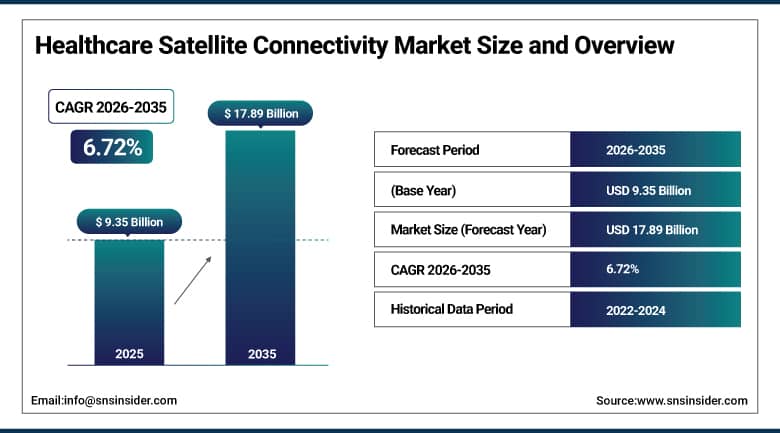
Healthcare Satellite Connectivity Market was valued at USD 9.35 billion in 2025 and is expected to reach USD 17.89 billion by 2035, growing at a CAGR of 6.72% from 2026-2035.
The Healthcare Satellite Connectivity Market is witnessing steady growth as a result of rising demand for reliable communication infrastructure in remote and underserved areas in the healthcare industry. Satellite communication is being used more frequently by healthcare organizations to provide telemedicine services, remote patient monitoring, exchange of health information electronically, emergency communication, and connected medical devices in places where there is a lack of terrestrial communication infrastructure. With the growing trend of digital healthcare and the use of cloud computing in the medical sector, there is increased demand for high-speed connectivity. Furthermore, innovations such as high-throughput satellites, low Earth orbit satellite constellations, and satellite broadband communications are enhancing connectivity performance and latency. Increased investments in healthcare infrastructure, disaster response, and rural healthcare are contributing to the adoption of the technology.
⮞ITU's State of Satellite Broadband 2025 highlights rapid expansion of satellite broadband and increasing use of space-based communications to connect remote, rural, and underserved areas.
To Get More Information On Healthcare Satellite Connectivity Market - Request Free Sample Report
Healthcare Satellite Connectivity Market Trends:
-
Growing demand for remote healthcare access is increasing satellite connectivity adoption across rural and underserved medical facilities.
-
Rising use of telemedicine is expanding satellite connectivity for virtual consultations, remote diagnostics, and specialist healthcare access.
-
Increasing adoption of connected medical devices is improving remote patient monitoring and real-time transmission of healthcare data.
-
Advancements in satellite broadband are supporting faster medical data sharing and reliable healthcare communication across remote locations.
-
Growing demand for disaster-resilient healthcare networks is increasing satellite connectivity adoption for emergency communication and medical response.
U.S. Healthcare Satellite Connectivity Market Outlook:
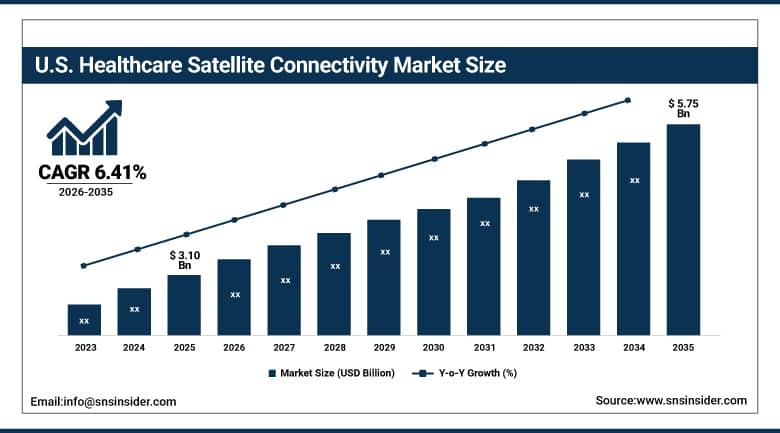
U.S. Healthcare Satellite Connectivity Market was valued at USD 3.10 billion in 2025 and is expected to reach USD 5.75 billion by 2035, growing at a CAGR of 6.41% from 2026-2035.
The U.S. Healthcare Satellite Connectivity Market is witnessing steady growth owing to rising demand for secure healthcare connectivity solutions in remote, rural, and poorly served regions. Satellite connectivity for telemedicine, remote patient monitoring, emergency medical communications, and transfer of medical information from locations lacking adequate terrestrial coverage networks is being adopted by healthcare organizations on an increasingly frequent basis. Rising demand for connectivity, fueled by connected healthcare devices, digital health solutions, and remote care solutions, is also expected to drive demand. Innovations in satellite technology, including low Earth orbit satellites, are making it possible to achieve enhanced coverage, lower latencies, and improved reliability. Investment in healthcare infrastructure, emergency preparedness, and digital healthcare access is also providing support for the adoption. The necessity of bridging the gaps in connectivity and ensuring secure access to healthcare services is helping boost the market.
⮞HRSA continues supporting Telehealth Resource Centers, with FY2025 awards exceeding $18 million to provide technical assistance and promote telehealth adoption across the U.S.
Healthcare Satellite Connectivity Market Segment Analysis:
-
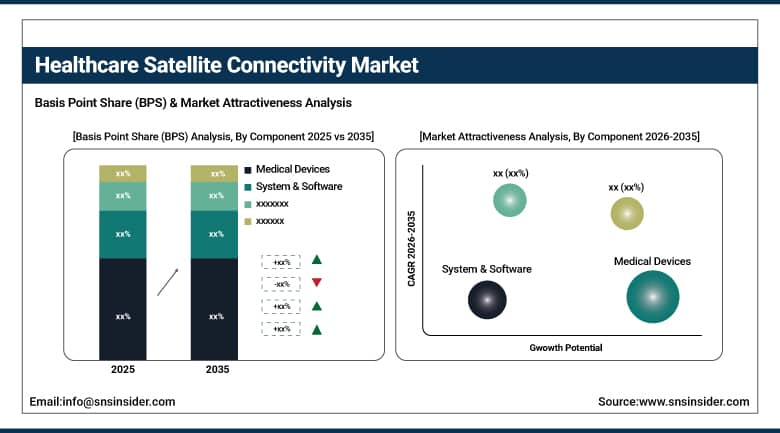
By Component, Medical Devices dominate the Healthcare Satellite Connectivity Market with 32% share in 2025; System & Software are expected to grow at the fastest CAGR of 6.52% from 2026–2035.
-
By Application, Telemedicine dominates the Healthcare Satellite Connectivity Market with 47% share in 2025; Connected Imaging is expected to grow at the fastest CAGR of 7.43% from 2026–2035.
-
By Connectivity, Mobile Satellite Services (MSS) dominate the Healthcare Satellite Connectivity Market with 21% share in 2025; Fixed Satellite Services (FSS) are expected to grow at the fastest CAGR of 7.04% from 2026–2035.
-
By End Use, Hospitals & Clinics dominate the Healthcare Satellite Connectivity Market with 65% share in 2025; Research & Diagnostic Laboratories are expected to grow at the fastest CAGR of 8.22% from 2026–2035.
By Component, Medical Devices dominate the Healthcare Satellite Connectivity Market, System & Software grow fastest.
Medical Devices dominated the Healthcare Satellite Connectivity Market with the highest revenue share of about 32% in 2025, because of the growing requirement for linking up diagnostic devices, medical monitoring devices, and patient care devices in remote and poorly-serviced healthcare facilities. Through satellite connectivity, it becomes possible to send data even where terrestrial connections are lacking, thus ensuring smooth operations of the healthcare services.
System & Software are expected to grow at the fastest CAGR of 6.52% from 2026–2035, driven by increasing demand for network management, cybersecurity, data integration, and intelligent connectivity technologies. Hospitals are embracing software that enhances the functionality of the satellite network and helps integrate the digital healthcare system. Increased telemedicine and remote care needs are adding impetus to the software adoption process.
By Application, Telemedicine dominates the Healthcare Satellite Connectivity Market, Connected Imaging grows fastest.
Telemedicine dominated the Healthcare Satellite Connectivity Market with the highest revenue share of about 47% in 2025, motivated by the increasing demand for offering remote consultations and medical services to the countryside areas that lack any means of accessibility. Satellite technology ensures that communication is possible in the absence of any terrestrial connectivity, and thus patients and healthcare experts can have a direct interaction.
Connected Imaging is expected to grow at the fastest CAGR of 7.43% from 2026–2035, due to the rising need for remote transmission of valuable medical imaging information. The satellite link will allow hospitals and clinics in remote areas to send diagnostic images to experts for quick interpretation. Increased use of digital imaging technology and remote diagnostics will also drive the connected imaging market further ahead.
By Connectivity, Mobile Satellite Services (MSS) dominate the Healthcare Satellite Connectivity Market, Fixed Satellite Services (FSS) grow fastest.
Mobile Satellite Services (MSS) dominated the Healthcare Satellite Connectivity Market with the highest revenue share of about 21% in 2025, backed up by their capability of providing connectivity for mobile health units, emergency response teams, ambulances, and remote health care operations. The Mobile Satellite System makes communication possible when health centers or healthcare professionals move from one location to another.
Fixed Satellite Services (FSS) are expected to grow at the fastest CAGR of 7.04% from 2026–2035, Fuelled by the rising demand for high-speed connectivity in healthcare institutions operating in regions where there is limited physical infrastructure. The FSS enables telemedicine, data transmission, cloud computing, and connected healthcare services. The growth in rural healthcare infrastructure and digitization is driving even greater demands for fixed satellite connectivity.
By End Use, Hospitals & Clinics dominate the Healthcare Satellite Connectivity Market, Research & Diagnostic Laboratories grow fastest.
Hospitals & Clinics dominated the Healthcare Satellite Connectivity Market with the highest revenue share of about 65% in 2025, Driven by the high demands placed on reliable communications, telemedicine applications, exchange of electronic health information, connected medical devices, and specialist availability remotely. Satellites aid hospitals to run their services in poorly serviced locations due to insufficient infrastructure.
Research & Diagnostic Laboratories are expected to grow at the fastest CAGR of 8.22% from 2026–2035, This is due to the increasing availability of diagnostic data, collaborative working from a distance, imaging connections, and digital research processes. The satellite connection allows the laboratories located remotely to safely send huge amounts of data and diagnostic information. There is an increased demand for the exchange of data.
Regional Analysis:
|
Region |
Major Country |
Share within Region, 2025 (%) |
|---|---|---|
|
North America |
United States |
91.0% |
|
Europe |
Germany |
24.0% |
|
Asia Pacific |
China |
38.0% |
|
Middle East & Africa |
UAE |
18.0% |
|
Latin America |
Brazil |
35.0% |
North America Healthcare Satellite Connectivity Market Insights
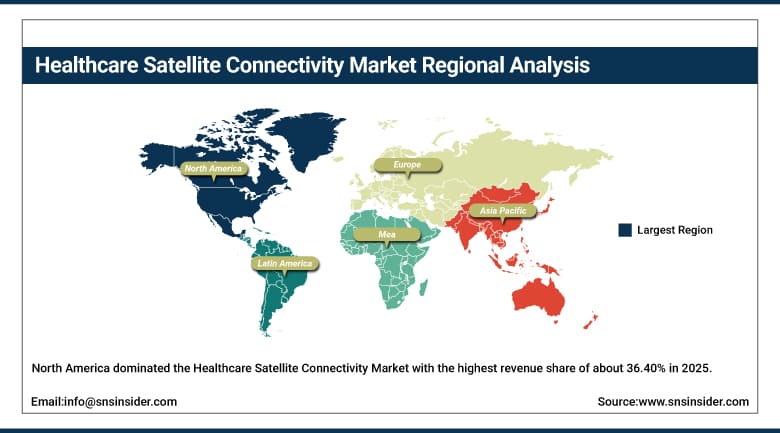
North America dominated the Healthcare Satellite Connectivity Market with the highest revenue share of about 36.40% in 2025, Backed up by the presence of an advanced healthcare infrastructure, satellite communications infrastructure, significant investments in telemedicine, and rising demand for connectivity in rural areas within healthcare institutions. Moreover, the presence of existing healthcare providers, advanced digital healthcare, and government support for rural connectivity boosts market leadership in the region.
The U.S. Healthcare Satellite Connectivity Market accounted for a market share of 91.0%, Enabled by advanced healthcare infrastructure, wide-ranging satellite communication facilities, and extensive telemedicine and digital health services. In addition, substantial spending on rural health care connectivity, remote patient monitoring, emergency medical communication, and healthcare technology is contributing to growing demand for satellite-based communication facilities.
Get Customized Report as Per Your Business Requirement - Enquiry Now
Europe Healthcare Satellite Connectivity Market Insights
Europe’s Healthcare Satellite Connectivity Market is supported by expanding telemedicine services, digital healthcare adoption, and increasing demand for reliable connectivity across remote and underserved areas. Well-established healthcare infrastructure, investments in connected medical technology, cross-border healthcare activities, and satellite emergency communication systems are facilitating market growth. Increased use of remote patient monitoring and connected healthcare solutions are additional factors contributing to market growth in the region.
The Germany Healthcare Satellite Connectivity Market accounted for a market share of 24.0%, Enabled by an efficient healthcare infrastructure, digital health usage, and increased need for connectivity at remote and underserved healthcare establishments. In addition to that, investments in telemedicine, connected healthcare technologies, remote patient monitoring, and digitalization of healthcare are enabling satellite connectivity solutions.
Asia Pacific Healthcare Satellite Connectivity Market Insights
Asia Pacific is expected to grow at the fastest CAGR of about 7.69% from 2026–2035, fueled by growing healthcare infrastructure, large underserved patient populations, telemedicine uptake, and increased spending on digital healthcare. Moreover, increasing smartphone and internet adoption, connectivity initiatives by governments, satellite technology adoption, remote medicine delivery, and healthcare modernization in emerging countries is driving the demand for satellite connectivity.
The China Healthcare Satellite Connectivity Market accounted for a market share of 38.0%, Backed by advancements in the healthcare infrastructure, a significant rural population, increasing telemedicine applications, and fast-growing digital healthcare solutions. In addition, there is a high demand for healthcare satellite connectivity owing to government initiatives toward healthcare innovations, satellite communications, remote healthcare services, and enhanced connectivity in underprivileged regions.
Middle East & Africa and Latin America Healthcare Satellite Connectivity Market Insights
The Middle East & Africa and Latin America Healthcare Satellite Connectivity Market is expanding due to growing healthcare modernization, underserved rural populations, and increasing demand for remote medical services. Telemedicine and emergency healthcare services can be provided through satellite connectivity in places where there are limitations to traditional connectivity. Other aspects like government programs for digital healthcare and improved healthcare infrastructure will contribute more to the development of the regional market.
The UAE Healthcare Satellite Connectivity Market accounted for a market share of 18.0%, Backed by advancements in healthcare modernization, digital health programs, and investments in telecommunication and satellite technologies. In addition, the rising uptake of telemedicine, remote healthcare services, connected healthcare systems, and increased efforts towards improving healthcare access in geographically dispersed regions are aiding market growth.
Market Dynamics:
Growth Drivers: Growing remote healthcare demand is increasing adoption of satellite connectivity solutions worldwide.
Growing demand for healthcare services in rural, remote, isolated, and underserved locations is increasing the need for reliable connectivity infrastructure. Satellite networks can provide broadband capability in regions where the availability of fiber, cellular, or wired connectivity is not feasible. Satellite connectivity can be used by healthcare facilities for teleconsultations, remote diagnostics, health information exchange, remote patient monitoring, and specialist consultations between geographically dispersed regions. Projects conducted under ESA and healthcare demonstrations have also indicated that satellite networks are being employed to offer remote monitoring, multidisciplinary video consultation, and telemedicine capabilities in regions where there are connectivity issues.
Restraints: High deployment and service costs can restrict satellite connectivity adoption among healthcare providers.
Satellite healthcare connectivity can involve significant expenditures for terminals, antennas, network equipment, installation, bandwidth, maintenance, and specialized service contracts. These may become particularly difficult issues for small clinics, rural medical facilities, and healthcare organizations that have to work on tight budgets. While the developments in high-throughput satellites and low Earth orbit (LEO) constellations increase the capacity and decrease the price of satellite services, economic viability still depends on the specific location, bandwidth needs, service availability, and scale of implementation. Applications in the healthcare field that need video transmission and monitoring will require better service level and bandwidth allocation. Thus, budget limitations may delay the process of transition to satellite communication if adequate terrestrial communication is still available.
Opportunities: LEO satellite expansion creates opportunities for faster and more flexible healthcare connectivity.
The expansion of low-Earth-orbit satellite constellations creates significant opportunities for healthcare connectivity by improving network coverage, reducing latency, and enabling faster deployment in underserved locations. It is reported by ITU that developments in the fields of low earth orbit constellations, high throughput satellites, and software defined satellites are enhancing capacity, lowering latency, and making satellite solutions a more viable solution for connectivity gaps. The healthcare sector can make use of such technologies to provide telemedicine, remote patient monitoring, connected medical devices, mobile clinics, emergency healthcare communication, and digital health platforms. The LEO connectivity will also serve as a complementary solution along with terrestrial systems when needed as a backup solution during outages or disaster times.
Recent Developments:
-
2026 : Viasat expanded its satellite connectivity capacity as ViaSat-3 F2 entered service across the Americas, strengthening high-capacity and resilient connectivity for remote and underserved healthcare locations.
-
2026 : Hughes Network Systems expanded managed LEO connectivity for enterprise and healthcare networks, combining Starlink and OneWeb services to support reliable connectivity, including remote healthcare facilities and critical applications.
-
2026 : SES advanced its multi-orbit satellite connectivity infrastructure through the IRIS² programme, supporting resilient connectivity expansion that can extend digital services, including healthcare, to underserved communities.
-
2025 : Viasat introduced its Omni-Route Cyber® solution through the ELEVATE programme, providing secure hybrid connectivity for healthcare applications including remote diagnosis, telemedicine, and high-resolution medical-image sharing.
Healthcare Satellite Connectivity Market key players are:
-
Viasat Inc.
-
Hughes Network Systems, LLC
-
SES S.A.
-
Eutelsat Communications S.A.
-
Inmarsat Global Limited
-
Space Exploration Technologies Corp. (SpaceX/Starlink)
-
Thales Group
-
Telesat
-
Globalstar, Inc.
-
Gilat Satellite Networks Ltd.
-
EchoStar Corporation
-
X2nSat Inc.
-
Expedition Communications Inc.
-
ST Engineering Ltd.
-
Comtech Telecommunications Corp.
-
Speedcast International Limited
-
Avanti Communications Group plc
-
Skylo Technologies Inc.
-
IEC Telecom Group
-
Kacific Broadband Satellites Group
Healthcare Satellite Connectivity Market Report Scope:
| Report Attributes | Details |
|---|---|
| Market Size in 2025 | USD 9.35 Billion |
| Market Size by 2035 | USD 17.89 Billion |
| CAGR | CAGR of 6.72% From 2026 to 2035 |
| Base Year | 2025 |
| Forecast Period | 2026-2035 |
| Historical Data | 2022-2024 |
| Report Scope & Coverage | Market Size, Segments Analysis, Competitive Landscape, Regional Analysis, DROC & SWOT Analysis, Forecast Outlook |
| Key Segments | • By Component (Medical Devices, System & Software, Services) • By Application (Telemedicine, Clinical Operations, Connected Imaging) • By Connectivity (Mobile Satellite Services (MSS), Fixed Satellite Services (FSS), Others) • By End Use (Clinical Research Organizations, Hospitals & Clinics, Research & Diagnostic Laboratories, Others) |
| Regional Analysis/Coverage | North America (US, Canada), Europe (Germany, UK, France, Italy, Spain, Russia, Poland, Rest of Europe), Asia Pacific (China, India, Japan, South Korea, Australia, ASEAN Countries, Rest of Asia Pacific), Middle East & Africa (UAE, Saudi Arabia, Qatar, South Africa, Rest of Middle East & Africa), Latin America (Brazil, Argentina, Mexico, Colombia, Rest of Latin America). |
| Company Profiles | Viasat Inc., Hughes Network Systems, LLC, SES S.A., Eutelsat Communications S.A., Inmarsat Global Limited, Space Exploration Technologies Corp. (SpaceX/Starlink), Thales Group, Telesat, Globalstar, Inc., Gilat Satellite Networks Ltd., EchoStar Corporation, X2nSat Inc., Expedition Communications Inc., ST Engineering Ltd., Comtech Telecommunications Corp., Speedcast International Limited, Avanti Communications Group plc, Skylo Technologies Inc., IEC Telecom Group, and Kacific Broadband Satellites Group. |

Frequently Asked Questions
Key players in the Healthcare Satellite Connectivity Market include Viasat Inc., SES S.A., Eutelsat Communications S.A., Hughes Network Systems, LLC, and Iridium Communications Inc., among others.
Key opportunities in the Healthcare Satellite Connectivity Market include expansion of telemedicine and remote patient monitoring, deployment of LEO satellite networks, and growing demand for reliable connectivity in remote and underserved healthcare facilities.
The market is driven by rising adoption of telemedicine, increasing remote patient monitoring, growing healthcare connectivity needs in underserved areas, and advancements in satellite broadband technologies.
The Medical Devices segment dominated the Healthcare Satellite Connectivity Market, accounting for approximately 32.00% market share.
The North America region dominated the Healthcare Satellite Connectivity Market in 2025 with a 36.40% share, driven by growing demand for remote healthcare connectivity and expanding telemedicine services.
