
Cell Therapy Monitoring Kits Market Report Scope & Overview:
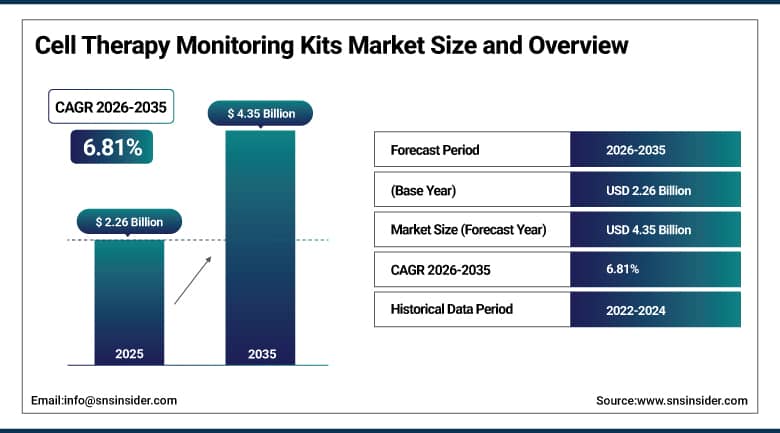
Cell Therapy Monitoring Kits Market was valued at USD 2.26 billion in 2025 and is expected to reach USD 4.35 billion by 2035, growing at a CAGR of 6.81% from 2026-2035.
The Cell Therapy Monitoring Kits Market is witnessing steady growth due to rising demands for monitoring systems in cell therapy research, development and manufacturing, and regenerative medicine applications. The rising trend of adopting cell therapy approaches in personalized medicine is motivating healthcare professionals and researchers to use monitoring systems to assess the cell viability, potency, quality, and performance of cells. Rising numbers of clinical trials and investments in the development of cell and gene therapies are driving the demands for monitoring systems even further. Moreover, developments in analytics tools, automation, testing systems, assay platforms, and real-time monitoring systems are enhancing the efficiency and effectiveness of cell therapy evaluation.
⮞WHO's biological-standardization program is developing standards and reference materials supporting quality, safety, efficacy, manufacture, and evaluation of cell and gene therapy products.
To Get More Information On Cell Therapy Monitoring Kits Market - Request Free Sample Report
Cell Therapy Monitoring Kits Market Trends:
-
Rising adoption of cell therapies is driving demand for monitoring kits that assess cell quality, viability, and therapeutic performance.
-
Increasing clinical development of CAR-T and stem cell therapies is expanding requirements for reliable cell characterization and monitoring solutions.
-
Growing demand for personalized medicine is supporting advanced monitoring of patient-derived cells throughout therapy development and treatment.
-
Advancements in flow cytometry and molecular analysis are improving accuracy, sensitivity, and efficiency of cell therapy monitoring.
-
Increasing investments in cell therapy manufacturing are accelerating adoption of standardized monitoring kits for quality control and process consistency.
U.S. Cell Therapy Monitoring Kits Market Outlook:
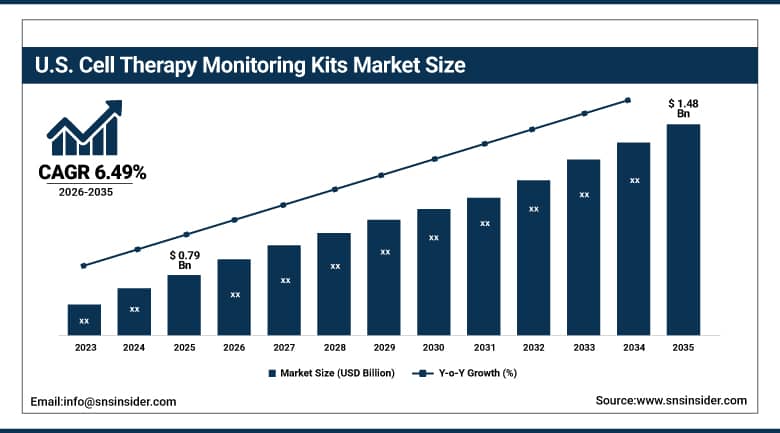
U.S. Cell Therapy Monitoring Kits Market was valued at USD 0.79 billion in 2025 and is expected to reach USD 1.48 billion by 2035, growing at a CAGR of 6.49% from 2026-2035.
The U.S. Cell Therapy Monitoring Kits Market is witnessing steady growth because of rising requirements for effective monitoring systems in cell therapy research and biopharmaceuticals production processes. Rising usage of cell therapy treatments and personalized medicines is leading to increased interest among scientists and medical facilities in using sophisticated monitoring systems for testing cell vitality, efficacy, and performance. Increased number of clinical trials and investments in regenerative medicines is further driving the demand for standardized monitoring solutions in cell therapies evaluation. Improvements in analytical technologies, automation, and real-time monitoring systems are helping to increase accuracy of evaluations. Development of additional biopharmaceutical research infrastructure and growing investments in the development of cell and gene therapy products are facilitating growth of the market in the USA.
⮞FDA highlights the importance of postapproval safety and efficacy monitoring because CGT products can have long-lasting effects and clinical trials often involve relatively small patient populations.
Cell Therapy Monitoring Kits Market Segment Analysis:
-
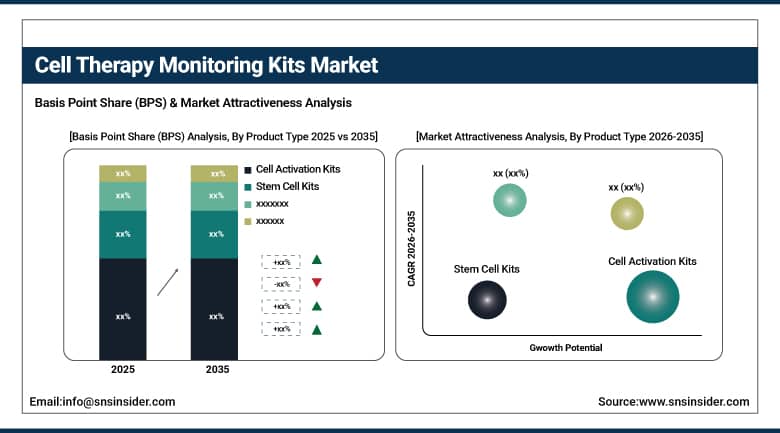
By Product Type, Cell Activation Kits dominate the Cell Therapy Monitoring Kits Market with 31% share in 2025; Stem Cell Kits are expected to grow at the fastest CAGR of 8.21% from 2026–2035.
-
By Application, Oncology dominates the Cell Therapy Monitoring Kits Market with 42% share in 2025; Neurological Disorders are expected to grow at the fastest CAGR of 10.98% from 2026–2035.
-
By Therapy Type, Stem Cell Therapies dominate the Cell Therapy Monitoring Kits Market with 37% share in 2025; Natural Killer (NK) Cell Therapies are expected to grow at the fastest CAGR of 8.63% from 2026–2035.
-
By End Use, Hospitals and Clinics dominate the Cell Therapy Monitoring Kits Market with 34% share in 2025; Biotechnology and Pharmaceutical Companies are expected to grow at the fastest CAGR of 7.67% from 2026–2035.
By Product Type, Cell Activation Kits dominate the Cell Therapy Monitoring Kits Market, Stem Cell Kits grow fastest.
Cell Activation Kits dominated the Cell Therapy Monitoring Kits Market with the highest revenue share of about 31% in 2025, this is due to the fundamental nature of flow cytometry in the determination and enhancement of cell activation during cell therapy development. The increase in studies conducted on immune-cell therapies, increasing number of clinical trials, and high demand for effective cell characterization and functional analysis have further contributed to this trend.
Stem Cell Kits are expected to grow at the fastest CAGR of 8.21% from 2026–2035, backed by growing research on stem cells, regenerative medicine, and cell therapy treatments. As clinical studies and investments in stem cell therapy increase, there will be more need for standardized systems to monitor these developments. Innovations in technology for cell characterization, viability, and quality control are also driving the trend.
By Application, Oncology dominates the Cell Therapy Monitoring Kits Market, Neurological Disorders grow fastest.
Oncology dominated the Cell Therapy Monitoring Kits Market with the highest revenue share of about 42% in 2025, due to advances in the research and clinical applications of cell-based cancer treatments, especially immune cell-based therapies. The increased incidence of cancer, the number of clinical trials being conducted, and increased funding for personalized medicine are creating the need for the tracking of cell viability, efficacy, and effectiveness.
Neurological Disorders are expected to grow at the fastest CAGR of 10.98% from 2026–2035, backed up by the emergence of an ever-expanding body of research focused on cell-based treatments of neurological diseases and regenerative medicine. The expanding interest in stem cell research, developments in cell therapy techniques, and the increased number of clinical trials are generating the need for innovative monitoring systems.
By Therapy Type, Stem Cell Therapies dominate the Cell Therapy Monitoring Kits Market, Natural Killer (NK) Cell Therapies grow fastest.
Stem Cell Therapies dominated the Cell Therapy Monitoring Kits Market with the highest revenue share of about 37% in 2025, As a result of thorough research, clinical development, and the application of stem cell therapy. The growing trend of using monitoring kits to determine the viability, proliferation, and quality of the cells will help in boosting the demand for this segment.
Natural Killer (NK) Cell Therapies are expected to grow at the fastest CAGR of 8.63% from 2026–2035, Backed by research on their use in cancer immunotherapy and other cell therapies. More clinical trials, advances in NK cell engineering, and off-the-shelf cell therapy products have increased the need for monitoring in order to assess the quality, function, viability, and efficacy of the cells.
By End Use, Hospitals and Clinics dominate the Cell Therapy Monitoring Kits Market, Biotechnology and Pharmaceutical Companies grow fastest.
Hospitals and Clinics dominated the Cell Therapy Monitoring Kits Market with the highest revenue share of about 34% in 2025, due to the rising application of cell therapy, clinical procedures, and specialized treatment programs. Monitoring kits help in evaluating cell viability, efficacy, quality, and performance in treatment. The rising uptake of advanced therapies and increasing specialized healthcare facilities will also boost the market growth.
Biotechnology and Pharmaceutical Companies are expected to grow at the fastest CAGR of 7.67% from 2026–2035, backed up by growing investments in the area of cell therapy R&D, trials, and commercialization. Such companies need advanced solutions for monitoring of cell characterization, quality control, process development, and therapy validation. Growing pipeline of cell therapies and technological advancements in manufacturing processes are further fueling their adoption.
Regional Analysis:
|
Region |
Major Country |
Share within Region, 2025 (%) |
|---|---|---|
|
North America |
United States |
91.0% |
|
Europe |
Germany |
24.0% |
|
Asia Pacific |
China |
41.0% |
|
Middle East & Africa |
UAE |
18.0% |
|
Latin America |
Brazil |
35.0% |
North America Cell Therapy Monitoring Kits Market Insights
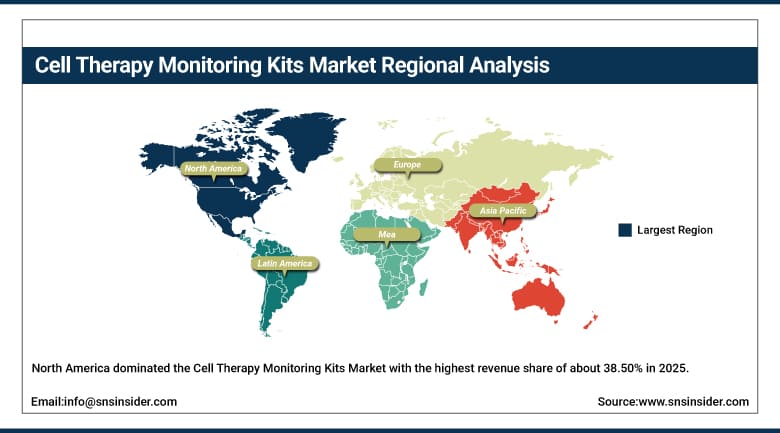
North America dominated the Cell Therapy Monitoring Kits Market with the highest revenue share of about 38.50% in 2025, powered by robust cell therapy research, sophisticated biotech research facilities, and major investments in regenerative medicines and biopharmaceuticals. Clinical trials, research centers, pharmaceutical organizations, and the use of cell analysis technologies contribute to the need for monitoring solutions in the region.
The U.S. Cell Therapy Monitoring Kits Market accounted for a market share of 91.0%, Backed up by scientific research in cell therapy, robust infrastructure in biotechnology, clinical trials, and investments in the field of regenerative medicine. In addition to this, the presence of top-notch pharma and biotech companies, institutes, and laboratory technology has raised the demand for cell viability, potency, quality, and functional monitoring solutions.
Get Customized Report as Per Your Business Requirement - Enquiry Now
Europe Cell Therapy Monitoring Kits Market Insights
Europe is witnessing steady growth in the Cell Therapy Monitoring Kits Market, supported by expanding cell and gene therapy research, increasing clinical trials, and growing investments in regenerative medicine. Well-developed pharmaceutical and biotechnology sectors, well-developed research capabilities, and regulatory focus on ensuring the quality and safety of cell therapy products favor market uptake. Growing need for monitoring cell viability, potency, and quality adds to this.
The Germany Cell Therapy Monitoring Kits Market accounted for a market share of 24.0%, backed by well-established research in pharmaceuticals and biotechnology, excellent healthcare infrastructure, and rising investments in cell and gene therapies. Also, factors such as clinical trials, advances in regenerative medicine, increased focus on the quality and safety of products, and demand for cell characterization technologies are driving the market.
Asia Pacific Cell Therapy Monitoring Kits Market Insights
Asia Pacific is expected to grow at the fastest CAGR of about 8.21% from 2026–2035, The growth in biotechnology industries, cell therapy research, and investment in regenerative medicine is driving the industry. Growing clinical trials, healthcare infrastructure developments, government backing, and increasing R&D in pharmaceuticals is boosting the acceptance. Demand for solutions related to cell characterizations, cell viability and potency, and quality monitoring is driving the market forward.
The China Cell Therapy Monitoring Kits Market accounted for a market share of 41.0%, which is fueled by developments in biotechnology, cell therapy studies, clinical trials, and investments made in regenerative medicine. In addition to that, the development in the biopharmaceutical sector, growth in pharmaceutical research and development, well-equipped laboratories, and usage of cell viability, potency, and quality testing technologies are also fueling the market.
Middle East & Africa and Latin America Cell Therapy Monitoring Kits Market Insights
Middle East & Africa and Latin America are experiencing increasing demand for cell therapy monitoring kits, supported by growing biotechnology research, healthcare modernization, and expanding pharmaceutical development. Growing investments in regenerative medicine, clinical trials, and high-end laboratory equipment are fostering market growth. The growing awareness of cell-based therapy along with the need to assess cell viability and potency is aiding the regional market growth.
The UAE Cell Therapy Monitoring Kits Market accounted for a market share of 18.0%, with the support of developing healthcare infrastructure, biotech investments, and increased use of advanced technologies in medical research. In addition, governmental programs that focus on innovations in healthcare, pharma, regenerative medicine, and upgrading of laboratories and clinics contribute to creating the demand for cell therapy monitoring and quality assessment systems.
Market Dynamics:
Growth Drivers: Increasing regulatory emphasis on quality control is driving adoption of standardized monitoring solutions.
Quality attributes of cell therapies are very important as far as the safety, effectiveness, and reliability of the products are concerned. Potency, identity, purity, viability, among others, are some of the attributes that regulators expect from such products. This is motivating the development and use of validated analytical methods for cell therapies. It has been observed that the recent expert advice also emphasizes the need for harmonization of the framework of biomarker assays for engineering immune effectors. Flow cytometry is increasingly being used for release, process, and immunomonitoring purposes. This is fostering the growth of kits for monitoring purposes.
Restraints: High assay validation requirements can increase development costs for monitoring kit manufacturers.
The monitoring assays that are required for use in cell therapy should show the appropriate levels of accuracy, precision, specificity, robustness, and reproducibility. The development and validation process may entail extensive optimization of various parameters including reagent optimization, controls, sample preparation, analytical panels, and instrumentation settings. More complicated requirements are posed when the kits are employed for clinical release or any other regulated applications. Panel design, compensation or spectral management and matrix-specific validation are required in the case of flow cytometry based monitoring. All these requirements could pose challenges for small companies trying to develop novel monitoring kits.
Opportunities: Growing adoption of flow cytometry creates opportunities for advanced multiparametric monitoring kits.
Flow cytometry continues to be a key analysis tool in cell and gene therapy due to its ability to measure a number of cellular parameters in a single cell. Current studies underscore the importance of flow cytometry in identity, purity, viability, potency marker profiling, CAR expression, immune reconstitution, and post-clinical follow-up analysis. This will present possibilities for kit suppliers to create standardized multiparameter flow kits that make sample preparation easier, minimize analysis variability, and increase throughput. Suppliers can also distinguish themselves through compatibility with spectral flow cytometry, automation, optimal antibody cocktails, and application-specific flow kits.
Recent Developments:
-
2026 : Thermo Fisher Scientific unveiled an integrated platform for scalable cell therapy manufacturing, combining processing, analytics, and quality-control capabilities to support cell therapy workflows.
-
2026 : Sartorius AG launched the Eveo Cell Therapy Platform, integrating automated production and quality control with live-cell imaging and high-throughput flow cytometry for cell therapy monitoring.
-
2026 : Sartorius AG also introduced Incucyte® AI Stem Cell QC Analysis Software, enabling label-free, real-time monitoring and automated classification of pluripotent stem-cell cultures.
-
2025 : Becton, Dickinson and Company launched new BD FACSDiscover™ A8 cell analyzer configurations with spectral and real-time imaging capabilities for cell characterization in immunology and cell-therapy research.
Cell Therapy Monitoring Kits Market key players are:
-
Thermo Fisher Scientific Inc.
-
STEMCELL Technologies Inc.
-
Merck KGaA
-
Lonza Group AG
-
Becton, Dickinson and Company (BD)
-
Miltenyi Biotec B.V. & Co. KG
-
Sartorius AG
-
Revvity, Inc. (PerkinElmer)
-
GE HealthCare Technologies Inc.
-
Cell Biolabs, Inc.
-
Bio-Techne Corporation
-
QIAGEN N.V.
-
Agilent Technologies, Inc.
-
Danaher Corporation
-
Bio-Rad Laboratories, Inc.
-
Corning Incorporated
-
Takara Bio Inc.
-
Charles River Laboratories International, Inc.
-
Promega Corporation
-
Cytiva
Cell Therapy Monitoring Kits Market Report Scope:
| Report Attributes | Details |
|---|---|
| Market Size in 2025 | USD 2.26 Billion |
| Market Size by 2035 | USD 4.35 Billion |
| CAGR | CAGR of 6.81% From 2026 to 2035 |
| Base Year | 2025 |
| Forecast Period | 2026-2035 |
| Historical Data | 2022-2024 |
| Report Scope & Coverage | Market Size, Segments Analysis, Competitive Landscape, Regional Analysis, DROC & SWOT Analysis, Forecast Outlook |
| Key Segments | • By Product Type (Cell Activation Kits, Immune Cell Differentiation and Expansion Kits, Stem Cell Kits, Others) • By Application (Oncology, Autoimmune Diseases, Cardiovascular Diseases, Neurological Disorders, Musculoskeletal Disorders, Others) • By Therapy Type (Stem Cell Therapies, Chimeric Antigen Receptor (CAR) T-Cell Therapies, Natural Killer (NK) Cell Therapies, Others) • By End Use (Hospitals and Clinics, Research Institutes, Biotechnology and Pharmaceutical Companies, Contract Research Organizations (CROs)) |
| Regional Analysis/Coverage | North America (US, Canada), Europe (Germany, UK, France, Italy, Spain, Russia, Poland, Rest of Europe), Asia Pacific (China, India, Japan, South Korea, Australia, ASEAN Countries, Rest of Asia Pacific), Middle East & Africa (UAE, Saudi Arabia, Qatar, South Africa, Rest of Middle East & Africa), Latin America (Brazil, Argentina, Mexico, Colombia, Rest of Latin America). |
| Company Profiles | Thermo Fisher Scientific Inc., STEMCELL Technologies Inc., Merck KGaA, Lonza Group AG, Becton, Dickinson and Company (BD), Miltenyi Biotec B.V. & Co. KG, Sartorius AG, Revvity, Inc. (PerkinElmer), GE HealthCare Technologies Inc., Cell Biolabs, Inc., Bio-Techne Corporation, QIAGEN N.V., Agilent Technologies, Inc., Danaher Corporation, Bio-Rad Laboratories, Inc., Corning Incorporated, Takara Bio Inc., Charles River Laboratories International, Inc., Promega Corporation, and Cytiva. |

Frequently Asked Questions
Key players in the Cell Therapy Monitoring Kits Market include Thermo Fisher Scientific Inc., Merck KGaA, STEMCELL Technologies Inc., Lonza Group AG, and Becton, Dickinson and Company (BD), among others.
Key opportunities in the Cell Therapy Monitoring Kits Market include development of automated and multiplexed monitoring kits, expansion into non-oncology cell therapies, and increasing adoption across emerging biotechnology markets.
The market is driven by rising adoption of cell therapies, expanding clinical pipelines, and increasing demand for standardized monitoring of cell viability, potency, safety, and quality.
The Cell Activation Kits segment dominated the Cell Therapy Monitoring Kits Market, accounting for approximately 31.00% market share.
The North America region dominated the Cell Therapy Monitoring Kits Market in 2025 with a 38.50% share, driven by growing cell therapy research and increasing adoption of advanced monitoring technologies.
