
Sexual Health Products Market Report Scope and Overview
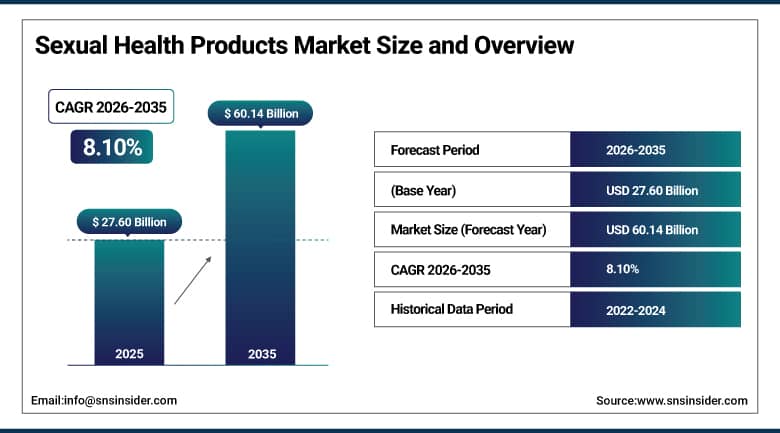
The Sexual Health Products Market was valued at USD 27.60 Billion in 2025 and is estimated at USD 29.84 Billion in 2026. The market is forecast to reach USD 60.14 Billion by 2035, registering a CAGR of 8.10% from 2026 to 2035. These are non-prescription products that support safe, comfortable, and satisfying sexual activity, including condoms, lubricants, sex toys and devices, intimate care items, and over the counter performance and wellness products. Asia Pacific accounted for the largest regional share at 35.40% in 2025 and is also expected to grow fastest. Demand is supported by greater openness, online retail, and preventive health awareness.
To Get More Information On Sexual Health Products Market - Request Free Sample Report
Key Market Trends and Insights
- By product type: Sex toys and devices held the largest market share of 37.40% in 2025.
- By end user: Women held the largest market share of 54.60% in 2025.
- By distribution channel: Offline sales held the largest market share of 56.40% in 2025.
- By price tier: Mass market products held the largest market share of 61.30% in 2025.
- Asia Pacific accounted for the largest regional share of 35.40% in 2025.
- Asia Pacific is projected to register the fastest regional CAGR of 9.30% from 2026 to 2035.
- The U.S. is the leading country market in North America, supported by high spending, strong retail distribution, and an active base of direct to consumer brands.
Growth Outlook
Attitudes toward sexual health are changing, and products that were once sold discreetly are now displayed openly in pharmacies, supermarkets, and online stores. Consumers see sexual wellness as part of overall health, and public campaigns on protection from sexually transmitted infections and unintended pregnancy keep condom and lubricant use steady. Younger adults, women in particular, are driving purchases of design led devices and body safe materials, and brands respond with quieter, smaller, and more attractive products that suit a wider range of buyers.
Digital retail has opened new routes to customers who prefer privacy. Subscription services, telehealth platforms, and marketplaces now sell products with discreet delivery and educational content, and this has widened the buyer base in countries where open display is limited. Large consumer health groups are also investing in the category, while specialist companies expand through acquisitions and new product lines, which keeps innovation active across devices, lubricants, intimate care, and over the counter performance products. Wider public health messaging also keeps new buyers entering.
Market Dynamics
Driver: Changing Attitudes, Online Retail, and Protection Awareness Drive Demand for Sexual Health Products
Open discussion of sexual wellbeing has increased across age groups, and this has reduced the stigma that long held back sales. Condoms remain important for protection against infection and pregnancy, while lubricants, intimate care products, and devices appeal to adults who see them as part of normal self care. Pharmacies and mass retailers now stock wider ranges, and online stores offer discreet delivery, product guides, and reviews that help first time buyers choose with confidence. Health campaigns by governments and charities, together with school programs, also keep protection top of mind among younger adults and support regular purchase. Steady repeat use gives the category stable volumes.
Company results show the strength of demand. Reckitt reported in March 2026 that Durex revenue rose 12.50% in 2025 after the group kept the brand when it sold its Essential Home business, and Hims and Hers completed the purchase of ZAVA in 2025 to widen its telehealth sexual health offer in Europe. Such moves show that large groups regard the category as a growth area and are ready to back it with capital. Retailers report that sexual wellness is among the faster growing sections of their health and beauty departments, which encourages them to give the range more shelf space and promotion.
Restraint: Social Stigma, Regulatory Tightening, and Price Pressure Restrain Market Growth
The cultural and religious restrictions are still an issue that prevents the sale and advertisement of sexual health goods. Restrictions of promotion by online retailers may also occur, making it hard for brands to promote their products in traditional advertising methods. Retailers may also prevent the presence of the products on the shelf in conservative markets. Additionally, import regulation and taxation increase the price of the product, and Chinese government applied 13.00% of VAT to condoms and contraceptive products starting from 1 January 2026. Payment processors and social media platforms may impose limitations on advertising as well, which increases the reliance on search engine marketing and word of mouth marketing.
There is an increased regulation that negatively affects the market. In May 2026, Food and Drug Administration moved external condoms into Class II with special controls, requiring premarket notifications, and in September 2025 warned online retailers about compounded erectile dysfunction products. These compliance expenses increase the cost for manufacturers, in particular small manufacturers. Private labels and cheap imports increase competition in the market; and poor volumes of condoms produced by Asian manufacturers reflect the elasticity of demand. Moreover, illegal counterfeit and substandard imported products may harm the reputation.
Opportunity: Telehealth Integration, Inclusive Design, and Emerging Market Retail Create New Revenue Pools
Telehealth providers have begun to bundle sexual health products with consultations, creating a trustworthy channel of reaching those customers who would not go to a clinic. Hims & Hers broadened its portfolio via ZAVA, while Cipla Health launched the Unfold sexual well-being range in Indian mass retail channels in October 2025. Product bundling with education and follow-up will drive repeat purchase and higher customer value in both mature and developing markets. Partnering with pharmacy chains and clinics will increase credibility, and educational material from doctors will allow opening up the category to more cautious consumers. Such connections may result in higher retention rates.
Another area where the opportunity to grow is seen lies in inclusive and body-safe design of the products. Various products are being developed for various genders, age groups, disabilities, and couples looking for a shared experience. In April 2026, COTR acquired the brand of the couple's vibrators -Together and the exclusive distribution rights. Higher incomes and retail development in Asia, Latin America, and the Middle East region give additional space for growth, especially for brands which are adapted in terms of packaging, pricing, and marketing to regional needs. Sustainability is a further angle, since refillable lubricants, recyclable packaging, and long life rechargeable devices can attract environmentally minded shoppers across several regions. Such steps may build loyalty. Such steps are low cost.
Market Characteristics and Concentration
The Sexual Health Products Market is Fragmented. Global consumer health groups, specialist condom makers, device companies, and direct to consumer brands compete, and no single company controls the market, although a few brands such as Durex and Trojan are widely known across several continents. New entrants appear regularly, particularly in design led devices and direct to consumer lubricants, which keeps the competitive field active across all major regions and price tiers.
Competition revolves around safety, quality of materials, design, branding, discretion, and pricing. Well-established companies depend upon retail availability and name recognition, whereas new companies market products through websites, subscriptions, and social media marketing to appeal to younger generations and women who want to maintain their privacy while shopping for such products. Companies frequently release new products, and design and color combinations change every year to stay appealing to younger generation customers and in line with their demands about safety and materials.
Entrance barriers vary depending upon the type of product being marketed in the industry. There are strict requirements for the development and marketing of condoms, whereas toys and lubricants require less regulatory compliance, although strong brand competition exists. Changes in ownership have been taking place in this industry as well, as private equity firms and bigger companies acquire specialist companies to develop sex wellness portfolios. Regulation of claims, imports, and advertising varies greatly from one country to another, thus providing competitive advantage to the firms with strong compliance departments.
Analyst Perspective
The Sexual Health Products Market is growing steadily as the category moves from the margins of retail into mainstream health and wellness. Growth will be shaped by online retail, women focused design, and telehealth links, while regulation of condoms and online claims requires careful compliance by every producer and seller in the category. Asia Pacific leads on value and is expected to expand fastest as incomes and openness increase. An SNS Insider Analyst commented, "Consumers now treat sexual wellness as part of everyday health, and brands that pair safe, well designed products with trusted information and discreet access will gain durable loyalty in this market."
Segment Analysis
End User Insights
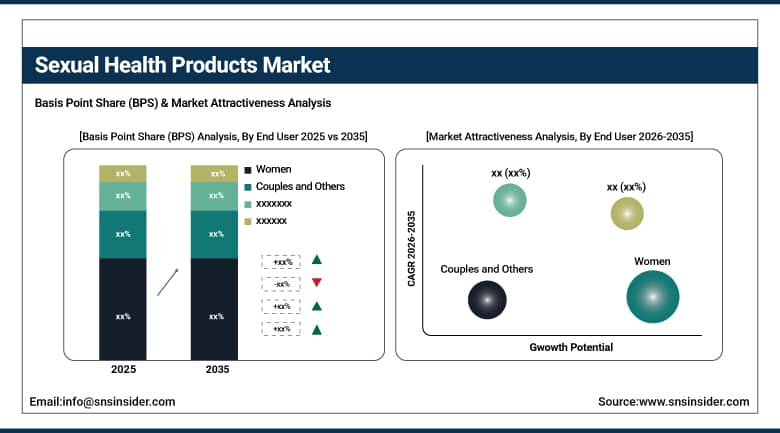
Women accounted for 54.60% of the market in 2025. Women buy toys, lubricants, intimate care products, and condoms, and they are shaping demand for body safe materials, attractive design, and educational content. Brands aimed at women use social media and online communities to build trust, and retailers are creating dedicated sexual wellness aisles that make shopping more comfortable and encourage regular repeat purchase over time. Sustainability claims, such as recyclable packaging, are also appearing in marketing for these products and reach younger shoppers. Gift purchases also add volume. Online reviews guide choice.
Couples and others are the fastest growing end user, with a projected CAGR of 9.10% from 2026 to 2035, as shared use devices, couples lubricants, and gift sets gain popularity. Men remain a large group, particularly for condoms, performance products, and masturbation devices, and telehealth providers have made it easier for men to buy over the counter products linked to online consultations. Surveys indicate that women now make most of the purchase decisions in several countries, and brands are therefore redesigning packaging, materials, and messaging, while retailers are expanding online communities that give advice and encourage trial.
Product Type Insights
Sex toys and devices constituted 37.40% of the market in 2025. Vibrators, massagers, and couples' devices using body safe silicone materials have entered the mainstream retail environment due to design-led brand and good online sales. Products that recharge easily, connect with apps, and make low noise levels are popular among younger consumers, who are predominantly women. Brands like Satisfyer, LELO, Lovehoney, and TENGA have expanded their reach via marketplaces and big retail partnerships. Subscription and gifting model generate repeat sales, and collaboration between brands and designers as well as influencers maintains visibility of product launches on digital channels.
Sexual performance and wellness products are the fastest-growing category with a projected CAGR of 10.30% in 2026 to 2035 due to telehealth and over-the-counter offers. Condoms constitute a considerable share of this segment and have a solid base, benefiting from public health campaigns and brand presence, including Durex, Trojan, Okamoto, and Karex. Lubricants and intimate care products develop in parallel with condoms and devices and are often combined with other categories. Continuous consumer interest in improved health outcomes drives sales of products that are tested, certified, and convenient to use. Periods of gifting, including Valentine Day and end-of-year holidays, increase demand temporarily.
Distribution Channel Insights
Offline sales accounted for 56.40% of the market in 2025. Pharmacies, supermarkets, convenience stores, and specialty shops remain the main point of purchase for condoms and lubricants, where impulse buying and brand familiarity matter. Shelf visibility, promotions, and pharmacist advice support sales, and large retailers have widened ranges of sexual wellness products in response to changing attitudes among shoppers across many countries. Loyalty programs from large drugstore chains and convenience formats also help sustain steady unit sales through the year. Seasonal promotions help sales. Pharmacists often advise first time buyers on products and sizes.
Online is the fastest growing channel, with a projected CAGR of 10.80% from 2026 to 2035. Marketplaces, brand websites, and subscription services offer privacy, wide selection, and discreet delivery, and educational content builds confidence among new buyers. Telehealth platforms also sell products with consultations, and direct to consumer brands collect customer feedback quickly, which helps them refine designs and launch new items. Direct to consumer companies lower costs by avoiding retail margins, and personalization tools, size guides, and chat support add value. Subscription refills for condoms and lubricants provide steady income, and secure payment with plain packaging has become a standard feature of this channel.
Price Tier Insights
Mass market products accounted for 61.30% of the market in 2025. Condoms, standard lubricants, and entry level devices sold at accessible prices drive volume, particularly in Asia Pacific and Latin America where income levels are lower. Large brands and private label ranges compete on price and availability, and promotions in pharmacies and supermarkets keep these products within reach of a large share of the adult population. Brand recognition remains a major advantage at this level, and shelf placement beside other personal care products keeps volumes steady. Mass market ranges also sell well.
The premium segment is the fastest-growing segment, with a forecasted CAGR of 10.10% between 2026 and 2035. Consumers are willing to shell out extra dollars for body-safe materials, better designs, quieter motors, and brand recognition. Luxurious toys are generally gifts or lifestyle purchases and premium lubricants, as well as organic/vegan intimate care lines help increase profitability while appealing to a younger and richer consumer base. In addition, premium brands work in collaboration with designers and wellness influencers, along with offering gift packs and limited edition products. The cost of development of the products, including material testing, safety, and sustainable sources, also raises the costs, but buyers are willing to pay.
Regional Insights
North America held 33.60% of the Sexual Health Products Market in 2025, ranking second behind Asia Pacific. The region has high spending, mature retail, and strong direct to consumer brands. Mexico is reported within Latin America in this analysis, so regional figures here cover the United States and Canada only, where condoms, devices, and wellness products are widely available and brand competition is intense across price levels. Strong funding for sexual wellness start ups also supports product development across the region.
U.S. Sexual Health Products Market
The U.S. Sexual Health Products Market Size is estimated to be worth USD 7.98 Billion in 2025 and will grow further at a CAGR of 7.30% from 2026 to 2035 due to high disposable income of consumers, extensive distribution across pharmacies and mass retail stores, and an active presence of online brands. Many market leaders such as Church and Dwight and Hims and Hers have their headquarters in this region. Moreover, some major retailers have created separate sexual health sections for consumers who used to purchase such products only online before.
The regulatory landscape continues to change. In May 2026, the FDA classified external condoms in Class II with special controls under 21 CFR 884.5305, which mandates pre-market notification, while in September 2025, it issued warning letters to those selling compounded sildenafil and tadalafil products. Therefore, it is essential for companies to review all their claims, labeling, and sources of supply to remain compliant. Companies are increasingly getting under the radar when it comes to marketing activities on social platforms.Retailers and platforms have responded to this accordingly.
Asia Pacific Sexual Health Products Market
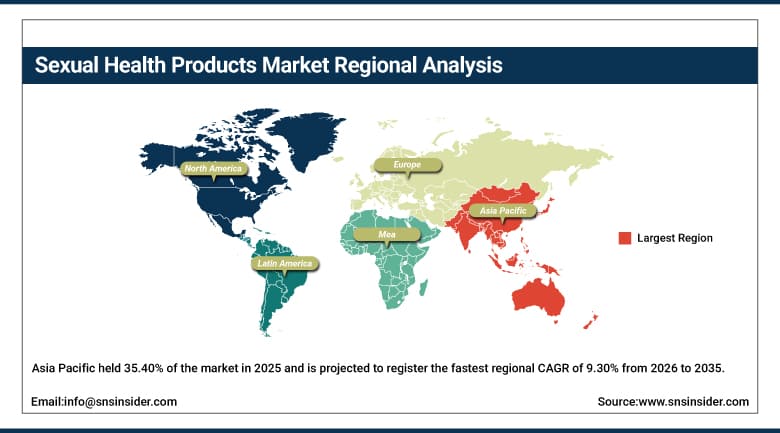
Asia Pacific held 35.40% of the market in 2025 and is projected to register the fastest regional CAGR of 9.30% from 2026 to 2035. China, Japan, India, South Korea, and Malaysia lead demand, supported by large populations, e-commerce growth, and major condom producers such as Okamoto and Karex. China applied a 13.00% value added tax on condoms from January 2026, while India saw new launches such as Unfold from Cipla Health. Cross border e-commerce also helps overseas brands reach buyers in large cities.
Get Customized Report as Per Your Business Requirement - Enquiry Now
Europe Sexual Health Products Market
Europe accounted for 24.10% of the market in 2025, led by the United Kingdom, Germany, France, Italy, and Spain. The region has strong pharmacy channels, a long tradition of sexual health education, and a high number of design led device brands, including several from Germany and Sweden. Reckitt, which owns Durex, is based in the United Kingdom, and telehealth providers such as ZAVA support online sales. Public health agencies also run active campaigns on protection from infection, which supports condom use.
Latin America Sexual Health Products Market
Latin America held 4.10% of the market in 2025, led by Brazil and Mexico, followed by Argentina and Colombia. Public health programs that distribute condoms, a young population, and growing online marketplaces support demand. Pharmacy chains are major sales points, and international brands compete with regional producers, while price sensitivity keeps volumes concentrated in mass market condoms and lubricants across most countries. Local brands also compete by adapting packaging, scents, and pricing to regional preferences, while international groups expand through pharmacy partnerships and online retail.
Middle East and Africa Sexual Health Products Market
The Middle East and Africa accounted for 2.80% of the market in 2025, led by South Africa, the United Arab Emirates, Saudi Arabia, Turkey, and Nigeria. Public health programs, particularly in sub-Saharan Africa, rely on large condom distribution, while online marketplaces and pharmacies in the Gulf offer wider ranges. Social and regulatory limits on advertising and import of some items restrain the pace of expansion. Government health programs and nongovernmental organizations also purchase large volumes of condoms.
Key Sexual Health Products Market Company Insights
Competition in the Sexual Health Products Market spans global consumer health groups, specialist condom producers, device and toy makers, and telehealth led brands. Leading participants compete on safety, design, brand trust, and retail reach, and ownership is shifting through acquisitions and investment.
Key Sexual Health Products Companies:
- Reckitt Benckiser Group plc (Durex)
- Church and Dwight Co., Inc. (Trojan)
- Okamoto Industries, Inc.
- Karex Berhad
- LifeStyles Healthcare Pte. Ltd.
- Satisfyer GmbH (including Fun Factory)
- LELO
- Lovehoney Group Ltd.
- TENGA Co., Ltd.
- Hims and Hers Health, Inc.
- Cipla Health Limited
Recent Developments
- In June 2025, Hims and Hers Health announced the acquisition of ZAVA, a European telehealth provider, and confirmed completion by July 2025. The transaction expanded the company offer of sexual health consultations and treatments in Europe and illustrated the growing link between telehealth platforms and sexual wellness products sold directly to consumers through digital channels.
- In December 2025, Reckitt completed the sale of its Essential Home business to Advent for about USD 4.80 Billion while retaining the Durex sexual wellbeing brand. The decision reflects the strategic focus of the group on health and hygiene brands, and it positions Durex as a core growth asset for the company in condoms, lubricants, and sexual wellness products.
- In September 2025, the Food and Drug Administration issued warning letters to Hello Cake and BlueChew over the marketing of compounded sildenafil and tadalafil products for erectile dysfunction. The action signaled closer scrutiny of online sellers of performance products and encouraged brands in the category to review claims, sourcing, and compliance with United States rules.
- In October 2025, Cipla Health launched Unfold in India, a sexual wellness range including condoms, lubricants, and related products, aimed at modern urban consumers. The launch brought a large pharmaceutical affiliated consumer health company into the category and reflects rising openness and retail availability of sexual health products across the Indian market.
- In January 2026, China began applying a 13.00% value added tax on condoms and contraceptives, ending an exemption that had applied for about thirty years. The change raises costs for producers and importers serving the largest Asian market and may influence pricing and distribution strategies for global and regional brands that sell in the country.
Scope and Research Methodology
This report estimates the Sexual Health Products Market through a bottom-up build from retail sales of condoms, lubricants, intimate care items, sex toys and devices, and over the counter performance and wellness products by region, checked against a top-down view of consumer health and personal care spending. The scope covers non-prescription products. Prescription drugs, contraceptive pills, intrauterine devices, and clinical treatments are excluded from the market definition. Retail prices are checked against listings on major marketplaces and pharmacy websites in each region, and procurement volumes from public programs are added for condoms. Supplier data on latex, silicone, and electronic components is reviewed to confirm cost structures.
Secondary research draws on company filings, regulatory notices, retail audits, trade publications, and public health reports. Primary research includes conversations with brand managers, pharmacists, distributors, and online sellers, used to confirm sales, prices, and channel patterns. Region coverage follows the five regions used throughout this report, with Mexico reported within Latin America, and country estimates consider population, income, retail structure, and regulation. Insights from experts are cross checked with company results and customs data, so that differences between sources are tested and final estimates rest on consistent evidence across countries and years. Reports are refreshed regularly.
Segment shares are built from sales and revenue by product type, end user, distribution channel, and price tier, then aligned with regional totals. Forecasts apply growth assumptions for each segment and region that reflect awareness, pricing, regulation, and channel shifts, and they are tested against alternative scenarios. Company positions are reviewed against announced results and ownership changes. Figures are reviewed at each update, and values are stated in U.S. dollars. Historical data from 2022 to 2024 is used as the base for trend analysis, and sensitivity checks on price, currency, tax, and regulation are applied before senior analysts review all results.
Sexual Health Products Market Report Scope:
| Report Attributes | Details |
|---|---|
| Market Size in 2025 | USD 27.60 Billion |
| Market Size by 2035 | USD 60.14 Billion |
| CAGR | CAGR of 8.10% From 2026 to 2035 |
| Base Year | 2025 |
| Forecast Period | 2026-2035 |
| Historical Data | 2022-2024 |
| Report Scope & Coverage | Market Size, Segments Analysis, Competitive Landscape, Regional Analysis, DROC & SWOT Analysis, Forecast Outlook |
| Key Segments | • By Product Type (Sex Toys and Devices, Condoms, Lubricants and Intimate Care, and Sexual Performance and Wellness Products) • By End User (Women, Men, and Couples and Others) • By Distribution Channel (Offline and Online) • By Price Tier (Mass Market and Premium) |
| Regional Analysis/Coverage | North America (US, Canada), Europe (Germany, UK, France, Italy, Spain, Russia, Poland, Rest of Europe), Asia Pacific (China, India, Japan, South Korea, Australia, ASEAN Countries, Rest of Asia Pacific), Middle East & Africa (UAE, Saudi Arabia, Qatar, South Africa, Rest of Middle East & Africa), Latin America (Brazil, Argentina, Mexico, Colombia, Rest of Latin America). |
| Company Profiles | Reckitt Benckiser Group plc (Durex), Church and Dwight Co., Inc. (Trojan), Okamoto Industries, Inc., Karex Berhad, LifeStyles Healthcare Pte. Ltd., Satisfyer GmbH (including Fun Factory), LELO, Lovehoney Group Ltd., TENGA Co., Ltd., Hims and Hers Health, Inc., Cipla Health Limited |

Frequently Asked Questions
The market was valued at USD 27.60 Billion in 2025 and is projected to reach USD 60.14 Billion by 2035.
The market is expected to register a CAGR of 8.10% from 2026 to 2035.
Asia Pacific led the market with a 35.40% share in 2025.
Asia Pacific is expected to grow the fastest, at a CAGR of 9.30% from 2026 to 2035.
Key players include Reckitt, Church and Dwight, Okamoto Industries, Karex, and LifeStyles Healthcare.
